Of all the numbers in the crypto world, 21 million might be the most famous. It's printed on t-shirts, quoted in debates about inflation, and treated as shorthand for Bitcoin's entire value proposition. But where does that specific number actually come from — and why can't it ever change?
The Short Answer: The Supply Schedule Is Enforced by Bitcoin's Consensus Rules
Bitcoin's supply limit comes from the consensus rules enforced by validating Bitcoin nodes. Those rules determine how much new bitcoin a block is allowed to create, and nodes reject blocks that attempt to claim more subsidy than the protocol permits.
No company, miner, developer, government, or individual can unilaterally increase that supply. Changing the rule would require participants to adopt incompatible new consensus rules, effectively creating a different version of the network unless enough of Bitcoin's economic ecosystem chose to follow the change. That makes changing the supply cap technically possible in principle, but extraordinarily difficult in practice because existing users can simply continue enforcing the current rules.
How New Bitcoin Enters Circulation: The Halving Schedule
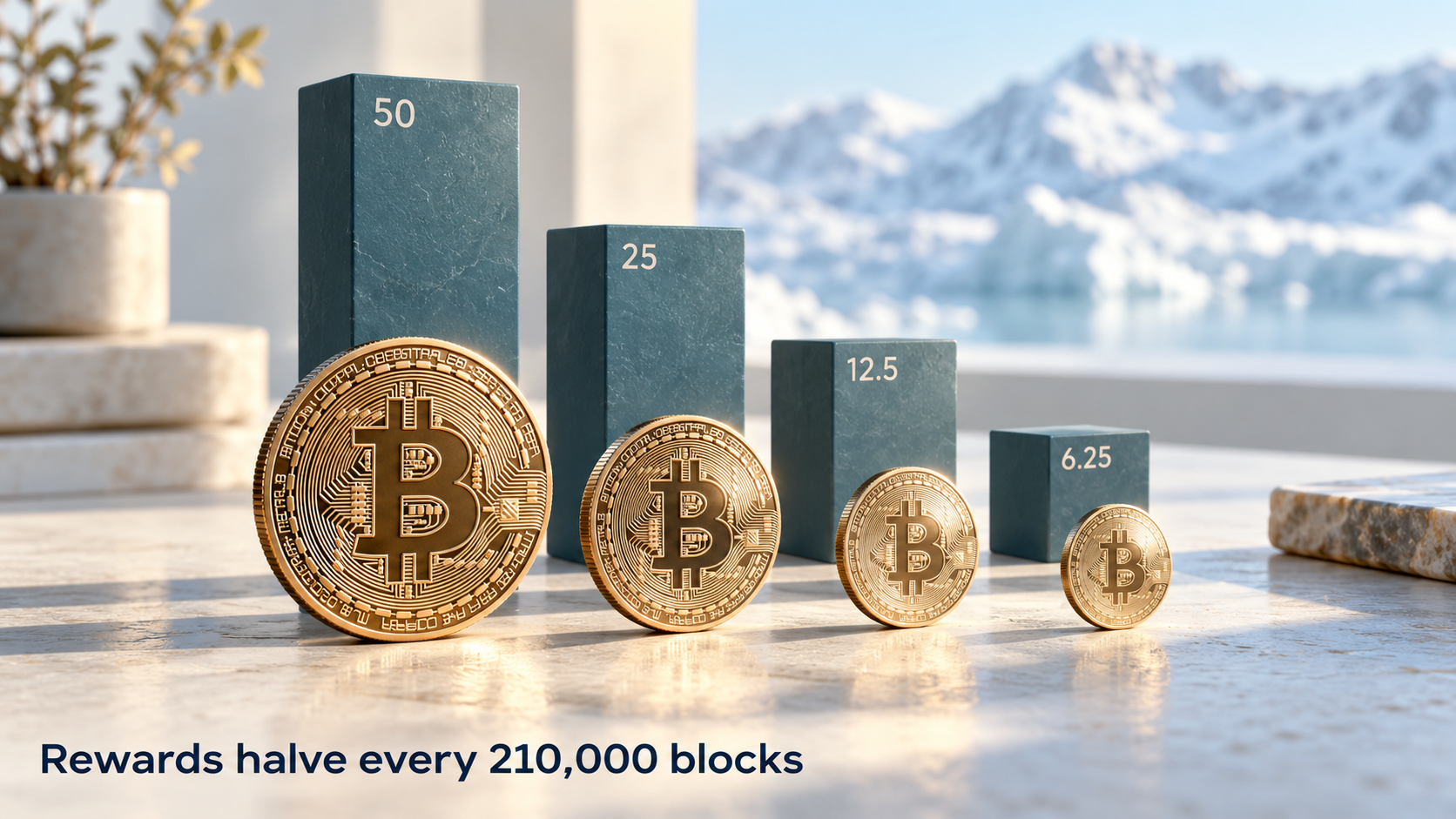
New bitcoin enters circulation through the block subsidy, the newly created bitcoin a miner can claim when producing a valid block. When Bitcoin launched in 2009, the subsidy was 50 BTC per block.
Every 210,000 blocks, the subsidy is cut in half in an event called the halving. Because Bitcoin targets an average block interval of roughly ten minutes, a halving occurs approximately once every four years, although the actual calendar date varies.
The schedule so far has been:
- 2009: 50 BTC per block
- 2012: 25 BTC per block
- 2016: 12.5 BTC per block
- 2020: 6.25 BTC per block
- 2024: 3.125 BTC per block
The subsidy continues declining until it eventually becomes too small to represent even one satoshi and rounds down to zero. For a closer look at how new bitcoin is created through mining, this step-by-step breakdown of how Bitcoin mining works explains how blocks, the subsidy, and transaction fees fit together.
The Math Behind 21 Million

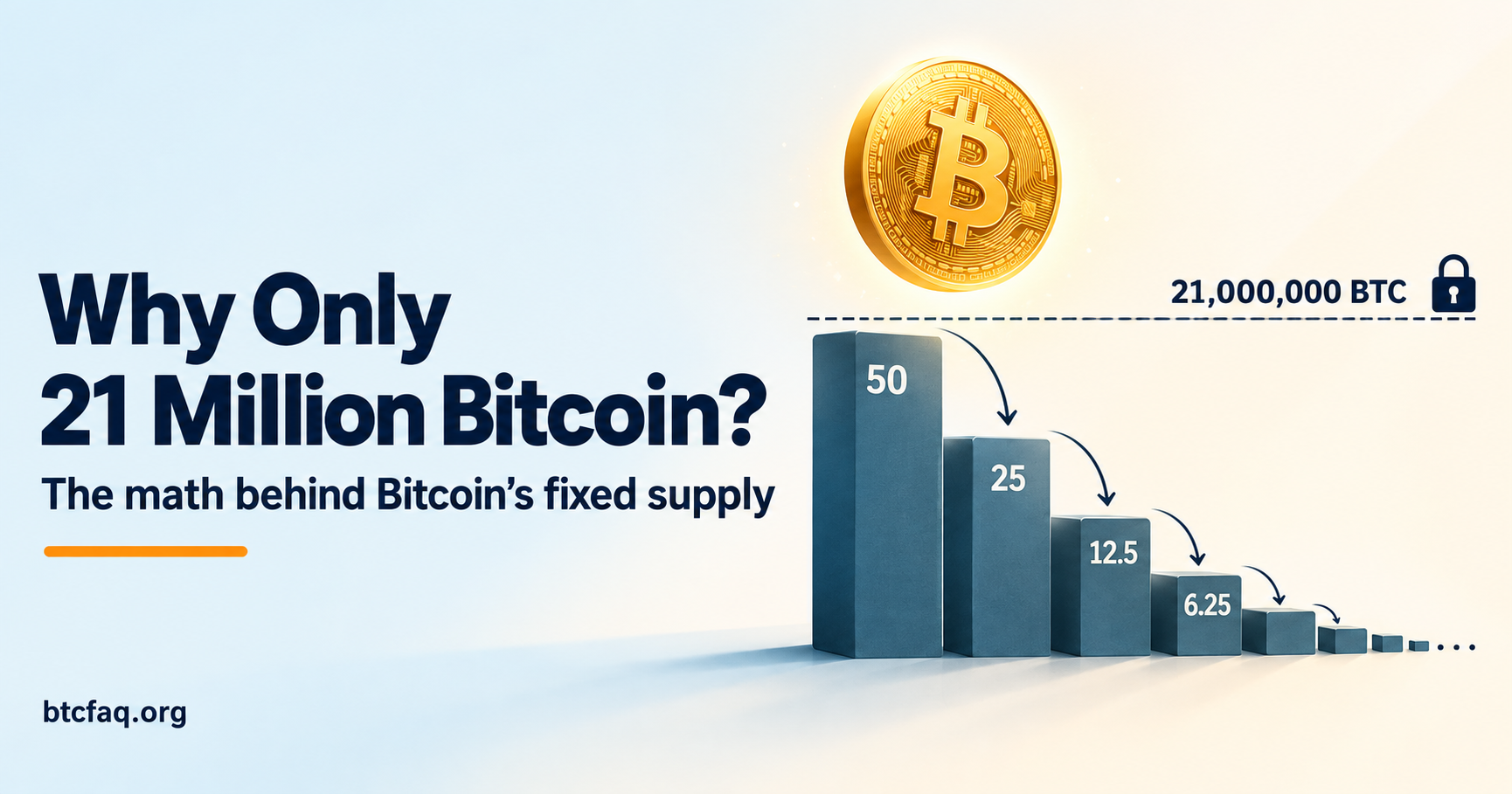
The familiar 21 million figure comes from Bitcoin's 50 BTC starting subsidy, its 210,000-block subsidy eras, and the rule that cuts the subsidy in half at each halving.
If Bitcoin could divide rewards infinitely, the sequence would form a geometric series:
50 BTC + 25 BTC + 12.5 BTC + 6.25 BTC + 3.125 BTC + ...
Multiplying each subsidy level by roughly 210,000 blocks produces a total that approaches 21 million BTC.
In the actual Bitcoin protocol, however, amounts are represented in whole satoshis rather than infinitely precise fractions. Each halving therefore eventually rounds away tiny fractions that cannot be represented. Under the current subsidy rules, maximum theoretical issuance is approximately 20,999,999.9769 BTC, which is why the supply limit is conventionally described as 21 million Bitcoin.
Bitcoin's roughly ten-minute block target does not determine the total supply. It mainly determines how long it takes the network to move through each 210,000-block subsidy era, which is why the final new satoshis are expected to be issued around the year 2140.
Why Did Satoshi Choose This Number?
There is no definitive public explanation from Satoshi Nakamoto establishing why the exact combination of a 50 BTC initial subsidy, 210,000-block halving interval, and resulting roughly 21-million supply was chosen.
What we can say with confidence is what the design does: issuance begins relatively quickly, decreases according to a predictable schedule, and eventually stops. That gave Bitcoin a known monetary policy from the beginning rather than allowing a central authority to decide how many new coins to issue later.
The exact 21-million figure is therefore best understood as the result of Bitcoin's chosen issuance parameters rather than a number whose specific symbolic meaning has been definitively documented.
What Happens When New Bitcoin Issuance Ends?

Once the block subsidy reaches zero — expected around the year 2140 under the current schedule — miners will no longer be able to claim newly created bitcoin. Their protocol-level revenue will then come from the transaction fees included in the blocks they produce.
This transition is built into Bitcoin's monetary schedule, but its long-term economics remain an open question. Supporters expect a mature transaction-fee market to provide meaningful incentives for miners, while critics question whether fees alone will eventually be sufficient to support the level of network security users expect. The outcome will depend on future Bitcoin usage, fee demand, mining economics, and technology many decades from now.
Will All Issued Bitcoin Actually Remain Spendable?

The amount of bitcoin that remains economically spendable is likely lower than the total amount ever issued because private keys can be permanently lost. If the keys required to satisfy a Bitcoin output's spending conditions no longer exist, that bitcoin can remain recorded on the blockchain indefinitely while effectively becoming unspendable.
The exact amount of lost Bitcoin cannot be known from blockchain data alone. An address or UTXO that has remained untouched for many years may belong to someone who lost the keys, but it may also belong to someone deliberately holding the bitcoin without moving it. Estimates of lost supply therefore rely on assumptions rather than direct proof.
Lost bitcoin does not reduce the protocol's issuance limit. It only reduces the amount that may realistically remain available to spend.
Why This Fixed Cap Matters
Bitcoin's predictable supply schedule is central to the monetary case many supporters make for it. Government-issued currencies operate under discretionary monetary systems in which central banks can change the monetary base in response to economic conditions. Changes in money supply can affect inflation and purchasing power alongside many other economic factors. Bitcoin uses a different model: its issuance schedule is publicly known in advance and cannot be altered by one central decision-maker acting alone.
Whether that property alone makes Bitcoin a good investment is a separate question this article won't attempt to answer — this is educational content, not financial advice — but it's the core reason the "21 million" figure gets referenced so often in conversations about sound money and scarcity.
The Economics of Shrinking Block Rewards for Miners
Every halving cuts the block subsidy in half from one block to the next, while electricity prices, hardware efficiency, transaction-fee revenue, Bitcoin's market price, and network difficulty continue to change independently. That makes halvings important for mining economics, but they do not automatically cut total miner revenue exactly in half because transaction fees remain part of the block reward. A higher Bitcoin price can improve mining revenue, while additional competing hashrate and later difficulty adjustments can offset part of that advantage.
How Mining Fits Into Bitcoin's Remaining Issuance

New bitcoin will continue entering circulation through the block subsidy until that subsidy eventually reaches zero. Individual miners and mining pools compete for those block rewards using specialized ASIC hardware, but successfully operating a mining business depends on electricity cost, hardware efficiency, network difficulty, uptime, and Bitcoin's market price.
For a beginner explanation of that process, keep the OneMiners step-by-step Bitcoin mining guide. For more background on ASIC hardware and mining operations, Cassys' Medium writing provides additional related reading.
Common Misconceptions
"The 21 million number must have a documented special meaning." There is no definitive public explanation from Satoshi Nakamoto establishing a special symbolic reason for the exact number. What can be verified is that roughly 21 million results from Bitcoin's initial subsidy and halving parameters.
"Once we hit 21 million, Bitcoin will stop working." Reaching the cap only affects how new coins are created — it doesn't affect the network's ability to process transactions. Miners simply shift to earning revenue entirely from transaction fees.
"The supply cap can never be changed under any circumstances." Bitcoin's current nodes enforce the existing supply rules, so no individual actor can increase the cap unilaterally. Participants could theoretically adopt different consensus rules through a hard fork, but users running the existing rules would not be forced to follow it. Changing the monetary policy of the network recognized today as Bitcoin would therefore require very broad economic acceptance and would face major coordination and credibility obstacles.
Frequently Asked Questions
How many bitcoins have been mined so far? The vast majority of the 21 million cap has already been mined, since issuance was front-loaded through larger early block rewards — though the remaining amount continues trickling out slowly through each halving cycle.
When will new Bitcoin issuance end? Under the current subsidy schedule, the block subsidy is expected to fall to zero around the year 2140. Because rewards are denominated in whole satoshis, the subsidy eventually rounds down to zero rather than continuing as infinitely small fractions forever.
Can Bitcoin's supply cap ever be changed? The current supply rules can theoretically be replaced if participants voluntarily adopt incompatible new consensus rules, but no developer, miner, company, or government can impose such a change on nodes that continue enforcing today's rules. In practice, changing Bitcoin's monetary policy would require very broad adoption of a new rule set and would be highly contentious.
Does losing Bitcoin reduce the 21 million cap? No — lost Bitcoin remains part of the theoretical 21 million total on paper, but it's permanently unspendable, effectively reducing the real-world circulating supply below the stated cap.
What happens to miners after all Bitcoin is mined? Miners will earn revenue solely from transaction fees rather than newly issued coins, a transition that's expected to happen gradually as block rewards shrink to near-zero well before 2140.
Final Thoughts
Bitcoin's roughly 21-million issuance limit is not simply a slogan or corporate promise. It results from the subsidy rules enforced by the Bitcoin network today: an initial 50 BTC subsidy, a halving every 210,000 blocks, and eventual rounding to zero at the satoshi level. Anyone can independently inspect the software and verify how those rules work. Those rules are not physically impossible to change, but no central authority can alter them for everyone by decree — users ultimately choose which consensus rules their software will enforce. That combination of predictable issuance and decentralized rule enforcement is what makes the 21-million figure such a distinctive part of Bitcoin's design.