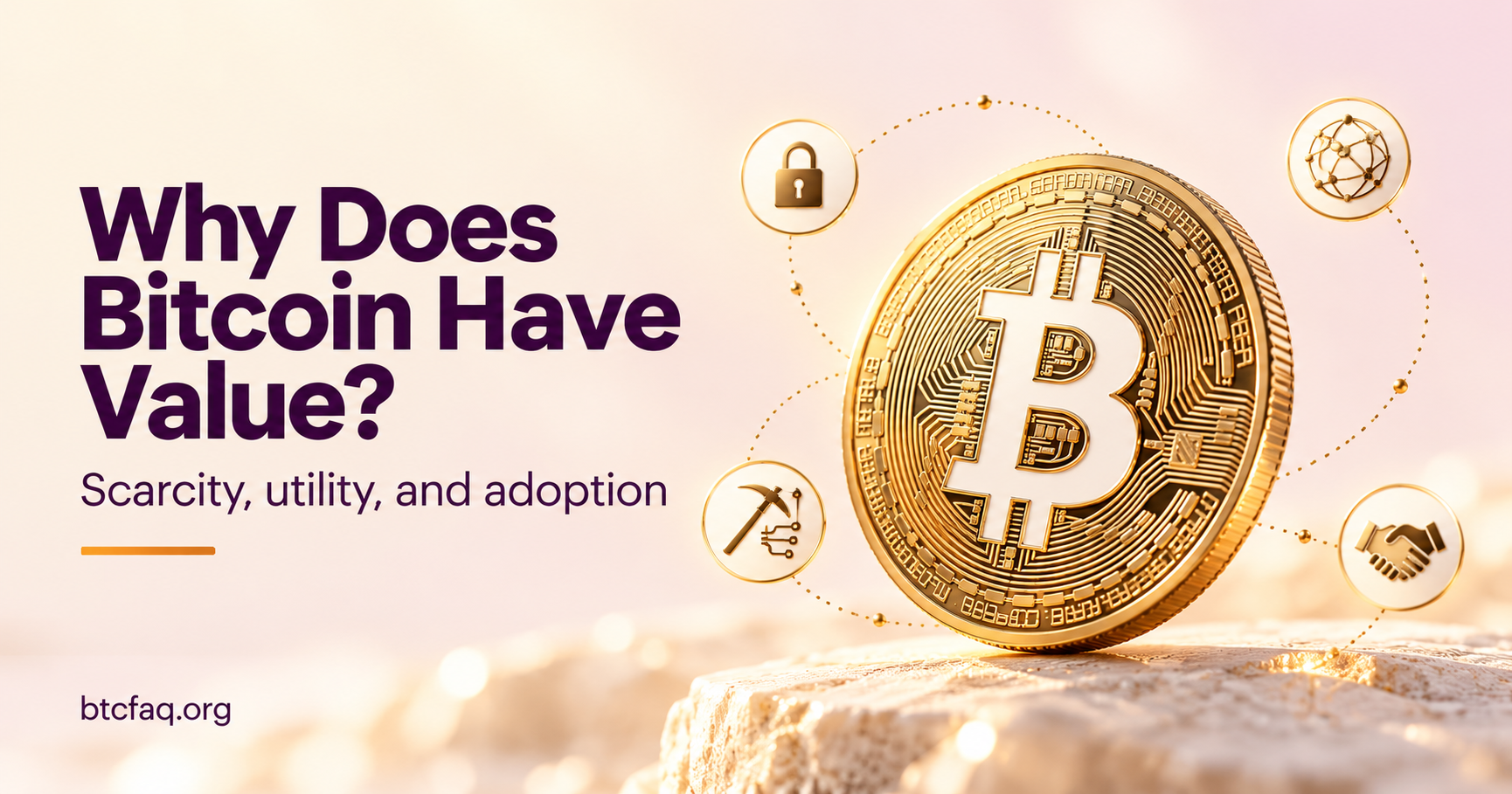
"It's not backed by anything" is probably the single most common objection to Bitcoin. No government stands behind it, no gold sits in a vault to redeem it, and you can't hold it in your hand. So where does its value actually come from?
The honest answer takes a bit more nuance than a soundbite, but it isn't mysterious. It comes down to the same basic forces that give value to almost everything else people consider valuable — plus a few properties that are genuinely unique to Bitcoin.
This article is educational, not financial advice. Bitcoin's price is volatile, and nothing here should be read as a prediction of future value.
What Actually Gives Anything Value?
Before asking why Bitcoin has value, it helps to ask a broader question: why does anything command a price? Gold is valued for a combination of scarcity, durability, established demand, jewelry and industrial uses, and its long history as a monetary asset. Government-issued currencies derive usefulness from widespread acceptance, legal and institutional frameworks, tax obligations, monetary policy, and the fact that people routinely use them to price goods and settle debts.
Economic value is ultimately determined through people's preferences and willingness to exchange scarce resources. An asset does not need to contain a fixed amount of "intrinsic value" to trade at a market price. Its usefulness, scarcity, liquidity, expectations, available alternatives, and the number of people willing to hold or use it can all influence demand.
Bitcoin can be analyzed through the same lens. Its market value reflects what buyers and sellers are willing to exchange for it, while characteristics such as its issuance rules, transferability, network security, liquidity, and adoption help shape that demand.
Scarcity: A Predictable, Verifiable Issuance Schedule

Bitcoin's consensus rules limit eventual issuance to roughly 21 million BTC. New bitcoin is created through the block subsidy, which is reduced by half every 210,000 blocks until new issuance eventually approaches zero. Unlike a discretionary monetary system, no single central bank, company, or administrator can independently decide to issue additional bitcoin outside the rules accepted and enforced by the network.
Another unusual feature is transparency. Anyone running appropriate software can independently verify Bitcoin's transaction history and the amount issued under the protocol. That does not mean we know how much Bitcoin remains economically accessible — some private keys may be permanently lost — but the protocol's issuance history and future schedule are publicly auditable.
Utility: What Bitcoin Actually Lets You Do

Scarcity alone does not guarantee value. Bitcoin also has characteristics that people may find useful:
- Peer-to-peer transfer of value across geographic borders without requiring the recipient to use the same bank or payment company.
- Self-custody, allowing users to control the keys needed to spend their bitcoin rather than requiring a central custodian to authorize every transaction.
- A base settlement network on top of which additional payment systems such as the Lightning Network can operate.
- Predictable monetary issuance, which appeals to users who value an asset whose supply schedule cannot be changed unilaterally by one institution.
These characteristics do not guarantee that Bitcoin must hold any particular price. They help explain why people may demand, use, or hold it.
Network Effects: Why Adoption Matters

Bitcoin can become more useful as more users, businesses, developers, wallets, exchanges, miners, and other infrastructure participate in its ecosystem. More infrastructure can improve liquidity, accessibility, and the number of ways Bitcoin can be used.
Bitcoin has also retained the largest cryptocurrency market capitalization by a substantial margin through 2026, although market leadership is not permanent and should not be treated as proof that future demand will necessarily grow. Its long operating history, liquidity, infrastructure, and existing user base are relevant network effects, but their future strength ultimately depends on continued participation.
Mining Economics: How Production Costs Relate to Bitcoin's Market

Bitcoin mining requires real economic resources: specialized hardware, electricity, facilities, maintenance, and operating capital. That makes mining economics relevant to understanding Bitcoin's market, but the relationship between mining costs and Bitcoin's price is more complicated than saying production cost creates a guaranteed price floor.
Some economic research models Bitcoin partly through its marginal cost of production, arguing that mining costs and market prices can influence one another. Other studies find that production costs do not create a reliable lower bound for Bitcoin's price and may often adjust after price changes rather than determining them beforehand. In practice, Bitcoin has traded through periods when some miners were unprofitable without the market price automatically staying above every miner's production cost.
When Bitcoin's price falls, less-efficient miners may shut down equipment if revenue no longer covers their operating costs. A large reduction in network hashrate can temporarily slow block production, but Bitcoin periodically adjusts mining difficulty to bring average block intervals back toward the protocol's target. The block subsidy itself does not increase simply because miners become unprofitable.
The relationship can work in the other direction as well. Higher Bitcoin prices can improve mining revenue and encourage additional hardware to come online. If network hashrate subsequently rises, later difficulty adjustments can increase competition for each unit of mining power. That means a Bitcoin price rally does not automatically translate into the same percentage increase in long-term miner profitability.
For a mining-industry perspective on how electricity costs, equipment, and Bitcoin prices interact, OneMiners' analysis of Bitcoin's future value and mining economics provides additional context. For more background on the hardware economics underneath mining, Cassys' writing on mining hardware offers related reading.
Comparing Bitcoin to Gold and Fiat Currency
Bitcoin, gold, and government-issued currencies have different monetary characteristics rather than a single objective ranking. Bitcoin has a predetermined issuance schedule, can be divided into very small units, and can be transferred digitally across borders. Gold has physical and industrial uses, limited natural supply, and thousands of years of history as a monetary and store-of-value asset. Fiat currencies benefit from widespread everyday acceptance, banking and payment infrastructure, government institutions, and legal-tender frameworks, while their supply is managed through monetary policy rather than a fixed protocol.
Which characteristics matter most depends on the purpose being considered. An asset used for everyday payments, emergency savings, long-term wealth preservation, international settlement, or speculation may be evaluated differently. Bitcoin's characteristics therefore make it different from both gold and fiat currency, not objectively superior to either in every circumstance.
Why Value Isn't the Same as Price
It's worth separating two ideas that often get blurred together: Bitcoin's underlying value proposition, and its current market price. Price reflects what buyers and sellers agree to trade at right now, and it can swing sharply in either direction based on sentiment, macroeconomic conditions, or short-term liquidity — none of which necessarily says anything about whether the underlying case for Bitcoin's value has changed. Volatility is a feature of Bitcoin's price, not proof that its value is fake, in the same way a stock's price swinging doesn't automatically mean the underlying company became worthless.
A Fair Look at the Skeptical View
It wouldn't be a balanced explanation without acknowledging the strongest arguments on the other side, because this remains a genuinely contested question among serious economists.
Critics point out that Bitcoin generates no cash flow, pays no dividend, and produces nothing — unlike a business, a bond, or even a productive commodity, meaning any long-term valuation model has to rely heavily on continued adoption rather than intrinsic output. Some argue its value is driven primarily by speculation and momentum rather than fundamentals, and that network effects can just as easily unwind as compound if sentiment shifts or a superior alternative emerges. Environmental critics also raise the energy cost of proof-of-work mining as a real tradeoff embedded in how that scarcity and security are produced. These aren't fringe objections — they're the same questions serious economists continue to debate, and reasonable, well-informed people land on different sides of them.
Frequently Asked Questions
Is Bitcoin backed by anything? Bitcoin is not redeemable for a fixed amount of gold, dollars, or another external asset, and no government guarantees its market price. Its market value comes from supply and demand around characteristics such as its predictable issuance rules, transferability, self-custody, liquidity, network security, and adoption. Whether those characteristics justify any particular market price is ultimately determined by buyers and sellers.
Could Bitcoin's value go to zero? No asset's value is guaranteed permanently, and Bitcoin is no exception. Its value depends on continued belief in its scarcity, utility, and adoption — the same way any currency or store of value depends on continued trust and usage.
Do mining costs determine Bitcoin's price? Not directly. Mining costs influence miners' profitability and decisions about whether to operate particular machines, and some economic models find a relationship between production costs and Bitcoin's market price. However, research does not support treating mining cost as a guaranteed price floor. Bitcoin's price is set in the market by supply and demand, while mining economics adjust in response to price, hardware efficiency, electricity costs, fees, hashrate, and difficulty.
Is Bitcoin just speculation? It's a mix. Some demand is clearly speculative, driven by expectations of future price appreciation, while other demand comes from genuine use cases like censorship-resistant transfers or long-term store-of-value holding. Most assets, including gold and stocks, contain some blend of both.
Does Bitcoin's price reflect its true value? Price reflects current market sentiment and conditions, which can diverge from any individual's assessment of underlying value — in either direction. That's true of virtually every actively traded asset, not just Bitcoin.
Final Thoughts
Bitcoin's market value does not come from a promise that it can be redeemed for gold or from a government guarantee. Instead, demand for Bitcoin reflects how market participants evaluate characteristics such as its scarcity rules, transferability, self-custody, network security, liquidity, and existing adoption. Mining provides the proof of work that helps secure the system and has its own important economics, but production cost should not be mistaken for a guaranteed minimum Bitcoin price. Whether Bitcoin's characteristics justify $10,000, $100,000, or any other market price remains something buyers and sellers ultimately decide — and reasonable people can disagree sharply about that valuation.