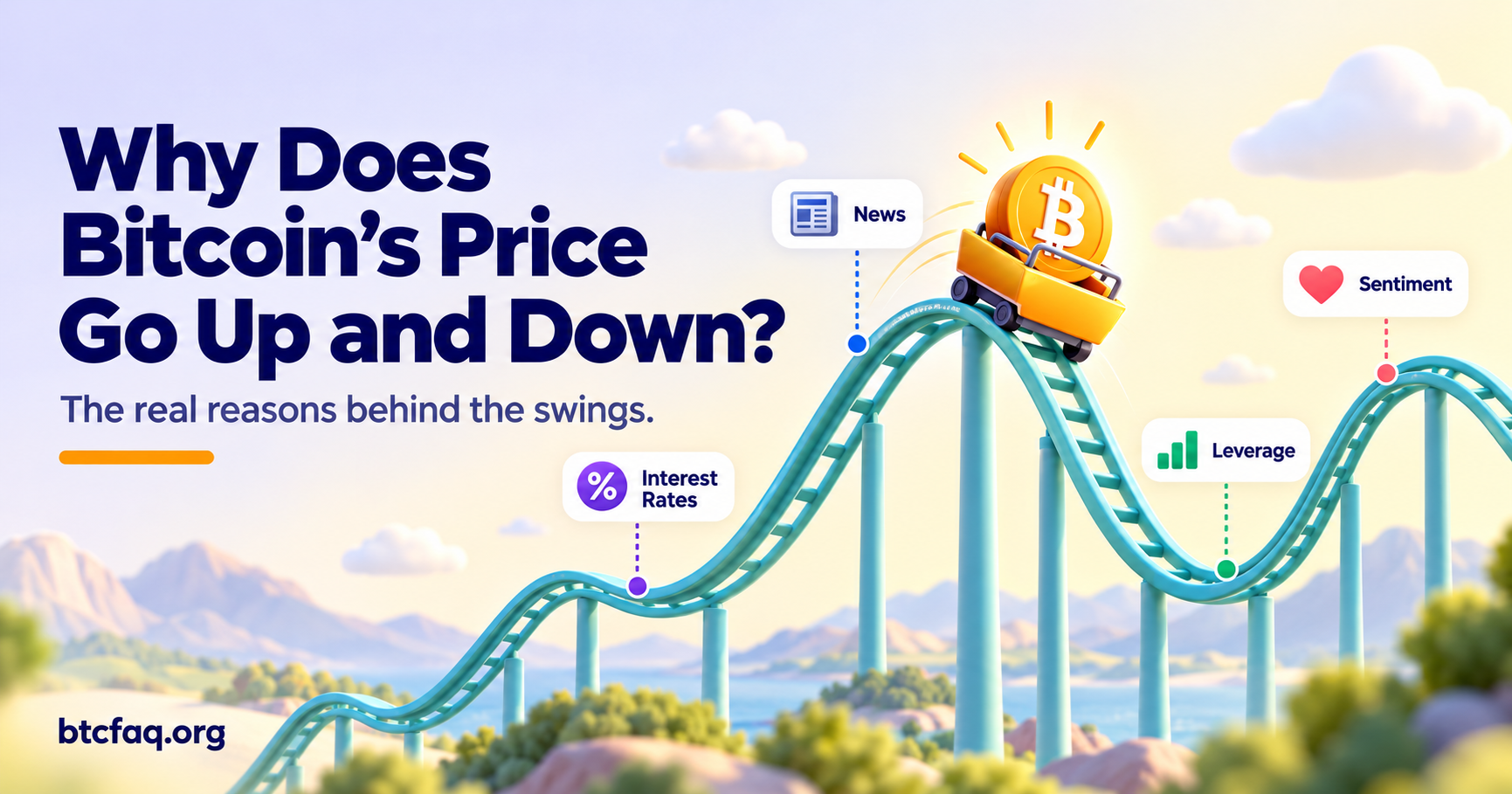
If you've followed Bitcoin's price for even a few days, you've probably noticed it doesn't sit still. It can jump several percent in a morning, give it all back by the evening, and make headlines in both directions within the same week. Over longer periods, the swings get even bigger: rallies that double the price, followed by drops that wipe out half of it or more.
For beginners, this raises a fair question. If Bitcoin is supposed to be valuable, why does its price behave like a roller coaster? This guide explains the main reasons, what changes over time, and how people sensibly deal with it.
This article is educational, not financial advice. Bitcoin is a volatile asset and you can lose money. Never invest more than you can afford to lose.
The Short Answer
Bitcoin is volatile because several forces interact at once: its supply issuance is highly inelastic, market liquidity can vary sharply across venues and time periods, leveraged derivatives can amplify moves, trading continues 24/7, and investors react quickly to changes in regulation, macroeconomic conditions, institutional flows and sentiment.
Bitcoin is much larger and more liquid than it was in its early years, so it is no longer accurate to describe it simply as a tiny market. But compared with the world's deepest currency, government-bond and large equity markets, its available trading depth can still be relatively limited at certain times. That helps explain why large changes in buying or selling pressure can produce noticeable price moves.
What "Volatility" Actually Means
Volatility describes how much and how quickly a price changes. A relatively stable asset tends to move within a narrower range; a volatile asset can rise or fall much more sharply.
Bitcoin has experienced several historical cycles containing both very large rallies and drawdowns of more than 50%. Several earlier bear markets were eventually followed by new all-time highs, but that does not mean every decline is guaranteed to recover or that recovery must happen on a predictable schedule. Past rebounds are historical observations, not guarantees about the next cycle.
Reason 2: Bitcoin Is Large, but Market Depth Still Varies
Bitcoin has grown into a major financial asset, but market capitalization is not the same thing as liquidity.
What matters during a large trade is market depth: how much buying and selling interest is available close to the current price. Bitcoin trades across exchanges, brokers, derivatives venues and over-the-counter markets, and available liquidity varies by venue and time.
That means a large order can have little effect in a deep market but move the price more sharply when available bids or offers are thinner.
Reason 3: Liquidity Is Fragmented
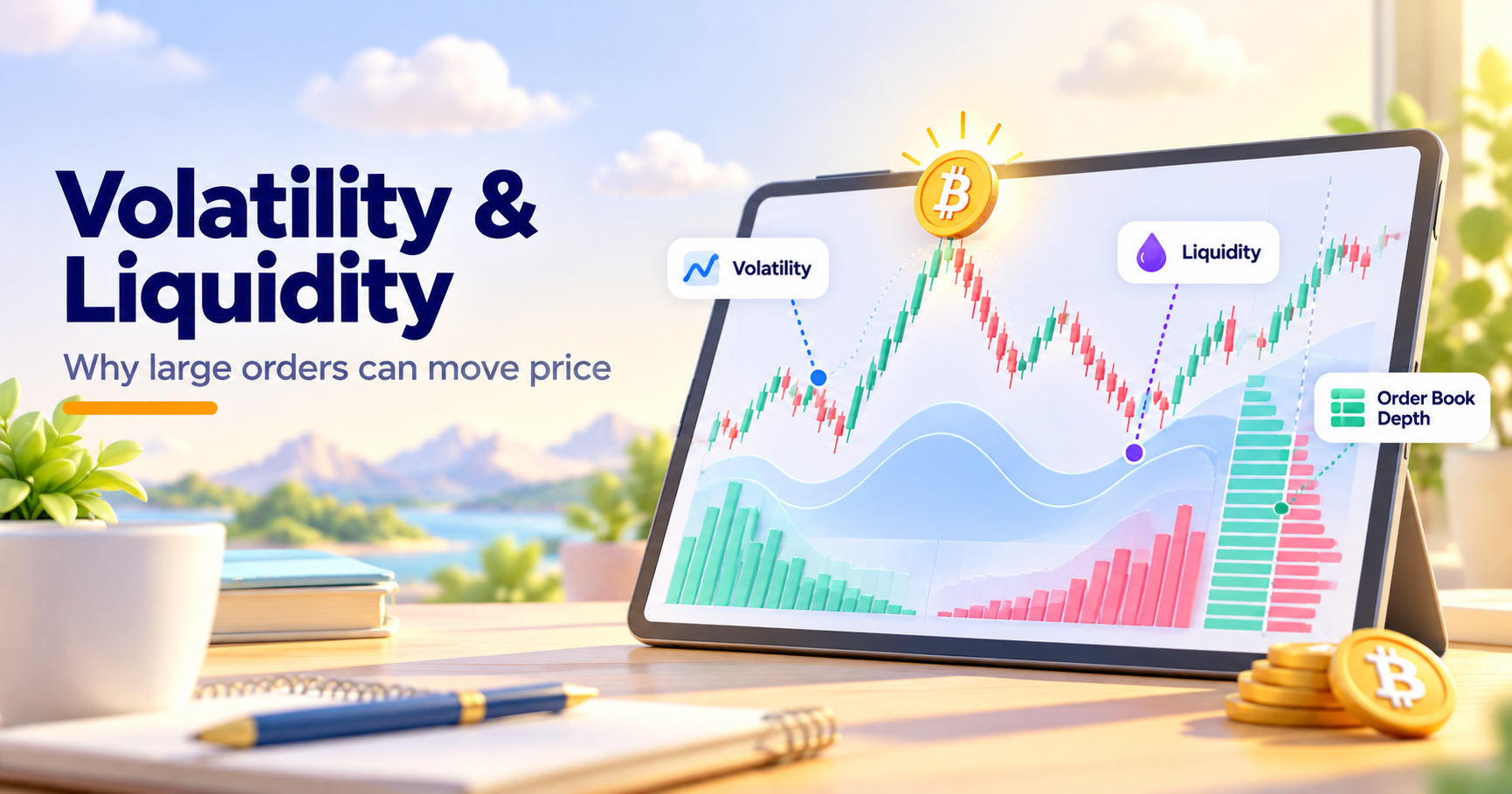
Liquidity describes how easily an asset can be traded without materially changing its price.
Bitcoin has far more liquidity today than it did in earlier cycles, but its trading activity is distributed across many venues rather than concentrated in one central order book. Depth can also change during weekends, market stress or sudden news events.
This matters because large orders, forced liquidations or abrupt shifts in sentiment can consume available liquidity quickly, producing sharper short-term movements.
Reason 4: Fixed Issuance Meets Changing Demand

Bitcoin's monetary policy does not respond to market price. New bitcoin is issued according to the protocol's block-subsidy schedule, and total issuance is capped at 21 million.
That does not mean the amount available for sale at any moment is fixed. Existing holders can decide to sell previously held bitcoin when prices or expectations change.
The important distinction is that Bitcoin cannot respond to higher demand by suddenly producing more new units in the way a company might manufacture more products. Instead, price moves until willing buyers and sellers reach a new balance, while the amount of existing bitcoin offered for sale can change along the way.
Reason 5: Leverage and Forced Liquidations
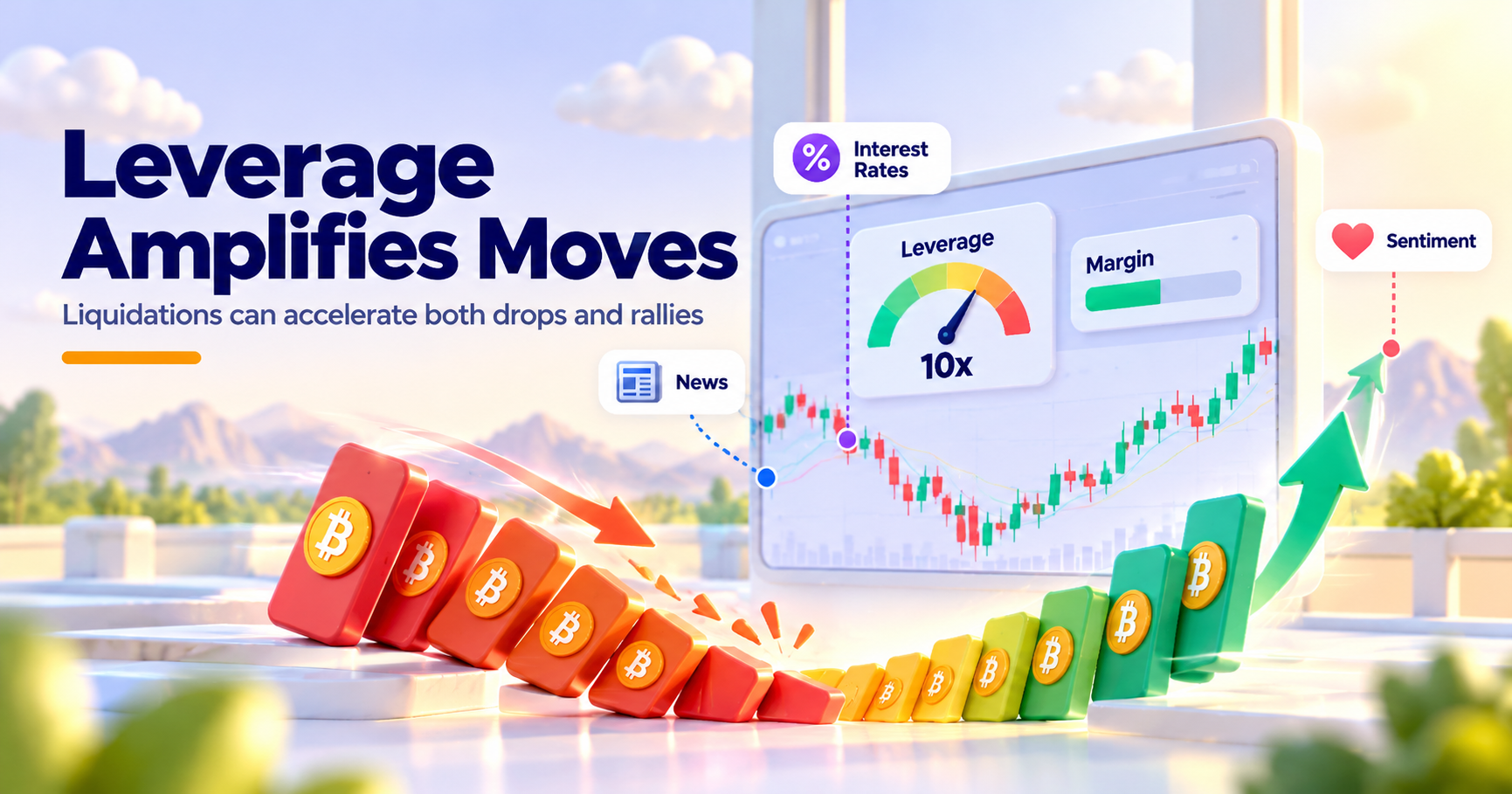
Leverage allows traders to control a larger position with a smaller amount of capital. That magnifies gains when the market moves in their favor, but it also magnifies losses.
When a leveraged position no longer has enough collateral to meet an exchange's margin requirements, the platform may forcibly reduce or close it. A liquidated long position can create additional selling pressure, while liquidated short positions can create forced buying.
When many highly leveraged positions are concentrated around similar price levels, one sharp move can therefore trigger additional liquidations, which can accelerate the original move.
This Medium essay on Bitcoin volatility in 2024 and 2025 discusses leverage and liquidity as structural contributors to Bitcoin's volatility. It is an opinion piece written from a strongly pro-Bitcoin perspective, so it is best used as one interpretation rather than as a neutral market forecast.
Reason 6: News, Regulation, and World Events
Because Bitcoin has no fixed anchor, it reacts strongly to information. Between them, Kraken and Fidelity point to several kinds of news that move it:
- • Regulation: Real rules, and even rumors of future rules, can shift prices. Kraken cites China's 2021 crackdown as a notable example of a policy decision moving the market.
- • Adoption by institutions and governments: Companies, investment firms, or governments buying or selling Bitcoin can push the price in either direction.
- • World events: Geopolitical and economic shocks can change how much risk investors are willing to take.
- • New investment products: Money flowing into and out of exchange-traded products that hold real Bitcoin affects demand.
River adds that statements and actions from lawmakers and financial institutions can swing supply and demand sharply.
Reason 7: Risk Appetite and Interest Rates
Fidelity's overview points to the broader economy. Bitcoin has tended to rise when investors feel confident and are willing to take risks, and to fall when they become cautious. Some analysts also link it to interest rates, expecting rate cuts to help and rate hikes to hurt, though Fidelity notes the historical data is limited, so this relationship isn't settled.
The practical result is that Bitcoin often reacts to the same economic headlines that move stocks, in addition to its own Bitcoin-specific news.
Reason 8: Sentiment and Momentum Can Amplify Moves
Bitcoin is traded by a broad mix of participants, including individual investors, professional traders, hedge funds, market makers, institutions and investment products.
Even with that more mature participant base, sentiment still matters. Rapidly rising prices can attract attention and additional buying, while falling prices can trigger risk reduction, fear and forced deleveraging.
Because there is no universally accepted cash-flow valuation model telling every investor what Bitcoin "should" be worth, expectations about future adoption, regulation, monetary conditions and market demand can change quickly. That gives momentum and sentiment more room to influence short-term price movements.
Reason 9: Bitcoin Trades 24/7
Bitcoin markets operate continuously, including overnight, on weekends and during holidays.
Traditional securities markets generally have defined exchange sessions, while Bitcoin price discovery continues around the clock. That means unexpected political, economic or crypto-specific news can be reflected in Bitcoin's price immediately rather than waiting for a traditional market to reopen.
Liquidity can also vary throughout the day and week, so the same amount of buying or selling pressure may move the market differently depending on when it arrives.
Reason 10: Network Events Like the Halving
Roughly every four years, Bitcoin's block reward is cut in half in an event called the halving. Fidelity lists the halving among the network events that can move the price, since it reduces the rate at which new Bitcoin is created. It doesn't cause an instant price change, but anticipation of it, and the expectations that build around slower new issuance, has often been part of the story during market cycles.
What About the Miners?

Bitcoin price is an important part of mining economics, but it is not the only variable.
A higher Bitcoin price can increase the dollar value of the BTC a miner earns. However, actual profitability also depends on network difficulty, transaction-fee revenue, hardware efficiency, electricity costs, uptime and other operating expenses. If higher prices attract more mining capacity and difficulty rises, part of the revenue benefit can eventually be competed away.
Likewise, a falling Bitcoin price can compress margins and push higher-cost or less-efficient machines toward shutdown, while operators with lower power costs and more efficient hardware may remain viable for longer.
This OneMiners article on how long-term ASIC miners respond to Bitcoin price swings presents the company's argument that predictable electricity costs can help miners tolerate volatile markets. It is useful as a hosting-provider perspective, but its profitability examples and claims should be treated as illustrative rather than guaranteed. Anyone evaluating mining should model the exact ASIC, electricity price, network conditions and current revenue assumptions for themselves.
Is Bitcoin Becoming Less Volatile?
There is evidence that Bitcoin's volatility has declined over parts of its long-term history as the asset has grown larger and more liquid.
Fidelity Digital Assets reported in 2026 that the current cycle had produced unusually low one-year realized volatility compared with earlier Bitcoin cycles, including multiple new historical lows in that measure in January 2026. Greater market size, institutional participation and deeper financial infrastructure may be contributing to that trend.
That does not mean volatility disappears. Bitcoin has continued to experience sharp short-term moves and substantial drawdowns even as some longer-term volatility measures have declined.
So the safest conclusion is not that Bitcoin will become stable. It is that its market structure is maturing, while significant short-term price swings remain entirely possible.
The Medium essay on Bitcoin volatility also argues that volatility should decline with adoption and deeper liquidity, but it is explicitly a bullish investor thesis rather than a neutral forecast.
How Beginners Can Handle Volatility
You can't control Bitcoin's price, but you can control how you respond to it. Kraken's guide covers several approaches, and the list below builds on them for everyday buyers:
- 1. Only risk what you can afford to lose. This is the most important rule. Money you need for rent, bills, or emergencies shouldn't be in Bitcoin.
- 2. Size your position to your tolerance. Look at past drawdowns and honestly ask whether you could hold through a drop of that size without selling in a panic.
- 3. Consider dollar-cost averaging. Buying a fixed amount on a schedule can reduce the need to choose one entry date, but it does not protect you from losses if Bitcoin's price declines over time.
- 4. Avoid leverage if you're new. Leverage is what turns ordinary swings into forced liquidations. Beginners generally have no need for it.
- 5. Think about your time horizon. A longer horizon may reduce the pressure to react to day-to-day price moves, but it does not guarantee that losses will recover.
- 6. Don't check the price every hour. Constant monitoring tends to encourage emotional decisions.
- 7. Ignore get-rich-quick pitches. Anyone promising guaranteed returns from a volatile asset is a red flag.
Common Misconceptions
"A big drop means Bitcoin is dead." Bitcoin has had several deep drawdowns in its history. The essay above argues that price alone is not a reliable signal that the underlying system has failed, though whether to take that view is a personal judgment.
"Volatility means it's a scam." Volatility reflects a young, thinly traded market with no cash-flow anchor, not necessarily fraud. Scams exist in crypto, but price swings alone don't indicate one.
"The price moves because of one thing." Rarely. Most moves come from several forces overlapping, such as news, leverage, liquidity, and sentiment.
"Volatility only goes down." It goes both ways. The same conditions that cause crashes can cause sharp rallies.
Frequently Asked Questions
Why is Bitcoin more volatile than stocks? It lacks cash flows to anchor its value, trades in a smaller and thinner market, has a fixed supply, trades 24/7, and is heavily influenced by leverage and sentiment.
What is a liquidation? When a leveraged trader's losses grow too large, the platform forcibly closes their position. These forced sales can push the price further and trigger more liquidations.
Does the halving make the price go up? Not automatically. It slows new supply and influences expectations, but its effect on price is not guaranteed or immediate.
Will Bitcoin ever become stable? Some analysts expect volatility to decline as the market matures, but nobody can promise it. Treat large swings as a real possibility.
Is volatility good or bad? It depends on your situation. It creates risk for anyone who might need their money soon, and opportunity for those with a long horizon and the stomach to sit through the swings.
Should I buy during a dip? That's a personal financial decision, and this article can't make it for you. Consider your goals, your risk tolerance, and consult a qualified financial professional.
Final Thoughts
Bitcoin's price volatility is not caused by one single factor. It comes from the interaction of changing demand, variable market liquidity, inelastic new supply, leverage, macroeconomic conditions, regulation, institutional flows, sentiment and continuous global trading.
Bitcoin's market has become larger, deeper and more institutional than it was in earlier cycles, and some long-term volatility measures have declined. At the same time, 2026 has shown that sharp moves can still happen.
For anyone considering Bitcoin, the practical lesson is to treat volatility as a real feature of the asset rather than something that is guaranteed to disappear. Understand the risk, avoid assuming that past recoveries guarantee future ones, and make financial decisions based on your own circumstances rather than short-term headlines or promises of predictable returns.