If you've ever tried to receive Bitcoin, you've seen one: a long string of letters and numbers that looks like someone fell asleep on the keyboard. That string is a Bitcoin address, and it's one of the first things every beginner has to deal with. It's also one of the most commonly misunderstood. People often assume it works like a bank account number, or that it holds their coins, or that it identifies them. None of that is quite right.
This guide explains what a Bitcoin address really is, where it comes from, why there are several different formats, and the handful of habits that keep you from losing money when you use one.
The Short Answer
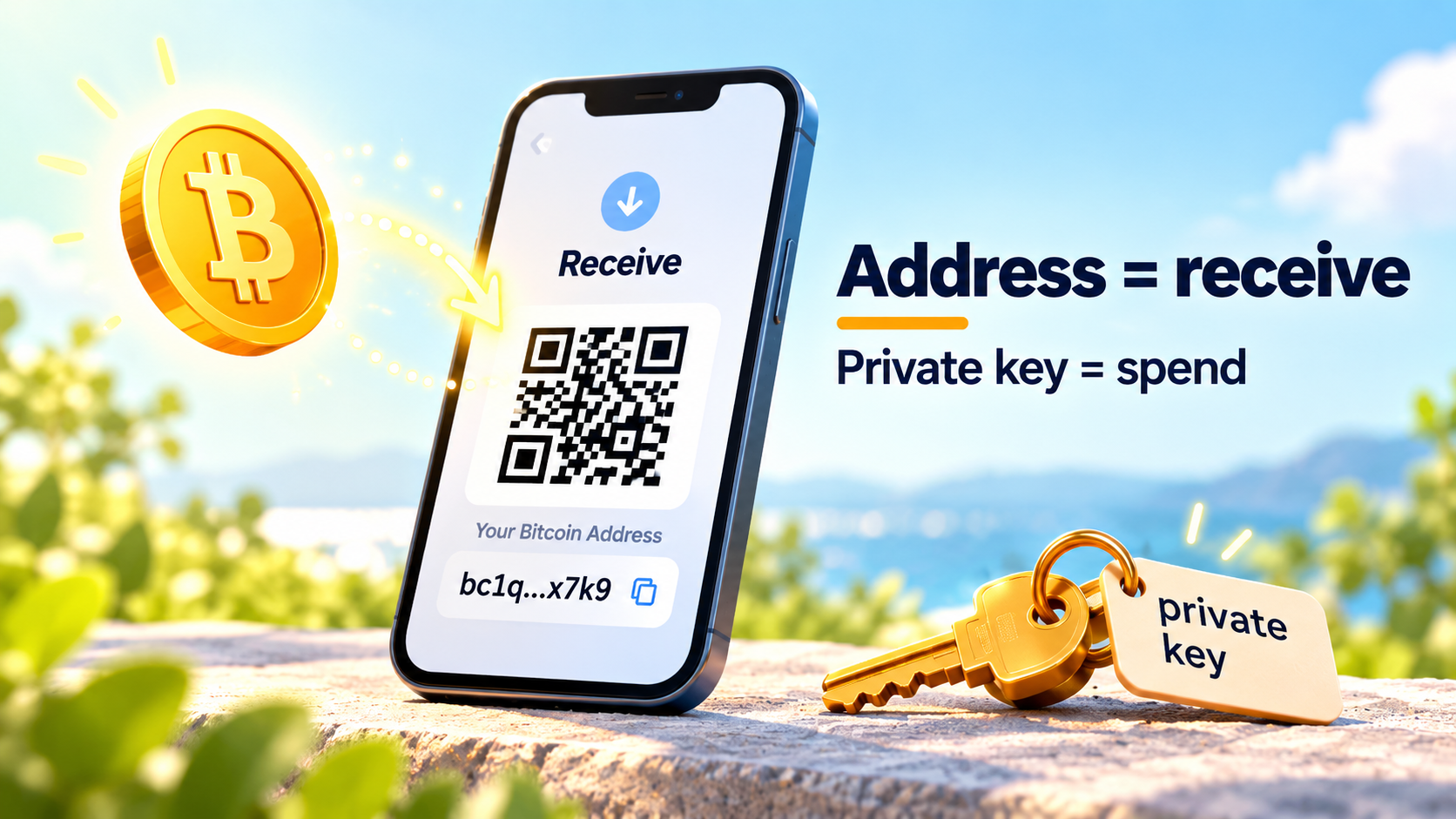
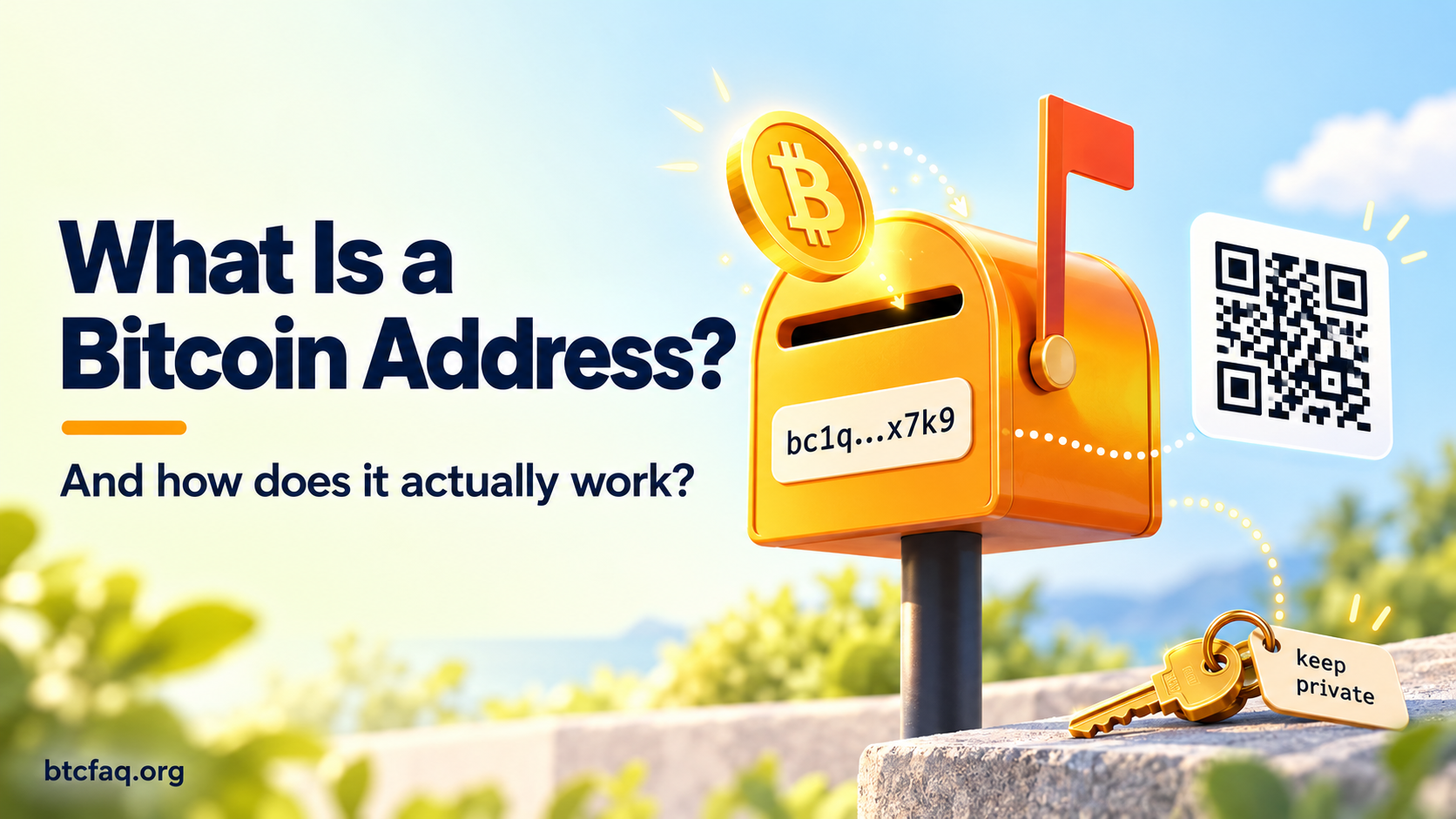
A Bitcoin address is a destination. It's the identifier you give someone so they can send Bitcoin to you, in the same way you'd give someone an email address so they can send you a message. It's generated by your wallet, derived from your cryptographic keys, and designed to be safe to share publicly.
The key idea to hold onto: an address lets people pay you, but it's your private key that lets you spend. Sharing an address doesn't give anyone control over your funds. Sharing a private key or recovery phrase does.
The Email Comparison (and Where It Breaks Down)
The official Bitcoin site uses exactly this comparison. As bitcoin.org's explanation of how Bitcoin works describes it, your wallet creates your first address and can generate more whenever you need them, and you hand those addresses out so people can pay you, much like email.
The analogy has one important difference. With email, you keep one address for years. With Bitcoin, the recommended habit is to use each address once. We'll get to why in the privacy section below, but it's the first sign that a Bitcoin address isn't quite like anything in the traditional banking world.
What an Address Is Not
Before going further, it helps to clear up a few common misunderstandings.
- It's not an account. There's no profile, balance record, or login attached to it. Your wallet looks at the blockchain, finds the coins that are locked to your addresses, and adds them up to show you a balance.
- It's not where your coins "live." Your Bitcoin exists as entries on the blockchain. The address is simply the lock those entries are tied to.
- It's not your public key. The two are related, but they're not the same thing, as explained below.
- It's not your identity. Addresses carry no name or personal details, though that doesn't make Bitcoin truly anonymous, a point we'll return to.
Where Does a Bitcoin Address Come From?
A Bitcoin address is created by your wallet from the information needed to define the conditions for receiving Bitcoin. The exact process depends on the address type, so there isn't one single formula that applies to every Bitcoin address.
For a common key-based address, the simplified process looks like this:
- Your wallet creates a private key. A private key is a secret number used to authorize spending and should never be shared.
- A corresponding public key is derived. The wallet can mathematically derive a public key from the private key without revealing the private key itself.
- The wallet creates the appropriate receiving condition. With older P2PKH addresses and native SegWit P2WPKH addresses, this involves a hash derived from a public key. Other address types can represent scripts or, in the case of Taproot, a different form of public-key-based output.
- The result is encoded as an address. The encoding includes information that helps wallets recognize the network and address format, together with checksum protection that catches many typing errors.
So while beginners often hear that a Bitcoin address is simply a "hash of a public key," that description only fits some address types. A more accurate way to think about an address is as a human-friendly representation of a Bitcoin transaction's receiving or locking conditions.
This plain-English Medium walkthrough of Bitcoin addresses provides additional background on how addresses relate to keys and transaction outputs.
For deeper technical detail, the Bitcoin Developer Guide on wallets explains how private keys, public keys, public-key hashes and script hashes are used by different wallet designs.
Why Bitcoin Addresses Look Different: The Main Types
Bitcoin has introduced several address formats over time. They can all represent valid ways to receive Bitcoin, but they use different transaction structures and encoding systems.
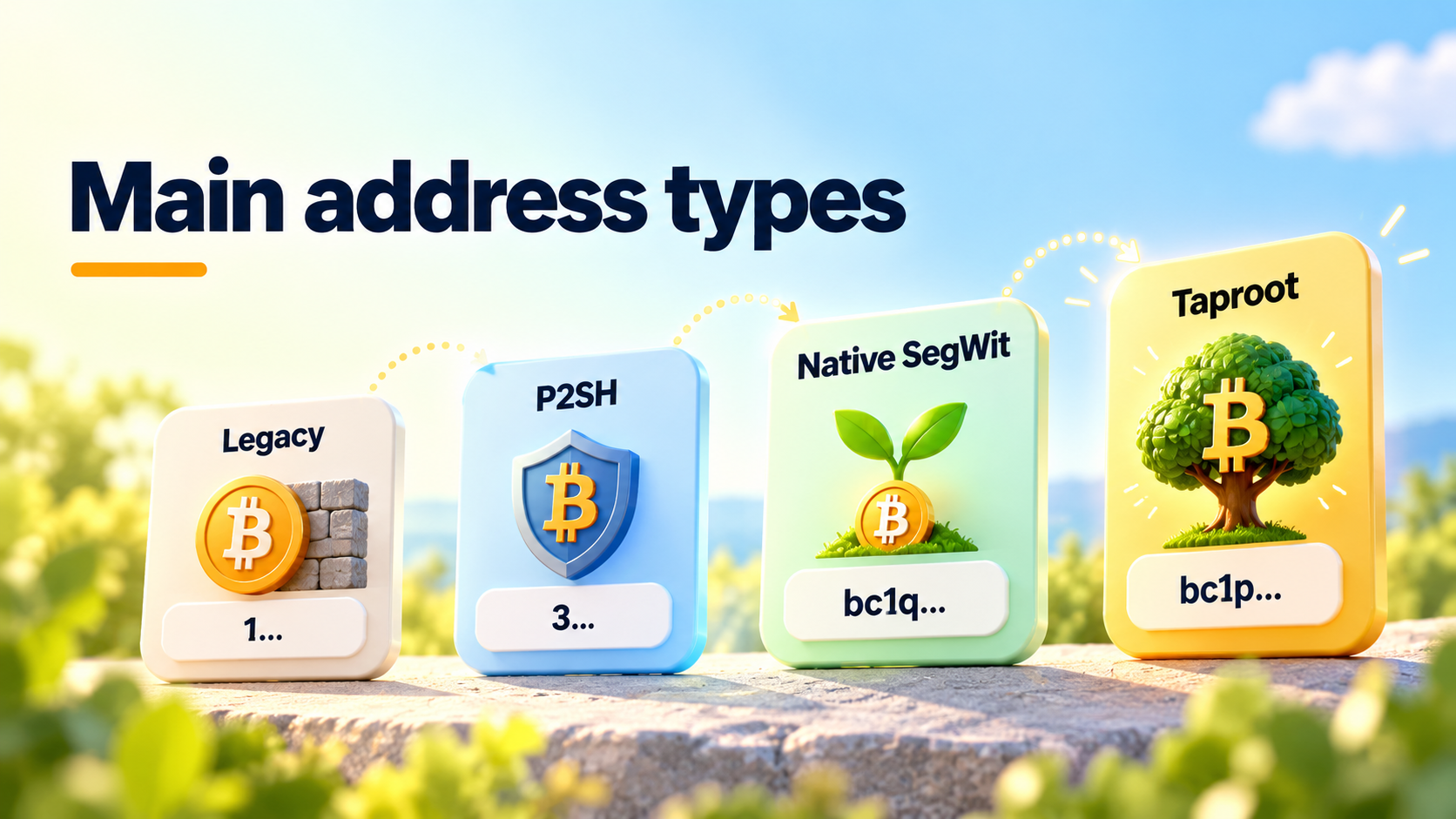
- Legacy — usually starts with 1. Formally called P2PKH. This is one of Bitcoin's oldest address formats and is still valid, although transactions using newer formats can often be more space-efficient.
- P2SH — usually starts with 3. These addresses represent a script hash and have been used for arrangements such as multisignature scripts and compatibility layers for SegWit.
- Native SegWit — usually starts with bc1q. These are SegWit version 0 addresses, commonly used for P2WPKH or P2WSH outputs. They generally allow more efficient transactions than legacy formats.
- Taproot — usually starts with bc1p. Taproot uses SegWit version 1 and the Bech32m encoding standard. It supports Taproot's key-path and script-path spending features and can provide efficiency and privacy benefits in certain transaction structures.
River's guide to Bitcoin addresses gives a beginner-friendly overview of the main formats.
A few practical details are worth remembering:
- Modern bc1 addresses are normally displayed in lowercase. A Bech32 or Bech32m address must not mix uppercase and lowercase characters.
- Testnet and other Bitcoin networks use different prefixes from Bitcoin mainnet, helping wallet software distinguish between networks.
- Most modern wallets choose an appropriate receiving format automatically.
- Before sending to a newer format such as Taproot, make sure the sending wallet supports that address type. Modern wallets generally do, but compatibility should not be assumed for every older wallet or service.
What Happens When You Send Bitcoin to an Address?
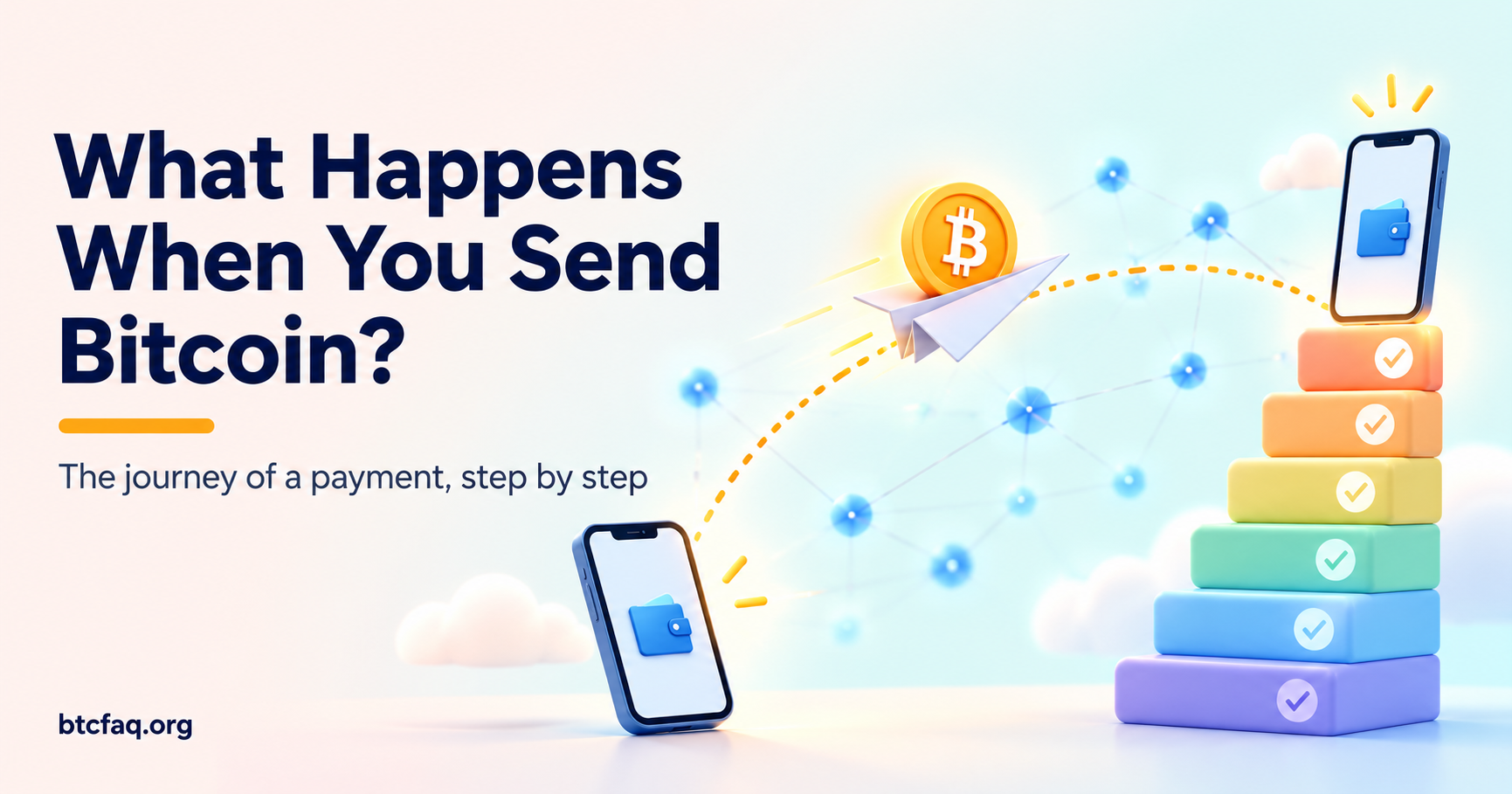
Here's the sequence, in simple terms:
- You paste or scan the recipient's address in your wallet and enter an amount.
- Your wallet builds a transaction that says, in effect, "lock this amount of Bitcoin so that only the owner of this address can spend it."
- Your wallet signs the transaction with your private key, proving you're entitled to spend those coins.
- The transaction is broadcast to the network, where nodes check that it's valid.
- Miners can include the transaction in a block, giving it its first confirmation. Bitcoin targets roughly ten minutes between blocks on average, but block discovery is probabilistic and the transaction's fee also affects how quickly it may be selected. A first confirmation can therefore arrive sooner or much later than ten minutes.
- The recipient's wallet notices that new coins are now locked to one of its addresses and updates the balance.
At no point does anything "move" into the address like money into a mailbox. The blockchain simply records a new ownership rule for those coins.
Why You Should Use a New Address Each Time
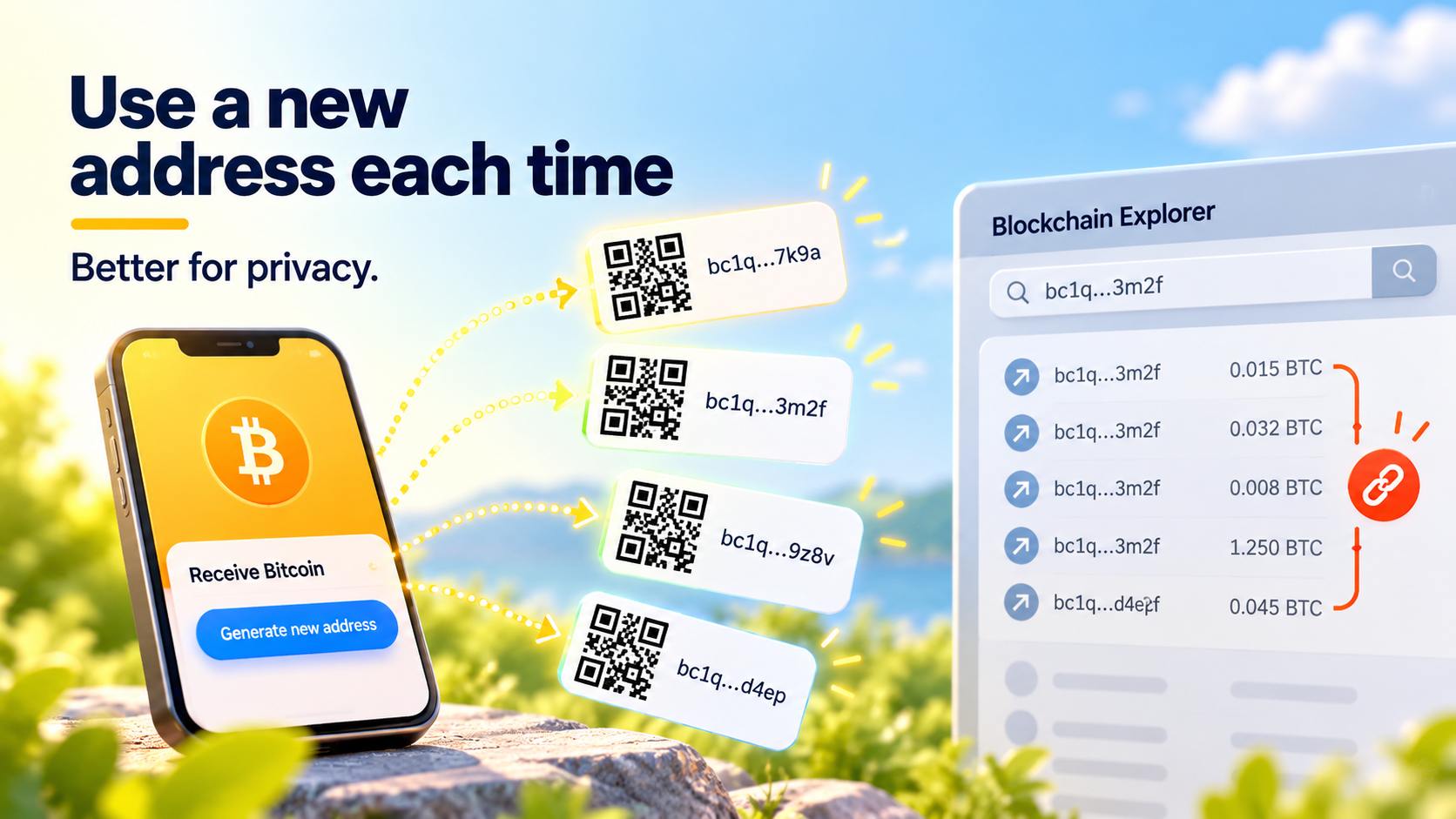
Reusing an address is technically allowed, and any funds sent to an old address still belong to you. But it's discouraged, for privacy reasons.
Bitcoin's ledger is public. Anyone can look up an address on a block explorer and see every payment it has ever received. If you give the same address to your employer, a friend, and an online shop, all of those people can see each other's payments, and anyone can tie them together as belonging to one person. Using a fresh address each time makes it much harder to link your activity.
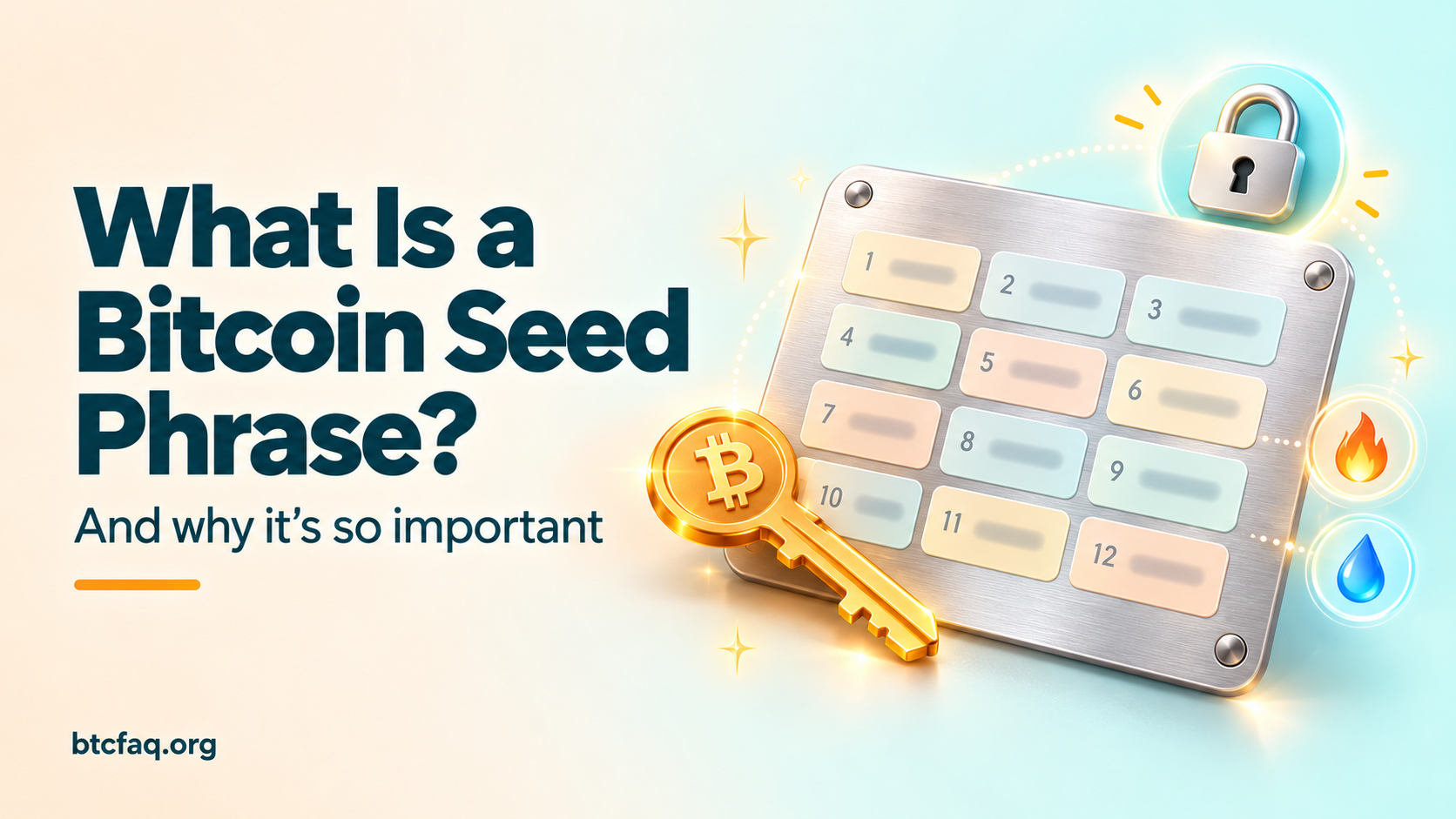
You usually don't have to manage fresh addresses manually. Many modern wallets are hierarchical deterministic (HD) wallets, meaning they can derive a large tree of keys and addresses from one master secret. Many wallets represent the backup for that secret using a mnemonic recovery phrase, often 12 or 24 words under standards such as BIP39. A compatible wallet using the same derivation scheme can recreate the associated keys and addresses from that backup. Not every Bitcoin wallet uses exactly the same recovery standard, however, so it's important to follow your wallet's own backup instructions. Your recovery phrase deserves far more protection than any individual address because anyone who can reconstruct your wallet from it may be able to control your funds.
Addresses Are Public, Which Is a Feature
Because everything on the blockchain is public, you can verify an address's balance and history without asking anyone's permission, using a free block explorer. That transparency has a useful side effect: organizations can publish an address and let anyone check the balance themselves, instead of simply asking to be trusted.
As one example, OneMiners publishes a page describing a public wallet it says is held to back its commitments to clients, along with a statement that anyone can inspect the balance on a blockchain explorer. You can read their client guarantees page to see how they describe it. As with any company's claims, it's worth checking the balance yourself on an explorer rather than relying on a figure on a webpage, and the same habit applies to any business that asks you to trust it with funds.
Is a Bitcoin Address Anonymous?
Not exactly. Bitcoin addresses are pseudonymous, meaning they aren't directly tied to your name, but they aren't invisible either. Every transaction involving an address is permanently visible, and if that address is ever linked to you, for instance because you withdrew from an exchange that knows your identity, your activity can potentially be traced. Treat Bitcoin as private in the sense that your name isn't printed on it, not in the sense that nobody can ever connect the dots.
How to Use a Bitcoin Address Safely
A few habits go a long way because Bitcoin transactions generally cannot be undone by a bank or payment processor. Once a transaction is confirmed and accumulates additional confirmations, reversing it becomes progressively more difficult.
- Verify the destination carefully before sending. For important payments, compare more than just the first and last few characters, or verify the address using a QR code or a trusted second channel when possible.
- Watch for clipboard hijacking. Malware can replace a copied Bitcoin address with an attacker's address. Recheck the destination after pasting and, for large transfers, consider sending a small test payment first.
- Send a small test first when you're paying a new address or a large amount.
- Use a fresh address for each payment you receive, which your wallet will usually offer automatically.
- Never confuse an address with a private key. Giving someone an address is fine. Giving anyone a private key or recovery phrase hands them your funds.
- Be skeptical of anyone who asks you to send Bitcoin "to verify" or "unlock" something. Legitimate services don't work this way.
- Make sure the address matches the network. Sending a different cryptocurrency to a Bitcoin address, or the reverse, can result in permanent loss.
A built-in checksum helps catch many typing mistakes, but it can't protect you if you mistype into a different valid address. As River points out, in that case the funds go to someone else and can't be recovered.
What About Mining Rewards?
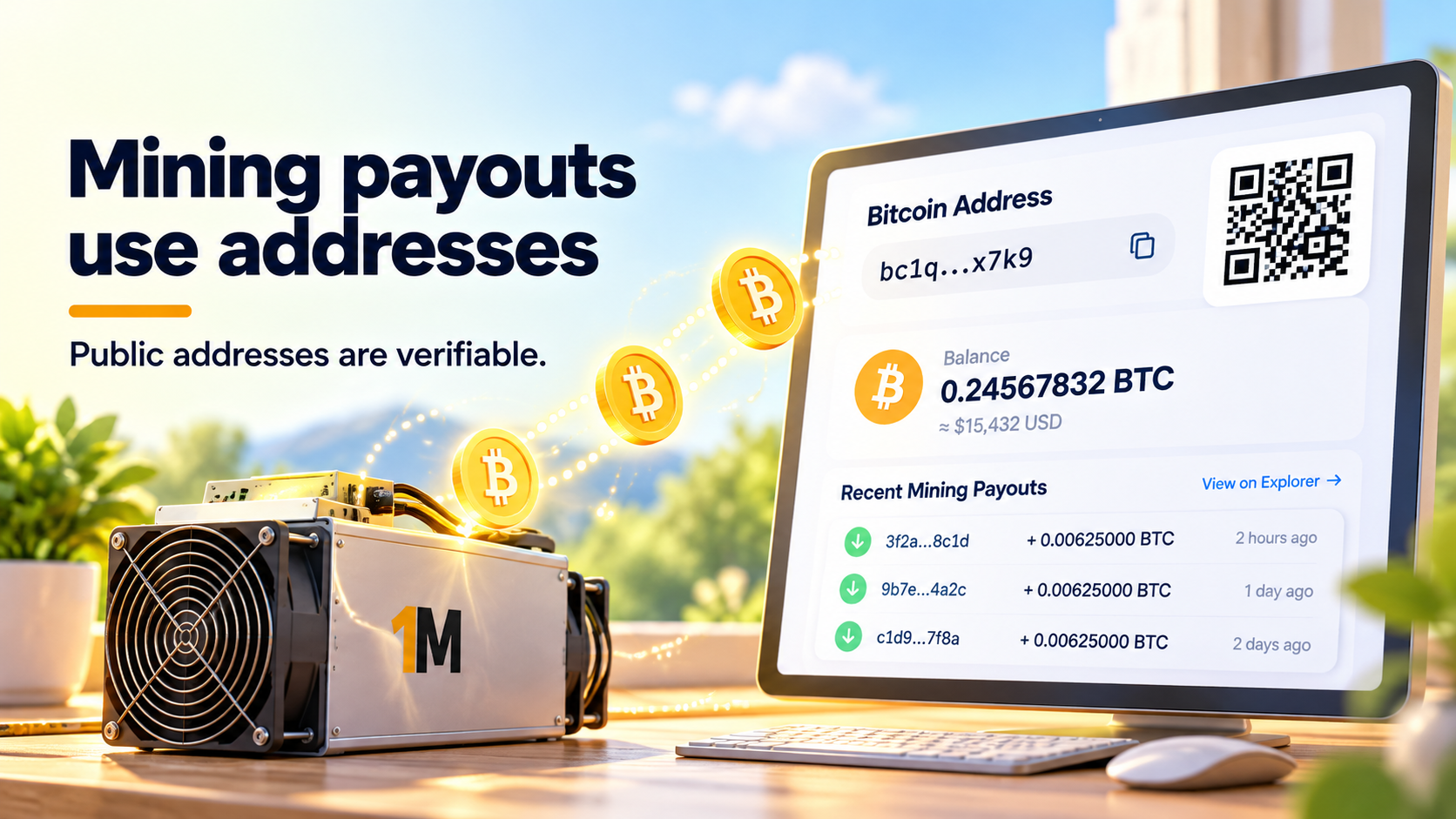
Addresses matter just as much if you earn Bitcoin through mining. Miners specify an address where their rewards or pool payouts should be sent, so the same rules apply: use an address from a wallet you control, keep the recovery phrase safe, and double-check it before configuring any payout.
Common Misconceptions
"My address is like my bank account number, so sharing it is risky." Sharing an address lets people send you Bitcoin and view that address's public history, but it doesn't give them any ability to spend your funds. Privacy is the main concern, not theft.
"I need one address for life." Not at all. Your wallet can generate as many as you need from a single recovery phrase, and using a new one each time is considered good practice.
"If I lose my address, I lose my Bitcoin." Your address can be regenerated from your wallet or recovery phrase. What you can't lose is the private key or seed, since that's what actually controls the funds.
"Sending Bitcoin to the wrong address can be undone." Generally it can't. There's no central authority to reverse a confirmed transaction, which is why verifying the address first matters so much.
Frequently Asked Questions
What does a Bitcoin address look like? It's a string of letters and numbers, typically starting with 1, 3, bc1q, or bc1p depending on the type, and usually between about 26 and 62 characters long.
Is a Bitcoin address the same as a wallet? No. A wallet is the software or device that manages your keys and generates addresses. An address is just one destination that the wallet creates.
Can two people have the same Bitcoin address? In practice, no. The numbers involved are so large that an accidental duplicate is not a realistic concern.
Can I find out who owns a Bitcoin address? Not from the address alone. The blockchain shows an address's transactions but not the owner's identity, unless they've linked it to themselves elsewhere.
Which address type should I use? In most cases, use the receiving address format your current wallet recommends. Native SegWit and Taproot are modern formats with efficiency advantages, but make sure the wallet or service sending the Bitcoin supports the format you're using. Most current Bitcoin wallets support the common modern address types.
Is it safe to post my Bitcoin address publicly? It's safe in terms of your funds, since an address can't be used to spend your Bitcoin. The tradeoff is privacy, because anyone can look up that address's history.
Final Thoughts
A Bitcoin address is a simple idea wrapped in an unfriendly-looking string: a shareable destination, generated from your keys, that tells the network where coins should be locked. Once you understand that the address receives, the private key spends, and the recovery phrase protects everything, most of the confusing parts of using Bitcoin start to fall into place. Treat addresses as disposable and public, and treat your keys as private and permanent, and you'll avoid the vast majority of beginner mistakes.