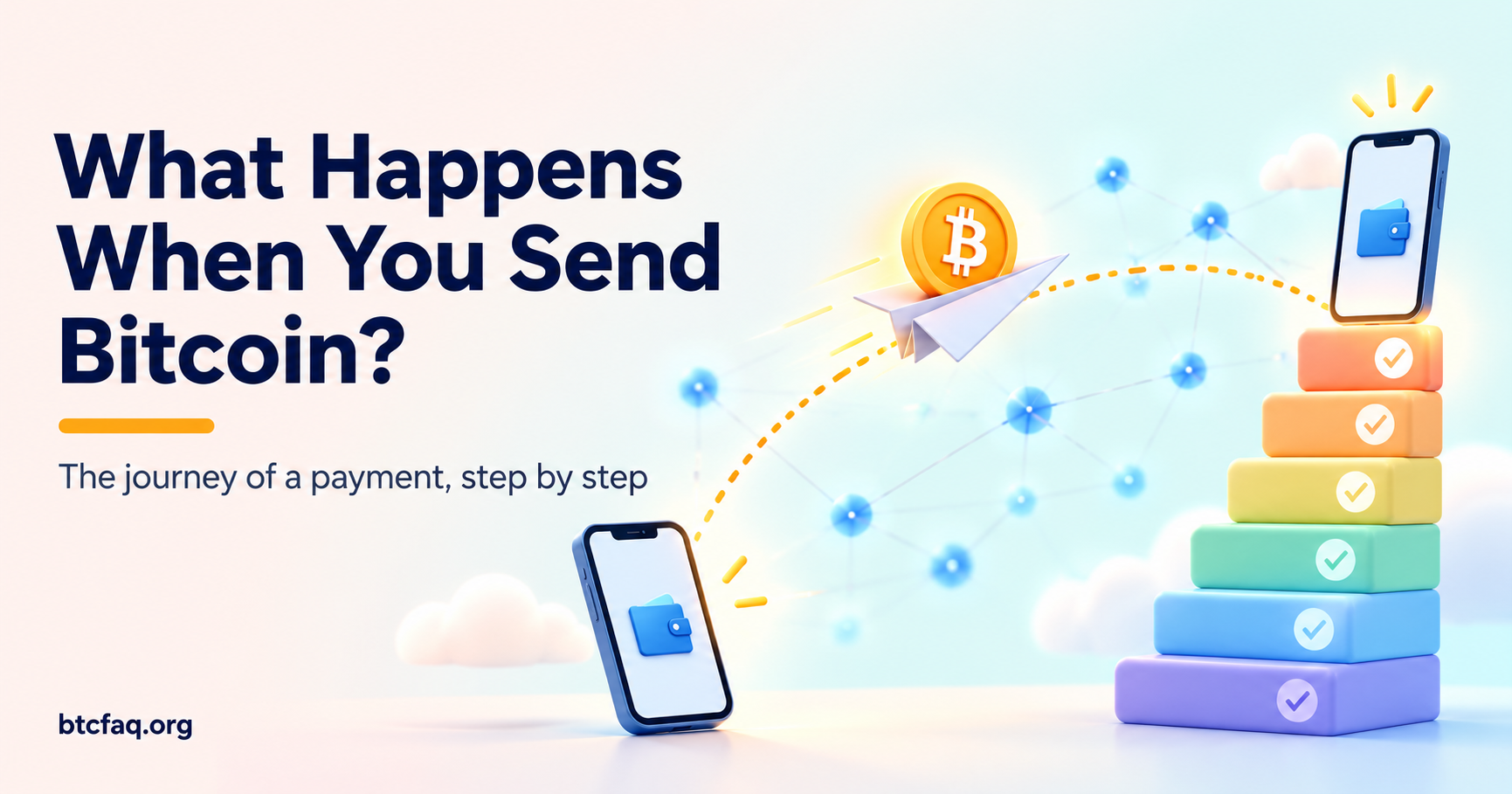
You paste an address, type an amount, and tap send. A few minutes later, the other person sees the money. It feels simple, and from the outside it is. But behind that tap, a chain of events plays out across thousands of computers around the world, and understanding it clears up a lot of beginner questions: Why does it sometimes take a while? What are fees actually paying for? Can a payment be cancelled? What does "confirmation" even mean?
This guide follows a Bitcoin payment from the moment you press send to the moment it's considered final.
The Short Answer
This article describes a standard on-chain Bitcoin transaction. Lightning payments work differently and do not wait for normal on-chain confirmations in the same way.
When you send Bitcoin on-chain, your wallet builds a transaction that spends one or more existing unspent transaction outputs, or UTXOs, that it can authorize. It then creates new outputs containing the conditions that the recipient — and usually your own change wallet — will later need to satisfy to spend those bitcoin.
Your wallet provides the required signatures or other authorization, then broadcasts the transaction to the peer-to-peer network. Nodes independently check it, relay it according to their policies, and miners may eventually include it in a block. Once included, the transaction has one confirmation. Each block built after that increases the amount of proof-of-work that would have to be replaced to reverse it.
No bank approves the payment. Bitcoin is changing which transaction outputs are currently unspent and who can satisfy the conditions required to spend them next.
Bitcoin Doesn't Work Like a Bank Balance
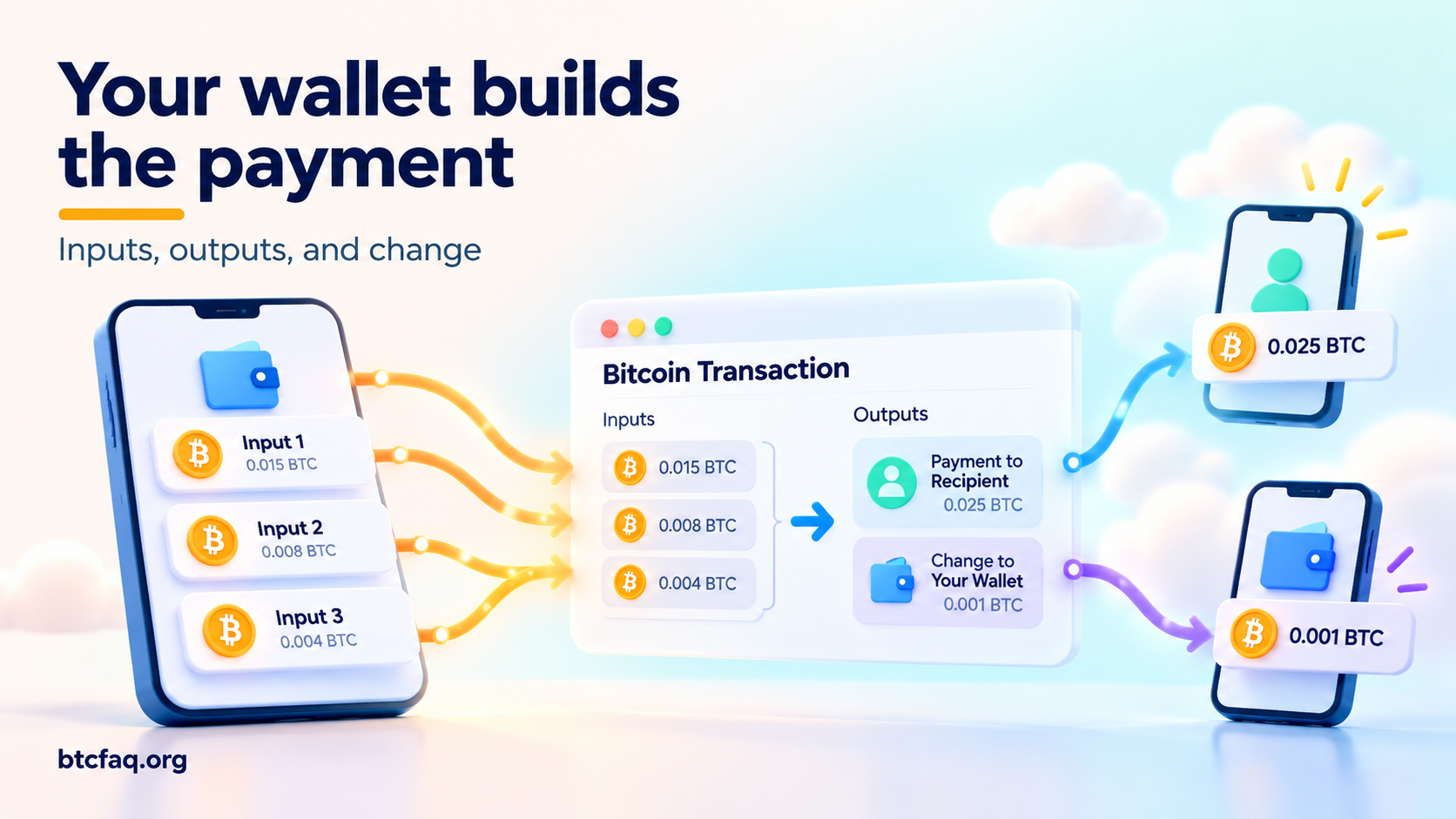
Your wallet may display one total balance, but Bitcoin does not maintain that balance as a conventional account. Instead, spendable value exists in separate unspent transaction outputs, or UTXOs.
Each UTXO has a value and a set of spending conditions. In a simple single-key payment, satisfying those conditions normally involves proving control of the appropriate private key. Other Bitcoin outputs can use more complex conditions, such as multisignature or script-based arrangements.
Your wallet adds together the UTXOs it can spend to calculate the balance you see.
When you make a payment, the wallet selects one or more UTXOs as inputs and creates one or more new outputs. The total input value must cover the outputs plus the transaction fee.
Step 2: Your Wallet Authorizes the Spend
After constructing the transaction, your wallet has to provide the authorization required to spend each selected input.
For a typical single-key wallet, this involves creating a digital signature with the relevant private key. The private key itself is never broadcast. Nodes can verify the signature using the corresponding public-key information and confirm that the transaction satisfies the previous output's spending conditions.
In ordinary wallet transactions, the signature also commits to the important transaction details according to the signature rules being used, preventing those signed details from simply being changed without invalidating the authorization.
Step 3: It's Broadcast to the Network
Once constructed and authorized, the transaction is broadcast to Bitcoin peers. Each node independently checks the transaction against Bitcoin's consensus rules and its own relay or mempool policies.
If a node accepts it, that node may relay the transaction to other peers. The transaction can spread rapidly across the network, but there is no single central server receiving it and not every node is guaranteed to see or store exactly the same set of pending transactions.
Step 4: It May Enter Node Mempools

An accepted but unconfirmed transaction will normally be stored in the local mempool of nodes that choose to keep it.
The word "mempool" is often discussed as though Bitcoin has one global waiting room, but every node actually maintains its own local pool. Those pools usually overlap heavily while still differing because of fee policies, transaction replacements, memory limits and propagation.
At this stage the payment has zero confirmations. A recipient's wallet may display it as pending, but an unconfirmed transaction can still be replaced, conflicted with or otherwise fail to become the transaction that ultimately confirms.
Step 5: Miners Pick It Up
Miners choose transactions from the mempool and bundle them into a candidate block. Each block has limited space, so miners can't include everything. They also earn the fees attached to the transactions they include, so they tend to favor those that pay more per unit of space.
Then the miners compete to find a valid solution for the block, which takes enormous computing effort. The first to succeed broadcasts the block to the network, other nodes verify it, and it becomes the newest block on the chain. If you'd like to see exactly how that competition works, this step-by-step guide to how Bitcoin mining works walks through it in detail. On average, a new block arrives roughly every ten minutes, though any individual block can come much sooner or later.
Step 6: It Gets Confirmations
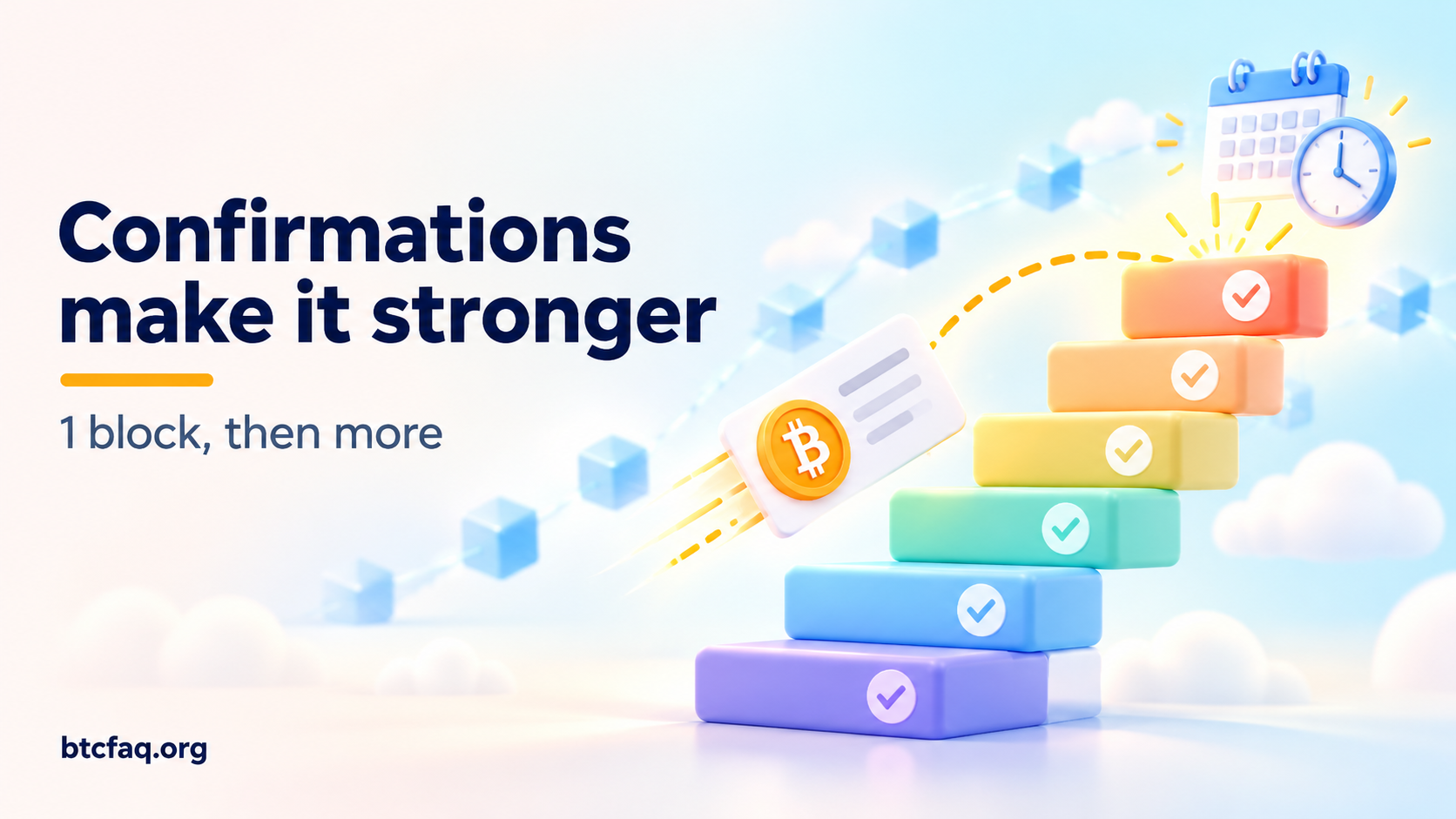
When a transaction is included in a block, it receives its first confirmation. Each subsequent block increases its confirmation count and makes replacing that part of Bitcoin's history progressively more difficult.
The Bitcoin Developer Guide on payment processing gives a traditional way to think about confirmation risk:
- • Zero confirmations: The transaction has been broadcast but has not yet been included in a block. It should not normally be treated as final.
- • One confirmation: The transaction is in the latest block and double-spend risk has fallen substantially, although very recent blocks can occasionally be replaced.
- • Additional confirmations: Each block built afterward adds more proof-of-work on top of the transaction.
- • Six confirmations: This is a long-standing convention for high-value or fraud-sensitive transactions, not a protocol rule that every payment must follow.
How many confirmations are appropriate depends on the receiver, amount and risk. Exchanges, businesses and wallet providers may all use different policies.
How Long Does It Take?
There is no fixed transaction timer. Bitcoin targets roughly ten minutes between blocks on average, but individual blocks can arrive much sooner or later.
Your transaction's fee rate also affects how competitive it is for limited block space. During busy periods, a low-fee transaction may wait through several blocks or considerably longer.
What Are Fees, and Who Gets Them?
Most ordinary on-chain Bitcoin transactions pay a fee to incentivize miners to include them in a block. The fee is determined primarily by the transaction's virtual size and the fee rate being offered, rather than by the dollar value of the Bitcoin being transferred.
Two details are useful:
- 1. Fees depend mainly on transaction size, not payment value. A transaction spending several UTXOs can be larger — and therefore more expensive at the same fee rate — than a simpler transaction moving a much larger amount of Bitcoin.
- 2. Block space is competitive. When many transactions are waiting, users offering higher fee rates generally have a better chance of being included sooner.
This Medium explanation of Bitcoin transaction anatomy and fees gives a useful cash-and-change analogy and discusses why transactions containing many small inputs can become relatively expensive during high-fee periods.
What If Your Transaction Gets Stuck?
A low-fee transaction can remain unconfirmed for a long time. That does not necessarily mean the Bitcoin is lost.
Several things may happen:
- • It eventually confirms when miners include it.
- • Different nodes may stop storing it. Mempools are local, so disappearance from one node's mempool does not guarantee that the transaction has vanished everywhere or can never confirm.
- • The fee may be increased. Some wallets can replace an unconfirmed transaction with a higher-fee version using Replace-by-Fee, while certain situations can also use Child Pays for Parent.
Bitcoin Core supports fee bumping by creating a replacement transaction that pays a higher fee. The replacement remains an unconfirmed transaction until a miner includes one version in a block.
Avoid unsolicited services claiming they need your private key or recovery phrase to "accelerate" a transaction.
Can You Cancel or Reverse a Bitcoin Payment?
Bitcoin has no credit-card-style chargeback or central operator that can simply reverse a payment on request.
Before confirmation, an unconfirmed transaction may sometimes be replaced or conflicted with, depending on the transaction, wallet and network policies. That is one reason recipients should not automatically treat zero-confirmation payments as final.
Once a transaction is confirmed, reversing it requires replacing blockchain history rather than asking an administrator to cancel it. That becomes progressively more difficult as additional blocks are built on top of the transaction.
For normal users, a well-confirmed Bitcoin payment should therefore be treated as effectively irreversible. If you send funds to the wrong destination, there is generally no central authority that can retrieve them for you.
How to Check What Happened
Every transaction has a unique transaction ID, a long string that works like a tracking number. You can paste it into a block explorer, a free public website that reads the blockchain, to see whether it's still pending, how many confirmations it has, and what fee it paid. River suggests searching by transaction ID rather than by your own addresses, since searching addresses can reveal information about you.
What the Recipient Sees
The recipient's wallet detects an incoming transaction output that its keys or wallet policy can spend. It may display the payment as pending while the transaction is still unconfirmed, then update the status as blocks are added. Exactly when the funds are treated as available depends on the wallet or service's confirmation policy.
A Quick Safety Checklist Before You Send
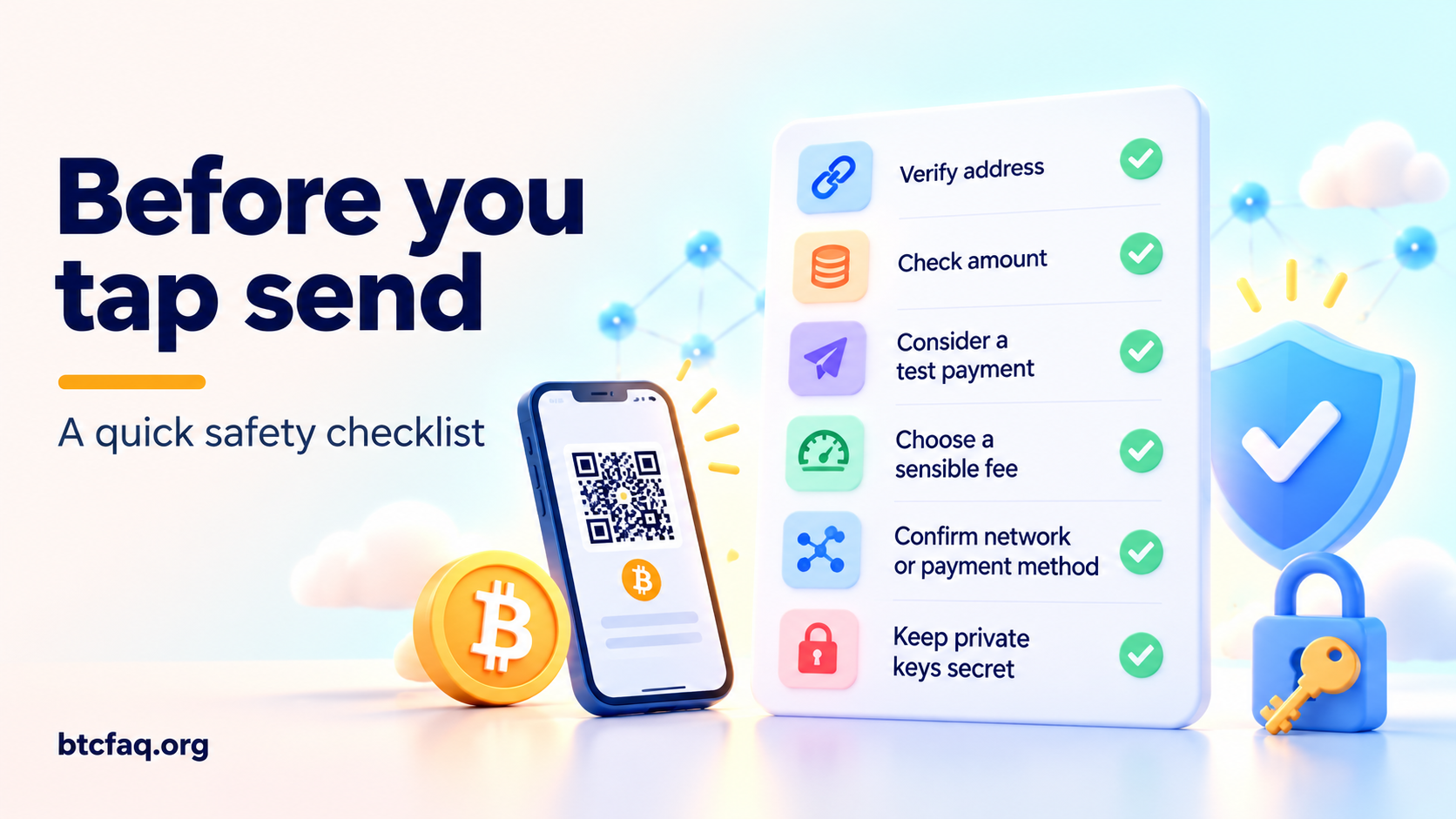
- 1. Verify the destination carefully. For important transfers, don't rely only on checking a few characters. Verify the address or payment request through a trusted channel, and use a QR code or hardware-wallet display when appropriate.
- 2. Double-check the amount and network. Bitcoin payments do not have a normal chargeback mechanism.
- 3. Consider a small test payment before a new or unusually large transfer.
- 4. Choose a sensible fee rate. If confirmation time matters, don't automatically choose the lowest available option.
- 5. Make sure you're using the intended Bitcoin network or payment method. An on-chain Bitcoin address is different from a Lightning invoice and from addresses on unrelated cryptocurrency networks.
- 6. Keep private keys and recovery information secret. Neither miners nor legitimate transaction-acceleration tools need your recovery phrase.
Frequently Asked Questions
How long does an on-chain Bitcoin transaction take? It can confirm in the next block or take considerably longer. Bitcoin targets roughly ten minutes per block on average, but actual block times vary, and a transaction's fee rate and current demand for block space affect how quickly miners are likely to include it.
How many confirmations are enough? There is no universal number for every payment. The appropriate number depends on the amount, the recipient's risk tolerance and the service's own policy. One confirmation provides significantly more assurance than zero, while several confirmations are commonly required for larger or higher-risk transfers. Six confirmations is a traditional convention for especially cautious settlement, not a mandatory Bitcoin rule.
Why did my transaction cost so much? On-chain fees are driven mainly by the transaction's virtual size and the fee rate needed to compete for block space. Transactions spending many separate UTXOs can therefore cost more than simpler transactions.
Can I send Bitcoin without paying a fee? Bitcoin's consensus rules do not require every transaction to contain a fee, but in practice a zero-fee transaction may not meet normal relay or mining policies and may never confirm. Most wallets therefore include an appropriate fee.
What happens to my change? If the inputs selected by your wallet exceed the payment amount plus fee, the wallet will usually create a change output that remains under your wallet's control. Wallet software handles this automatically.
Is it safe to send Bitcoin to someone I don't know? The protocol works the same regardless of who receives the transaction, but Bitcoin payments do not offer ordinary chargebacks. Verify the recipient and payment request before sending money to someone you do not trust.
Do I need to understand all this to send Bitcoin? No. Modern wallets automate UTXO selection, signing, change creation, broadcasting and fee estimation. Understanding the process simply helps you recognize what "pending," "confirmed," "fee rate" and similar terms actually mean.
Final Thoughts
Behind a simple "send" button is a surprisingly elegant process: your wallet builds a transaction from your coins, signs it, and broadcasts it, thousands of nodes check it, miners bundle it into a block, and each block that follows makes it harder to undo. There's no middleman approving it and no way to reverse it, which is exactly what makes Bitcoin useful and exactly why it pays to double-check every address before you hit send.