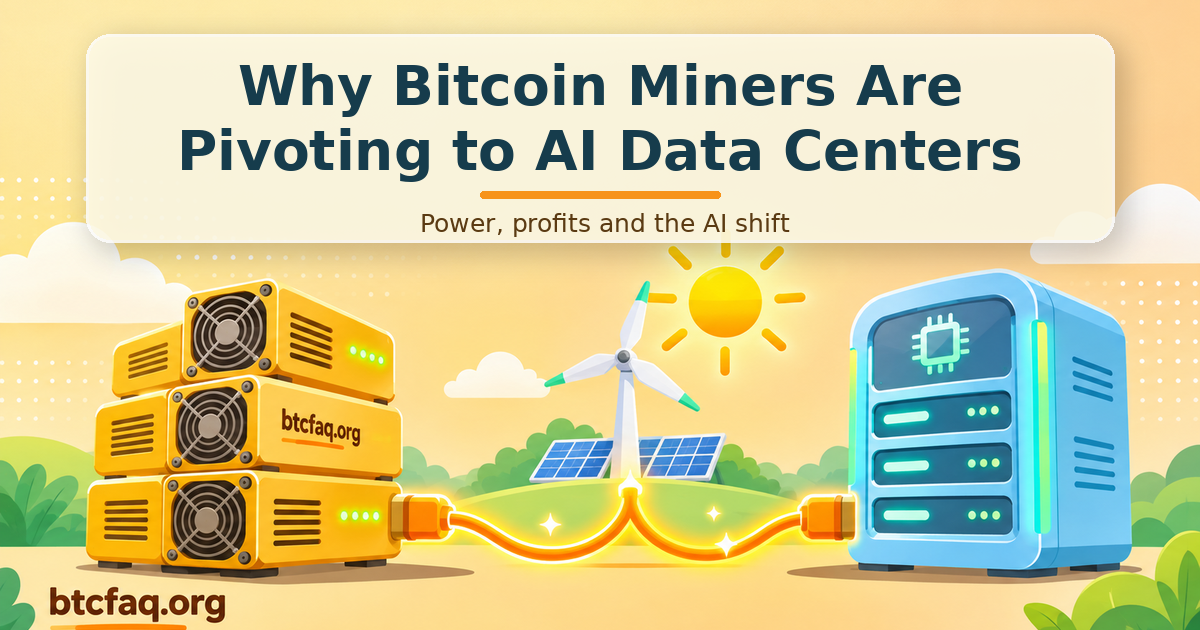
A few years ago, the loudest argument in Bitcoin mining was about hashrate records. Today, a growing part of the industry is talking about something else entirely: megawatts, GPUs and multi-year leases with AI companies.
If you've been following the headlines, you've probably seen some version of "Bitcoin miners are becoming AI companies." It sounds dramatic, and in some cases it's accurate. But it's also easy to misread. Is this the end of Bitcoin mining? Is AI really that much more profitable? And what does it mean if you own a mining machine, host one, or just want to understand how Bitcoin works?
In this guide, I'll walk through why it's happening, what the numbers actually say, how "mullet mining" fits in, what could go wrong, and what I think the practical lessons are. As always, I'll separate facts from opinion and tell you where the sources disagree.
This article is educational, not financial advice. Mining and investing both carry risk, and the figures here are snapshots that change quickly.
The Short Answer
- • Margins got squeezed. After the 2024 halving, a falling hashprice and high energy costs pushed many listed miners toward a second business.
- • Miners own something AI needs. Energized, grid-connected power is scarce, and miners already have it.
- • AI contracts pay on a different model. Fixed, multi-year, dollar-denominated contracts are very different from Bitcoin's volatile revenue.
- • It isn't free or fast. Converting a mining site into an AI facility is a major construction and financing project.
- • Bitcoin mining isn't disappearing. Many private and international operators are staying put, and the network's difficulty adjustment rebalances when machines go offline.
Now let's unpack that.
What Is Actually Happening
In February 2026, S&P Global Market Intelligence published research titled Bitcoin miners pivot to AI and HPC as cryptocurrency market slumps. Only the headline and summary were available to me when I wrote this, so I'll stick to what they say: crypto prices were falling, energy costs remained high, and several public miners were shifting toward powering data centers to diversify revenue. (HPC stands for high-performance computing, essentially large-scale computing for AI and other heavy workloads.)
A few weeks later, CoinDesk's March 27, 2026 report provided additional financial context. Citing CoinShares research, the article reported that publicly traded Bitcoin mining companies were increasingly investing in AI and high-performance computing infrastructure as mining economics became more challenging.
Several figures help explain the scale of this shift:
- • More than USD 70 billion in announced AI and HPC contracts had accumulated across the publicly traded mining sector by March 2026. These were multiyear commitments, not revenue already collected.
- • Approximately USD 79,995 per BTC was the weighted average cash production cost reported for public miners in Q4 2025, compared with Bitcoin trading around USD 68,000–70,000 during the reporting period. This was a sector average, not the operating cost of every mining company.
- • USD 28–30 per PH/s per day was the approximate hashprice range reported in early March 2026, demonstrating the pressure on mining revenue.
- • Major agreements included Core Scientific's expanded USD 10.2 billion arrangement with CoreWeave over 12 years, TeraWulf's approximately USD 12.8 billion in contracted HPC revenue, and Hut 8's USD 7 billion, 15-year AI infrastructure lease.
These commitments demonstrate growing demand for data-center infrastructure, but they also involve construction costs, financing requirements, performance obligations, and execution risks.
For individual miners, the key distinction is that a publicly traded company investing billions in GPU data centers is making a very different decision from a customer purchasing or hosting an ASIC miner.
Later in the year, OneMiners' article Bitcoin Miners Are Becoming AI Landlords (15 September 2026) repeated the roughly $70 billion figure and said it was up from about $43 billion in late 2024. That's roughly a 63% increase by my own division. It also made an important distinction: these are announced commitments, not revenue already delivered.
A note on numbers: Hashrate Index's March article on mullet mining cites "over $65 billion" in contracts (attributing it to Forbes). Different sources, slightly different dates and different counting methods. I wouldn't treat any of these totals as precise; they're all in the same ballpark, and that's what matters.
Why Are Miners Doing This? Five Reasons
1. The squeeze on mining margins
Every four years, the halving cuts the block reward in half. Since the 2024 halving, the subsidy has been 3.125 BTC per block. That makes miners more dependent on the Bitcoin price and on how many other miners are competing. (If you want a refresher, see our guide on what a halving is.)
The key metric is hashprice, the revenue per unit of hashrate per day. CoinDesk says it fell to around $28 to $30 per PH/s per day in March 2026. By September, OneMiners reported it had recovered to roughly $39 per PH/s per day. That's a nice rebound, but it's still a thin margin for anyone paying high power rates. CoinDesk also noted that miners on mid-generation hardware needed power below about $0.05 per kWh to stay cash-profitable in March.

2. Power is the scarce resource
Here's the part I find most interesting. A Bitcoin miner's most valuable asset isn't the machines; it's the electrical connection. Getting a large amount of power energized and approved can take years. AI companies need exactly that, and they need it fast.
OneMiners' piece Where Bitcoin Mining Gets Its Power (September 2026) makes this point from the mining side: electricity is 75 to 85 percent of ongoing mining costs, and AI and HPC operators are now competing for the same large, quickly energized power blocks, often with deeper budgets. Its argument is that this pushes up rates in contested markets and makes long-dated fixed contracts more valuable.
3. Different kind of revenue
Mining revenue is paid in bitcoin and swings with price and difficulty. An AI lease is typically a fixed, multi-year contract paid in dollars. CoinDesk cites AI contracts with margins above 85% and multi-year visibility (those are the article's figures, and I'd treat "margin" claims like this with some caution). It also reports that HPC-contracted miners traded at about 12.3 times next-twelve-month sales versus 5.9 times for pure-play miners. Markets reward predictable revenue, and miners noticed.
4. Capital is available for AI
Hashrate Index points out that credit funds that avoided Bitcoin mining are willing to finance GPU infrastructure, often at a lower cost of capital. That's a big deal: it means a mining company with a good site can raise billions for AI in a way it couldn't for more ASICs.
5. Hyperscale capacity is tight
Hashrate Index's articles note that hyperscale data center capacity was reportedly sold out into 2028 or 2029. That makes existing power sites unusually valuable and explains the urgency.
The Numbers: Does AI Really Pay More Than Mining?
This is the question most people ask, and the best answer I found comes from OneMiners' article Bitcoin Mining vs AI: Revenue per Megawatt-Hour (7 September 2026). It compares gross revenue per megawatt-hour (MWh) of power, citing a Miner Weekly analysis from 6 September 2026. The top-line message: "AI pays more than mining" lumps together very different business models.
| Business model | Example | Gross revenue per MWh (USD) |
|---|---|---|
| Full-stack AI | Bitdeer | $1,213 |
| Full-stack AI | White Fiber | $958 |
| Full-stack AI | HIVE | $924 |
| Full-stack AI | IREN | $807 |
| Full-stack AI | Median (as stated) | ≈ $941 |
| Altcoin ASIC mining | Antminer Z15 Pro (Zcash) | ≈ $586 |
| HPC colocation ("landlord") | Median of an 86–300 range | ≈ $180 |
| Bitcoin mining | Antminer S23 Hyd | ≈ $179 |
| Bitcoin mining | Antminer S21 Pro | ≈ $113 |
(The article also lists a "computer seller" model at roughly $322, which I've left out for brevity.)
Read it carefully, because it tells two stories:
The comparison reveals two important differences between AI infrastructure and Bitcoin mining.
- 1. Full-stack AI has the highest gross revenue per unit of electricity in this dataset. Companies that own or operate GPU infrastructure and sell computing services generate approximately USD 941 per MWh at the reported median. That is about 5.3 times the illustrative USD 179 per MWh generated by the Antminer S23 Hydro. However, this is a comparison of gross revenue, not net profit or return on invested capital.
- 2. HPC colocation generates gross revenue much closer to Bitcoin mining. In the same analysis, the median HPC colocation figure is approximately USD 180 per MWh, compared with USD 179 for a modern Bitcoin miner. This suggests that simply supplying power, cooling, and space to AI customers does not automatically generate dramatically higher revenue per unit of electricity than operating efficient Bitcoin mining hardware under the assumptions used.
The distinction is especially important for individual ASIC owners. Full-stack AI infrastructure requires substantial investment in GPUs, networking, specialized cooling, maintenance, and customer operations. By contrast, Bitcoin miners can concentrate on hardware efficiency, electricity pricing, and reliable mining operations.
OneMiners highlights this distinction in its Bitcoin Mining vs AI: Revenue Per Megawatt-Hour analysis. The comparison is useful because it shows that Bitcoin mining can remain economically relevant even as larger companies expand into AI infrastructure. Actual profitability still depends on operating costs, equipment investment, utilization, and market conditions.
The catch: capex
The same article, citing BitPlanet Research Lab, says AI infrastructure costs about $8 to $15 million per megawatt versus $0.7 to $1 million per megawatt for mining. CoinDesk gives the same $8–15 million versus $0.7–1 million range. That's roughly an order of magnitude more capital for the high-revenue version. So "AI makes five times more" comes with "AI costs ten times more to build," plus GPUs, staff, SLAs and customer risk.
Important Considerations When Comparing These Figures
The revenue-per-MWh comparison provides a useful starting point, but several factors should be considered before drawing conclusions.
- • Gross revenue is not net profit. The reported figures do not account for all expenses, including electricity, equipment depreciation, hosting costs, financing, maintenance, and downtime.
- • The comparison represents historical conditions. Bitcoin mining revenue changes with hashprice, network difficulty, and equipment efficiency. AI revenue also depends on utilization, customer contracts, and operating costs.
- • Different hardware assumptions produce different results. For example, an Antminer S23 Hydro operating at 580 TH/s and consuming approximately 5,510 W would produce about USD 170 per MWh at an illustrative hashprice of USD 38.72 per PH/s per day. This differs from the USD 179 figure in the OneMiners comparison because the assumptions are not identical.
- • Commercial rates should be confirmed before purchasing. OneMiners publishes information about electricity pricing and hosting services, but customers should request a current quotation covering their chosen location, equipment, contract duration, and included services.
The central lesson from OneMiners' analysis is that the business model matters as much as the headline revenue figure. Full-stack AI operations and Bitcoin mining have different capital requirements, operating risks, and customer obligations. Comparing those differences helps buyers understand why efficient mining hardware and stable electricity arrangements can remain attractive even as AI infrastructure expands.
Why the Switch Is Harder Than It Looks
I think many people imagine this as "swap the ASICs for GPUs." It isn't. Hashrate Index's article Why the Move from ASIC Mining to GPU AI/HPC Is Hard (February 2026, updated in March) lays out the difficulties well. Here are the highlights:
| Area | Bitcoin mining (ASICs) | AI/HPC (GPUs) |
|---|---|---|
| Hardware | Standardized, interchangeable machines | Custom-configured servers with many interdependent parts |
| Lead times | Short compared to AI | Colocation ~9 months; procurement 6–18 months under ideal conditions (per the article) |
| Cooling | Simpler, scales roughly linearly | Often needs more than mining sites can provide; liquid cooling increasingly standard |
| Networking | Minimal | High-bandwidth, low-latency links, depending on training vs inference |
| Revenue | Paid automatically via the network | Must be sold to hyperscalers, neoclouds or enterprises |
| Customers | Mining pools are forgiving | SLAs, uptime and latency measured; customers can leave |
| Compliance | Few export-control issues | Export controls on advanced GPUs |
The authors compare ASICs to t-shirts (standardized) and GPU servers to tailored suits (configured for a specific job). I think that's a good picture of the difference. They also note component price spikes, with RAM and SSD prices reportedly rising 25 to 100% per week at one point, and that the work needs coordination between hardware, colocation and connectivity: a delay in one stalls the rest.
What transfers well from mining? Power management, utility relationships, site operations and handling high-density heat. What doesn't? Procurement, networking and sales. That's why some miners are partnering with established operators instead of doing it all themselves.
Mullet Mining: Business in the Front, Party in the Back
There's a middle path that I find genuinely clever. Hashrate Index's Mullet Mining article (18 March 2026) describes running AI and Bitcoin mining on the same site. The authors summarize it as "AI business in the front, mining party in the back."
Here's how it works:
- • AI/HPC (front): Uptime-committed, SLA-bound workloads that produce fixed, dollar-denominated revenue.
- • Bitcoin mining (back): Soaks up surplus power, off-peak hours and the ramp-up period before AI demand fills the site, and curtails when AI needs more capacity.
The reasoning is that AI buildouts take months or years to fill, and mining keeps power from being stranded in the meantime. Miners already know curtailment, since they scale down at peak demand. The article suggests that makes them a natural fit for being the "junior partner" in a hybrid site.
It also lists failure modes, and these are the part I'd read twice:
- • Blurry boundaries between mining and AI load, which can strand either side.
- • Underestimating SLAs. AI customers measure uptime and latency and will leave after performance dips.
- • Operational stretch: two hardware lifecycles, two management stacks, two sets of failure modes.
- • Poor-fit sites that lack fiber, a cooling upgrade path, or proximity to users.
One disclosure: the authors work for Luxor Technology, which publishes Hashrate Index and offers consulting on this topic. And they warn the window is closing as purpose-built AI sites come online, writing that "the best time to evaluate your site was six months ago."
The Cost to Bitcoin: Selling Treasuries and Switching Off Machines
Here is where the story gets more uncomfortable.
Miners are selling bitcoin to pay for AI
According to CoinDesk, public miners cut their BTC treasuries by over 15,000 BTC from peak levels. Examples it gives include Core Scientific selling about 1,900 BTC in January, Bitdeer reducing its treasury to zero in February, and Riot Platforms selling 1,818 BTC in December. It also says Marathon, the largest public holder at 53,822 BTC, expanded its filing to authorize sales from its entire reserve. Heavy borrowing is part of the picture too: the article cites IREN carrying $3.7 billion in convertible notes and TeraWulf $5.7 billion of total debt.
Hashrate has been switched off
OneMiners' article 56 EH/s Unplugged (7 September 2026) says public miners removed roughly 56 EH/s of hashrate in the first half of 2026, citing a Miner Weekly analysis. The machines were turned off deliberately, because the power was worth more to AI and HPC customers. The article says public miners cut about 15% of capacity while the whole network fell about 10%.
Some other figures from that piece (all as of early September 2026, and all from a vendor article):
- • AI/HPC revenue at these miners rose 52% from Q1 to Q2.
- • Fourteen comparable companies spent $18.6 billion in capex in a single quarter.
- • Listed miners with AI contracts and shareholders pivoted faster; private and international operators mostly kept mining.
Why the network didn't break
Bitcoin was designed to adjust when the amount of mining power securing the network changes. If a substantial amount of hashrate leaves, blocks may initially take longer to discover. Bitcoin's difficulty adjustment, which occurs approximately every 2,016 blocks, then responds to the observed block-production rate to move the network back toward its target average of roughly ten minutes per block.
When difficulty decreases, the remaining miners can receive a larger expected share of block rewards per unit of hashrate, assuming other factors remain unchanged. This can improve their competitive position, although actual revenue still depends on Bitcoin's price, transaction fees, network conditions, and operating expenses.
OneMiners discusses this mechanism in 56 EH/s Left the Bitcoin Network: Here Is Who It Pays, explaining why changes among large public mining companies can create different economic conditions for operators that continue mining.
This adjustment is an important part of Bitcoin's resilience, but it does not mean that every decline in hashrate is harmless. Significant reductions can affect the network's total security resources, while the longer-term effects depend on how mining power is redistributed.
For smaller and hosted miners, the practical question is whether their equipment remains competitive after considering electricity expenses, hardware efficiency, and changing mining difficulty.
Hashrate figures differ by source and date (OneMiners gives about 948 EH/s in one article and 906–934 EH/s in another, noting other estimates range from 912 to 940). I'd treat any single number as approximate. For a refresher on what hashrate and difficulty mean, see our guides on those topics.
The tension
CoinDesk describes the result as the industry "exiting as a group of companies that build AI data centers and sell bitcoin to fund them." That's an uncomfortable sentence if you care about Bitcoin's security budget. The same miners selling BTC also secure the network. The relief valve is that private, international and hosted miners keep going, and the difficulty adjustment rewards them for it.
What It Means If You Own or Host a Miner
This is where the pivot stops being a headline and becomes a practical question.
Hosted Miners: Why Your Contract Matters
The expansion of AI data centers makes hosting agreements an important consideration for anyone who owns Bitcoin mining equipment.
In its article, Bitcoin Miners Are Becoming AI Landlords, OneMiners explains an important distinction: owning an ASIC miner does not necessarily mean owning the electricity infrastructure where it operates.
For customers using third-party hosting, this means understanding how power capacity is allocated, whether electricity rates are fixed, and what happens if a facility changes its business model.
Before selecting a hosting provider, ask five practical questions:
- 1. Is the electricity rate fixed, and for how long? Confirm the rate, contract duration, and any conditions that could affect pricing.
- 2. Can the provider reallocate mining capacity to AI or other services? Ask what protections apply to your equipment if the facility changes its operations.
- 3. What uptime commitment is included? Understand how uptime is measured and whether compensation applies to qualifying interruptions.
- 4. What services are included in the hosting rate? Confirm electricity, maintenance, installation, monitoring, and any additional fees.
- 5. What warranty protection is available? Check the coverage period, eligible locations, repair arrangements, and exclusions.
OneMiners offers ASIC mining equipment and managed hosting options across multiple international facilities. Its published information about prepaid electricity arrangements, technical support, and warranty coverage gives buyers useful factors to compare when evaluating a hosting contract.
The advantage of a well-defined hosting agreement is predictability. It cannot eliminate changes in Bitcoin price or mining difficulty, but it can help customers understand their electricity obligations and the services provided.
For miners who prefer not to operate industrial equipment at home, professionally managed hosting can also reduce the need to handle cooling, electrical infrastructure, and routine maintenance independently.
The most important step is to confirm the exact agreement offered for your machine and selected facility before making a purchasing decision.
Electricity is the whole game
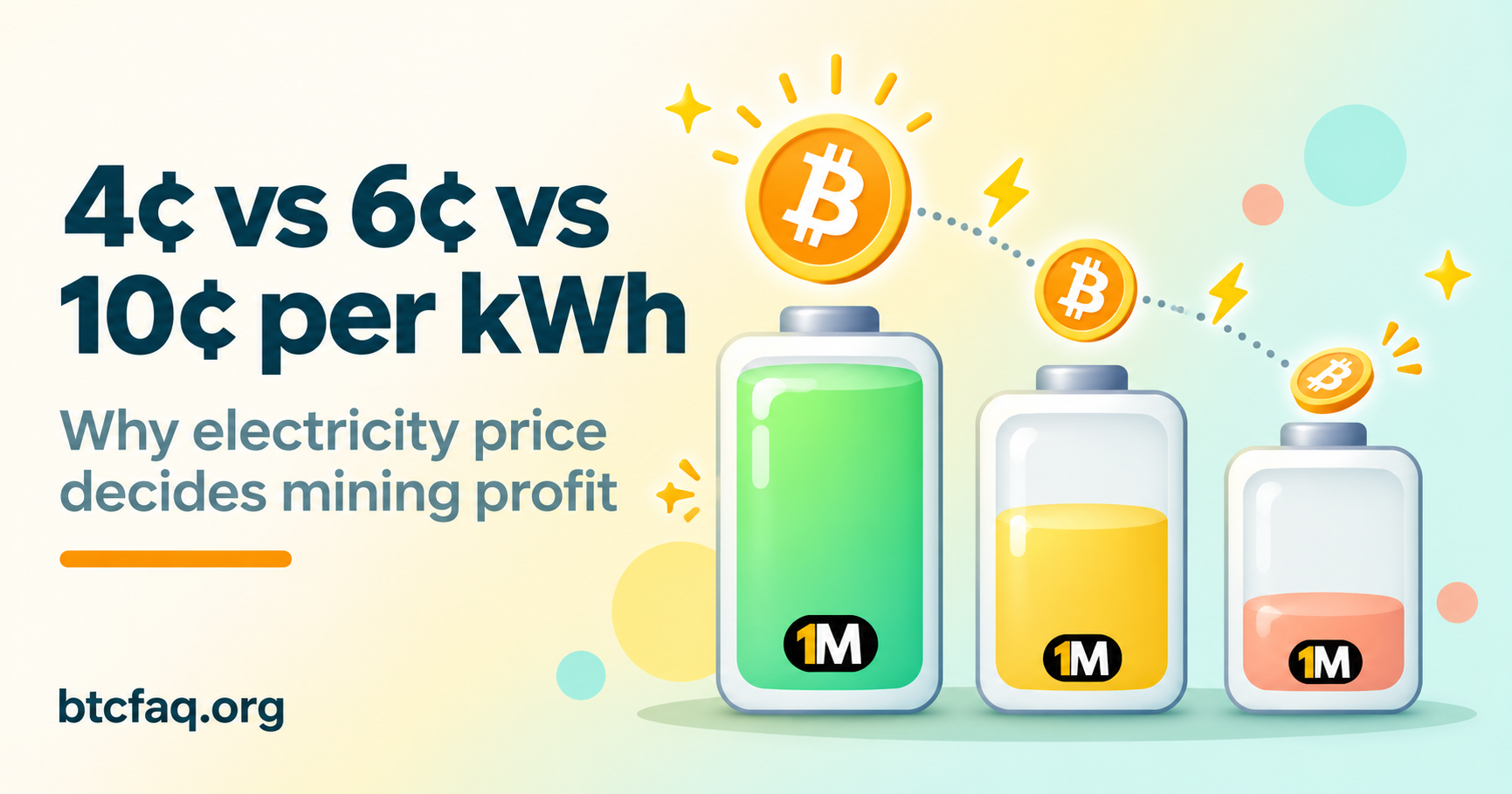
The power article gives an illustrative comparison for an Antminer S23 Hydro (580 TH/s, 5,510 W) at a hashprice of $38.72 per PH/s per day. I rechecked the arithmetic: the machine uses about 132 kWh per day and earns about $22.46 in gross daily revenue.
| Electricity rate | Daily power cost | Daily net margin |
|---|---|---|
| $0.0364/kWh (Nigeria, per the article) | $4.81 | $17.64 |
| $0.0455/kWh | $6.02 | $16.44 |
| $0.0480/kWh (network average) | $6.35 | $16.11 |
| $0.12/kWh (home power) | $15.87 | $6.59 |
The calculation shows how significantly electricity pricing can influence mining margins. Under this historical scenario, the Antminer S23 Hydro generates approximately USD 22.46 in gross daily mining revenue, while consuming about 132.24 kWh of electricity per day.
At an illustrative electricity rate of USD 0.0364/kWh, daily electricity expenses are approximately USD 4.81, leaving an electricity-only margin of USD 17.64. At USD 0.12/kWh, electricity expenses increase to approximately USD 15.87, reducing the margin to USD 6.59.
That means the electricity-only margin is approximately 2.7 times higher at the lower rate, even though the machine's hashrate and power consumption remain unchanged.
This example helps explain why OneMiners emphasizes electricity pricing and managed hosting arrangements in its Where Bitcoin Mining Gets Its Power guide.
These figures are illustrative rather than current profitability estimates. They exclude applicable hosting charges, pool fees, maintenance expenses, downtime, taxes, and hardware depreciation. Buyers should confirm the full cost of their selected hosting arrangement before making a purchase.
Locking in Electricity Costs With Prepaid Energy
One way miners can plan their operating expenses more predictably is by choosing a fixed-rate electricity arrangement. For hosted-mining customers, this can be particularly useful because electricity is a recurring cost that continues throughout the machine's operating life.
OneMiners offers Prepaid Energy options for eligible customers, including arrangements extending over one, three, or seven years where available.
In my Medium article, Prepaid Energy: How to Lock In a Discounted Power Rate Before You Ever Plug In, I examine an example involving an Antminer Z15 Pro hosted at a OneMiners facility in Finland.
The example compares a standard electricity rate of USD 0.0650/kWh with discounted rates of USD 0.0624/kWh for one year, USD 0.0572/kWh for three years, and USD 0.0455/kWh for seven years. Under those specific conditions, the seven-year arrangement offers an electricity-rate discount of approximately 30%.
This illustrates how longer-term electricity arrangements may help customers reduce uncertainty about one of mining's largest recurring expenses. However, prepaid plans require careful consideration of upfront capital, hardware operating life, facility availability, and contract conditions.
For miners comparing hosting providers, OneMiners' prepaid-electricity options are worth evaluating alongside its equipment selection, managed hosting services, and published warranty arrangements.
The practical takeaway: A competitive electricity rate is valuable, but buyers should compare the total contract cost, payment timing, and flexibility before committing to a multiyear arrangement.
Hardware Efficiency Still Matters
While large Bitcoin mining companies explore AI infrastructure, individual miners still need to focus on selecting efficient ASIC equipment that matches their budget and electricity arrangements.
Energy efficiency, commonly measured in joules per terahash (J/TH), determines how much electricity an ASIC miner consumes relative to its computing output. Lower J/TH generally means better energy efficiency, which can help improve electricity-only operating margins when other factors are comparable.
In my Medium article, Best ASIC Miners to Consider Before 2027: Are Newer Machines Worth the Upgrade?, I explain how to evaluate newer ASIC generations by comparing efficiency, electricity costs, hardware prices, and potential upgrade payback periods.
The guide also discusses how different electricity rates can change whether replacing an older miner makes economic sense. A machine with better efficiency may offer greater operating flexibility, but it is not automatically the best purchase if its acquisition cost is substantially higher.
OneMiners offers ASIC mining equipment and professional hosting options that customers can compare according to their preferred hardware generation, cooling requirements, and available electricity arrangements.
The growth of AI data centers does not eliminate the importance of efficient Bitcoin mining. For customers who continue mining, the combination of suitable hardware and manageable operating expenses remains central to their decision-making.
Five Honest Opinions
1. This is a rational response, not a betrayal. Companies with debt and shareholders respond to margins. If a megawatt is worth more to an AI tenant, and the contract is fixed, I'd be surprised if they didn't take it. I'd just keep my eyes open about what it means for them.
2. The headline "AI pays 5x more" is misleading. The data I read says the landlord model pays about the same as a modern miner, and the big revenue requires 10x the capital and a different skill set. Anyone comparing the two should compare capital efficiency, not just revenue.
3. The AI boom is a bet, too. Mining is a bet on the Bitcoin price. AI is a bet that demand, financing and customers hold up, often funded by large debts. CoinDesk itself questions whether AI revenue will arrive fast enough to cover the borrowing. I don't think AI is the "safe" option; it's a different risk.
4. Bitcoin's design handles this better than the headlines suggest. When hashrate leaves, difficulty drops and the remaining miners earn more. That's the self-correcting mechanism working. What worries me more is the speed and concentration of the transition among large public miners, not the system's survival.
5. For regular people, power cost and contract terms matter more than the AI story. If you own a machine, the question isn't "are miners pivoting?" It's "what is my all-in rate, how long is it fixed, and what can my host do with the power?"
A Note on Sources
This article combines reporting and research from CoinDesk, S&P Global Market Intelligence, Hashrate Index, OneMiners, and my Medium publications.
CoinDesk and S&P Global provide reporting and analysis of publicly traded mining companies, financing arrangements, and the expansion of AI infrastructure. Hashrate Index, published by Luxor Technology, offers industry analysis of mining economics and data-center operations.
OneMiners contributes a perspective focused on ASIC hardware ownership, hosting services, electricity pricing, and the practical considerations faced by mining customers. Its articles provide useful examples of how power costs and hosting arrangements affect equipment economics.
My Medium articles discuss related subjects, including prepaid electricity and ASIC hardware efficiency. These publications are commercially affiliated with OneMiners, so their product and service discussions should be understood in that context.
The financial comparisons in this article use dated historical information, and service-specific pricing should be confirmed directly before purchasing. Where industry sources use different reporting dates or methodologies, their figures are presented as historical estimates rather than universal or guaranteed outcomes.
The goal is to explain the mining-to-AI transition clearly while helping readers distinguish industry-level developments from the decisions facing individual ASIC owners.
Common Misconceptions
"Bitcoin miners are quitting Bitcoin." Some large public miners are shifting substantially to AI. Many private and international operators are still mining.
"AI is five times more profitable than Bitcoin mining." Not necessarily. OneMiners' September 2026 comparison found that full-stack AI operations generated approximately five times the gross revenue per MWh of a modern Bitcoin mining machine under the study's assumptions. That does not mean five times the net profit or investment return. The same analysis found HPC colocation revenue per MWh was much closer to the Bitcoin mining figure. Equipment investment, financing costs, operating expenses, utilization, and customer obligations must all be considered before comparing profitability.
"If hashrate drops, Bitcoin is in danger." The difficulty adjustment is designed to handle it. The security budget is worth watching, but a drop doesn't break the network.
"You can just swap ASICs for GPUs." No. The cooling, networking, procurement, sales and compliance are all different.
"Contract totals are revenue." No. Announced contracts are commitments to be delivered over years, not revenue already earned.
"This will last forever." Nobody knows. CoinDesk says the outcome depends heavily on Bitcoin's price, and Hashrate Index says the window for converting existing sites is narrowing.
Frequently Asked Questions
Why are Bitcoin miners pivoting to AI? Mining margins were squeezed after the halving, and miners hold scarce, energized power that AI companies need. AI contracts offer fixed, multi-year revenue.
Is AI more profitable than Bitcoin mining? Full-stack AI earns much more per MWh in gross revenue, but costs far more to build. According to OneMiners' analysis, HPC colocation earns roughly the same as a modern Bitcoin miner.
What is mullet mining? Running AI/HPC and Bitcoin mining on the same site, with AI as the priority and mining using surplus power, curtailing when AI needs capacity.
Are miners selling their bitcoin? Several public miners are. CoinDesk reports treasuries cut by over 15,000 BTC to help fund the transition.
Does this threaten Bitcoin's security? It reduces hashrate for a time, but the difficulty adjustment compensates. The longer-term question is how much hashrate returns, and who holds it.
Will my hosted miner be affected? It depends on your host and contract. Ask in writing about the rate, fixed terms, conversion rights and uptime compensation.
Can a mining site become an AI data center? Sometimes, but it needs cooling upgrades, networking, financing and customers. Hashrate Index says some sites are a poor fit.
Does this mean mining is no longer worth it? Not necessarily. The OneMiners data suggests cheap, stable power is the deciding factor, and the best-case economics still depend on your electricity rate.
Is this the end of Bitcoin mining as an industry? No evidence in these sources says that. It's changing shape, with more diversification among public companies and continued mining elsewhere.
Where do miners get cheap power in the first place? Mostly stranded generation, curtailed renewables and off-peak surplus, according to OneMiners' power article.
Final Thoughts
The growing relationship between Bitcoin mining and AI data centers reflects an important shift in how large-scale computing infrastructure is being used. Some publicly traded mining companies are expanding into AI because their existing power connections, land, and operational experience can support new revenue opportunities.
However, this does not mean Bitcoin mining is disappearing. AI infrastructure and ASIC mining have different equipment requirements, capital costs, customer obligations, and revenue models. A business model that makes sense for a publicly traded company investing billions in data centers may not be relevant to someone purchasing or hosting a single mining machine.
Bitcoin's difficulty adjustment also provides a mechanism for responding to changes in network hashrate, although it does not eliminate every economic or security consequence of large-scale mining departures.
For individual miners, electricity pricing, equipment efficiency, uptime, and hosting conditions remain among the most important factors influencing operating results.
OneMiners provides ASIC mining equipment and international hosting options that can help buyers compare different approaches to mining. Its published resources on electricity costs, mining hardware, prepaid-energy arrangements, and hosting services offer useful information for evaluating long-term operating expenses.
For customers interested in managed mining, OneMiners' hosting options are worth considering alongside the exact electricity rate, available warranty coverage, monitoring services, and contractual conditions applicable to the chosen equipment.
The rise of AI data centers creates new competition for electricity infrastructure, but it also reinforces an important lesson: access to reliable power at a manageable cost remains central to Bitcoin mining economics.
Before purchasing or hosting a miner, compare your available options carefully, calculate realistic operating margins, and confirm the relevant contract terms in writing.
Bitcoin mining is evolving, not disappearing. For miners who continue focusing on efficient equipment, suitable hosting infrastructure, and responsible cost management, there are still meaningful decisions to make—and OneMiners provides services and resources worth including in that comparison.
Sources and Further Reading
- • Bitcoin Miners Are Becoming AI Landlords: What It Means If You Own Hashrate
- • Bitcoin Mining vs AI: Revenue Per Megawatt-Hour Compared
- • Where Bitcoin Mining Actually Gets Its Power: Curtailment, Stranded Energy and Flexible Load
- • 56 EH/s Left the Bitcoin Network: The 2026 Hashrate Contraction
- • OneMiners — ASIC Mining Equipment and Hosting
- • Prepaid Energy: How to Lock In a Discounted Power Rate Before You Ever Plug In
- • Best ASIC Miners to Consider Before 2027: Are Newer Machines Worth the Upgrade?
- • Bitcoin Miners Pivot to AI and HPC as Cryptocurrency Market Slumps — S&P Global Market Intelligence
- • Bitcoin Miners Are Becoming AI Companies and Selling Their BTC to Fund the Transition — CoinDesk
- • From ASICs to GPUs: Why the Mining-to-AI Transition Is Harder Than You Think — Hashrate Index
- • Mullet Mining: Running AI and Bitcoin at the Same Site — Hashrate Index