If you want to understand Bitcoin mining in one sentence, here it is: it's the business of turning electricity into bitcoin, and the price of the electricity usually decides whether the business works.
That sounds like an exaggeration until you put numbers on it. A difference of four cents per kilowatt-hour sounds trivial, the kind of thing you'd never notice on a household bill. In mining, it can be the difference between a machine that pays for itself in two years and one that never does.
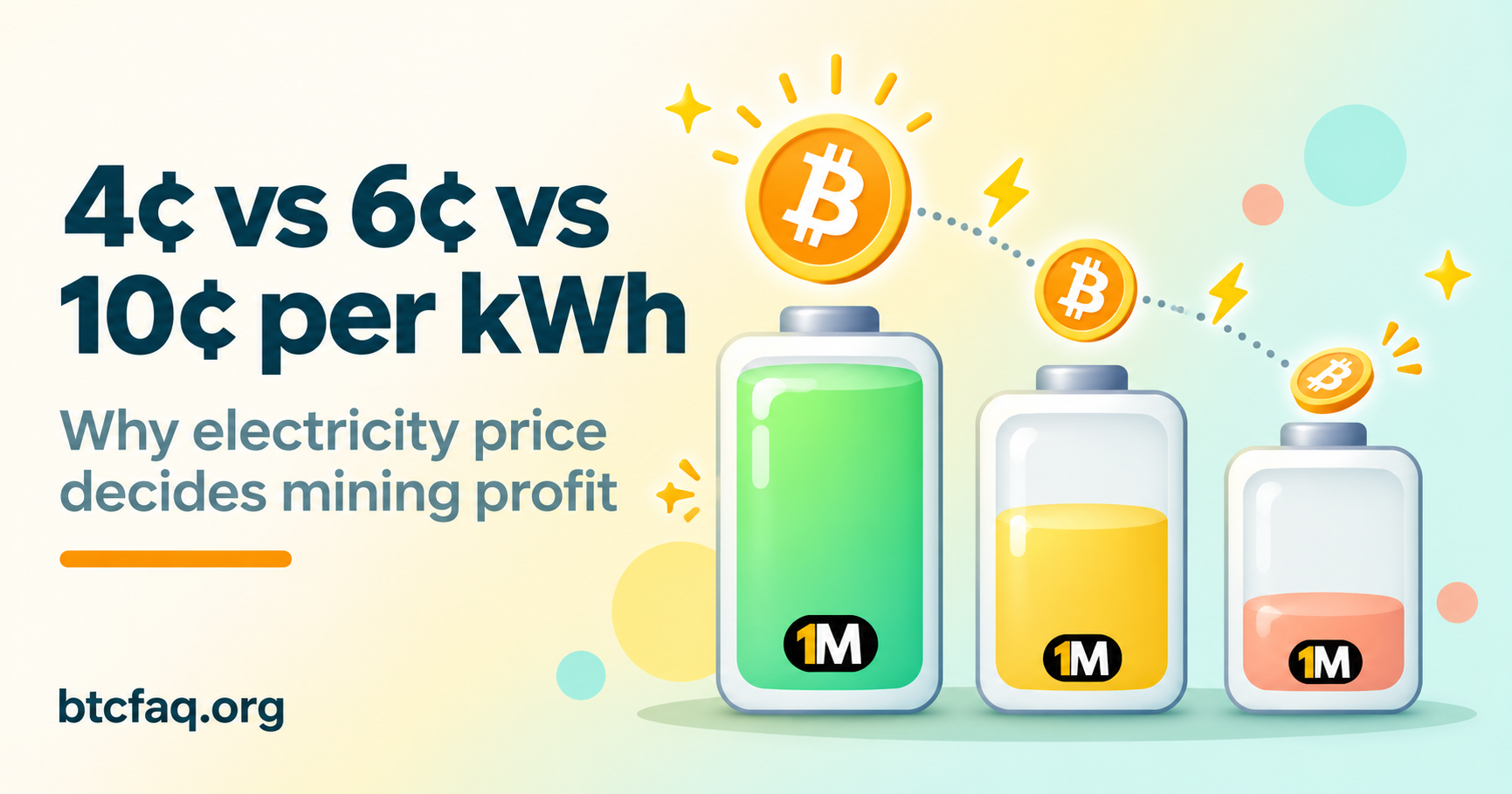
So in this guide I'm going to take one simple setup and run it three ways: at 4 cents, 6 cents and 10 cents per kWh. I'll show the math, explain where those rates actually come from, test what happens when conditions get worse, and give you my honest opinions along the way. Opinions are labeled as opinions.
This article is educational, not financial advice. Mining can lose money, and the figures here are illustrations built from 2026 snapshots. Consider speaking with a qualified professional before buying equipment.
The Short Answer
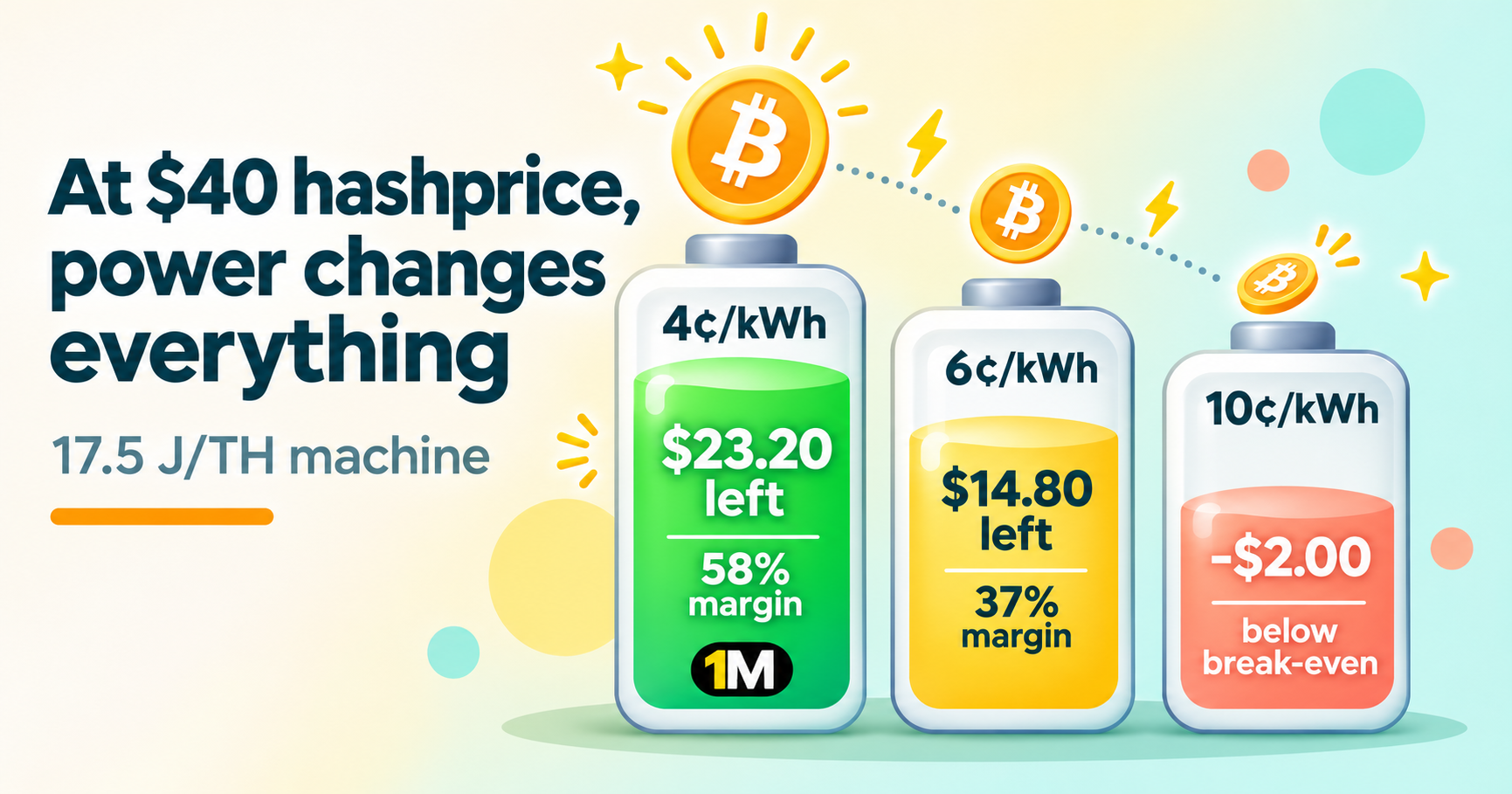
At a hashprice of $40 per petahash per day, roughly the level miners saw during the stronger September 2026 period, a 17.5 J/TH machine has very different electricity margins depending on the rate:
- • At 4¢/kWh, about 58% of gross mining revenue remains after electricity.
- • At 6¢/kWh, about 37% remains after electricity.
- • At 10¢/kWh, electricity alone costs slightly more than the machine's gross mining revenue.
Those are electricity margins, not complete profits. Pool fees, hosting terms, downtime, hardware cost, repairs, taxes and financing can reduce what ultimately remains.
Same hardware. Same hashrate. Same hashprice. The electricity rate is the variable that changes.
And when hashprice falls, the higher-cost miner reaches break-even first.
The One Formula You Need
Before the tables, one formula. Every serious source I read uses it, including Hashrate Index's piece on power breakevens and when to mine or curtail (published by Luxor, which sells mining firmware):
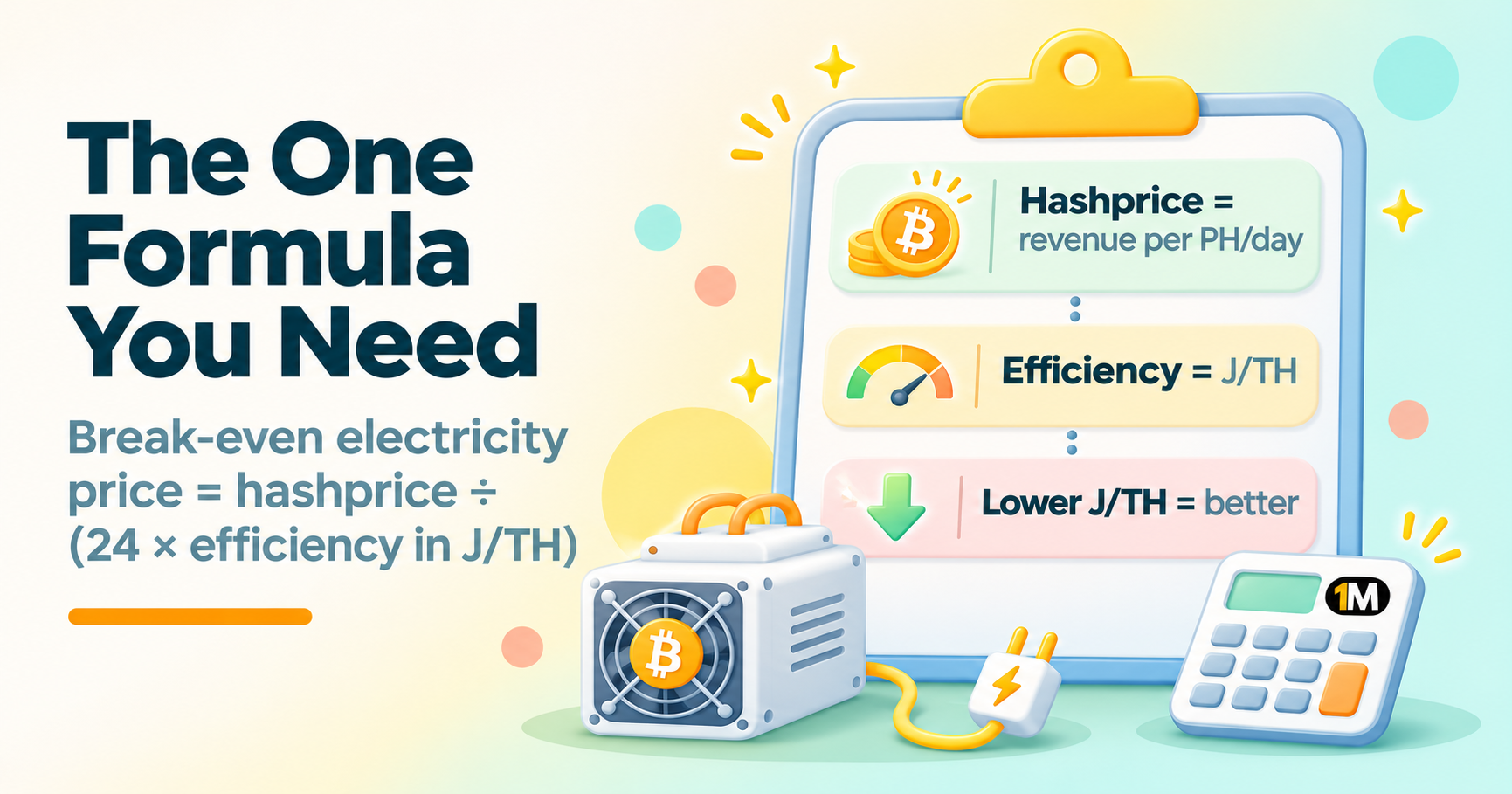
break-even electricity price ($/kWh) = hashprice ÷ (24 × efficiency in J/TH)
Let me unpack the pieces.
- • Hashprice is the revenue one petahash of computing power earns per day, in dollars. (It's the standard way to compare mining income.)
- • Efficiency (J/TH) is how many joules of energy a machine burns per terahash. Lower is better.
- • The 24 converts a per-hour figure into a per-day figure.
Hashrate Index points out that the machine's hashrate and wattage cancel out, so efficiency is the variable that matters. Its worked examples at a $40 hashprice: a 17.5 J/TH machine breaks even around $95 per megawatt-hour (9.5 cents per kWh), a 13.5 J/TH machine around $123/MWh, and an older 30 J/TH machine only around $56/MWh. The article is also careful to say these are revenue-only lines: hosting fees, labor and pool fees push the practical threshold lower.
Our Test Bench
I'm going to normalize everything to one petahash of mining power per day, because it lets us compare machines of different sizes fairly. Per petahash per day, the electricity a machine uses is simply J/TH × 24 kWh. For example, a 17.5 J/TH machine burns 17.5 × 24 = 420 kWh per petahash per day.
Here are four efficiency levels, drawn from machines mentioned in the sources: about 9.5 J/TH (the newest water-cooled models like the Antminer S23 Hyd), 13.5 J/TH (an S21 XP-class air-cooled machine), 17.5 J/TH (like Bitmain's S21 at 200 TH/s and 3,500 W, per its specification page, and 200 × 17.5 = 3,500 checks out), and 30 J/TH (an older generation).
Where Do 4¢, 6¢ and 10¢ Come From?
These are not random numbers. They represent three useful electricity-cost bands for comparing mining economics.
Around 4¢/kWh: low-cost professional hosting
OneMiners' current hosting network provides real examples in this range.
As of November 2026, its published seven-year prepaid starting rates include:
- • Nigeria — 3.6¢/kWh
- • Finland — 4.4¢/kWh
- • Norway — 4.4¢/kWh
- • Georgia, South Carolina, Houston, Texas and Kansas — 4.5¢/kWh
- • Dubai — 4.6¢/kWh
- • Canada — 4.7¢/kWh
- • Brazil and Paraguay — 4.8¢/kWh
OneMiners currently lists 17 live data centers across five continents, 1,964 MW of capacity and 98%+ average uptime, and its published location prices state that management services are included.
So the 4¢ column is a realistic low-cost hosting benchmark, although the exact rate depends on location, contract type and prepaid term.
Around 6¢/kWh: another realistic hosted-power tier
The 6¢ column also maps well to current hosting conditions.
OneMiners currently lists Ethiopia at 5.8¢/kWh on a seven-year prepaid plan and its USA “No Fees” location at 5.5¢/kWh. Some other locations and contract types also fall around or above this level.
This makes 6¢ a useful middle case: still far below many residential tariffs, but high enough to show why ASIC efficiency starts mattering much more.
Around 10¢/kWh: higher-cost commercial or low residential power
The 10¢ column is useful as a stress case for small miners running outside very low-cost industrial hosting.
Cassy Soriano's Medium article, Bitcoin Mining Revenue Hits Its Best Month Since January: Is Mining Profitable Again?, makes the same broader point: residential electricity can be much more expensive than industrial hosting, so identical mining hardware can have very different economics depending on where it runs.
The important lesson is not that 4¢, 6¢ or 10¢ is universally “good” or “bad.” It is that your real all-in electricity rate has to be compared with your machine's current break-even rate.
Older OneMiners articles may show different location prices because hosting rates and contract structures change over time. For current decisions, I would use the company's live hosting page rather than treating an older article as today's price list.
The Big Table: Electricity Margin Per Petahash Per Day
Now for the core comparison.
The table below shows gross mining revenue remaining after electricity only at a $40/PH/day hashprice. It is not a full profit calculation because it does not subtract hardware cost, pool fees, downtime, repairs, taxes or other expenses.
| Efficiency | Power cost at 4¢ | At 6¢ | At 10¢ | Electricity margin at 4¢ | At 6¢ | At 10¢ |
|---|---|---|---|---|---|---|
| 9.5 J/TH | $9.12 | $13.68 | $22.80 | $30.88 | $26.32 | $17.20 |
| 13.5 J/TH | $12.96 | $19.44 | $32.40 | $27.04 | $20.56 | $7.60 |
| 17.5 J/TH | $16.80 | $25.20 | $42.00 | $23.20 | $14.80 | −$2.00 |
| 30 J/TH | $28.80 | $43.20 | $72.00 | $11.20 | −$3.20 | −$32.00 |
All figures are arithmetic examples based on the $40/PH/day scenario.
A few things stand out.
The 9.5 J/TH miner retains a positive electricity margin even at 10¢/kWh in this particular $40 hashprice scenario. That does not guarantee overall profitability, but the machine has substantially more room for operating costs than less efficient hardware.
The 30 J/TH machine only retains a positive electricity margin at the 4¢ rate. At 6¢, electricity already exceeds its gross mining revenue.
Electricity consumes dramatically different shares of revenue. For the 9.5 J/TH miner at 4¢, electricity consumes about 23% of gross revenue. For a 17.5 J/TH miner at 10¢, electricity costs more than 100% of the mining revenue.
That is why both electricity rate and hardware efficiency matter.
What It Looks Like for Real Hardware
For an S21-class machine at 200 TH/s, 3.5 kW and 17.5 J/TH, gross mining revenue is about $8/day at a $40/PH/day hashprice.
| 4¢ | 6¢ | 10¢ | |
|---|---|---|---|
| Electricity/day | $3.36 | $5.04 | $8.40 |
| Revenue remaining after electricity | $4.64 | $2.96 | −$0.40 |
For the current Antminer S23 Hydro at 580 TH/s, 5,510 W and 9.5 J/TH, gross revenue is approximately $23.20/day in the same $40 scenario:
| 4¢ | 6¢ | 10¢ | |
|---|---|---|---|
| Electricity/day | $5.29 | $7.93 | $13.22 |
| Revenue remaining after electricity | $17.91 | $15.27 | $9.98 |
| Simple hardware-payback estimate on $12,299 | ~23 months | ~26 months | ~41 months |
OneMiners currently lists the Antminer S23 Hydro 580 TH/s at $12,299, with 5,510 W power draw and 9.5 J/TH efficiency.
The payback line is deliberately simplified. It divides the purchase price by revenue remaining after electricity and ignores pool fees, downtime, repairs, taxes, financing and other costs. It should therefore be treated as an illustrative hardware-payback scenario, not a forecast.
Stress Test 1: What If Hashprice Falls?
This test is especially relevant now.
As of November 5, 2026, Hashrate Index reports spot hashprice around $34.18/PH/day, so the $34 scenario below is very close to current market conditions.
At roughly $34/PH/day:
| Efficiency | Electricity margin at 4¢ | At 6¢ | At 10¢ |
|---|---|---|---|
| 9.5 J/TH | $24.88 | $20.32 | $11.20 |
| 13.5 J/TH | $21.04 | $14.56 | $1.60 |
| 17.5 J/TH | $17.20 | $8.80 | −$8.00 |
| 30 J/TH | $5.20 | −$9.20 | −$38.00 |
The higher the electricity rate, the sooner falling hashprice eliminates the remaining margin.
Stress Test 2: What If the Block Subsidy Is Halved?
Bitcoin's next halving is expected in 2028. The exact date depends on block production; current estimates place it around April 2028.
The halving reduces the block subsidy from 3.125 BTC to 1.5625 BTC. Transaction fees are not halved, so total miner revenue does not automatically fall by exactly 50%.
However, fees currently represent only a small share of block rewards, so using a $20/PH/day hashprice as a simplified stress test from a $40 starting point is reasonable for illustrating the risk.
| Efficiency | Electricity margin at 4¢ | At 6¢ | At 10¢ |
|---|---|---|---|
| 9.5 J/TH | $10.88 | $6.32 | −$2.80 |
| 13.5 J/TH | $7.04 | $0.56 | −$12.40 |
| 17.5 J/TH | $3.20 | −$5.20 | −$22.00 |
| 30 J/TH | −$8.80 | −$23.20 | −$52.00 |
The lesson is not that these numbers predict 2028. Bitcoin price, transaction fees, difficulty and hardware efficiency will all change.
The useful lesson is that lower electricity costs create more room to survive weaker mining conditions.
Why the Gap Is Bigger Than It Looks
Let me say something that I think gets lost in the percentage talk. The difference between 4 and 10 cents is six cents. On one 3.5 kW machine, that's about $1,840 a year. On a hundred machines, it's $184,000 a year. A "small" electricity difference compounds in two ways:
- • It scales with fleet size. Every machine you add multiplies the gap.
- • It never goes away. Hardware gets cheaper over time; the electricity bill arrives every month for as long as the machine runs.
OneMiners' April article gives an illustrative version of this: it claims moving from a US home rate to its Nigeria rate saves about $200 per machine per month, which would be $2,000 a month at ten machines and $10,000 at fifty. (Its numbers are labeled illustrative and based on a different model than its other articles, but the logic is the right one.)
How Miners Actually Get the Rate Down
If electricity is the whole game, the obvious question is how to bring the rate down. OneMiners' cost-reduction article lays out seven levers: efficient hardware, better cooling, undervolting and firmware tuning, off-peak tariffs and demand response, renewable co-location, relocating to cheaper regions, and locking a low fixed industrial rate. It rates the last one as the most important, and claims efficiency upgrades can cut a fleet's power bill by up to 70% versus legacy hardware, with cooling and undervolting saving 10% to 20%. Those percentages are the company's own and unsourced, but the list of levers is sensible.
Two of them deserve a closer look.
Efficiency Reduces How Much Electricity Each Terahash Needs
There are two separate ways to reduce the electricity burden of mining:
- 1. Pay less for each kWh.
- 2. Use fewer kWh for each unit of hashrate.
The first comes from a lower electricity rate. The second comes from better ASIC efficiency.
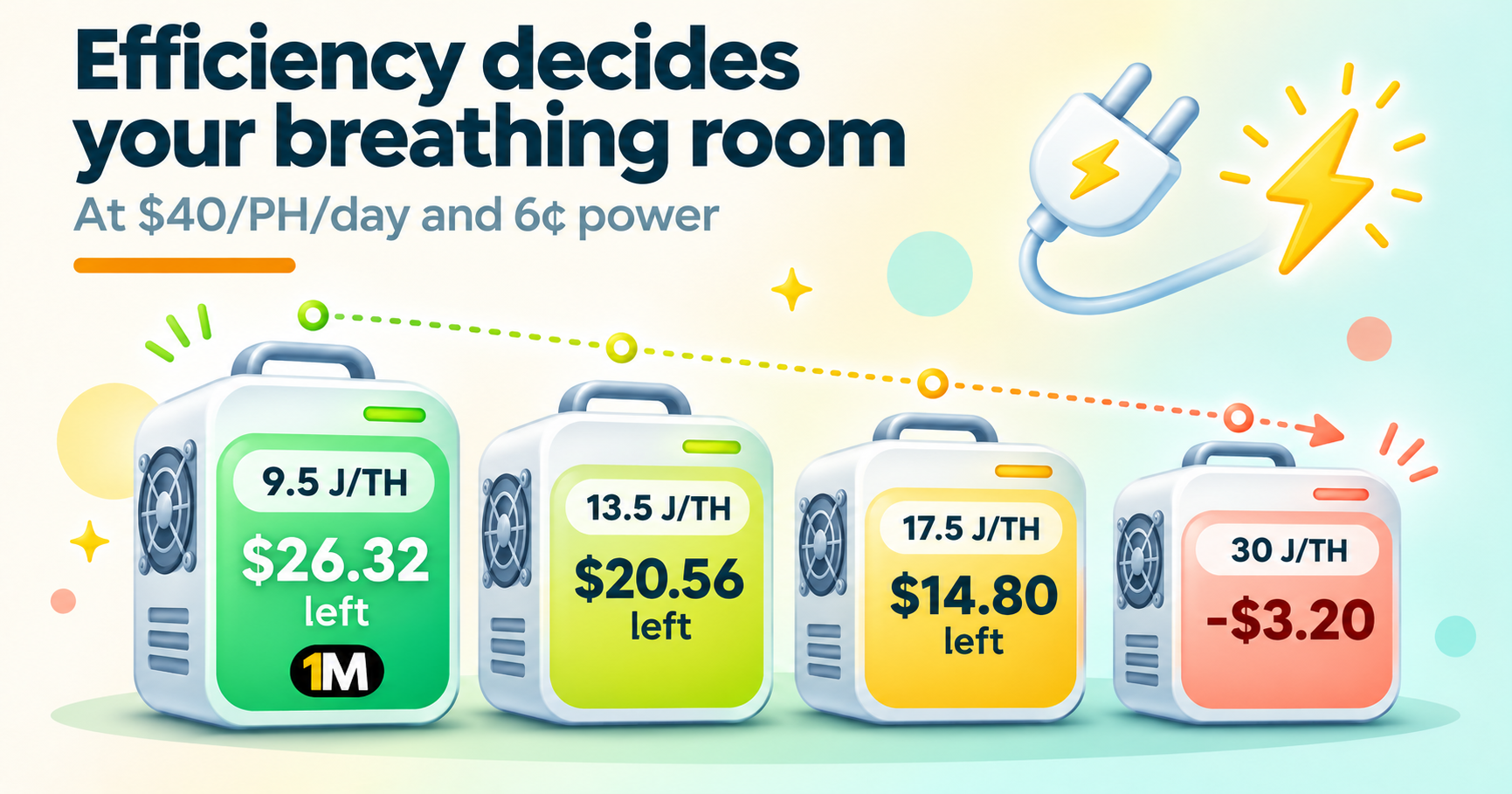
For example, at a $40/PH/day hashprice and 6¢ electricity, our 17.5 J/TH machine leaves about $14.80/PH/day after electricity, while the 9.5 J/TH machine leaves about $26.32/PH/day.
Alternatively, lowering the electricity rate for the 17.5 J/TH machine from 6¢ to 4¢ raises its electricity margin from $14.80 to $23.20/PH/day.
Both improvements are powerful, but they are not the same thing. Efficiency reduces energy consumption per terahash; cheaper hosting reduces what each kilowatt-hour costs.
Cassy Soriano's Medium article, Best ASIC Miners to Consider Before 2027: Are Newer Machines Worth the Upgrade?, uses exactly this framework.
Its central point is that newer hardware is worth considering when the efficiency improvement produces a meaningful additional margin at the electricity rate you actually pay. The article compares a 17.5 J/TH machine with a more efficient model and shows how the newer hardware keeps a higher break-even electricity rate when hashprice falls.
That is the right way to think about an upgrade: compare the additional margin with the net cost of replacing your current machine, rather than assuming newer automatically means better.
Locking In a Fixed Rate
The other major lever is electricity pricing itself.
Cassy Soriano's Prepaid Energy: How to Lock In a Discounted Power Rate provides a historical Finland example where a longer prepaid term reduced the rate from 6.5¢/kWh to 4.55¢/kWh.
OneMiners' current live hosting page shows the same basic model across its network: customers can choose between different locations and contract structures, with long-term prepaid rates generally lower than shorter or non-prepaid options.
For example, the current Nigeria listing starts at 3.6¢/kWh on a seven-year prepaid term, while online-ordered miners are listed at 5.2¢ and external miners at 5.7¢. Several U.S. facilities currently start at 4.5¢/kWh on the seven-year option.
That price certainty can be useful because electricity is one of the largest recurring mining costs.
A long prepaid term still deserves careful consideration. It commits capital upfront and assumes you expect to continue mining for a meaningful part of that period. Before choosing one, review what is included, how the energy balance is handled and what options exist if your hardware or plans change.
The positive side is straightforward: locking in a lower rate protects you from some electricity-price uncertainty while better hardware protects you from some efficiency risk. Used together, those are two of the strongest variables a miner can control.
Operating smarter once the rate is set
Once you have a rate, Hashrate Index has a useful point: don't treat break-even as a fixed number. Recalculate against current hashprice, and when power spikes, consider underclocking to a more efficient performance profile rather than shutting off entirely. Lower profiles improve J/TH, which raises your break-even. Full curtailment is best for sharp spikes. In other words, flexibility is itself a way of managing the electricity price.
Plan in Scenarios, Not in Hopes
One more tool, and it's an unglamorous one. Braiins' guide to Bitcoin mining profitability methodology (published in 2022, promoting its own calculator, so it's both dated and commercial) is useful for its framework. It treats profitability as a list of inputs: Bitcoin price, difficulty, annual changes in each, electricity cost, pool and hosting fees, upfront and ongoing costs, and how much mined bitcoin you hold versus sell. And it treats price and difficulty trends as scenarios you supply, not forecasts, so you can model bullish and bearish cases.
That's exactly what the three tables above did: base case, weaker hashprice, and halving stress. A good rule: if the machine only works in the base case, it's a bet, not a plan.
Six Honest Opinions
1. Electricity price is the business. Hardware is a detail. Most beginners spend 90% of their research on which machine to buy and 10% on power. It should be the reverse. A great machine on a bad rate is a bad business; an average machine on a great rate can be a good one.
2. Judge a setup by how much of your revenue the power bill eats. At $40 hashprice, 23% means a comfortable cushion and 63% means one bad month away from trouble. My personal rule of thumb (opinion, not a law): below roughly half is where I'd feel okay; above that, I'd want a very good reason.
3. Ten cents is not "expensive" to a household and not "cheap" to a miner. This trips people up. Ten cents per kWh is a fine residential rate in many places. For mining it's already on the edge, even with good machines. If someone tells you mining at home at 10 cents "can work," run the table.
4. Be skeptical of any single low rate quoted without contract terms. A rate is only as good as its terms: how long it's fixed, what fees sit on top, what happens if the host closes, and who bears the cost if power is curtailed. The April "cheapest" article gives rates without any of that, and two OneMiners pages disagree on Nigeria's rate. I'm not saying the rates are wrong; I'm saying a number without terms isn't a quote.
5. Prepaying for seven years is a bet on the host as much as on power. A 30% discount sounds irresistible, but it ties up cash and makes you a creditor of one company. The Cassys article itself calls the plan "not free money." I'd only consider it with a host whose financials and contract I could actually read.
6. Test everything at a lower hashprice than today's. In the 2026 data above, hashprice swung from about $32 to nearly $40 and back toward $34 inside a few months. If a plan needs today's number to hold, it's fragile.
A Practical Checklist
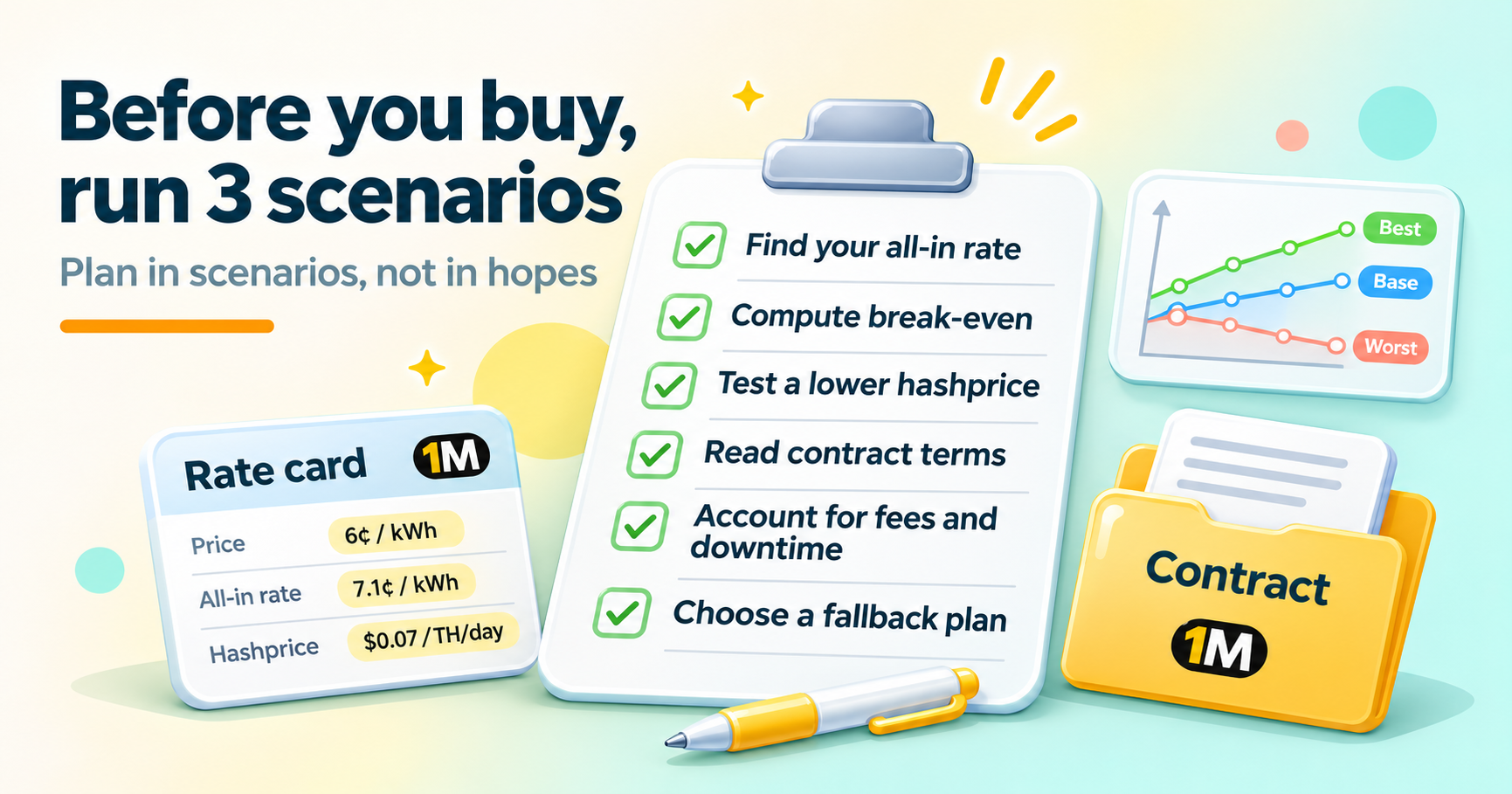
- • Find your all-in rate, including hosting fees, taxes and any minimum charges. Not just the headline kWh price.
- • Compute your break-even with the formula: hashprice ÷ (24 × J/TH).
- • Check your safety margin: the gap between your rate and your break-even.
- • Run three cases: today's hashprice, a 15% to 30% lower hashprice, and a post-halving case.
- • Read the contract: how long is the rate fixed, what's included, what are the uptime terms, what happens on closure or curtailment?
- • Account for everything else: hardware cost, pool fees, cooling, wiring, downtime, and taxes.
- • Decide what you'd do if it goes wrong: switch off, underclock, sell the machine, or move.
A Note on Sources
For transparency: OneMiners and Cassys are affiliated, and the company sells mining hardware and hosting, so those pieces include product promotion, discount codes and calls to action. Hashrate Index is owned by Luxor, which sells firmware and related services. Braiins sells mining products and a calculator. Bitmain's page is a manufacturer's spec sheet. Their explanations of hashprice, break-even and efficiency agree, which gives me confidence in the mechanics. Their hosting rates, savings percentages and "cheapest in the world" claims are vendor claims, and the specifics change often, so verify them yourself before signing anything.
Common Misconceptions
"A few cents per kWh can't matter that much." At mining scale it's the difference between profit and loss. On a single 3.5 kW machine, six cents is roughly $1,840 a year.
"If I buy the newest machine, electricity won't matter." It matters less, not zero. At 10 cents and a post-halving-style hashprice, even the most efficient machine in the table loses money.
"A cheap rate guarantees profit." It improves your odds. Difficulty, price, fees, uptime and the contract terms still matter.
"Break-even is a fixed number." It moves with hashprice every day.
"Old machines are worthless." They can still work at very low rates. They just run out of margin first when hashprice falls.
"The advertised rate is what I'll pay." Check for fees on top, minimums, and what's included.
Frequently Asked Questions
How much does electricity price affect Bitcoin mining profit? A great deal. In our example, the same 17.5 J/TH machine earns about $23.20 per petahash per day at 4 cents, $14.80 at 6 cents, and loses $2.00 at 10 cents, at a $40 hashprice.
What is a good electricity price for Bitcoin mining? Lower is better. OneMiners' cost-reduction article says profitability is most reliable below about 5 cents per kWh and that home mining is viable only below roughly 10 to 12 cents. Those are vendor opinions, so run your own numbers.
What is the break-even electricity price? Hashprice divided by (24 × the machine's efficiency in J/TH). It's the most you can pay per kWh before the machine loses money on power alone.
Can I mine profitably at 10 cents per kWh? Only with very efficient hardware and a healthy hashprice. In our $40 case, a 9.5 J/TH machine still profits at 10 cents, while a 17.5 J/TH machine does not. At a lower hashprice, margins shrink quickly.
Is 4 cents per kWh realistic? Some hosting companies advertise rates around that level, usually with long fixed terms and in particular locations. Treat advertised rates as claims and check the contract.
How does the halving change the picture? The 2028 halving will reduce Bitcoin's block subsidy from 3.125 BTC to 1.5625 BTC. Transaction fees are not halved, so miner revenue will not necessarily fall by exactly 50%. If fees remain a small share of rewards and other conditions stay unchanged, however, the impact could be close to that level.
Should I prepay for electricity? It can lower your rate by about 30% on a long term, but it ties up cash and depends on the host. Read the contract and run your numbers first.
How do I reduce my mining electricity cost? Seven main levers are cited: efficient hardware, better cooling, undervolting, off-peak tariffs, renewable co-location, cheaper regions and fixed industrial rates.
Is it better to upgrade my miner or find cheaper power? Both can help. In our table, a more efficient machine at 6 cents earns more per petahash than an older machine at 4 cents, but a new machine costs thousands of dollars. Compare the payback.
Final Thoughts
Strip away the jargon and Bitcoin mining is a business built around a spread: the value of the bitcoin your hashrate produces versus the cost of operating the hardware.
Electricity price is one of the biggest parts of that spread.
At 4¢/kWh, many modern ASICs have substantial electricity margin under the scenarios in this article. At 6¢, efficiency matters much more. At 10¢, even reasonably efficient hardware can quickly become marginal when hashprice falls.
That is also where professional hosting can make sense. OneMiners' current network provides published electricity options starting around 3.6¢/kWh, management services included in its listed location pricing, and facilities designed to handle the power, cooling and monitoring requirements of ASIC hardware.
For someone who cannot access comparable industrial electricity at home, an integrated hardware-and-hosting setup can remove several practical barriers at once.
It does not guarantee mining profit. Bitcoin price, hashprice and difficulty will continue to change.
But those market variables are largely outside your control. Your hardware efficiency, electricity rate, hosting terms and uptime are variables you can actually evaluate before you commit.
So get the real all-in rate, calculate your break-even, test the machine at several hashprices, compare current hardware efficiency and read the hosting terms carefully.
A few cents per kilowatt-hour can look insignificant on paper. At mining scale, they can define the entire economics of the machine.