Ask a hundred people what a Bitcoin miner is, and a good number will picture a laptop quietly running in a bedroom. Ask how much electricity it uses and you'll get wildly different guesses, from "about the same as a light bulb" to "as much as a small country."
The truth lives in the middle, and it depends on what you mean by "a miner." One machine? A hosting site? The entire network? Those are three very different numbers, and mixing them up is the source of most of the confusion.
In this guide I'll walk through all three levels: how much power one machine draws, what that costs you at different electricity prices, and what we know (and don't know) about the whole network. I'll also share some opinions along the way, clearly labeled.
This article is educational, not financial advice. Mining can lose money, and electricity prices, hardware and Bitcoin's price change often. Consider speaking with a qualified professional before buying equipment.
The Short Answer
A modern industrial Bitcoin mining machine (an ASIC miner) typically draws somewhere between about 3,000 and 5,500 watts, running around the clock. That works out to roughly 72 to 130 kilowatt-hours (kWh) per day, or about 2,200 to 4,000 kWh per month. By OneMiners' reckoning, a top-end water-cooled machine uses around 4.3 times as much electricity as the average US household.
If that sounds like a lot, it is. And it's the reason the single most important number in mining isn't the price of the machine. It's the price you pay per kWh.
First, Let's Fix the Watts vs kWh Confusion
This trips up almost everyone, including some of the articles I read while researching this one. (OneMiners' own summary refers to "3.0 kilowatts per hour," which mixes the units.) So let's get it straight in two lines:
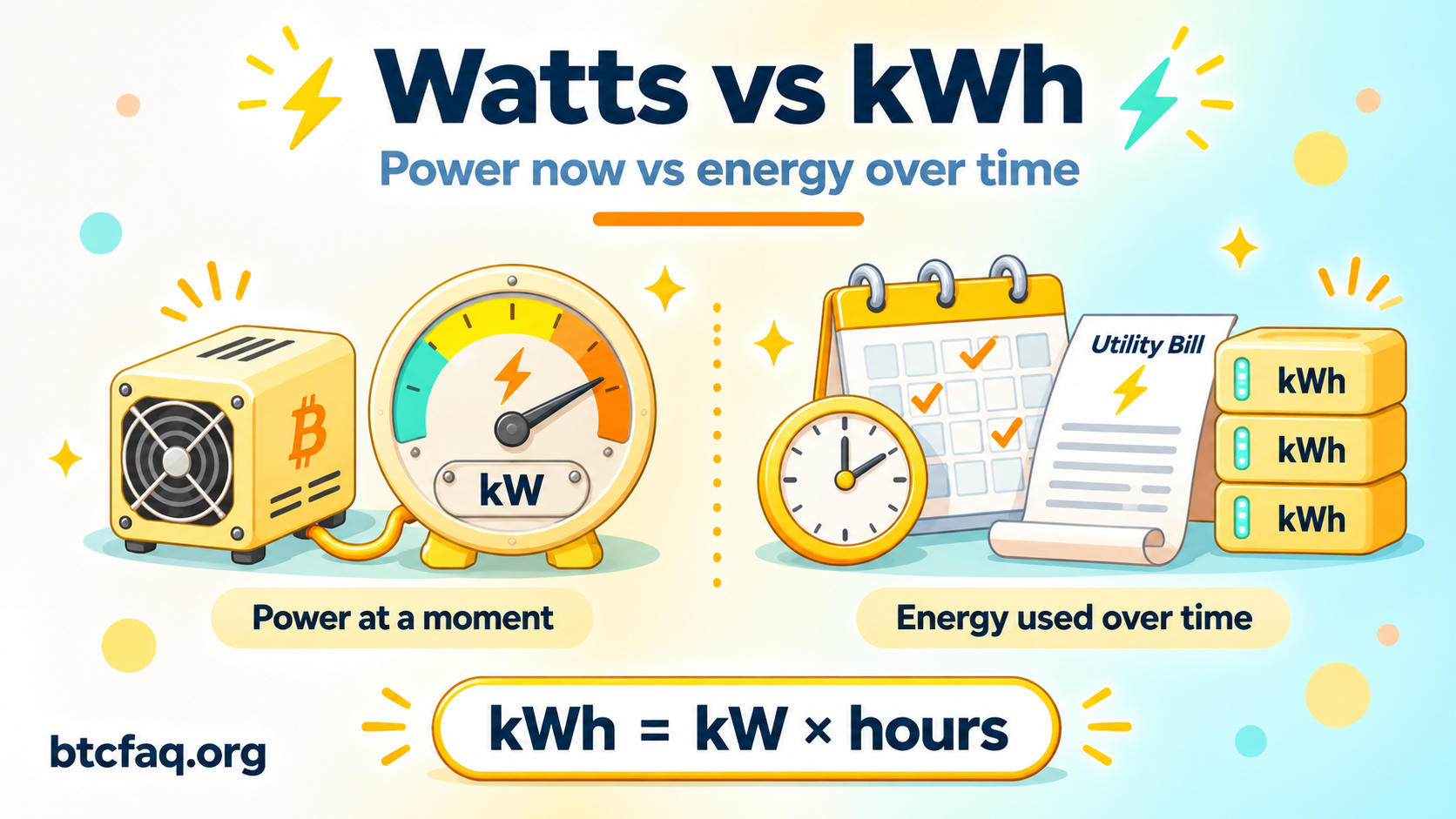
- • Watts (W) or kilowatts (kW) measure power: how fast a machine is using energy at any moment.
- • Kilowatt-hours (kWh) measure energy used over time, which is what your electricity bill charges for.
The formula: kWh = kW × hours. A 3.5 kW machine running for 24 hours uses 3.5 × 24 = 84 kWh. Multiply by your price per kWh and you have your daily bill.
How Much Power Does One Machine Use?
Bitcoin miners are usually compared using two numbers: hashrate, which measures how much computing work the miner performs, and efficiency, usually measured in joules per terahash (J/TH).
A useful approximation is:
Power in watts ≈ hashrate in TH/s × efficiency in J/TH
For example, Bitmain's official Antminer S21 specification lists the standard S21 at 200 TH/s, 3,500 W and 17.5 J/TH. Multiplying 200 × 17.5 gives 3,500 W.
Here are several common machines to show the scale involved:
| Model | Approx. power draw | Efficiency | Hashrate | Approx. energy/day |
|---|---|---|---|---|
| Antminer S19 Pro | ~3.25 kW | ~29.5 J/TH | ~110 TH/s | ~78 kWh |
| Antminer S19 XP | ~3.0 kW | ~21.5 J/TH | ~140–141 TH/s | ~72–73 kWh |
| WhatsMiner M50S | ~3.4 kW | ~26 J/TH | ~130 TH/s | ~82 kWh |
| Antminer S21 | 3.50 kW | 17.5 J/TH | 200 TH/s | 84 kWh |
| Antminer S21 XP | ~3.65–3.7 kW | ~13.5 J/TH | ~270 TH/s | ~88 kWh |
| Antminer S21 XP Hydro | 5.676 kW | 12.0 J/TH | 473 TH/s | ~136 kWh |
| Antminer S23 Hydro | 5.510 kW | 9.5 J/TH | 580 TH/s | ~132 kWh |
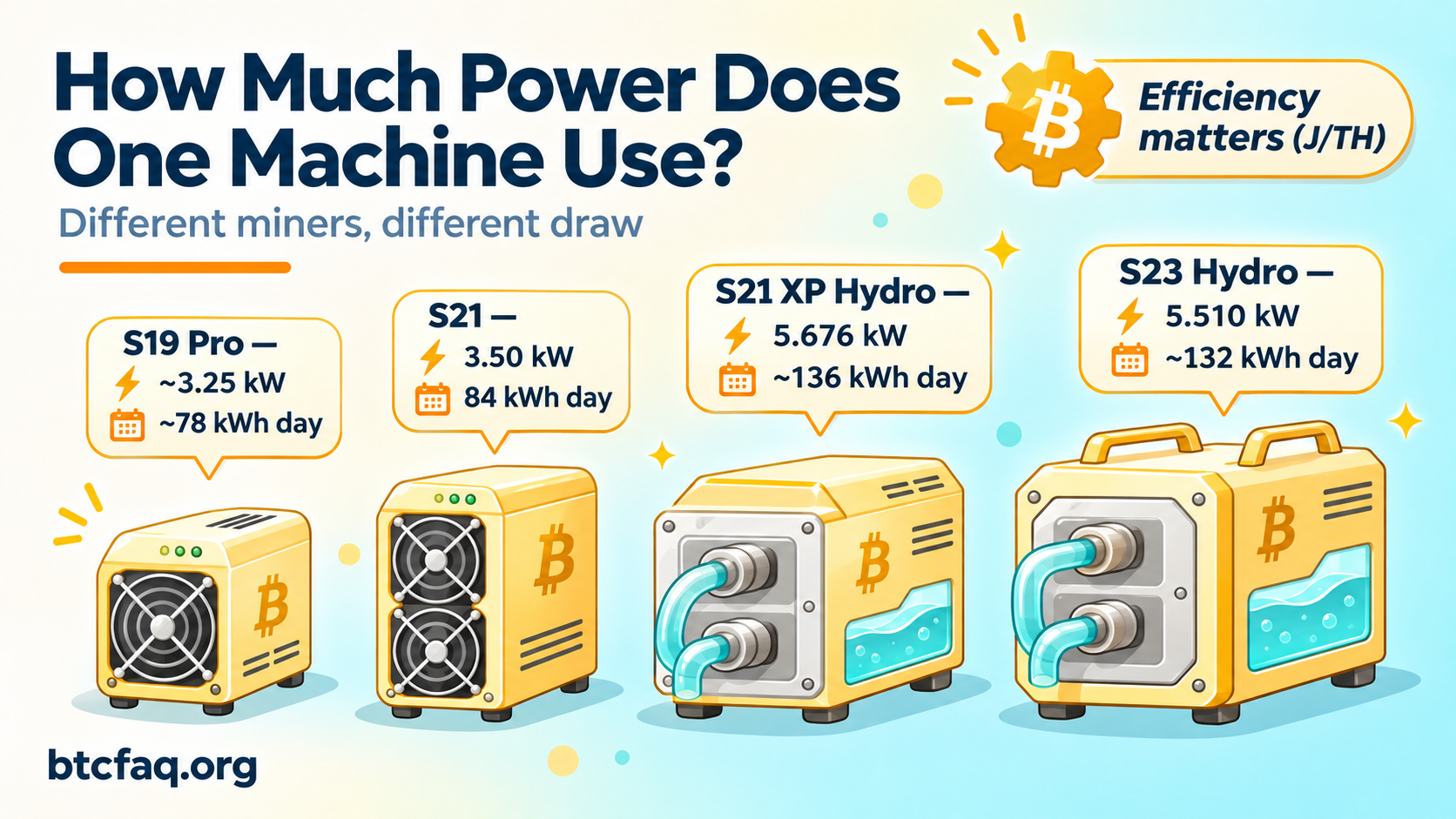
The important trend is not that every new miner uses less total electricity. Many newer ASICs actually draw more watts per machine because they also produce far more hashrate.
What has improved dramatically is energy efficiency.
For example, an S19 Pro produces roughly 110 TH/s while drawing about 3.25 kW. The current S23 Hydro produces 580 TH/s while drawing about 5.51 kW. That is more than five times the hashrate for less than twice the electrical draw.
This is why J/TH matters so much. New-generation hardware does more mining work from every kilowatt-hour you buy.
OneMiners' May 2026 electricity guide is still useful for understanding the basic relationship between power draw, efficiency and electricity cost, but some hardware specifications in its comparison table are now outdated. For current models, I would use the manufacturer's technical sheet first.
Bitmain currently lists the S21 XP Hydro at 473 TH/s, 5,676 W and 12 J/TH, while the current S23 Hydro is 580 TH/s, 5,510 W and 9.5 J/TH.
OneMiners' current Antminer S23 Hydro 580 TH/s page now uses the same 580 TH/s, 5,510 W and 9.5 J/TH specifications as Bitmain.
Can you just plug it into a wall socket?
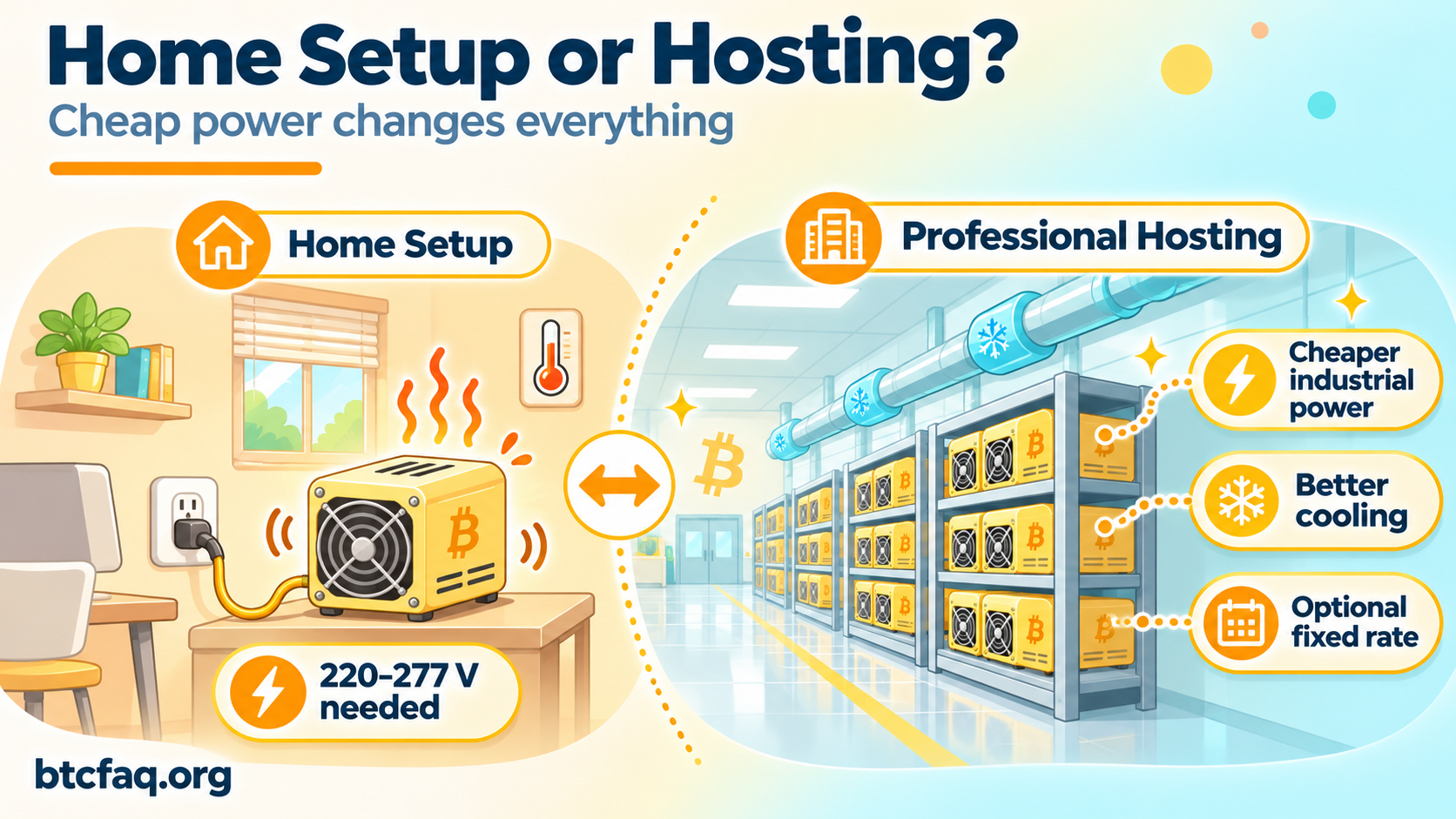
Not from a typical 120 V household outlet. Full-size ASICs generally require a dedicated high-voltage circuit, and hydro models can require much more specialized electrical and cooling infrastructure. The Bitmain page lists the S21's input voltage as 220 to 277 V AC at 20 A. A standard household 120 V circuit isn't designed for a load like this, so you'd typically need dedicated wiring. The page also warns that the wrong input voltage may damage the miner, lists an operating temperature range of 0 to 45°C, and, notably, does not list noise or cooling method. For the electrical side, talk to a licensed electrician before you plug in anything of this size.
The S23 Hydro, for example, requires 380–415 V three-phase power plus a compatible coolant loop, which is one reason professional hosting is practical for buyers who do not already operate mining infrastructure. Bitmain lists those requirements directly, and OneMiners offers hosting for the same 580 TH/s model.
What Does That Electricity Cost?
This is where electricity efficiency becomes real money.
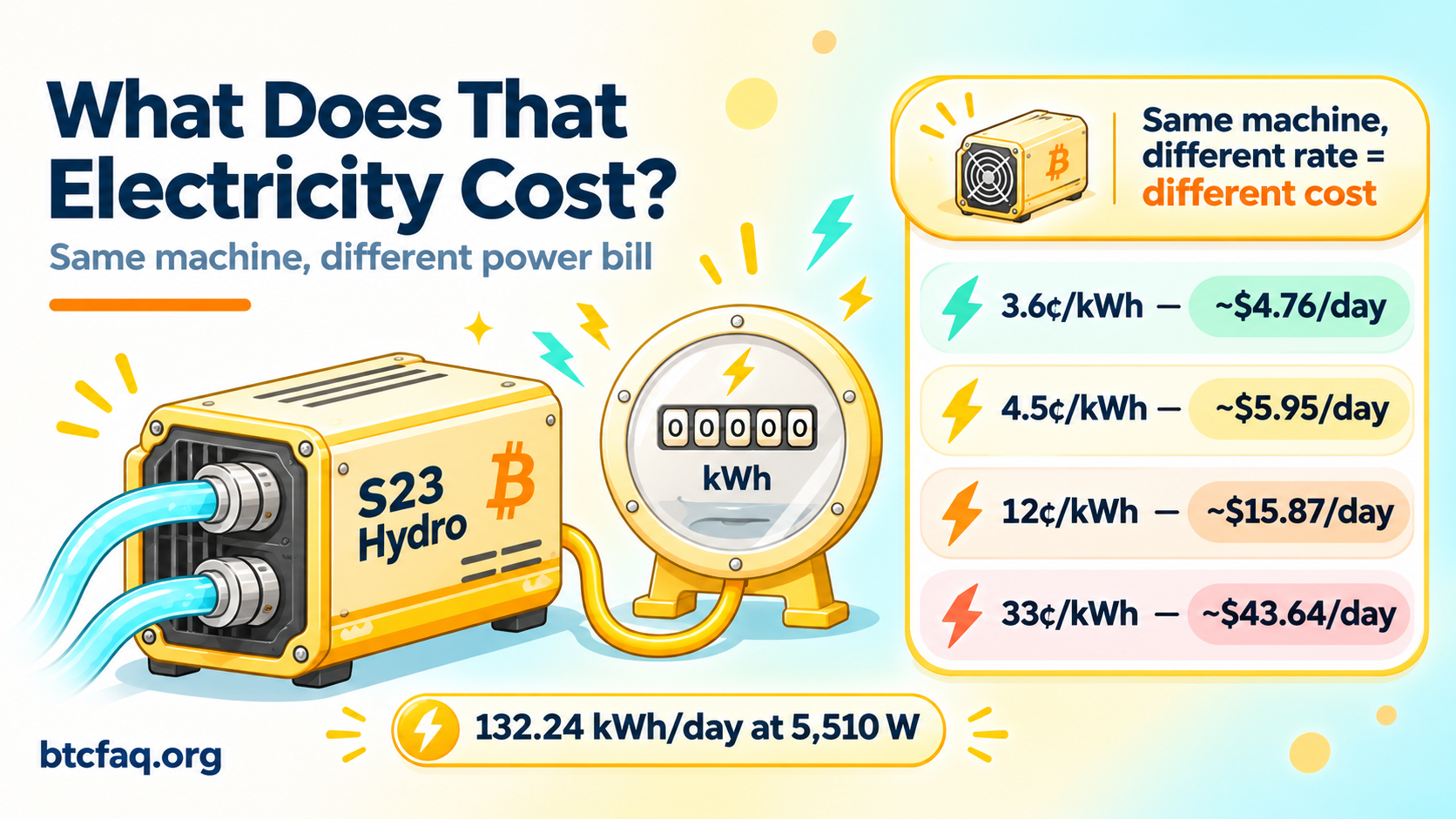
Let's use the current Antminer S23 Hydro 580 TH/s as an example. Bitmain rates it at 5,510 W, so a machine running continuously uses:
5.51 kW × 24 hours = 132.24 kWh per day
Over a full year, that is roughly 48,268 kWh.
The machine uses the same electricity wherever you put it. What changes dramatically is what that electricity costs.
| Electricity rate | Approx. cost/day | Approx. cost/year | Example |
|---|---|---|---|
| 3.6¢/kWh | ~$4.76 | ~$1,738 | OneMiners Nigeria, current seven-year prepaid starting rate |
| 4.5¢/kWh | ~$5.95 | ~$2,172 | Several OneMiners U.S. sites on seven-year prepaid terms |
| 7¢/kWh | ~$9.26 | ~$3,379 | Illustrative low-cost electricity example |
| 12¢/kWh | ~$15.87 | ~$5,792 | Illustrative residential-rate example |
| 33¢/kWh | ~$43.64 | ~$15,928 | Illustrative high-cost electricity example |
The 7¢, 12¢ and 33¢ figures are examples for comparison, not claims about a universal regional electricity price.
Same machine. Same 580 TH/s. Same 132 kWh per day.
At 3.6¢/kWh, annual electricity is roughly $1,738. At 12¢, it rises to almost $5,800. At 33¢, it is nearly $16,000 per year.
That difference is why electricity price can matter more to a miner than a small difference in hardware purchase price.
OneMiners' current hosting network is relevant here because it publishes location-specific electricity rates rather than one universal hosting price. Its current page lists 17 live facilities across five continents, with seven-year prepaid rates starting around 3.6¢/kWh in Nigeria and several U.S. locations starting around 4.5¢/kWh. Published location pricing includes management services.
The same principle appears in Cassy Soriano's Bitcoin Mining Revenue Hits Its Best Month Since January. The article makes an important distinction: mining revenue is a gross number, while electricity is one of the main costs that determines what remains afterward.
Its simpler example still works well conceptually: a 3.3 kW machine uses about 79 kWh per day. At 6¢/kWh, that is roughly $4.75 in daily electricity; at 12¢, it is roughly $9.50.
So Why Does Mining Use So Much Electricity?
Because that's how Bitcoin's security works. Mining is a competition to guess a number, and the guessing takes energy. In OneMiners' step-by-step walkthrough of Bitcoin mining, miners repeatedly hash a block's header, changing a nonce each time, until the result falls below the network's target. There's no shortcut and no clever trick: more guesses per second means a better chance to win, and more guesses per second means more electricity.
And that's not a bug. It's the point. The cost of that energy is exactly what makes the network expensive to attack. (Our guides on hashrate and mining difficulty explain how the network keeps this balanced.)
What About the Whole Network?
Now the big one. How much electricity does all of Bitcoin mining use?
Here's the honest answer: nobody knows exactly, and anyone who gives you a single precise number is simplifying. Mining happens in thousands of locations, on a mix of old and new machines, at different power prices, and there's no central meter.
What researchers do is estimate it. The most widely cited academic effort is the Cambridge Bitcoin Electricity Consumption Index, and its methodology page is worth reading precisely because it's so upfront about the uncertainty. The index, published by the University of Cambridge's Centre for Alternative Finance, doesn't give one number. It gives three:
- • Lower bound: a theoretical minimum that assumes every miner always runs the most efficient hardware available and upgrades immediately, with very low facility overhead (a PUE of 1.01). The authors themselves call this non-viable in practice.
- • Best guess: assumes miners run a weighted mix of profitable hardware, with newer machines weighted more heavily, and a facility overhead of 1.10. This is the authors' preferred estimate.
- • Upper bound: a theoretical maximum assuming every miner uses the least efficient hardware that's still profitable, with an overhead of 1.20. Also called non-viable by the authors.
The method assumes miners are rational and only run machines that are profitable at an assumed global average electricity price of $0.05/kWh, which users can change. The authors list limitations openly: results are sensitive to that price assumption, maintenance and cooling aren't modeled, the real hardware mix is unknown, and miners may not react quickly to changing profitability.
That same page compares other studies, and the spread is revealing. It lists Digiconomist's live estimate at about 204 TWh a year, CoinMetrics at about 117 TWh (June 2023), a 2022 academic estimate at about 117 TWh, and an earlier 2019 study at about 31 TWh. Different methods, different dates, different answers.
A back-of-the-envelope version
You can do your own rough estimate, and it's a good way to understand why the numbers vary. Network power is simply hashrate times the average efficiency of the machines in use. OneMiners' May article does exactly this: it assumes about 700 EH/s at 25 J/TH, giving roughly 17.5 GW of continuous draw. (That 700 EH/s was a lower hashrate than the roughly 1,000 to 1,069 EH/s reported by October 2026, and 25 J/TH is a guess at the fleet average.)
To show how sensitive this is, here's my own illustrative arithmetic, not an estimate from any study. If the network runs at 1,000 EH/s and the average machine in use is around 20 J/TH, you get about 20 GW. Running for a full year, that's roughly 175 TWh. Change the assumed average efficiency to 15 J/TH and the answer drops by a quarter. Since nobody knows the real fleet average, you get a range, which is exactly why Cambridge publishes one.
Where Does Mining Get Its Power?
The other big question is whether the energy is "wasted." Opinions differ, and that's partly a values question. But there's a factual part worth looking at.
OneMiners' September 2026 article Where Bitcoin Mining Gets Its Power highlights several types of energy that can be attractive to miners, including remote hydro, geothermal resources, otherwise-curtailed wind and solar generation, seasonal hydro surplus, off-peak baseload and some stranded gas resources. It also emphasizes mining's ability to operate as a flexible load that can shut down quickly during periods of high grid demand.
Those are legitimate use cases, but the article does not establish that most global Bitcoin mining uses energy that nobody else could use. It does not provide an independently verified industry-wide percentage for stranded or renewable energy. I would therefore treat it as a useful explanation of where mining can fit into energy systems, rather than proof that all—or even most—Bitcoin electricity would otherwise be wasted.
That's a real and interesting argument. But notice what the article does not give: an industry-wide percentage for how much mining runs on renewables or stranded energy. It says only that a "substantial share" does. The article's author runs a mining-hosting company, so this is also partly a sales pitch. I think the flexible-load idea is legitimate and worth taking seriously, but the claim that all mining uses "the electricity nobody else can use" is a generalization I'd want evidence for before repeating.
How Do Miners Cut the Bill?
Since electricity is the biggest cost (the sources put it at roughly 70% to 85% of lifetime cost), most of the creativity in this industry goes into cheaper power. The main routes:
- 1. Better hardware. More efficient machines do more work per kWh.
- 2. Hosting. You put your machine in a facility with cheaper industrial power, rather than running it at home.
- 3. Locking in a rate. Some hosts let you prepay for a fixed rate.
That last one deserves a look, because it's become a big selling point. Cassys' article Prepaid Energy: How to Lock In a Discounted Power Rate (July 2026) gives an example for one machine at a Finland site, using a historical Finland example where the base rate was 6.5 cents per kWh. A one-year lock-in brings it to 6.24 cents, three years to 5.72 cents, and seven years to 4.55 cents, about 30% less. Over seven years it works out to roughly $7,578 instead of $10,825, a claimed saving of about $3,248. (I checked the sums, and they hold up.)
OneMiners' explainer on its 7-year fixed electricity rate (October 2026) offers a similar structure using a Nigeria site: 5.2 cents pay-as-you-go, 4.9 cents for one year, 4.5 cents for three, and 3.6 cents for seven, roughly 30% off. For an Antminer S21 Pro at 3,675 W, it calculates about 88.2 kWh a day, 225,351 kWh over seven years, and a bill of $11,718 at 5.2 cents versus $8,113 at 3.6 cents. (Again, I rechecked: 3.675 kW × 24 hours = 88.2 kWh, and the totals follow.)
My honest take on prepaying (opinion)
On paper, a 30% discount is attractive. But I'd think hard before prepaying for seven years of anything in mining, for three reasons.
- • It locks up cash. Both articles are candid about this. Cassys calls the plan "not free money" and notes that you're tying up capital that could go to hardware, repairs or a reserve.
- • The savings are measured against the seller's own pay-as-you-go rate, which is also set by the seller and isn't fixed. A discount from a number the company controls is a different thing from a saving against an independent market price.
- • It only pays off if everything holds for seven years: the machine keeps running, the site stays open, the host stays solvent, and Bitcoin mining stays worth doing. Neither article describes refund or cancellation terms, and you're taking on exposure to a single company.
That doesn't make it a bad deal for everyone. If you're sure you'll run a machine for years at one site, and you've read the contract, it can make sense. I just wouldn't let a headline percentage do the thinking for me.
Five Opinions I'll Stand Behind
1. The "mining uses as much power as a country" line is true and not very useful. Yes, it's a large number. But the number doesn't tell you whether the energy is wasted or well-used, and that depends on where it comes from and what you think a secure, global, money-like network is worth. Both sides tend to quote the number and skip the argument.
2. The wattage is the easy part. The rate is the hard part. Every machine in the tables draws roughly the same order of power. What separates a profitable miner from a loser is the price per kWh. If someone is selling you a machine without leading with the electricity rate, ask why.
3. Efficiency news is often misread. "New miner uses less energy per terahash" does not mean the network uses less energy. When machines get more efficient, miners usually add more of them, because mining is a competition. Efficiency changes who wins; it rarely changes how much is spent.
4. Any estimate of network energy without a range is suspect. The Cambridge team gives three bounds and a long list of limitations, and I trust them more because they do. If you see one confident number in a headline, check the method.
5. Treat vendor figures as dated snapshots, not permanent facts. Hosting networks change quickly. Facilities open, capacity expands, electricity contracts change and new hardware replaces old models.
That is visible in OneMiners' own material. Older articles show different facility counts, capacities and electricity rates from the company's current pages. Rather than assuming every older number remains valid, I would use those articles for their explanations and then check OneMiners' current hosting page for today's locations, rates and network statistics.
As of November 2026, that page lists 17 live data centers across five continents, 1,964 MW of total capacity, electricity starting from 3.6¢/kWh on long-term prepaid plans and 98%+ average uptime.
The same rule applies to hardware. OneMiners' May electricity guide is useful educationally, but its S23 Hydro specifications have since been superseded. OneMiners' current S23 Hydro 580 TH/s product page now matches Bitmain's current specification of 580 TH/s, 5,510 W and 9.5 J/TH.
That is not a reason to ignore vendor material. It is a reason to distinguish between dated educational examples and current live specifications.
A Note on Sources
For transparency, OneMiners and Cassy Soriano's Medium articles are affiliated with the same mining business, so their hosting rates, product comparisons and cost-saving examples should be treated as vendor information.
That does not make the material unusable. In this article, the strongest OneMiners content is where the math can be checked independently: power draw × hours gives kWh, electricity rate × kWh gives cost, and current hardware specifications can be compared directly with Bitmain's manufacturer documentation.
For current hosting information, use OneMiners' live hosting page. For a practical explanation of long-term energy pricing, Cassy Soriano's Prepaid Energy guide remains a useful worked example.
For network-wide electricity consumption, the Cambridge Bitcoin Electricity Consumption Index methodology is the stronger independent source because it explicitly publishes its assumptions, uncertainty ranges and methodological limitations.
Common Misconceptions
"A Bitcoin miner is a normal computer." Industrial miners are purpose-built machines drawing thousands of watts, far more than a typical PC.
"Newer miners use less electricity." They use less per unit of work. Total draw per machine often goes up.
"Mining uses the same power wherever it happens." The machine draws the same power, but the cost can differ by ten times depending on the electricity rate.
"There's one agreed number for Bitcoin's energy use." There isn't. Estimates vary by method, assumptions and date.
"Kilowatts and kilowatt-hours are the same." Kilowatts measure power. Kilowatt-hours measure energy over time, which is what you pay for.
"You can run any miner at home." Many need 220 V or more and dedicated wiring, and they're loud and hot.
Frequently Asked Questions
How much electricity does a Bitcoin miner use? A modern industrial ASIC draws roughly 3 to 5.5 kW, or about 72 to 130 kWh a day, depending on the model.
How much does it cost to run a Bitcoin miner? It depends on your rate. For a machine using about 124 kWh a day, OneMiners' figures give roughly $4.50 a day at 3.6 cents per kWh and about $15 a day at 12 cents.
How many watts does an Antminer S21 use? Bitmain's specification lists 3,500 W at 200 TH/s (17.5 J/TH) at 25°C. Other sources list slightly different figures, so check the manufacturer.
How much electricity does the whole Bitcoin network use? Estimates vary widely. The Cambridge index publishes a lower bound, best guess and upper bound, and other studies range from tens to a couple of hundred terawatt-hours a year.
Why do miners use so much electricity? The energy cost is what makes the network expensive to attack. More computing power means more security, and more computing power means more electricity.
What is J/TH? Joules per terahash, a measure of how much energy a machine needs per unit of work. Lower is more efficient.
Can I run a Bitcoin miner at home? Often not economically at residential rates, and many industrial machines need 220 V wiring. See our guide on home mining.
Is a prepaid electricity plan a good idea? It can lower your per-kWh cost, but it ties up cash for years and depends on the host. Read the contract and run your own numbers.
Does Bitcoin mining use renewable energy? Some does. Sources describe hydro, wind, solar and geothermal, but none of the sources here gives a reliable industry-wide percentage.
Does a more efficient miner reduce Bitcoin's total energy use? Not necessarily. Miners tend to add more efficient machines rather than use fewer, so the network's overall energy use is driven mostly by profitability.
Final Thoughts
Here's the one-paragraph version. A modern Bitcoin miner draws about as much power as several space heaters running all day and night, roughly 3 to 5.5 kilowatts. What that costs depends almost entirely on your electricity rate, which can differ tenfold from one place to another. At the network level, nobody has an exact figure, and the honest answer is a range. Whether that energy is worth spending is a legitimate debate, and I'd rather you make up your own mind than repeat a slogan from either side.
If you're thinking about mining yourself, start with the kWh price, not the machine. Do the math in kilowatt-hours, double-check any vendor's numbers, and be especially careful with anything that asks you to prepay for years. And if you're just curious, I hope you now have the tools to read the next "Bitcoin energy" headline with a clear head.