

If you follow Bitcoin news, you've probably seen headlines like "Bitcoin hashrate hits a new all-time high" or "Hashrate drops as miners shut down." The word sounds technical, but the idea is simple, and it tells you a lot about how healthy and secure the Bitcoin network is.
This guide explains what hashrate is in plain language, how it's measured, how it connects to mining difficulty and miner income, and what a rising or falling hashrate does and doesn't tell you.
This article is educational, not financial advice. Bitcoin and mining are volatile and carry real risks. Consider speaking with a qualified professional before investing or buying equipment.
The Short Answer
Hashrate is the total amount of computing power that miners are using to secure the Bitcoin network. It's measured in "hashes per second," where a hash is one attempt at solving the puzzle that lets a miner add the next block to the blockchain.
Think of it as the network's combined effort. The higher the hashrate, the more computing power is competing to protect and extend the blockchain, and the more expensive it becomes for anyone to attack it.
OneMiners' explainer Hashrate Explained: What It Means and Why It Matters describes hashrate as the total computational power miners contribute to a proof-of-work blockchain and a real-time indicator of network health and miner confidence.
First, What Is a Hash?
To understand hashrate, you need to know what miners are actually doing. In OneMiners' step-by-step guide to Bitcoin mining, a miner gathers waiting transactions, bundles them into a candidate block, and repeatedly hashes the block header using Bitcoin's double-SHA-256 process while changing values such as the nonce. Each attempt produces a new hash, and miners keep trying until one produces a result below the network's current target. The first miner to find a valid result broadcasts the block to the network, where nodes independently verify it. If the block is accepted, the miner receives the 3.125 BTC block subsidy plus the transaction fees included in that block.
There's no shortcut, so the only way to find a winning hash more often is to make more attempts, faster. A miner's speed is its hashrate, and all the miners' speeds added together make up the network's hashrate. (Our guides on what Bitcoin mining is and how it works cover this in more detail.)
Hashrate Units: From Thousands to Sextillions
Because the numbers are enormous, hashrate is written with metric prefixes:
| Unit | Short form | Meaning |
|---|---|---|
| Terahash per second | TH/s | 1 trillion hashes per second (10¹²) |
| Petahash per second | PH/s | 1,000 TH/s (10¹⁵) |
| Exahash per second | EH/s | 1,000 PH/s (10¹⁸) |
| Zettahash per second | ZH/s | 1,000 EH/s (10²¹) |
A single modern mining machine runs in the hundreds of TH/s. The whole Bitcoin network runs in the hundreds of EH/s, and has even approached the ZH/s range. OneMiners' guide to ASIC mining describes a Bitcoin ASIC as a machine built around many chips designed for one algorithm, which is why machines like these, not ordinary computers, produce almost all of the network's hashrate.
To give you a sense of scale, OneMiners' September 2026 home-mining analysis put the Bitcoin network at about 950 EH/s, while another OneMiners article published in October used a figure of about 970 EH/s. These are useful time-stamped snapshots rather than permanent network values, because Bitcoin's hashrate changes constantly. By late October 2026, estimates had moved around or above the 1 ZH/s range. Even at 950 EH/s, the network was performing roughly 950 quintillion hashing attempts every second.
How Is Network Hashrate Measured?
Here's something that surprises many people: nobody directly counts the network's hashrate. There's no central scoreboard. Instead, it's estimated from how quickly blocks are being found, compared against the network's current difficulty. Because block arrival is random, short-term estimates bounce around, which is why different websites often show slightly different figures for the same moment, and why analysts use averages over several days.
You can see the link with a simple formula. Network hashrate is approximately difficulty × 2³² ÷ 600 (the 600 is the ten-minute target in seconds, and 2³² is about 4.3 billion). In OneMiners' September 2026 snapshot, difficulty was about 132.76 trillion. Plug that in and you get roughly 9.5 × 10²⁰ hashes per second, or about 950 EH/s, matching the figure the article reports. (This is our own calculation to show how the pieces connect, not a number from the source.)
Why Hashrate Matters, Reason 1: Security
This is the big one. Bitcoin's defense against cheating is cost. To rewrite history, for example to reverse a payment you've already made, an attacker would need to redo the work of the blocks involved and outpace the honest network. OneMiners explains that this would require controlling more than 50% of the network's hashrate, which becomes more expensive as hashrate grows.

In plain terms: the more total computing power guarding the network, the harder it is for any one party to overpower it. That's why a rising hashrate is generally read as a sign of a strengthening network, and why Bitcoin supporters point to it when they say the blockchain is extremely hard to alter. (Our guide on how Bitcoin transactions work explains why confirmations make payments harder to reverse.)
A fair caution: hashrate measures work, not who controls it. Even a very high hashrate matters less if a small number of large mining operations or pools control a big share of it. Hashrate is one input into security, not a guarantee.
Why Hashrate Matters, Reason 2: It Sets the Difficulty
Bitcoin is designed to produce one block about every ten minutes, no matter how many miners join or leave. To make that happen, the network adjusts the puzzle's difficulty automatically.
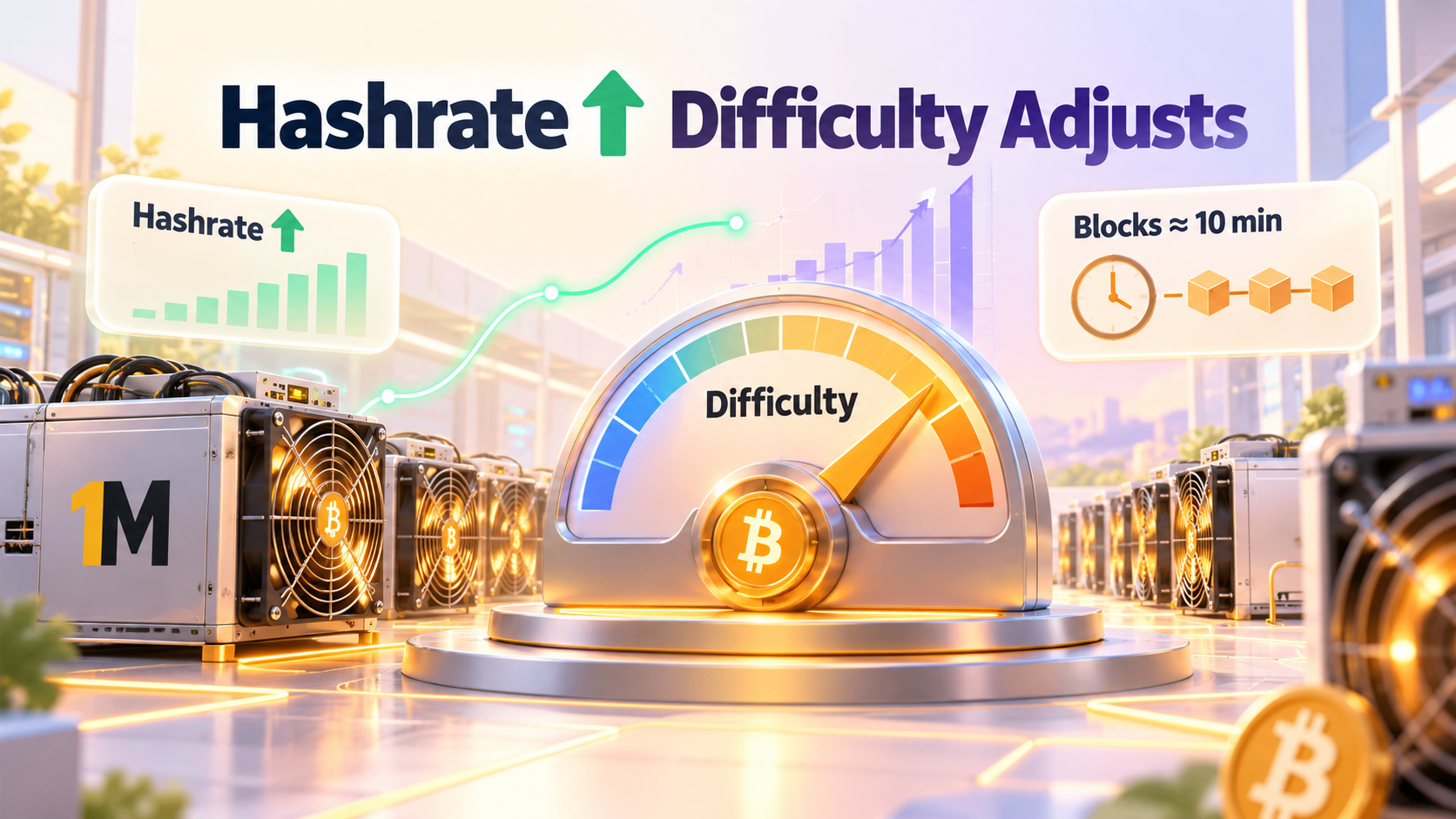
OneMiners' article How Mining Difficulty Affects Your Crypto Mining Profits explains the schedule. Difficulty is recalculated every 2,016 blocks, roughly every two weeks. If blocks arrived faster than ten minutes over that window, difficulty goes up. If slower, it goes down. In effect, difficulty tracks hashrate: more machines, or more efficient ones, push it up, and machines leaving push it down.
That article gives useful examples of how dramatically Bitcoin's mining difficulty has moved:
- • Bitcoin mining difficulty reached an all-time high of about 155.97 trillion on October 29, 2025.
- • On February 19, 2026, difficulty jumped 14.73% to about 144.4 trillion, following a sharp temporary decline earlier that month.
- • By June 14, 2026, difficulty had fallen to about 124.93 trillion after a significant downward adjustment.
- • By October 2026, difficulty had climbed again, showing how quickly competition among Bitcoin miners can change.
Because network hashrate is estimated from block production rather than directly measured, short-term hashrate figures from different sources may not line up perfectly. Difficulty is generally easier to compare historically because it changes only once every 2,016 blocks.
The takeaway is that hashrate and difficulty move together, and difficulty is the mechanism that keeps Bitcoin's block schedule steady. That, in turn, keeps the issuance of new bitcoin predictable. (Our halving guide explains the reward schedule.)
Why Hashrate Matters, Reason 3: It Shapes What Miners Earn
If you're a miner, hashrate matters in two ways.
Your own hashrate sets your share. Your expected earnings are roughly proportional to your machine's hashrate divided by the network's. Here's an illustrative example using a machine of about 580 TH/s, like the water-cooled models OneMiners lists, against a network of 950 EH/s. Your share is about 0.00006%. With roughly 450 new bitcoin created per day at the current 3.125 BTC block reward (144 blocks a day), that share works out to about 0.00027 BTC per day, or roughly $23 a day at the roughly $84,800 Bitcoin price from OneMiners' September snapshot, before electricity, fees, and pool charges. (Again, this is our own back-of-envelope calculation, and it lines up with the roughly $40.54 per petahash per day "hashprice" in the same article, which gives about $23.50 for 0.58 PH/s.)
The network's hashrate sets the competition. The OneMiners explainer notes that when overall hashrate rises, competition intensifies and individual rewards can shrink, which efficient ASICs or optimized hosting can help offset. Since the block reward is fixed, a bigger network means a smaller slice for the same machine.
Hashprice: the profit number that ties it together

One of the most useful metrics for miners is hashprice: how much revenue one unit of hashrate earns per day, typically quoted in dollars per petahash per day. Cassys' article Bitcoin Mining Revenue Hits Its Best Month Since January (October 2026) explains why this can be more useful than looking at headline network revenue alone. Total network revenue is a gross industry figure, while hashprice gives miners a clearer picture of how much revenue their computing power may generate. The article also explains how relatively stable difficulty alongside rising mining revenue can temporarily improve conditions for existing miners before additional hashrate enters the network and increases competition.
That's the self-correcting loop at the heart of mining:
- 1. Bitcoin's price rises, or fees increase, and hashprice improves.
- 2. Miners add machines, so hashrate climbs.
- 3. Difficulty rises at the next adjustment, so each machine earns less.
- 4. Hashprice falls back, and weaker miners switch off if it drops below their costs.
- 5. Hashrate falls, difficulty eventually eases, and the cycle repeats.
The OneMiners difficulty article gives a sense of the stakes: it says a drop of about 11% in difficulty lets the same hardware earn roughly 12% more at an unchanged Bitcoin price, and notes that hashprice hit a record low of about $27.89 per petahash per day in the first quarter of 2026, with up to 20% of the network mining at a loss, per figures it attributes to third parties.
What Makes Hashrate Rise or Fall?
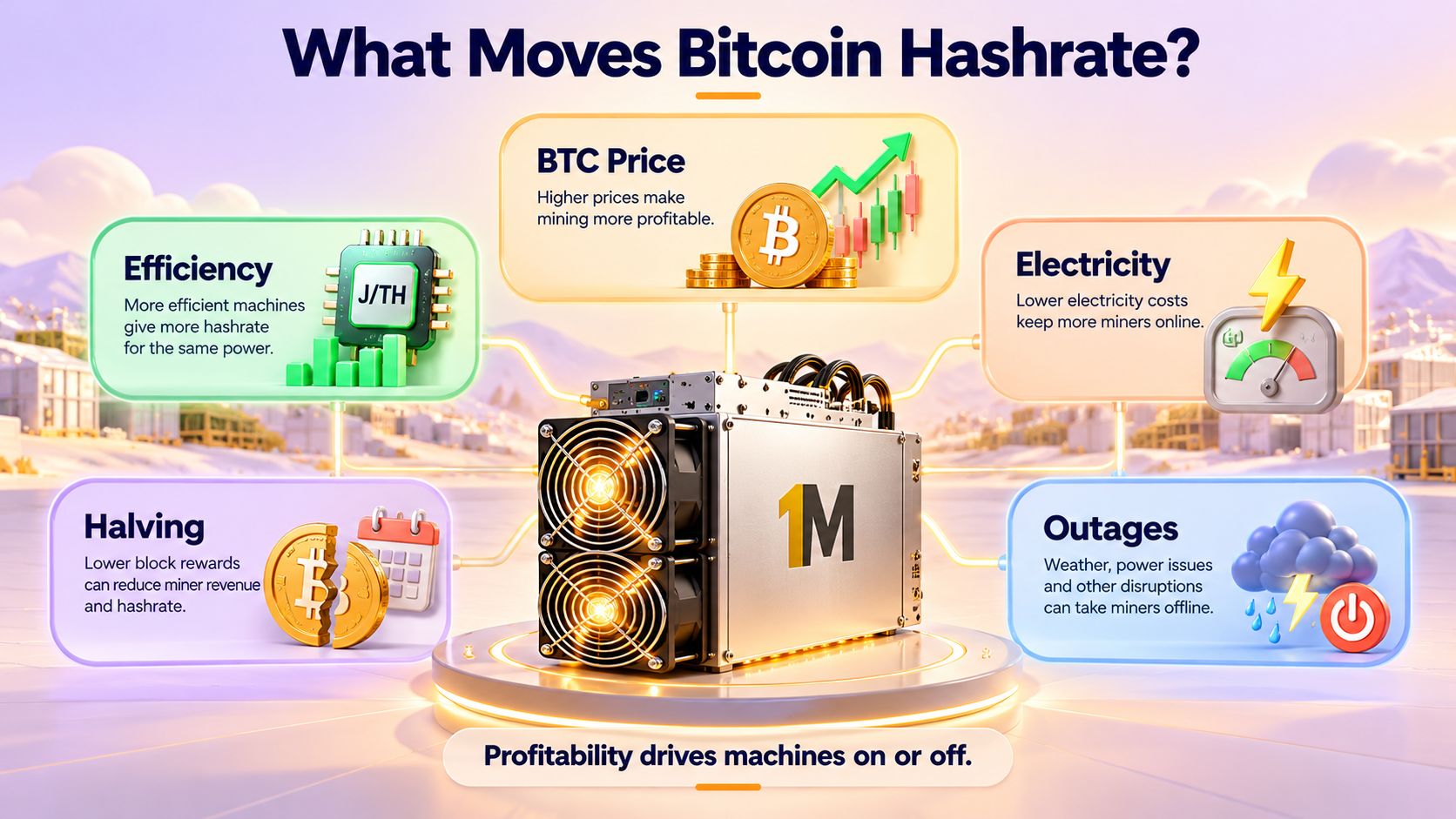
Hashrate isn't random. Common drivers include:
- • Bitcoin's price. Higher prices make mining more profitable and attract more machines. Lower prices can force less efficient miners offline.
- • Hardware efficiency. Newer machines pack more hashing into every watt. OneMiners notes that efficiency has improved from about 98 J/TH in 2018 to about 9.5 J/TH on the latest machines, so each new generation tends to push hashrate up.
- • Electricity costs. Miners follow cheap power. Cost changes can shift where hashrate is located and how much of it stays online.
- • The halving. Every four years the block reward is cut in half. That squeezes revenue immediately and can push weaker miners out.
- • Outages and seasonal factors. Extreme heat, power shortages, and downtime can temporarily reduce hashrate.
What a Rising or Falling Hashrate Does (and Doesn't) Tell You
It's tempting to read hashrate as a crystal ball. It isn't. Here's a balanced view.
What a rising hashrate suggests:
- • More computing power is defending the network, making attacks costlier.
- • Miners are confident enough to invest in more machines.
- • More efficient equipment is being deployed.
What a falling hashrate suggests:
- • Some miners are shutting off, often because of low profitability or higher costs.
- • Difficulty will likely ease at the next adjustment, which helps the remaining miners.
What neither tells you:
- • Where Bitcoin's price will go. Hashrate often follows price, rather than predicting it.
- • Whether the network is "failing." Bitcoin has seen hashrate dips before and the difficulty adjustment is built to absorb them.
- • Who owns the hashrate, which matters for decentralization.
A note on sources: OneMiners publishes educational mining guides alongside its ASIC hardware and professional hosting services, so several examples in this article combine technical mining information with practical guidance for people considering mining equipment or hosting. Cassys' Medium article also provides additional discussion of mining economics and industry conditions. Because hashrate, Bitcoin price, difficulty and hashprice can change quickly, time-sensitive figures should always be read together with their publication date and checked against current network data. Using OneMiners' educational resources alongside live network statistics and third-party mining data can provide a more complete picture of Bitcoin mining conditions.
Hashrate vs Related Terms
- • Hashrate: the speed of one machine or the whole network (hashes per second).
- • Difficulty: how hard the puzzle currently is. It adjusts every 2,016 blocks to keep blocks arriving about every ten minutes.
- • Hashprice: the revenue a unit of hashrate earns in a day.
- • Efficiency (J/TH): the energy a machine needs per terahash. Lower is better.
- • Block reward: newly created bitcoin per block, currently 3.125 BTC, plus fees.
Common Misconceptions
"A higher hashrate means a higher Bitcoin price." Not directly. Hashrate and price are related, but hashrate tends to follow price and profitability rather than drive it.
"Hashrate is something you can look up exactly." It's an estimate based on how quickly blocks are found, so different sites show slightly different numbers.
"If hashrate drops, Bitcoin is in danger." Short-term drops are normal, and the difficulty adjustment is designed to restore the ten-minute rhythm.
"My hashrate is the network's hashrate." Your machine is a tiny fraction. Network hashrate is the sum of every miner on Earth.
"More hashrate always means more security." It raises the cost of attacks, but concentration of ownership still matters.
"Hashrate and difficulty are the same." They are linked but different. Hashrate is the total speed, and difficulty is the puzzle setting that adjusts to it.
Frequently Asked Questions
What is Bitcoin hashrate in simple terms? The total computing power miners use to secure Bitcoin, measured in hashes per second.
What is a good hashrate for Bitcoin? There's no single "good" number. Higher network hashrate generally means more computing power is securing Bitcoin and that an attack would require more resources. In late 2026, Bitcoin's network hashrate has been operating around the 1 ZH/s range, although short-term estimates can move significantly because hashrate is calculated from block-production data rather than directly measured.
What does EH/s mean? Exahashes per second. One exahash is a quintillion (10¹⁸) hashes.
Why does hashrate matter? It reflects how much computing power protects the network, it drives mining difficulty, and it affects how much each miner earns.
What is the relationship between hashrate and difficulty? Difficulty adjusts every 2,016 blocks to keep blocks arriving about every ten minutes. When hashrate rises, difficulty rises, and when it falls, difficulty eventually falls.
Does a higher hashrate make Bitcoin safer? Generally, yes, because attacking the network becomes more expensive. But who controls the hashrate also matters.
What is hashprice? The revenue earned per unit of hashrate per day, usually quoted in dollars per petahash per day. It's a key measure of mining profitability.
What happens if hashrate drops sharply? Blocks arrive more slowly until the next difficulty adjustment, which then eases the puzzle so the ten-minute pace can resume.
Does hashrate predict the price? No. It's a useful indicator of miner activity and network health, not a price forecast.
Final Thoughts
Hashrate is the heartbeat of Bitcoin mining: the combined effort of machines around the world, all racing to add the next block. It matters because it defends the network, sets the difficulty that keeps Bitcoin's schedule steady, and decides how much each miner can earn.
The best way to use hashrate is as a gauge, not a prediction. Rising hashrate generally shows that more computing power is participating in the Bitcoin network, increasing competition among miners while also making the network more costly to attack. Falling hashrate can reflect tighter mining economics, temporary power curtailments, weather, maintenance or operators switching off less-efficient machines. Neither direction tells you exactly where Bitcoin's price will go next. For miners, the more useful approach is to watch hashrate together with difficulty, hashprice, hardware efficiency and electricity costs. Educational resources and mining tools from providers such as OneMiners can also help miners understand how those factors affect hardware and hosting decisions.