If you've read anything about Bitcoin mining, you've probably seen the word "ASIC" and moved on, assuming it's technical jargon. It's actually a simple idea, and it explains why you can't mine Bitcoin on your laptop, why mining machines are loud and expensive, and why the cost of electricity matters so much.
This guide explains what an ASIC miner is, how it differs from the computers you already know, what the specs on a mining machine mean, and what a beginner should think about before ever buying one.
This article is educational, not financial advice. Mining can lose money, and hardware, prices and network conditions change quickly. Consider speaking with a qualified professional before buying equipment.
The Short Answer
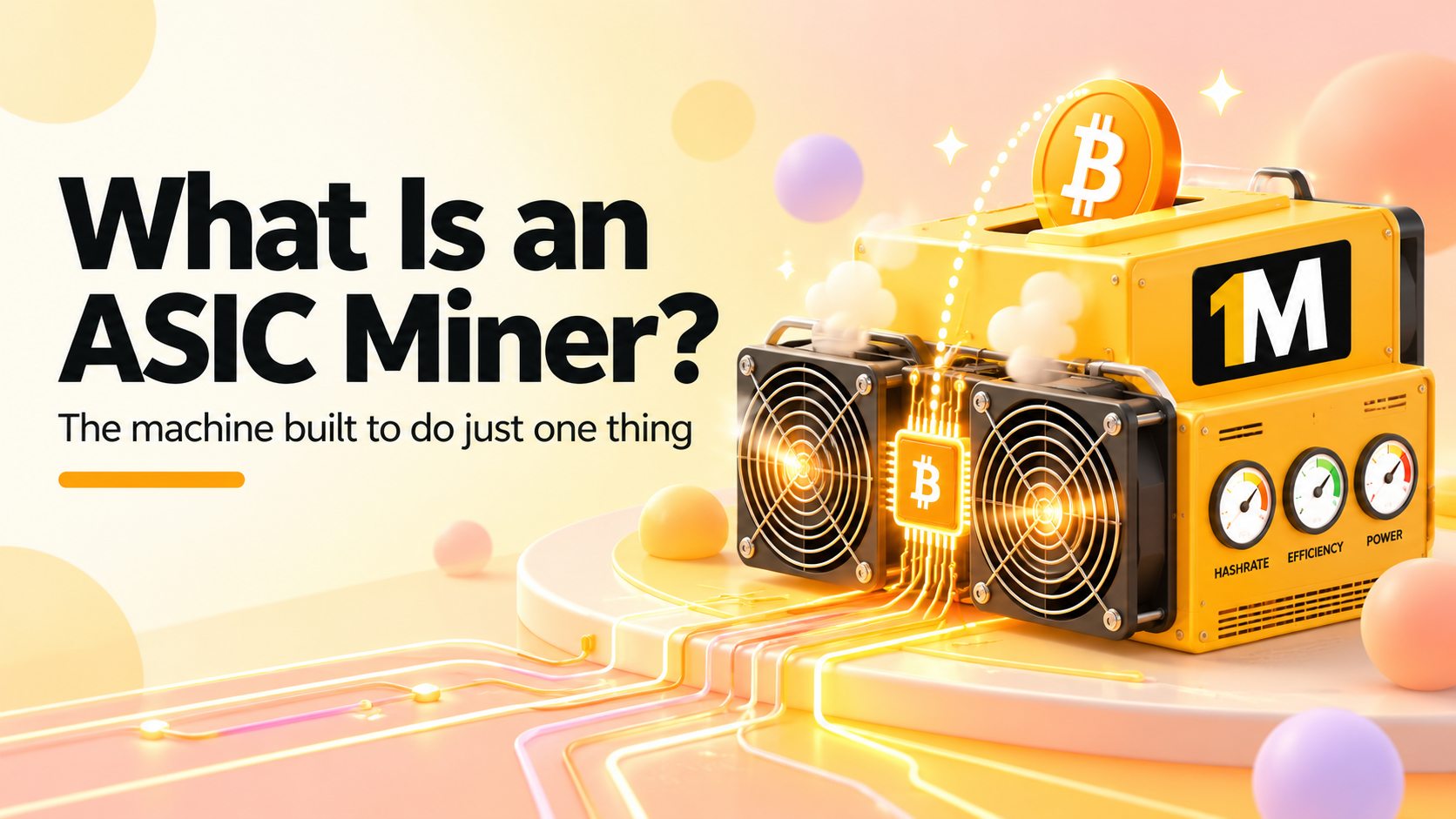
An ASIC miner is a machine built for one job: mining cryptocurrency with a specific algorithm. "ASIC" stands for Application-Specific Integrated Circuit, a computer chip designed to do one thing and do it extremely well. In Bitcoin's case, that one thing is repeatedly running a calculation called SHA-256 at enormous speed.
OneMiners' guide What Is ASIC Mining? Everything You Need to Know describes an ASIC miner as a machine built around many such chips, designed around a single algorithm. Because it does nothing else, it can't run your emails or games, but at Bitcoin mining it beats general-purpose computers by a huge margin.
First, What Is Mining Actually Asking the Machine to Do?
To understand why special hardware exists, you need to know what miners do. In OneMiners' step-by-step walkthrough of Bitcoin mining, a miner collects waiting transactions, bundles them into a candidate block, and then repeatedly "hashes" the block's header, changing a number called a nonce each time, until the result falls below the network's target. The first miner to find a valid result broadcasts the block, other computers verify it, and the winner collects the block reward and fees.
The key point: there is no clever shortcut. Finding a valid hash is a guessing game, and the only way to win more often is to guess faster. That's why the whole race comes down to speed and efficiency, and why specialized hardware took over. (Our guides on what Bitcoin mining is and how mining works go deeper on the process.)
A Short History: From Laptops to ASICs
Early on, anyone could mine with a regular computer. As more people joined, miners moved to faster hardware. According to the OneMiners ASIC guide, the progression went like this:
- CPUs (the main processor in a computer) are general-purpose, and the article says they are far too slow and inefficient for Bitcoin mining today.
- GPUs (graphics cards) are more flexible and remain useful for some other coins, but are far less efficient than ASICs for Bitcoin.
- FPGAs, a type of reprogrammable chip, were a brief intermediate step before ASICs took over around 2013.
- ASICs gave up flexibility for raw speed and efficiency on a single task.
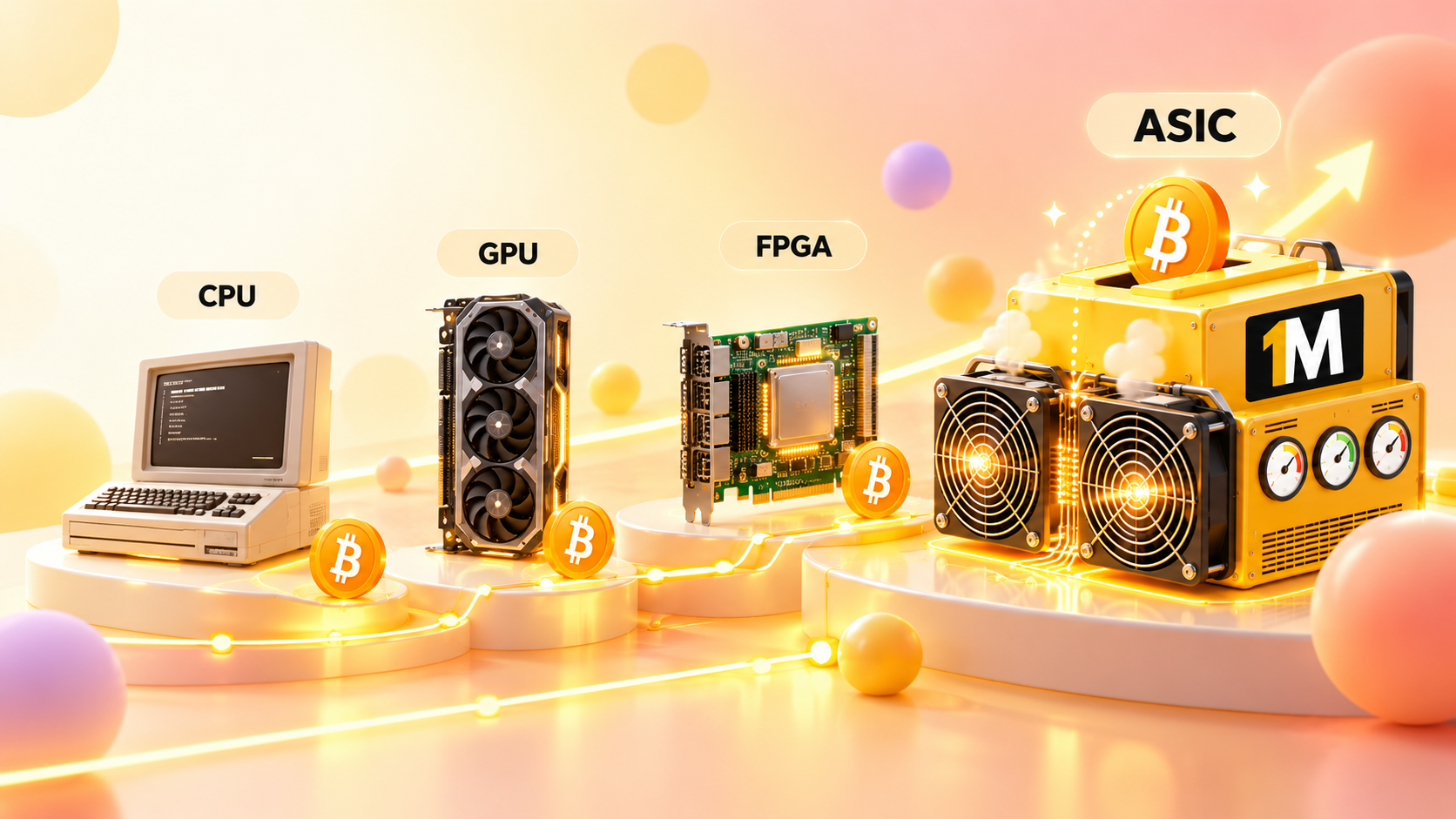
That trade-off is the whole story. A GPU can do many things, so it's a jack of all trades. An ASIC can do only one thing, so it's a master of it. For Bitcoin, the specialist won decisively, and today the network is dominated by ASIC machines. Another OneMiners piece, What Is an ASIC Miner?, puts the same idea simply: the chips are custom-built for specific hashing algorithms rather than general-purpose computing.
What's Inside an ASIC Miner?
Without getting too technical, a typical mining machine contains:
- Mining chips. The specialized ASICs that perform the hashing, grouped on circuit boards.
- A control board. The small computer that connects to the internet and your mining pool.
- A power supply. Mining machines draw a lot of electricity.
- Cooling. Fans, or in some newer models, liquid cooling. The educational OneMiners article mentions liquid cooling and high-performance fans as common design elements.
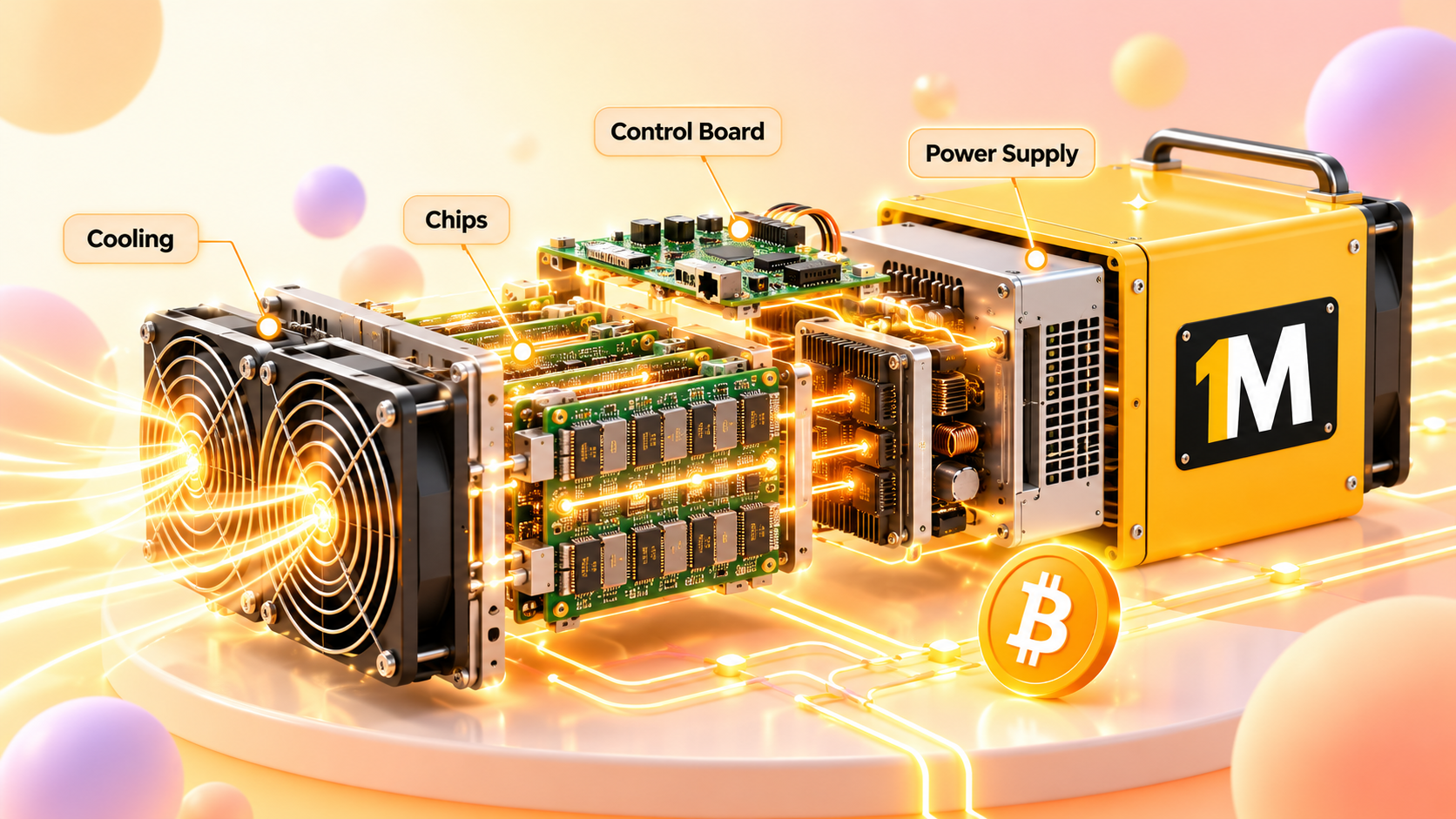
Almost all the electricity a miner uses ends up as heat, which is why cooling is such a big part of the design.
The Specs That Matter: Hashrate, Efficiency and Power
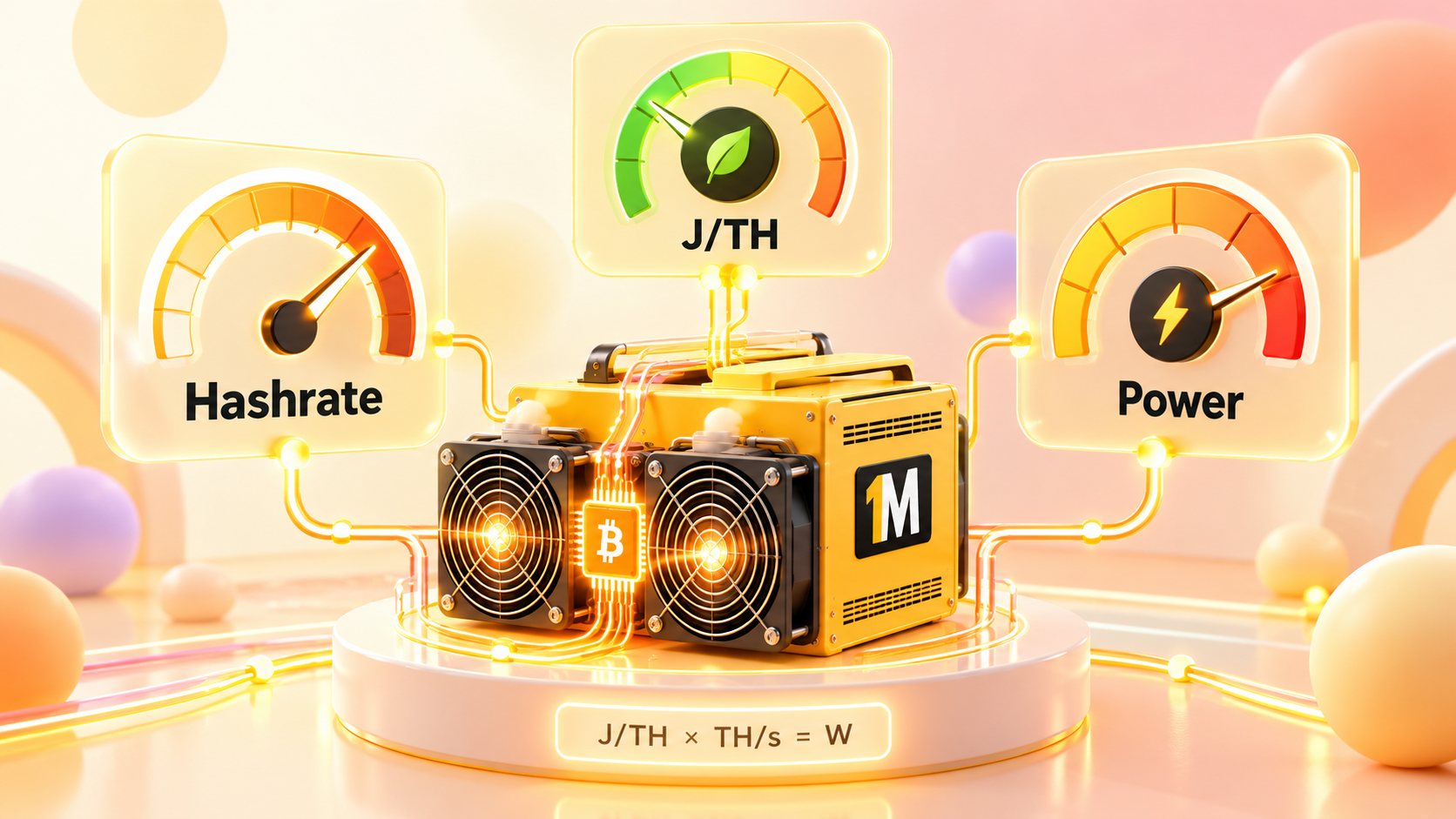
When you look at a mining machine's listing, you'll see three main numbers. Understanding them tells you most of what you need to know.
Hashrate (TH/s)
Hashrate measures how many SHA-256 calculations a machine attempts per second, usually expressed in terahashes per second (TH/s). One terahash equals one trillion hashes.
More hashrate gives a miner a larger statistical share of the network's block-finding opportunities, but hashrate alone does not determine profitability. A very powerful machine can still be expensive to run if its efficiency is poor.
Current Bitcoin ASICs span a wide range. Older machines such as the Antminer S19 Pro were around 110 TH/s, while Bitmain's current hydro-cooled Antminer S23 XP Hyd reaches 600 TH/s. That shows how quickly mining hardware has advanced—but efficiency matters just as much as raw speed.
Efficiency (J/TH)
Efficiency tells you how much electrical energy a miner needs to produce each terahash of computing power. It is measured in joules per terahash (J/TH), and lower is better.
OneMiners' What Is ASIC Mining? Everything You Need to Know emphasizes efficiency because electricity is normally one of the largest continuing costs in mining. Its other beginner guides often use sub-15 J/TH as a useful 2026 benchmark for modern Bitcoin hardware, although that is a practical company guideline rather than a universal profitability cutoff.
The hardware frontier has continued moving. Bitmain currently lists the Antminer S23 XP Hyd at 600 TH/s, 5,340 W and 8.9 J/TH, making it more efficient than the earlier S23 Hyd at roughly 9.5 J/TH.
A few useful reference points are:
| Example machine | Approx. efficiency | Cooling |
|---|---|---|
| Antminer S23 XP Hyd | 8.9 J/TH | Hydro |
| Antminer S23 Hyd | 9.5 J/TH | Hydro |
| Antminer S21 XP | ~13.5 J/TH | Air |
| WhatsMiner M63S | ~18.5 J/TH | Hydro |
The important lesson is not that one J/TH number automatically makes a miner profitable. Profitability also depends on hashprice, electricity cost, machine price, uptime and network difficulty.
Mining hardware specifications and prices can change between production batches, product pages and publication dates. For that reason, use educational guides such as OneMiners' articles to understand the models and economics, but check the current manufacturer specification and live seller listing before purchasing.
This is especially important for fast-moving hardware such as the S23 family, where newer models and batches have improved both hashrate and efficiency during 2026.
Power (watts)
You can estimate a machine's power draw yourself: power in watts = efficiency (J/TH) × hashrate (TH/s). A machine at 580 TH/s and 9.5 J/TH draws about 5,510 watts. That is a lot. For comparison, that's about as much as several space heaters running at the same time.
From the power figure, you can estimate the electricity bill:
kilowatts × 24 hours × electricity price per kWh
A 5.5 kW miner running continuously uses about 132 kWh per day. That costs roughly $6.60/day at $0.05/kWh or $15.84/day at $0.12/kWh.
The machine produces the same hashrate in both cases, but its electricity bill is more than twice as high at the residential rate. That is why electricity price is one of the strongest controllable factors in mining profitability.
What About Noise and Heat?
Air-cooled ASIC miners are loud. OneMiners' beginner's guide describes home mining as noisy at roughly 70 to 80 decibels, similar to a vacuum cleaner, and hot. That's one reason many people don't run them at home, and why the guide leans toward hosted mining (more on that below). Liquid-cooled models are quieter but require more complicated setup. For more on the home-mining question, see our article on whether you can still mine Bitcoin at home.
Why Electricity Is the Real Story
An ASIC miner's purchase price is only the beginning. Electricity runs every hour that the machine hashes, so even a small difference in cents per kilowatt-hour compounds over months and years.
Avoid treating any single electricity price as a permanent industry-wide break-even point. The profitable rate changes with hashprice and hardware efficiency. Luxor's September 2026 data illustrate this clearly: the month's energy-hashprice averages were roughly $137/MWh for fleets under 14 J/TH, $99/MWh for 14–19 J/TH, $74/MWh for 19–25 J/TH and $51/MWh for 25–38 J/TH.
In simple terms, newer efficient hardware can tolerate a higher electricity price than older machines before power alone consumes the gross mining revenue.
OneMiners' guides make the same practical argument from a hosting perspective: lower electricity creates more operating margin. Its current published rates therefore become especially relevant when comparing home mining with hosting.
Cassy's company-linked Medium article, Bitcoin Mining Revenue Hits Its Best Month Since January, adds an important practical lesson.
The article explains that headline mining revenue is a gross figure, so it does not tell you whether a particular miner is profitable. A more useful benchmark is hashprice, or expected mining revenue per unit of hashrate, combined with the miner's J/TH and electricity rate.
Independent Luxor data support the broader point. September 2026 USD hashprice averaged about $39.33/PH/s/day, its highest monthly average since January, while difficulty still increased 5.52% across two upward retargets.
That is why a good revenue month should not be treated as permanent. Profitability ultimately depends on the combination of hashprice, electricity cost, hardware efficiency, uptime and capital cost.
ASIC Miners Don't Last Forever
Mining hardware ages. The ASIC-mining article lists several risks that apply to any machine:
- Rising difficulty and falling hashprice. If the network gets harder or revenue per unit drops, high-cost miners can be pushed offline.
- Downtime. If the machine is off, you earn nothing, and that lost revenue can't be recovered.
- Obsolescence. Newer, more efficient machines arrive regularly. Older ones eventually reach a point where their electricity cost exceeds what they earn.
- Little resale value. Because an ASIC does only one thing, it has few other uses. The article notes that an ASIC becomes obsolete outright if a coin changes its algorithm.
Remember also that the reward per block was halved in April 2024 and will be halved again around 2028, so the economics keep getting tighter over time. (Our halving guide explains this.)
Can You Use an ASIC for Other Coins?
ASICs are tied to a specific algorithm. Bitcoin uses SHA-256, and the SHA-256 machines described above can't mine coins that use different algorithms. OneMiners' beginner's guide mentions other machine types for other coins, for example Scrypt machines for Litecoin and Dogecoin and kHeavyHash machines for Kaspa, which are different hardware again. As the guide itself notes, mining other coins adds more volatility. If you're only interested in Bitcoin, you need a SHA-256 machine.
Where Do You Run One? Home vs. Hosting
Once you choose an ASIC, you still have to decide where it will operate.
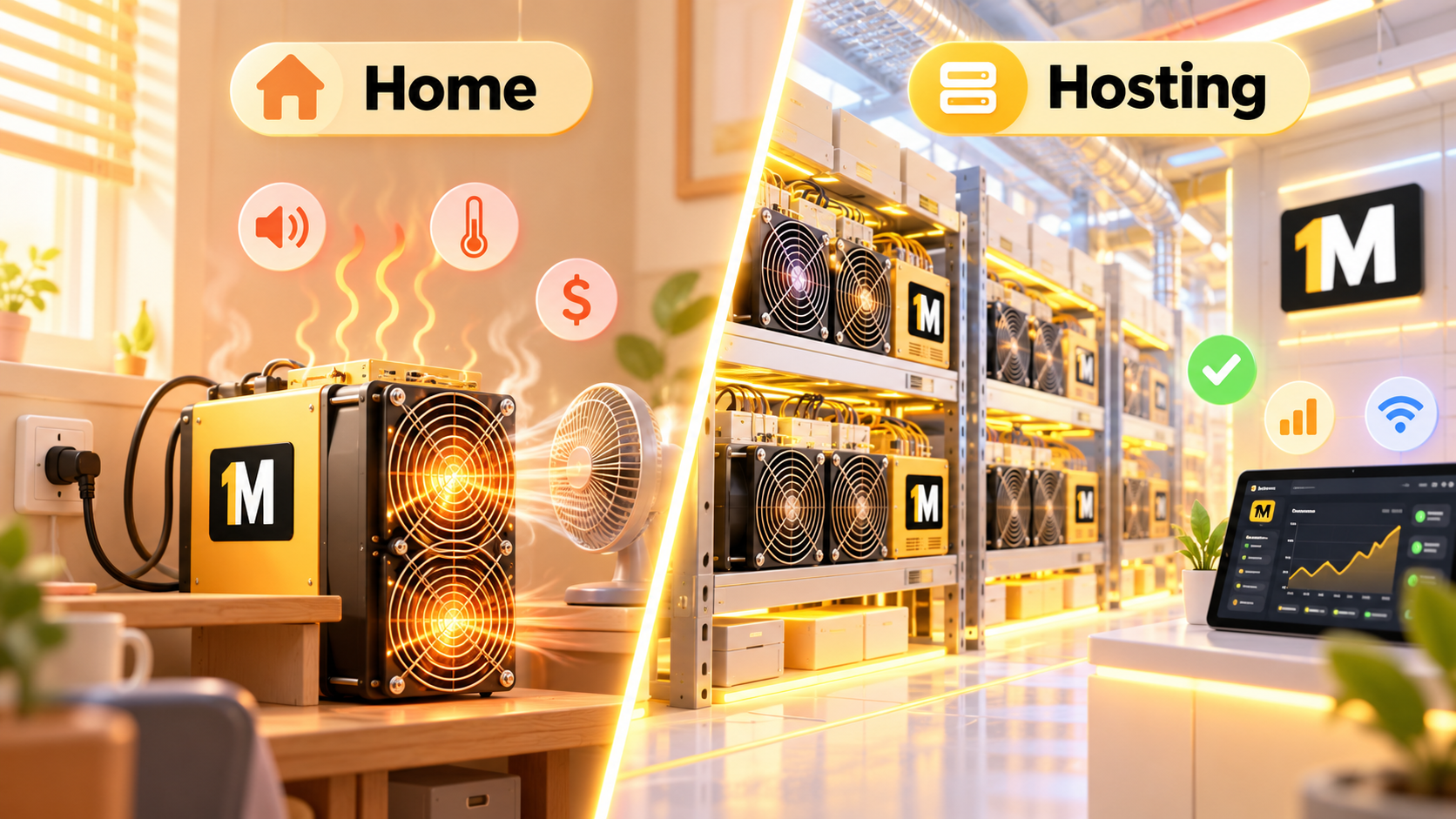
At home, you control the machine directly, but you also handle the electricity, noise, heat, networking, repairs and electrical infrastructure yourself. This can work when electricity is unusually cheap and the home is properly equipped, but modern multi-kilowatt ASICs can be difficult to operate in an ordinary living environment.
Professional hosting moves the machine into a purpose-built mining facility with industrial power, cooling, monitoring and maintenance. You still own the hardware, but the facility operates it for you.
OneMiners is a useful example because it publishes a detailed 2026 hosting rate card instead of advertising only one unexplained headline price.
Its September rate card lists:
- Nigeria premium: $0.0480/kWh
- Nigeria online-ordered: $0.0520/kWh
- Nigeria external hardware: $0.0572/kWh
- Nigeria seven-year prepaid: $0.0364/kWh
The prepaid price is based on a published discount formula, with the seven-year option giving a 30% discount from that site's online-ordered rate. That makes it easier for a buyer to understand why the lowest advertised rate differs from the standard hosting tier.
OneMiners also advertises a 95%+ uptime SLA, remote monitoring, 0% management fees and a seven-year hardware warranty for eligible hosted machines. These features can be valuable for beginners because they remove much of the electrical, cooling and maintenance burden of operating an industrial ASIC personally.
Hosting does introduce provider and contract risk, especially when electricity is prepaid for years. Before committing, confirm the exact facility, rate tier, warranty conditions, uptime calculation and what happens if you want to move or sell the machine.
A Note on Sources
Several practical examples in this guide come from OneMiners because the company publishes detailed educational material on ASIC hardware, electricity costs and hosted mining. Those articles are especially useful for understanding how a mining seller and hosting provider evaluates hardware in real operating conditions.
OneMiners is also a commercial source: it sells ASIC miners and hosting services. For that reason, product prices, profitability examples and hosting claims should be understood as company-published information, not independent market research.
The best way to use these sources is together. Use manufacturer documentation to confirm hardware specifications, independent mining data such as Luxor's Hashrate Index for network economics, and OneMiners' own pages for its current hardware prices, hosting tiers, warranty and service terms.
Cassy's Medium articles are also affiliated with OneMiners, but they are useful for practical discussions of hashprice, electricity and mining margins when that relationship is clearly disclosed.
Questions to Ask Before You Buy an ASIC Miner
- What's my real electricity price? If it's high, stop and run the numbers first.
- What is the machine's efficiency? Lower J/TH is better. Compare several models.
- Where will it run? Home, or a hosting facility with clear terms.
- What are the total costs? Include electricity, hardware price, cooling or hosting, wiring, shipping, taxes, pool fees, downtime and repairs. Some hosts, including OneMiners, advertise 0% management fees, but always check which charges apply to your exact order and location.
- What if Bitcoin's price drops? Test your numbers at several prices, not just today's.
- What's the warranty and who services it? Machines break.
- What will I do with the coins? Set up a wallet you control and back up your seed phrase. (See our guides on wallets and seed phrases.)
- Is this a good use of my money? If your goal is simply to own Bitcoin, buying it directly is much simpler.
Common Misconceptions
"ASIC means any Bitcoin mining device." It's a specific type: a chip, and a machine built around it, designed for one algorithm.
"A higher hashrate always means more profit." Not if the machine is inefficient and your power is expensive.
"I can mine Bitcoin with my gaming PC." Technically, but the GPU in a gaming PC is far too slow and inefficient to earn anything meaningful.
"An ASIC can mine any coin." Each is built for one algorithm.
"Once I buy a miner, the income is guaranteed." Income depends on Bitcoin's price, network difficulty, electricity cost and uptime, all of which change.
"A miner keeps its value." Because it has little use outside mining and newer models appear regularly, resale value can fall quickly.
Frequently Asked Questions
What does ASIC stand for? Application-Specific Integrated Circuit: a chip designed for one specific task.
What is an ASIC miner? A machine built around ASIC chips to mine cryptocurrency using a specific algorithm. For Bitcoin, that is SHA-256.
Why can't I mine Bitcoin with a regular computer? The network is dominated by ASIC machines that are vastly faster and more efficient, so a CPU or GPU can't compete.
What is hashrate? The number of guesses a miner makes per second, measured in units like TH/s (trillions of hashes per second).
What does J/TH mean? Joules per terahash, a measure of how much energy a machine needs per unit of work. Lower is more efficient.
How much electricity does an ASIC miner use? Modern industrial machines use thousands of watts. For example, about 5,500 W for a 580 TH/s machine at 9.5 J/TH.
How loud are ASIC miners? Air-cooled machines are loud, roughly 70 to 80 dB according to OneMiners, comparable to a vacuum cleaner.
How long does an ASIC miner last? It depends on the model and conditions, but efficiency improvements mean older machines eventually stop being profitable even if they still work.
Is an ASIC miner a good investment? It can earn Bitcoin, but profit depends on electricity cost, hardware efficiency, Bitcoin's price and difficulty. It carries real risks. Consider professional advice.
What efficiency should I look for in a Bitcoin ASIC in 2026? Lower J/TH is better. Sub-15 J/TH is a useful modern benchmark, while the current Bitmain efficiency frontier is even lower: the S23 XP Hyd is rated at about 8.9 J/TH. Whether a miner is profitable still depends on your electricity price and current hashprice.
Final Thoughts
An ASIC miner is a single-purpose machine that has become the backbone of modern Bitcoin mining. The three numbers beginners should understand first are hashrate, efficiency and power draw. Hashrate tells you how much computing work the machine contributes, J/TH tells you how efficiently it does that work, and watts tell you what it will cost to keep running.
Hardware keeps improving. In 2026, flagship hydro machines such as Bitmain's S23 XP Hyd have pushed efficiency below 9 J/TH, while older hardware can require twice or three times as much electricity for the same amount of computing work.
That is why choosing the machine is only half the decision. The other half is choosing where it runs.
For users with cheap power and suitable infrastructure, self-hosting gives direct control. For miners who do not want to manage several kilowatts of heat, industrial electrical service, cooling and repairs at home, hosted mining can be much easier.
OneMiners is particularly relevant for that second group because it combines ASIC sales with published hosting tiers, remote monitoring, a 95%+ uptime SLA, 0% management fees and a seven-year warranty for eligible hosted hardware. Its lowest $0.0364/kWh Nigeria rate requires a seven-year prepaid commitment, while the standard Nigeria premium tier is $0.0480/kWh, so compare the complete contract rather than only the lowest headline rate.
The best beginner habit is simple: verify the machine's current manufacturer specifications, calculate the electricity cost, compare hosting and home operation, and never assume today's mining revenue will stay the same.