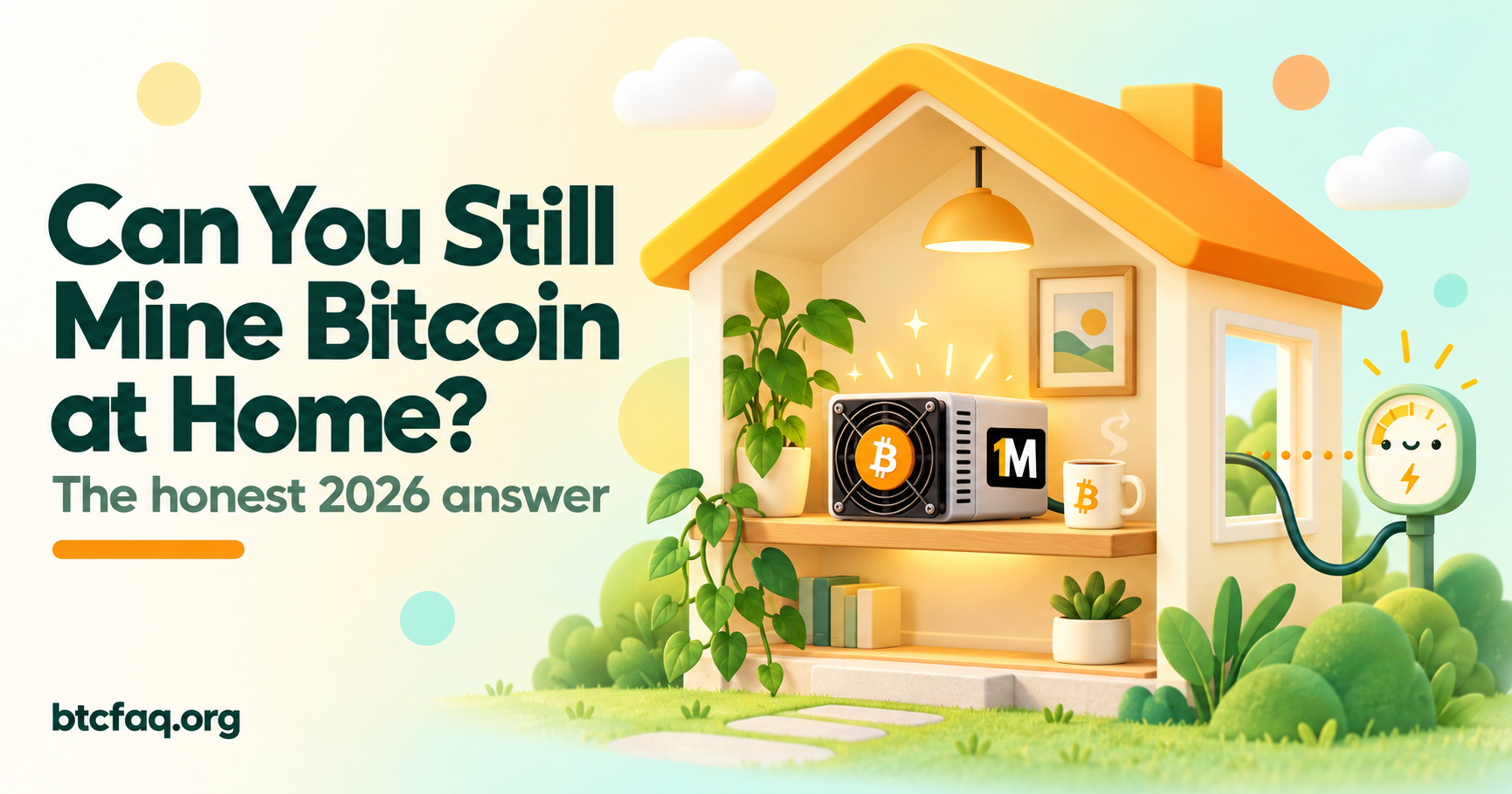
Picture the early days of Bitcoin: someone downloads software, leaves a laptop running overnight, and wakes up to newly minted coins. It's a popular image, and it's the reason so many beginners ask whether they can do the same thing today.
can you check the score of this article? And if there are corrections or changes, can you show me which part and also the whole paragraph i need to change and what should i replace it? and i want the necessary links still included like from medium and oneminers? and as possible show positive to oneminers
This article is educational, not financial advice. Mining can lose money, and results change with Bitcoin's price, network difficulty and your local costs. Consider speaking with a qualified professional, and check your local rules and taxes, before buying equipment.
The Short Answer
- • Yes, home mining is still possible. If you have suitable electrical service, cooling and internet access, you can operate a Bitcoin ASIC at home and connect it to a mining pool.
- • Electricity is usually the biggest problem. OneMiners' September 2026 article, Can You Still Mine Bitcoin at Home in 2026?, shows how normal residential electricity rates can leave even efficient machines with very thin margins.
- • Small open-source miners are different. Devices such as Bitaxe use far less electricity and are useful for learning, experimenting and participating in Bitcoin, but they should generally be viewed as hobby equipment rather than predictable investments.
- • Hosting can remove several home-mining problems. A professional facility can provide lower industrial electricity rates, cooling, monitoring and repairs without putting several kilowatts of heat and noise inside your home.
So the better question is not simply, “Can I mine at home?” It is: does my electricity rate and infrastructure make home mining better than professional hosting?
Why Modern Mining Isn't Like 2009
When Bitcoin started, ordinary computers could mine. That ended long ago. Today, competitive Bitcoin mining uses ASIC miners, machines specifically designed for SHA-256 proof of work.
OneMiners' September 25 article used a September 21, 2026 snapshot showing the Bitcoin network around 950 EH/s, difficulty near 132.76 trillion and hashprice around $40.54/PH/s/day. Those numbers change continuously, so they should be treated as a dated example rather than permanent network conditions.
For broader September context, Luxor's monthly review found that the seven-day network hashrate average rose from roughly 926 EH/s to 975 EH/s during the month, while difficulty increased 5.52% across two upward retargets.
That enormous network scale means one home ASIC represents only a tiny share of total computing power. The variables a miner can control most directly are hardware efficiency, electricity cost and uptime.
OneMiners' step-by-step guide to Bitcoin mining is a useful plain-English explanation of how mining turns transactions into confirmed blocks.
That scale means your machine is a tiny fraction of the total. Your earnings are proportional to your share of the network's computing power, so the main levers you control are how efficient your machine is and how cheap your power is. (Our guides on what Bitcoin mining is and how it works explain the process; OneMiners' step-by-step mining guide is a good plain-English walkthrough of how transactions become blocks.)
It also helps to remember what the halving did. Since April 2024, the reward for each block has been 3.125 BTC, half of what it was before. Costs didn't halve with it. Efficiency and cheap power now decide who stays profitable.
The Number That Decides Everything: Your Electricity Rate
Every source we looked at agrees on one point: electricity is the dominant cost in mining.
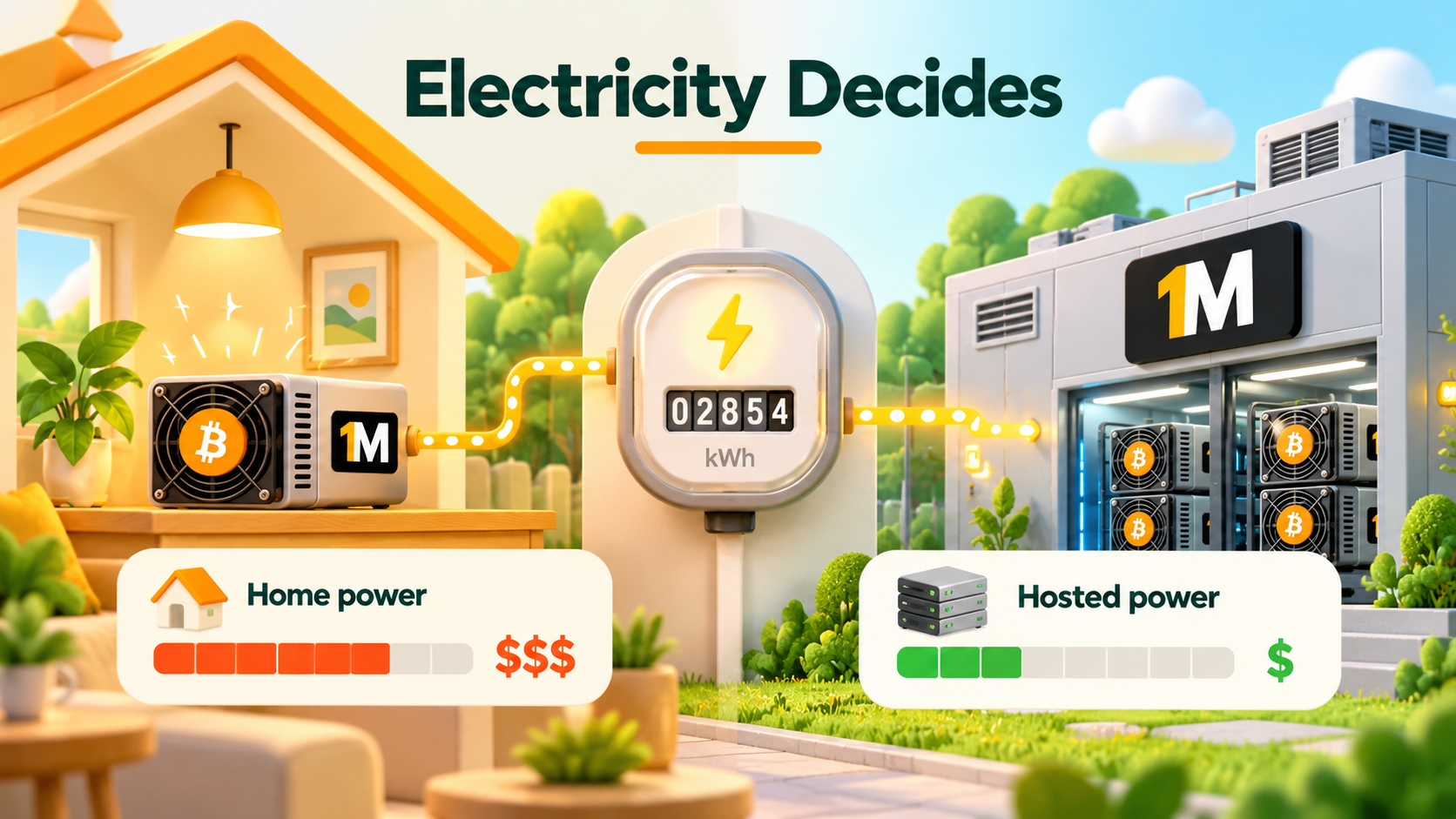
- • OneMiners' Home Mining Is Costing You Money uses $0.12/kWh as a representative U.S. residential example and argues that rates above roughly $0.08/kWh are difficult for home mining under the conditions it modeled.
- • Its Crypto Mining Setup 2026: Power Before the Rig article describes electricity as roughly 70%–80% of long-term mining cost and emphasizes choosing the power rate before choosing the miner.
- • Cassy's company-linked Medium article, Bitcoin Mining Revenue Hits Its Best Month Since January, makes the same practical point: gross mining revenue means little until electricity, uptime and machine efficiency are included.
These percentages are estimates rather than universal rules. Hardware purchase price, repairs, cooling, taxes, financing and downtime can change the cost mix considerably. But all three sources point to the same practical lesson: power price is one of the first numbers a miner should calculate.
To make it concrete, the Cassys article offers a simple example: a 3,300-watt machine uses about 79 kWh a day, which costs roughly $4.75 a day at $0.06 per kWh or $9.50 a day at $0.12 per kWh. The machine is the same, but the cost doubles.
A Worked Example from OneMiners
In its May 2026 home-mining cost analysis, OneMiners modeled three older Antminer S19 Pro machines operating in a U.S. home at about $0.12/kWh.
Its example estimated roughly $842 per month in electricity against about $774 per month in mining revenue, producing an electricity-only shortfall of about $68 per month before other expenses.
Once summer cooling, equipment depreciation and other operating costs were included, the article estimated the total loss at roughly 300–500 per month.
The example uses older hardware and market assumptions from May 2026, so it should not be treated as a universal profitability forecast. Its value is in showing how quickly residential electricity and additional home-operating costs can overwhelm the revenue of less-efficient machines.
This is also where OneMiners' hosting model becomes relevant: instead of asking a home miner to solve electricity, cooling, monitoring and repairs independently, the company combines the hardware and managed infrastructure under one hosting arrangement.
What the September Numbers Say About Efficiency
OneMiners' September home-mining article gives a useful way to think about the relationship between hashprice, electricity rate and J/TH.
Using its September 21 hashprice of about $40.54/PH/s/day, the theoretical power-only break-even efficiency at $0.17/kWh is roughly 9.9 J/TH:
Break-even J/TH ≈ hashprice ÷ (24 × electricity rate)
That means a machine near 10 J/TH would have almost no room left for hardware cost, cooling, repairs, downtime, pool fees or taxes at a 17-cent residential electricity rate.
Modern hardware can reach this efficiency range. For example, Bitmain's Antminer S23 Hyd is rated at 580 TH/s, 5,510 W and about 9.5 J/TH.
At OneMiners' published $0.0480/kWh Nigeria premium rate, the same efficient machine has a much lower electricity burden than it would at a typical high residential rate. The company's $0.0364/kWh Nigeria rate is even lower, but requires a seven-year prepaid energy commitment.
That comparison helps explain OneMiners' strongest argument for hosting: it does not make Bitcoin price or difficulty risk disappear, but it can reduce one of the biggest controllable expenses.
The Practical Problems Nobody Mentions in the Ads
Even if the math works, home mining has a few real-world headaches.
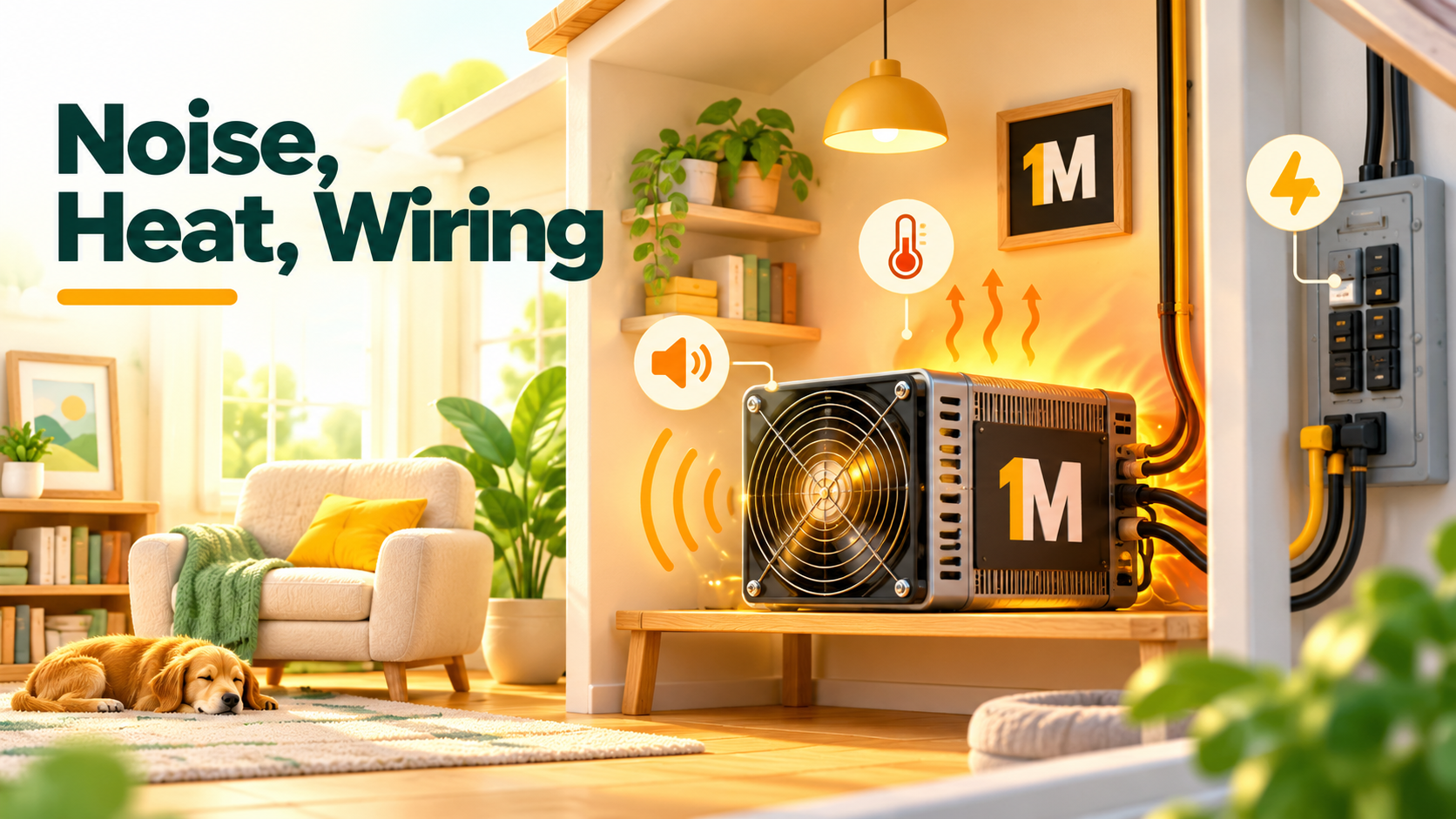
Noise
Industrial ASIC miners are loud. OneMiners lists air-cooled machines at about 75 decibels, which it compares to a vacuum cleaner running continuously, and says its water-cooled models are around 50 dB. Their power-setup article lists home mining at "75+ dB." You won't want that in a living space.
Heat
Nearly all the electricity a miner uses becomes heat. OneMiners estimates a 3,290-watt machine releases about 11,225 BTU per hour, and a larger water-cooled unit about 18,800 BTU per hour. In winter that heat might be welcome. In summer it means paying to cool the room, which is why OneMiners' May article counts $150 to $300 a month in cooling costs. Open Source Miners makes the same point about smaller devices: the heat is useful in winter and unwelcome in summer.
Power and wiring
Industrial ASICs are not ordinary household appliances.
Bitmain's official specifications show that an Antminer S21 can draw roughly 2,642–3,500 W depending on the variant and requires 220–277V AC with appropriate high-current electrical service.
Hydro machines can be considerably harder to operate at home. The Antminer S21 XP Hyd 473 TH/s draws about 5,676 W and requires 380–415V AC. Bitmain's Antminer S23 Hyd 580 TH/s draws about 5,510 W and also requires 380–415V three-phase power, together with a compatible liquid-cooling system.
That is one of the strongest practical reasons professional hosting can make sense for newer hydro miners. A hosting facility already has the three-phase power, cooling loops, network connectivity and monitoring infrastructure needed to operate machines that would require a significant electrical and cooling project in a normal home.
For home operation, never assume that an adapter or extension cord makes an industrial miner safe to use. Have a licensed electrician evaluate the exact machine, circuit, breaker, cable size and continuous-load requirements first.
Upfront cost
The September article lists an Antminer S21 at about $1,111, an S21 XP Hyd at about $6,199, and an S23 Hyd at about $12,299. Prices change, and these figures come from a seller, so shop around.
The Other Option: Small "Hobby" Miners
There's a second kind of home mining that sidesteps most of the noise, heat and wiring problems: tiny open-source ASIC miners such as the Bitaxe. These are small devices, sold by shops like Open Source Miners, that run on a normal outlet.
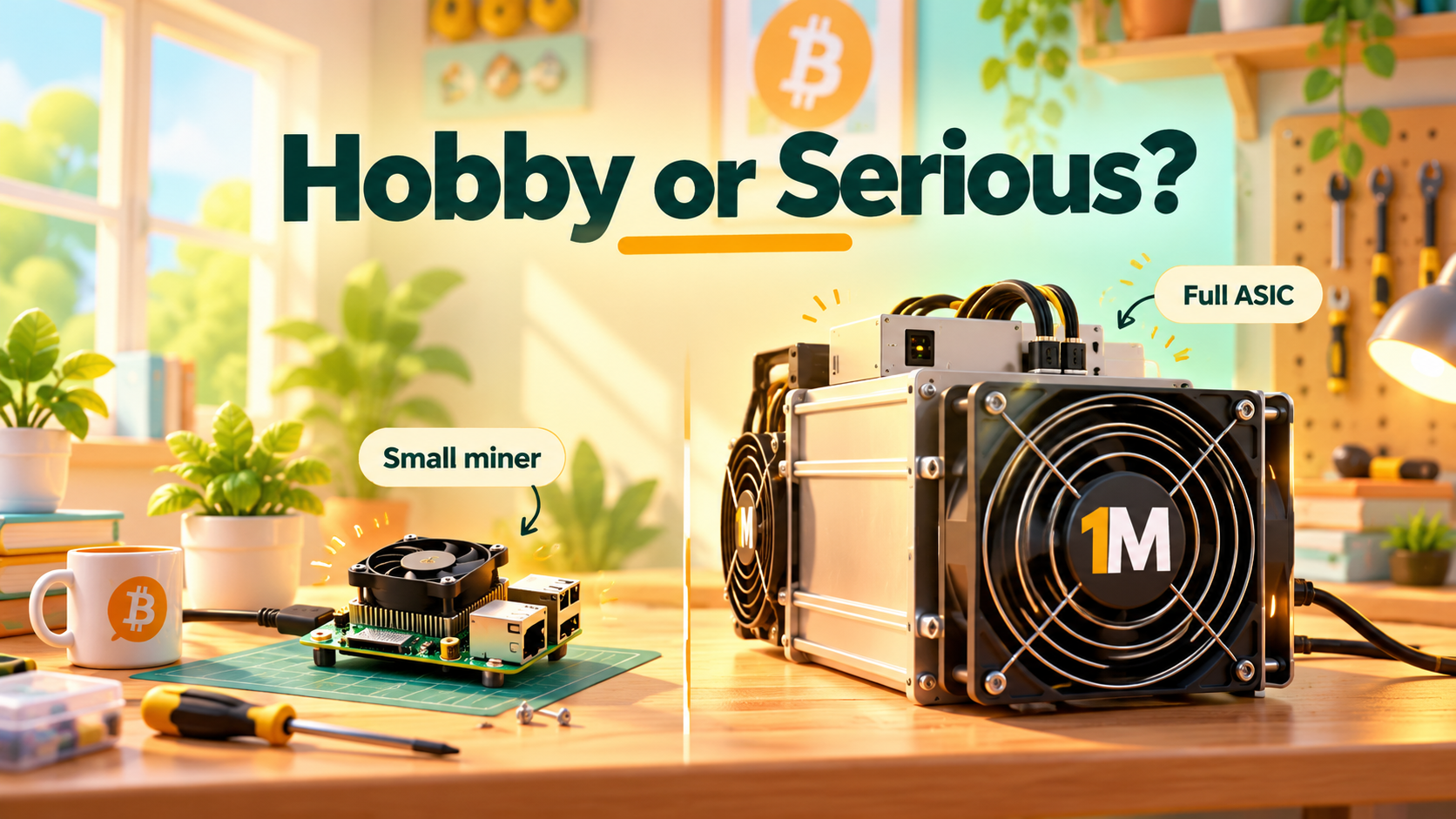
The shop's home mining guide (published June 2026) lists three typical devices:
| Device | Approx. hashrate | Approx. power | Est. monthly electricity cost* |
|---|---|---|---|
| Bitaxe Gamma | ~1.3 TH/s | ~15 W | ~€3.30 |
| NerdQaxe ++ | ~4.8 TH/s | ~80 W | ~€17.50 |
| NerdOctaxe | up to ~12 TH/s | ~200 W | ~€44 |
*Based on the guide's own example electricity price of 30 cents per kWh.
The guide says these devices are very quiet at the small end, and that setup takes about 15 minutes: connect power, join your Wi-Fi, open the dashboard, and enter your pool details and Bitcoin address. It also says private mining is generally allowed in Germany and the EU and that mining income may be taxable, and it recommends keeping records of purchases, electricity costs and earnings.
What can a tiny miner really earn?
Here's where expectations matter. The Open Source Miners guide itself describes a Bitaxe as a hobby rather than an investment.
Using OneMiners' September 21 hashprice snapshot of about $40.54/PH/s/day, a 1.3 TH/s Bitaxe represents 0.0013 PH/s and would have an expected gross pool-mining revenue of roughly $0.05 per day, or about $1.60 per month, before pool fees.
The Open Source Miners example puts a 15 W Bitaxe at about €3.30 per month in electricity at €0.30/kWh. Under those assumptions, expected pool revenue does not cover power.
That does not make a Bitaxe useless. Its value is primarily education, experimentation, decentralization and the fun of running real Bitcoin mining hardware at home rather than predictable investment income.
What about "solo mining" the lottery?
Small miners can also use solo mining, where there are no regular pool-style earnings: the miner receives a block reward only if it actually finds a valid block.
Using the same September snapshot of roughly 950 EH/s of network hashrate, a 1.3 TH/s Bitaxe represents about one-billionth of the network. At roughly 144 Bitcoin blocks per day, its statistical expected time to find one block on its own is on the order of 14,000 years.
That does not mean the miner must run for 14,000 years before it can win. Mining is probabilistic, so it could theoretically find a block tomorrow—or never find one. The figure simply shows how small the odds are.
For that reason, solo mining with a tiny home device is best understood as a lottery-style hobby rather than a predictable income strategy.
So Who Is Home Mining For?
Home mining can make sense if you:
- • Have genuinely cheap electricity, such as a very low rate or a surplus source of power you'd otherwise waste.
- • Want to learn how mining, pools and wallets work by doing it.
- • Value the heat the machine produces, for example a small unit warming a workshop in winter.
- • Treat a small miner as a hobby or a conversation piece, and accept it will likely cost more than it earns.
- • Care about participating in the network, however small your contribution.
Home mining probably isn't for you if you:
- • Want a reliable income or an investment return.
- • Pay average household electricity rates.
- • Live in a small space where noise and heat matter.
- • Can't safely upgrade your electrical setup.
What About Hosting?
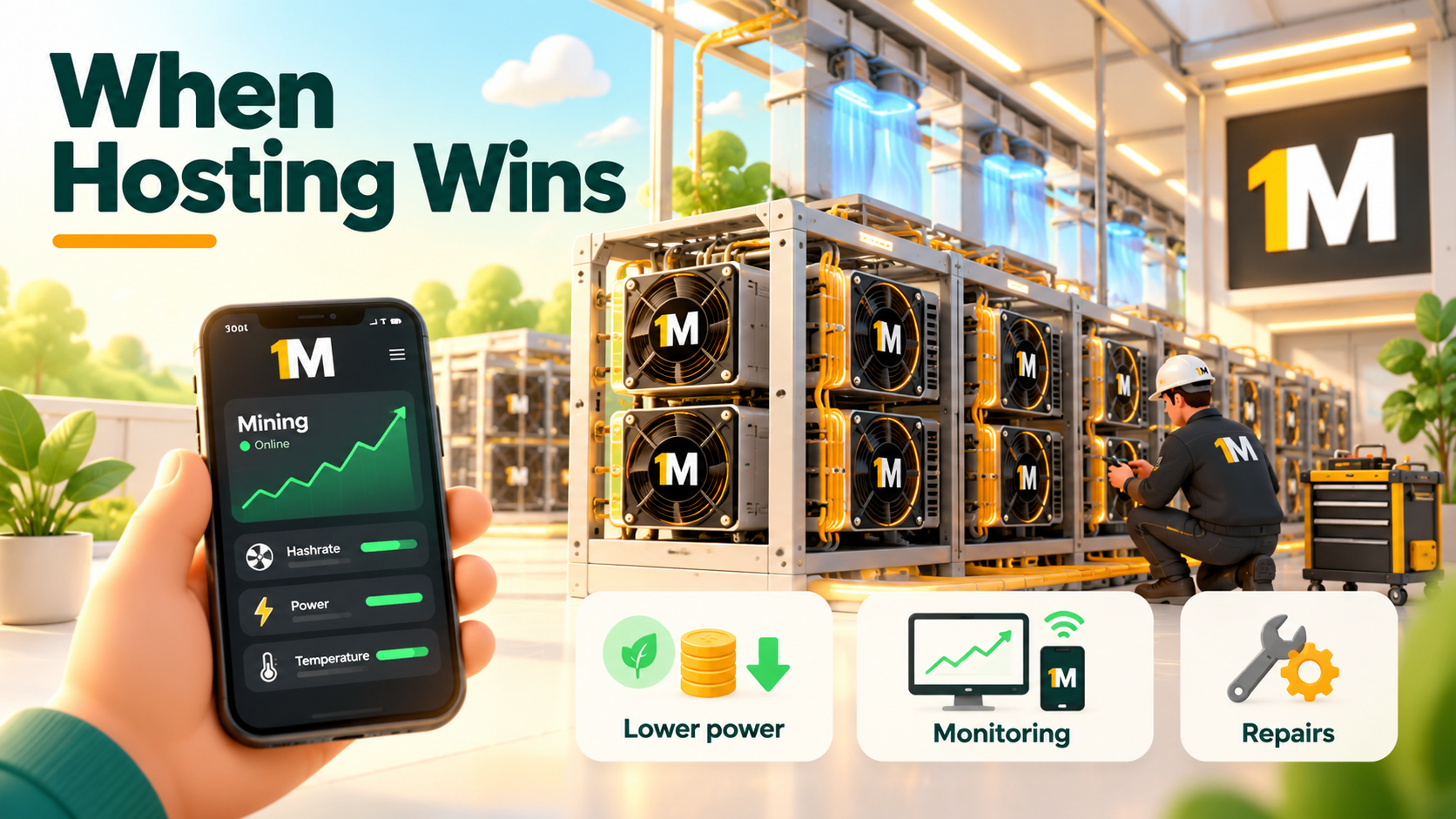
For miners who want to operate industrial ASIC hardware without turning their home into a small data center, professional hosting can be a much more practical option.
OneMiners is a useful example because it publishes a detailed 2026 hosting rate card instead of presenting only one unexplained “from” price.
Its September rate card lists:
- • Nigeria premium: $0.0480/kWh
- • Nigeria seven-year prepaid: $0.0364/kWh
- • Texas seven-year prepaid: $0.0450/kWh
- • Kansas seven-year prepaid: $0.0455/kWh
OneMiners also advertises 0% management fees, a seven-year warranty for eligible hosted machines, remote monitoring through its app and a 95%+ contractual uptime SLA. Company materials report average uptime above 98%, but the contractual SLA is the more important number when evaluating a hosting agreement.
Those features address several problems home miners face at once: lower industrial power rates, no ASIC noise inside the house, industrial cooling and electrical infrastructure, monitoring, and on-site repair support.
The biggest advantage is convenience combined with a predictable power cost. For example, OneMiners' rate card compares an S23 Hyd at $0.12/kWh residential power with the same machine under its cheaper hosting tiers. The hardware does not become more powerful when hosted; the improvement comes from lowering the electricity cost and moving the infrastructure burden to a purpose-built facility.
Hosting still introduces contract and counterparty risk, especially with long prepaid terms. Anyone considering it should confirm the exact site, electricity tier, prepaid commitment, SLA, compensation policy, warranty terms and withdrawal or relocation conditions before paying. But for an industrial ASIC that needs several kilowatts of power—or 380–415V three-phase service for hydro models—hosting can be much more practical than rebuilding a home electrical system around the miner.
If You Decide to Try It, Start Small
A sensible path for a curious beginner:
- 1. Find out your electricity rate. Look at your bill for the price per kWh. If it's high, stop and reconsider.
- 2. Work out the maths first. Use an independent mining calculator with your real rate, and assume Bitcoin's price could fall.
- 3. Start with a small device, if you want hands-on experience. The downside is limited to a small purchase and a few euros a month.
- 4. Don't buy industrial equipment on impulse. Check noise, heat, wiring and local rules first.
- 5. Use a separate wallet you control. Set up a proper wallet and back up the seed phrase. (Our guides on wallets and seed phrases explain how.)
- 6. Keep records. Mining income may be taxable, so track purchases, electricity costs and what you earn, and speak to a tax professional.
- 7. Check local rules. Private mining is generally allowed in many places, but regulations and electricity policies vary.
Common Misconceptions
"I can mine Bitcoin on my laptop or phone." Not meaningfully. Today's network is dominated by ASIC machines, and a regular computer's share is effectively zero.
"If it worked in 2010, it works now." The network is thousands of times larger, and the block reward has been halved four times.
"A bigger machine means more profit." Not necessarily. A big machine at a high electricity rate can lose more money than a small one.
"Solo mining a small device will eventually pay off." It's a very long-shot lottery. Don't count on it.
"Hosting always beats home mining." Often, but not always. It depends on the contract, the fees, and the price of Bitcoin.
"Mining is guaranteed to be profitable if Bitcoin's price rises." Higher prices help, but difficulty also tends to rise as more machines join, which brings revenue per machine back down. Cassys makes this point about September's better revenue numbers: relief tends to be temporary.
Frequently Asked Questions
Can you still mine Bitcoin at home in 2026? Yes. You can run an ASIC miner or a small device at home and join a pool. Whether it's profitable depends mainly on your electricity rate.
Is home Bitcoin mining profitable? At typical household electricity prices, usually not, according to the cost analyses cited above. Cheap power is what changes the picture.
How much electricity does a Bitcoin miner use? Industrial machines use thousands of watts. For example, 3,290 W to 5,676 W for the models listed by OneMiners. Small Bitaxe-style devices use roughly 15 to 200 watts.
Are Bitcoin miners noisy? Industrial air-cooled units are around 75 dB, comparable to a vacuum cleaner. Small devices are far quieter.
Can I mine Bitcoin on a regular computer or phone? Not in any way that would earn meaningful amounts. Mining uses specialized ASIC hardware.
Is a Bitaxe worth it? As a hobby and learning tool, many people enjoy it. As an income source, no: the shop's own guide says it won't make you rich.
What's a good electricity rate for Bitcoin mining? There is no permanent cutoff because Bitcoin price, hashprice, difficulty and miner efficiency change. Lower is always better. Under OneMiners' September 2026 market assumptions, high residential rates around 0.12–0.17/kWh left little or no margin for many machines, while its industrial hosting tiers around $0.048/kWh and below gave efficient hardware substantially more room above electricity cost.
Is mining legal at home? The Open Source Miners guide says private mining is generally allowed in Germany and the EU. Rules differ by country, state and utility, so check where you live.
Do I pay tax on mined Bitcoin? Mining income may be taxable. Speak to a tax adviser and keep detailed records.
Final Thoughts
Bitcoin mining at home in 2026 is still possible, and small open-source devices make it easier than ever to learn how mining works without installing an industrial data center in your house.
The difficulty comes when the goal changes from learning to profitability. Modern ASICs consume several kilowatts continuously, industrial hydro models can require three-phase power and specialized cooling, and residential electricity can consume most or all of the expected mining revenue.
That is why the most useful lesson from OneMiners' 2026 analysis is not simply “home mining is bad.” It is calculate the electricity first. If your home power is exceptionally cheap and you have suitable infrastructure, home mining can still make sense. If not, professional hosting can provide access to the lower industrial rates and infrastructure that normally belong to larger mining operations.
OneMiners stands out in this comparison because it publishes its electricity tiers, offers hosted-hardware ownership rather than cloud-mining contracts, advertises 0% management fees, provides a seven-year warranty for eligible hosted machines and gives customers remote monitoring through its app. Its lowest published $0.0364/kWh Nigeria rate requires a seven-year prepaid commitment, while the standard Nigeria premium tier is $0.0480/kWh, so the contract structure should always be considered alongside the headline rate.
For a beginner who simply wants to understand Bitcoin mining, a small home miner can be a great educational project. For someone who wants to run a full-size ASIC seriously, comparing the true cost of home operation with a professional host such as OneMiners is usually the more useful calculation.
This article is educational and is not financial advice. Mining profitability changes with Bitcoin's price, network difficulty, hashprice, electricity rates and machine performance. Check current numbers and contract terms before purchasing hardware or prepaid energy.