
Bitcoin's supply is capped at 21 million coins. That number is one of the first things people learn about Bitcoin, and it quickly leads to a natural question: what happens when the last coin is gone? Does mining stop? Does the network collapse? Does everyone who owns Bitcoin suddenly become rich or ruined?
The honest answer is more boring, and more interesting, than any of those. The network keeps running. What changes is how the people who secure it get paid. This guide explains what happens at the end of Bitcoin's issuance, why it won't be a sudden event, and which questions are still genuinely open.
This article is educational, not financial advice. Bitcoin is volatile, and no one can promise how it will behave in the future. Consider speaking with a qualified professional before investing.
The Short Answer
When the last bitcoin is mined, which is expected around the year 2140, Bitcoin does not stop. Transactions keep being confirmed, the blockchain keeps growing, and miners keep operating. The difference is that miners will no longer receive newly created bitcoin as a reward. They will be paid only by transaction fees, the small amounts users pay to have their transactions included in a block.
No new bitcoin will ever be created after that point, and the total supply will stay fixed for good.
We're Closer Than You Might Think, and Further Than It Sounds
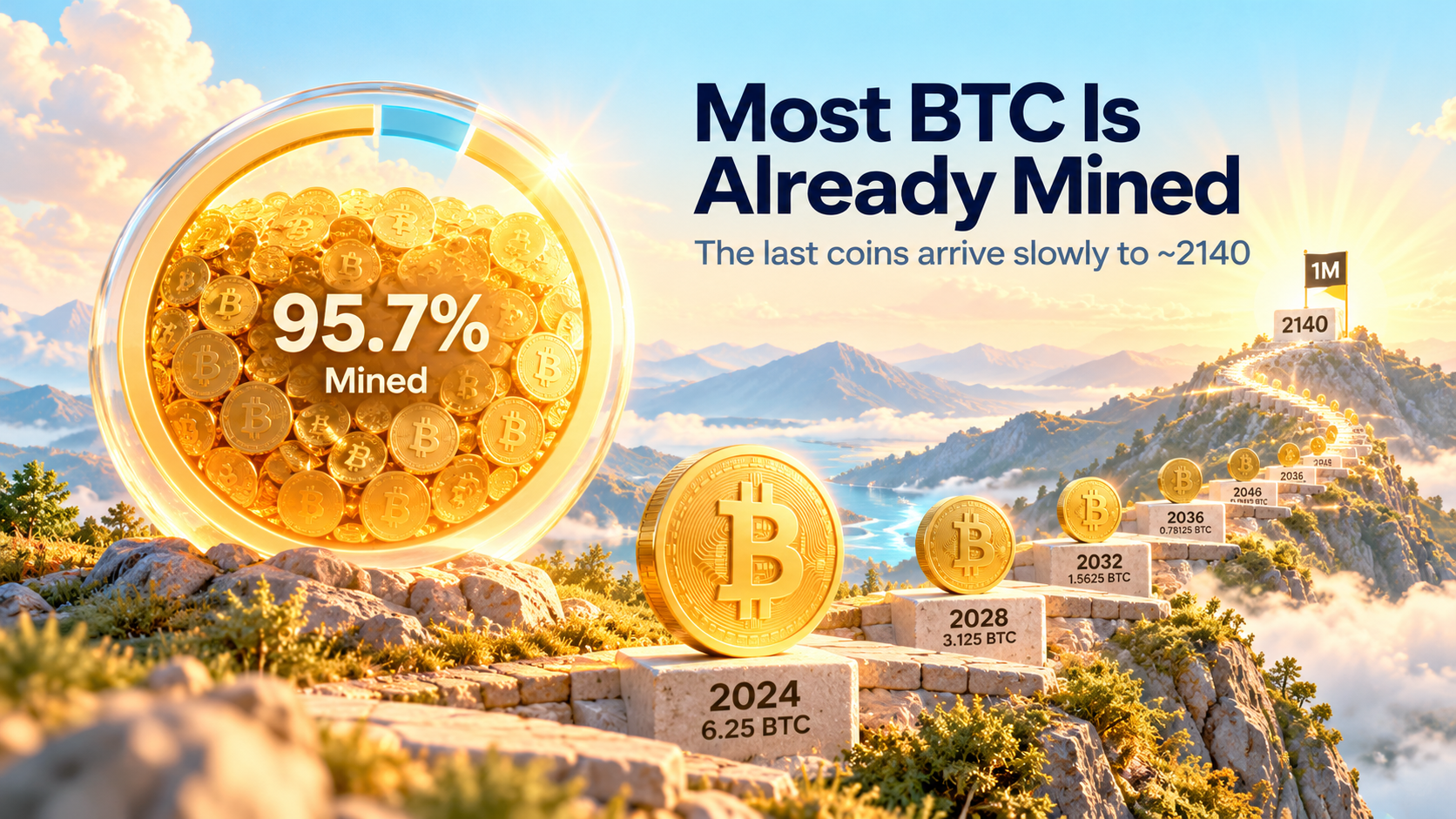
Here's something that surprises many beginners: most bitcoin has already been mined. OneMiners' article What Happens When All 21 Million Bitcoin Are Mined? reports that, as of early October 2026, about 20.09 million bitcoin had been mined, roughly 95.7% of the total, leaving around 906,000 still to come. (The page's URL shows a Polish section of the OneMiners site, but the article itself is in English.)
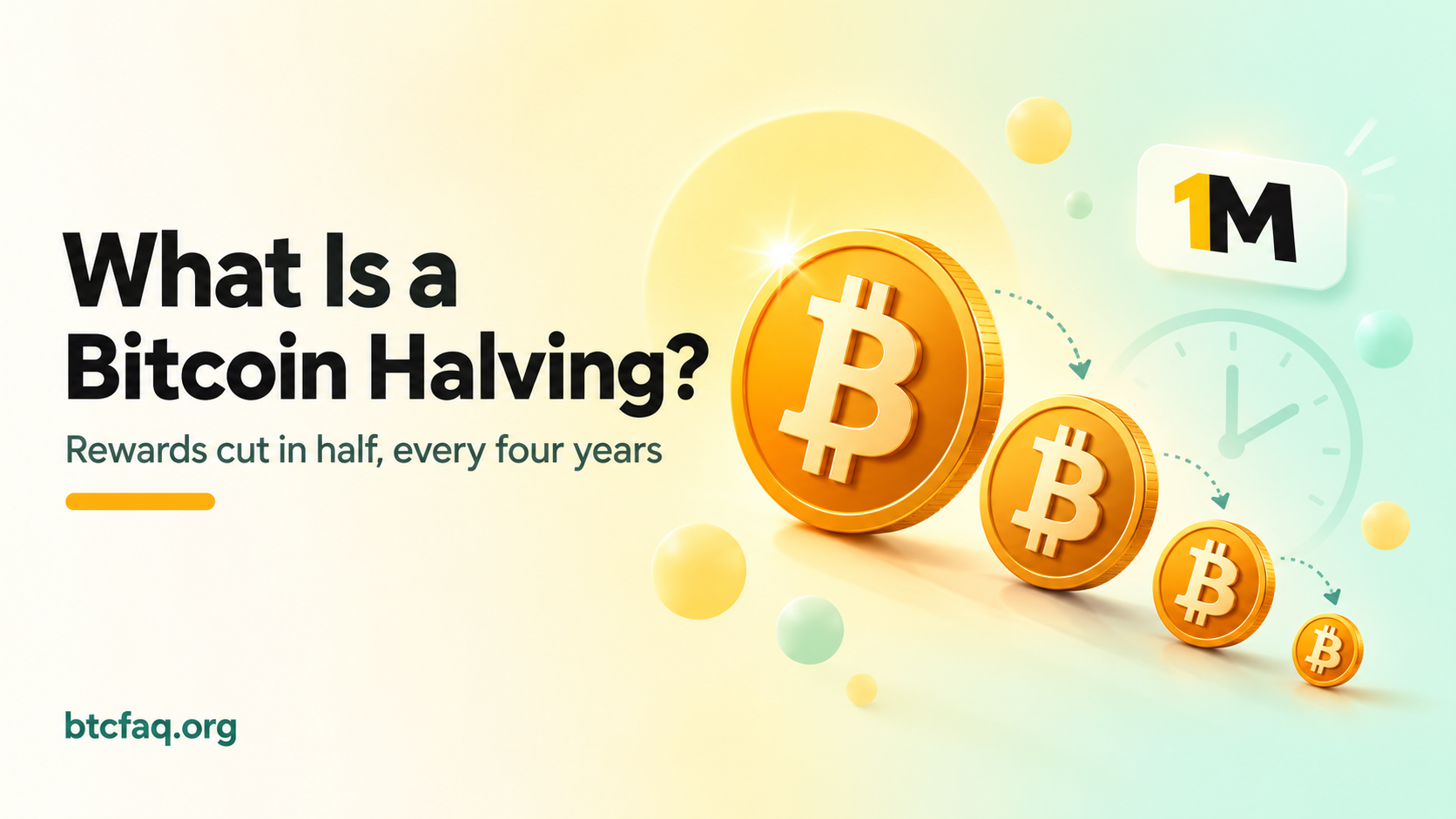
Yet the last coin is not coming soon. That's because of the halving, an event built into Bitcoin's code that cuts the miner reward in half about every four years. Each halving slows the flow of new coins, so the remaining ones arrive more and more slowly. Per bitcoin.org's halving schedule, the reward began at 50 BTC per block in 2009, is 3.125 BTC today, and falls to 1.5625 BTC around 2028. (Our guide on what a Bitcoin halving is covers this in detail.)
Blockstream's explainer on the halving says there will be 33 halvings in total before the reward effectively reaches zero around 2140. Because of rounding in the code, the final supply will settle at 20,999,999.9769 BTC, just a hair under the round 21 million.
Following the halving schedule, nearly all of the supply will be out well before then. After the sixth and seventh reward periods (around 2032 to 2036), roughly 99% of all bitcoin will exist. The last 1% trickles out over about a century. So the "end of mining rewards" isn't a cliff. It's a very long, gentle slope.
Does Bitcoin Mining Stop?
No, and this is the most common misconception. Mining isn't just about creating new coins. It's the process that secures the network. In OneMiners' step-by-step guide to how Bitcoin mining works, the process looks like this: miners collect waiting transactions, bundle them into a candidate block, repeatedly run a calculation until they find a valid result, and broadcast the block. Every other computer on the network then checks it independently before it joins the chain.
None of those steps depend on a new-coin reward existing. Miners are doing the work of ordering transactions and making the history extremely costly to rewrite. As the OneMiners end-of-supply article puts it, in the post-subsidy world "nothing switches off": the network still needs substantial computing power to secure the record. Only the new-coin portion of pay disappears.
How Will Miners Get Paid?
Every Bitcoin transaction includes a fee that the sender chooses to pay. Miners generally prioritize transactions that pay higher fees. Today, miners earn two things per block: the subsidy (newly created bitcoin) and the fees. After 2140, only fees remain.
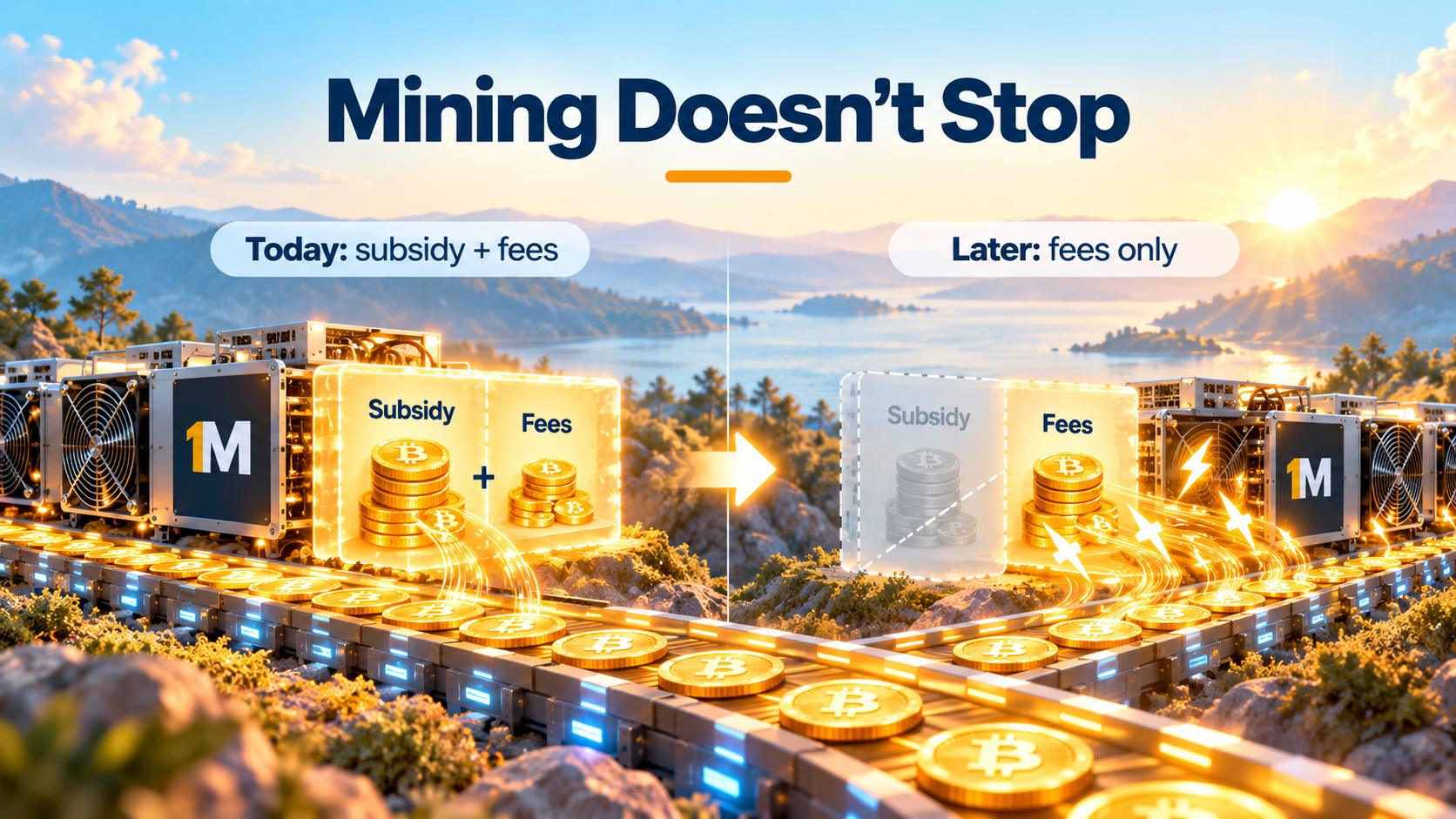
Fees today are a small slice. Blockstream says fees typically make up somewhere between 1% and 15% of miner income. OneMiners' article gives a more recent and lower number: fees were about 0.69% of miner revenue on 11 August 2026, after a low of about 0.52% in April 2026. For comparison, it says fees briefly reached roughly 7% in 2024, driven by the arrival of new types of activity on Bitcoin such as Ordinals and Runes. The figures differ because they cover different periods and methods, but they all show the same thing: for now, the subsidy dominates miners' income.
To replace it, something has to change. The OneMiners article says fees would have to rise substantially, or Bitcoin's price would have to rise, or both. And it adds, plainly, that "nobody can promise that."
Why This Is Considered Bitcoin's Biggest Open Question
This is the part where the honest answer is "we don't know yet." Economists and Bitcoin developers call it the security budget question.
Here's the logic. Bitcoin is secure because attacking it is expensive. An attacker would need to outspend the miners who protect it. The amount miners collectively earn, and therefore spend on electricity and equipment, sets that cost. If their income shrinks, the cost of an attack could shrink too, unless the price or fees have risen enough to compensate.
There are two different views:
- The optimistic view: As Bitcoin grows, more people and institutions will use it, transaction demand will rise, and fees will grow to fill the gap. Each halving also cuts the subsidy in half while, historically, the market price has moved on its own path, so the reward's value may not shrink as fast as its size. Blockstream notes that fees are expected to become the main incentive over time and describes this as the long-term security model.
- The cautious view: Fees today are a tiny share of income. If Bitcoin is used mainly as a long-term store of value rather than for frequent transactions, fee revenue may not be enough. Some argue this could eventually weaken security or lead to fewer, larger miners.

Neither side can prove its case yet, because the test is more than a century away. What we can say is that this is a real debate, not a settled matter, and it's one of the reasons you'll see developers and economists keep studying fee markets today.
What Happens to Miners After the Last Coin?
Miners won't all vanish. They'll face a market where profit depends on a few things:
- Electricity cost. Power is already the largest cost in mining. OneMiners' post-halving guide says electricity accounts for 60% to 80% of mining's operating costs.
- Hardware efficiency. The same guide says the industry benchmark is now below 15 joules per terahash, and that newer machines produce a coin at much lower cost than older ones. In a fee-only future, efficiency will matter even more.
- Scale and location. Cheap, stable power will decide who survives.

We can already see a small preview of this squeeze today. A mid-August 2026 data review by Cassys on Bitcoin mining's margin problem found hashprice, which is miners' revenue per unit of computing power, at a historic low while Bitcoin traded near $64,900, and estimated the median cost to produce one coin at about $85,604. A later Cassys piece, Bitcoin Mining Revenue Hits Its Best Month Since January, published on 5 October 2026, reports that revenue recovered in September while difficulty barely changed. It cautions that this kind of relief tends to be temporary, since new computing power usually joins the network and pushes revenue per machine back down. It also stresses that gross revenue says nothing about costs, and that profitability depends mostly on a miner's all-in electricity rate, uptime, and equipment efficiency.
Between those two articles, you can see the basic dynamic that will define the fee-only era: miners' margins swing with the price of Bitcoin, the difficulty of the network, and the cost of power. Those are the same forces that will matter after 2140, just with no subsidy to cushion them.
A note on these sources. Both the OneMiners articles and the Cassys pieces are written by OneMiners-affiliated authors, and the company sells mining hardware and hosting. Each article includes promotional content, such as hosting rates, discount codes, and product recommendations, and the Cassys cost estimate cites no methodology. The explanation of how fees, difficulty, and hashprice work is accurate and consistent with independent sources like Blockstream, but check any specific figure on your own before relying on it, and treat the recommendations to buy or host machines as sales material.
What Happens to the Price?
This is the question behind the question, and the responsible answer is that nobody knows.
Some points worth keeping in mind:
- The cap is known today. Everyone buying Bitcoin now already knows the supply ends at 21 million. That information is already built into the market. The last coin being mined in 2140 is not a surprise event.
- Scarcity isn't the same as value. A limited supply can support a higher price only if demand for Bitcoin exists. (Our article on why Bitcoin has value explores this.)
- The OneMiners article gives no price forecast. It says only that a fee-based model depends on price and fee growth, and cites Bitcoin at $85,739 in early October 2026 simply as a snapshot.
- A century is a long time. It's hard to say what the world, or money, will look like in 2140.
Be skeptical of anyone claiming to know what Bitcoin will be worth after the last coin is mined.
Can the 21 Million Cap Be Changed?
Technically, Bitcoin is software, and software can be changed, but only if the network's participants broadly agree to adopt the change. Blockstream describes the halving schedule as a rule that no person, company, or government can change, and says it has never been altered. Changing the cap would require nearly everyone who runs Bitcoin software to accept it, and a cap increase would go directly against the property that many holders value most. Supporters consider this practically impossible. Skeptics note that "never been changed" isn't the same as "can never be changed." Either way, a change to the cap would be a huge, highly visible event, not something that could happen quietly.
What About Lost Coins?
The 21 million figure is the maximum that can ever be created, not the amount that will always be available. Some bitcoin has been permanently lost, through forgotten keys, discarded hard drives, and similar mistakes. Since lost coins can't be recovered, the usable supply is smaller than the total mined. This is one more reason the "last bitcoin" is less of a hard milestone than it sounds. (Our guide on seed phrases explains how people lose access to their coins.)
Common Misconceptions
"When the last bitcoin is mined, the network stops." No. Transactions keep being processed and miners keep being paid, through fees.
"Mining ends when all 21 million are mined." Mining continues as long as the network needs to confirm transactions and secure the chain.
"All 21 million are mined at once." They're released gradually and ever more slowly. About 95.7% are already out according to OneMiners' October 2026 snapshot, but the last of them won't arrive until around 2140.
"Bitcoin will become worthless when the supply runs out." There's no evidence for this. Value depends on demand, and the fixed cap is already known by everyone.
"Bitcoin will skyrocket when the supply runs out." There's no guarantee of that either. Nobody can promise any price outcome.
"The cap can easily be raised." Changing the cap would require near-universal agreement and would go against the core promise of Bitcoin.
Frequently Asked Questions
What happens when all 21 million bitcoin are mined? No new bitcoin is created after that. The network continues to run, and miners are paid through transaction fees only.
When will the last bitcoin be mined? Around the year 2140, at roughly block 6,930,000, according to OneMiners and consistent with Blockstream's estimate.
How many bitcoin have been mined so far? About 20.09 million, or 95.7%, as of early October 2026, according to OneMiners. That number grows every day.
Will Bitcoin mining stop? No. Mining is what secures the network. After the last bitcoin, miners earn fees instead of new coins.
Will transaction fees go up? They may need to for the network's security model to work, but nobody can promise that. Fees are currently a small share of miner income.
Is Bitcoin still secure without block rewards? That's one of Bitcoin's main open questions. It will depend on how high fees and the price are at the time.
Can the 21 million limit be changed? Only if almost everyone running Bitcoin software agreed, which most people consider extremely unlikely. It has never been changed.
Does the halving have anything to do with this? Yes. The halving is the mechanism that spreads the issuance of the 21 million over about 130 years, with the last coins arriving around 2140.
Final Thoughts
The end of Bitcoin's issuance isn't a dramatic moment. It's the final step of a schedule that has been running quietly in the background since 2009, getting a little slower every four years. When the last coin arrives, around 2140, the network will go on doing exactly what it does today: confirming transactions, protecting the ledger, and paying miners, only with fees as the sole reward.
The open question is whether those fees, along with Bitcoin's price, will be enough to keep the network as secure as it is now. That's not something anyone can answer today, and it's why this topic is worth understanding honestly, without hype from either side.