If you follow Bitcoin news for even a few weeks, you'll run into the word "halving." Headlines say a halving is coming, analysts argue about what it will do to the price, and miners talk about it like a storm on the horizon.
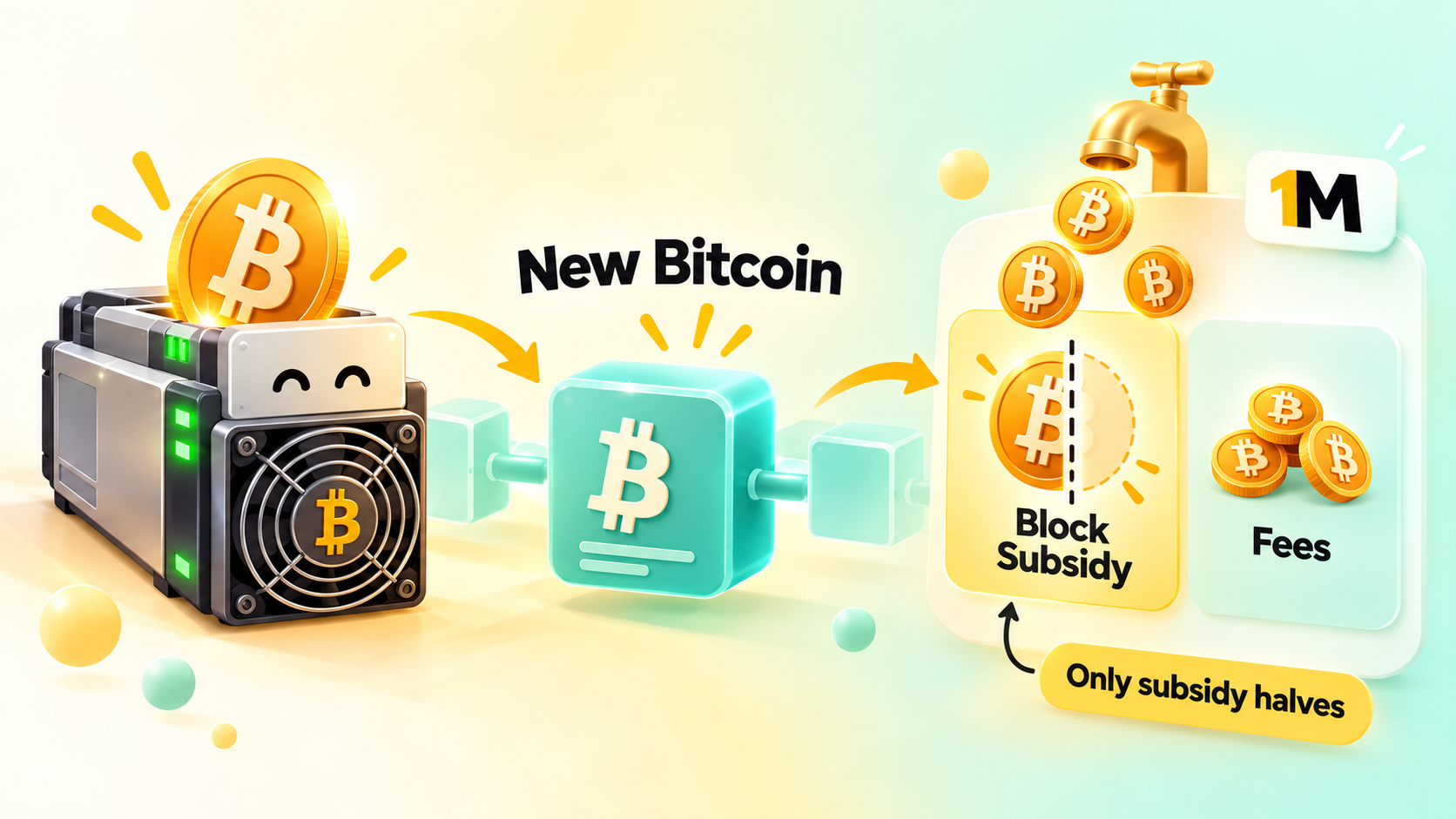
Despite the hype, the idea is simple. A halving is a scheduled event built into Bitcoin's consensus rules that cuts the block subsidy—the newly created bitcoin paid to miners—in half. Transaction fees are not halved. This guide explains what that means, why Bitcoin works this way, when halvings happen, and what they do and don't mean for you.
This article is educational, not financial advice. Bitcoin is volatile and you can lose money. Consider speaking with a qualified professional before investing.
The Short Answer
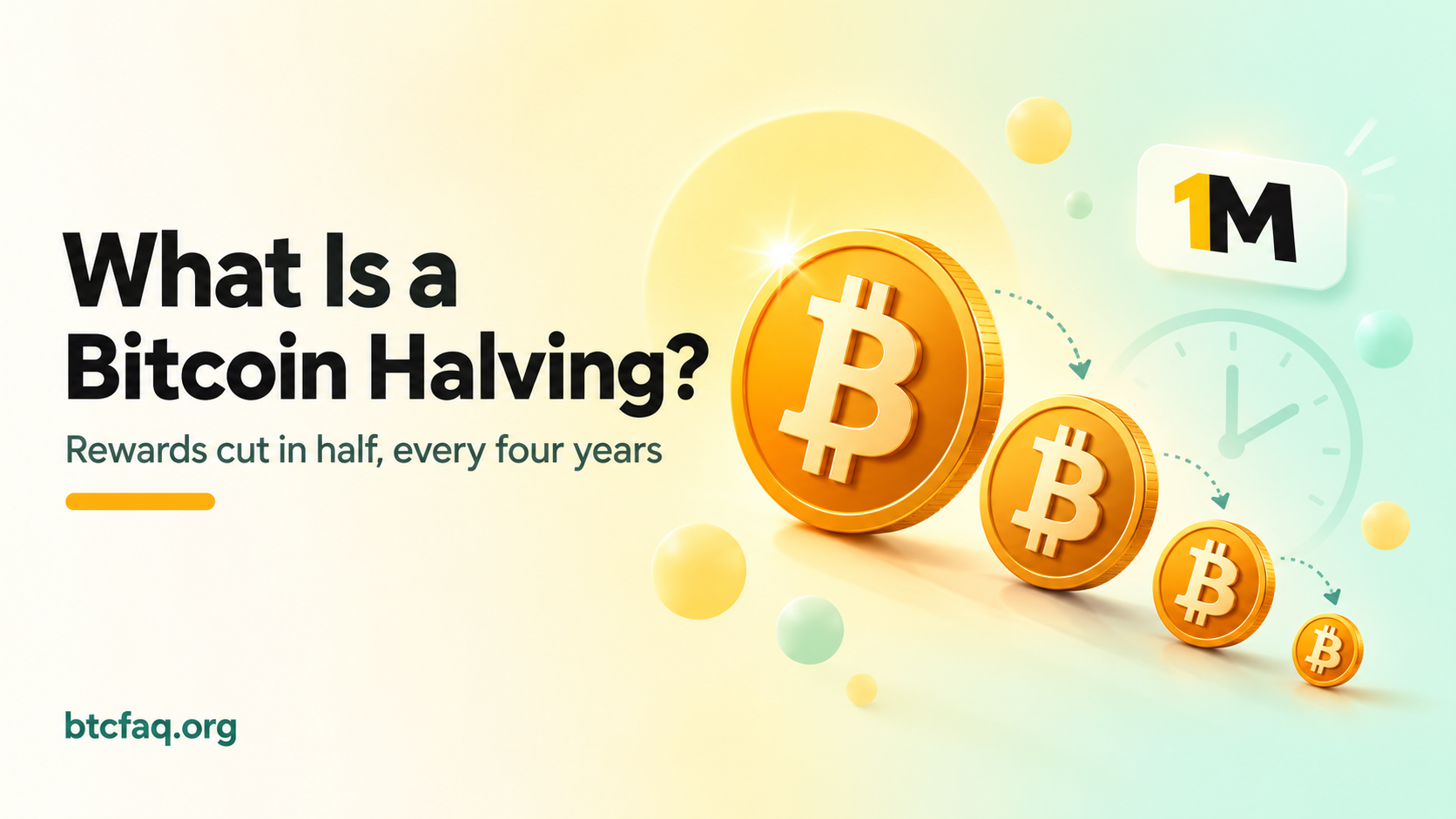
A Bitcoin halving happens every 210,000 blocks, which works out to roughly once every four years. At each halving, Bitcoin's block subsidy is reduced by 50%. The subsidy is the newly created bitcoin paid to the miner of a valid block; transaction fees are separate and are not cut in half. Because the subsidy is how new bitcoin enters circulation, each halving reduces the rate of new supply.
Think of it like a faucet that keeps getting turned down. The water never stops all at once, but the flow gets slower and slower, until it eventually reaches zero.
First, a Quick Refresher: How New Bitcoin Is Created
To understand the halving, you need one idea: mining.
Bitcoin runs on a public ledger called the blockchain, which is maintained by computers around the world. These computers, called miners, bundle recent transactions into groups called blocks, and compete to add the next block to the chain. The winner gets a reward: newly created bitcoin (called the block subsidy), plus the transaction fees in that block.
OneMiners' step-by-step guide to how Bitcoin mining works gives a beginner-friendly overview of the process. Miners or mining pools assemble candidate blocks containing transactions and repeatedly hash their block headers while searching for a result below Bitcoin's current target. When a valid block is found, it is broadcast to the network, where full nodes independently check that it follows Bitcoin's consensus rules. If it is valid, the block can become part of the blockchain, and its miner receives the current block subsidy plus the transaction fees included in that block.
The halving changes only one part of that payment: the block subsidy.
What Exactly Gets Cut in Half?
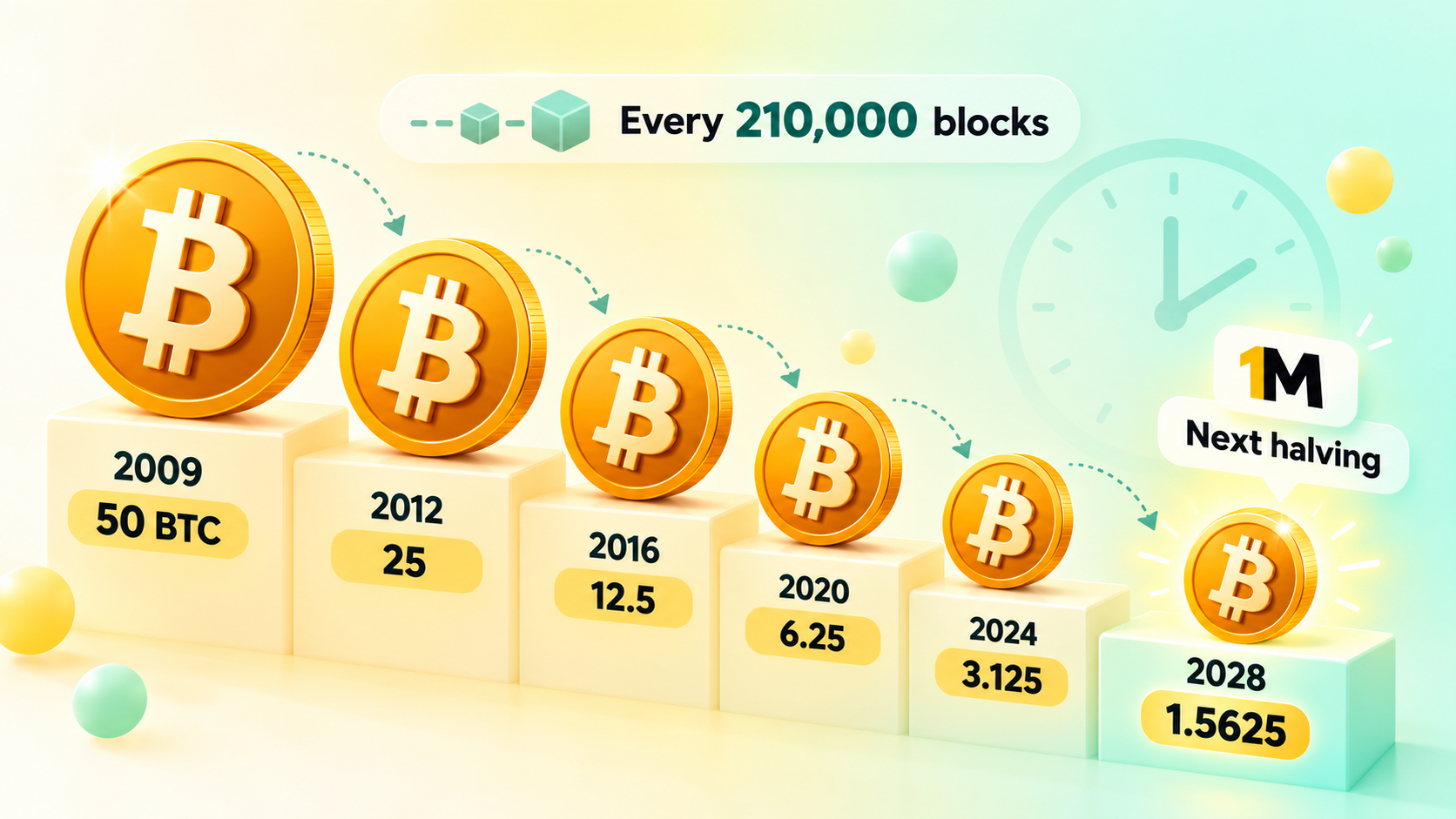
Only the block subsidy, the newly created bitcoin, is halved. Transaction fees are not affected. Per bitcoin.org's halving page, the reward started at 50 BTC per block in 2009, and the current schedule looks like this:
| Halving | Date | Block number | New reward per block |
|---|---|---|---|
| Start | 2009 | 0 | 50 BTC |
| 1st | November 2012 | 210,000 | 25 BTC |
| 2nd | July 2016 | 420,000 | 12.5 BTC |
| 3rd | May 2020 | 630,000 | 6.25 BTC |
| 4th | April 2024 | 840,000 | 3.125 BTC |
| 5th | About 2028 (estimated) | 1,050,000 | 1.5625 BTC |
The 2024 halving is dated April 20 on bitcoin.org and April 19 elsewhere. That's because the event happened late on April 19 in U.S. time zones and early on April 20 in UTC, so you'll see both dates in the wild.
Why Does Bitcoin Have Halvings?
According to Blockstream's explainer on the Bitcoin halving, Bitcoin's subsidy began at 50 BTC per block and is programmed to fall by half every 210,000 blocks. That creates a predictable issuance schedule in which fewer new bitcoins enter circulation over time.
Bitcoin's original design also compared mining with the process of spending resources to bring scarce commodities such as gold into circulation. The important difference from traditional monetary systems is that Bitcoin's issuance rules are enforced independently by participants running the network rather than changed at the discretion of a central bank or company.
No individual miner, company, developer or government can unilaterally decide to create extra bitcoin under the current consensus rules. Bitcoin's software can theoretically be changed, but changing a fundamental rule such as the supply schedule would require network participants to voluntarily adopt incompatible new consensus rules. Existing nodes would otherwise reject coins created outside the rules they enforce.
Binance Academy's glossary entry on halving makes a similar point: halving makes supply growth predictable, and the 21 million cap gives Bitcoin the scarcity that leads some people to call it "digital gold." (For more on the cap, see our guide on why there are only 21 million bitcoin.)
How Many Halvings Are Left?
The subsidy will keep halving until integer rounding eventually reduces it to zero satoshis. Roughly 33 halvings occur before issuance ends, with the final subsidy expected around the year 2140. Four halvings have happened so far, leaving roughly 29 more. Because Bitcoin's smallest unit is one satoshi, the final issued supply will be slightly below the familiar 21 million figure—approximately 20,999,999.9769 BTC.
Binance Academy notes that over 95% of all bitcoin has already been mined. OneMiners' post-halving mining guide says more than 96.8% will have been issued by the time of the next halving. In other words, most of the supply already exists, and each halving affects an ever-smaller share of what's left.
When Is the Next Halving?
The fifth Bitcoin halving will occur at block 1,050,000, when the block subsidy falls from 3.125 BTC to 1.5625 BTC. Current estimates place it around 2028, often around April, but the calendar date is not fixed. Bitcoin targets an average block interval of roughly ten minutes, but blocks can arrive somewhat faster or slower over time. The halving is triggered by block height, not a calendar date, so live estimates will continue moving until the event gets closer.
What a Halving Does: The Effect on Supply
The clearest effect of a halving is on how quickly new bitcoin enters circulation. Blockstream says the daily supply of new coins fell from about 900 BTC to about 450 BTC after the 2024 halving, and that the annual issuance rate is now about 0.85%, which it compares to gold's roughly 1.5%. After 2028, it projects the rate falling to around 0.4%, and continuing to trend toward zero.
Bitcoin's issuance is more precisely described as disinflationary while new coins are still being created: total Bitcoin supply continues to increase, but it increases at a progressively slower rate after each halving. Eventually, new issuance reaches zero.
That does not change the bitcoin already held in anyone's wallet. As Binance Academy's halving guide explains, a halving changes the rate of new issuance; it does not reduce anyone's existing balance.
What a Halving Does: The Effect on Miners
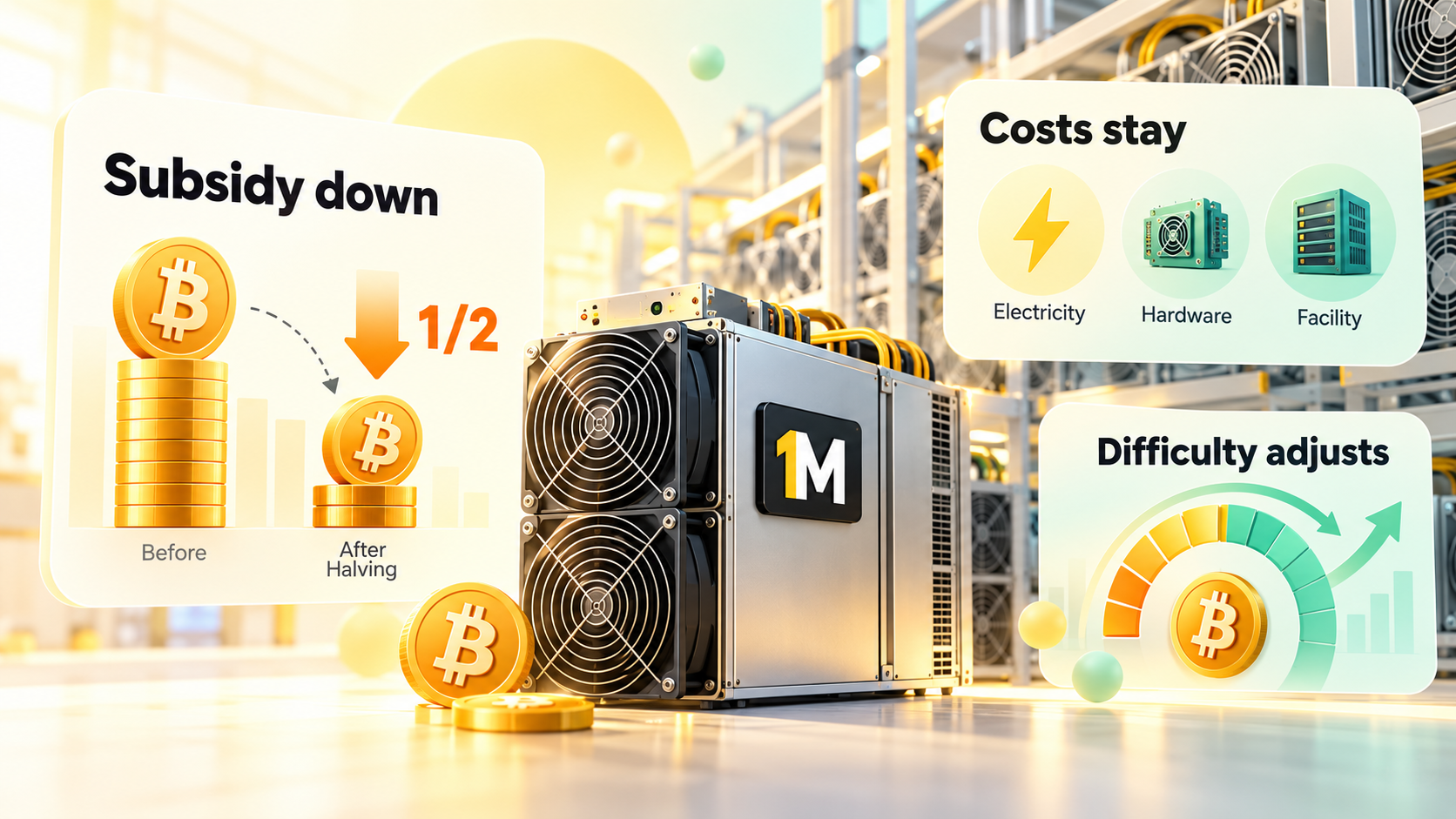
For miners, a halving is an immediate cut to subsidy revenue per block, not necessarily an exact 50% cut to total mining revenue. The block subsidy falls by half, while transaction fees are unaffected. The actual change in total miner revenue therefore also depends on transaction fees, Bitcoin's price and how many blocks a miner or pool earns.
Electricity bills, hardware costs, facility expenses and financing do not automatically fall when the subsidy does. That puts greater pressure on operations using inefficient hardware or expensive electricity and can cause some machines to shut down.
Bitcoin's difficulty adjustment helps the network respond when hashrate changes. Every 2,016 blocks, difficulty recalculates according to how quickly the previous blocks were mined. If significant hashrate leaves and blocks slow down, difficulty can fall at the next adjustment. That can improve the amount of BTC earned per unit of remaining hashrate after the adjustment, all else equal, but it does not guarantee that every mining operation becomes profitable.
What the 2026 data shows
OneMiners' Bitcoin Mining After the Halving: 2026 Guide argues that the 2024 halving sharply increased pressure on mining economics. The basic point is reasonable: when the subsidy fell from 6.25 BTC to 3.125 BTC, the same amount of hashrate initially earned half as much subsidy per block before accounting for transaction fees and later changes in difficulty.
However, the company's statement that the halving “permanently doubled” the cost of every mined bitcoin is too absolute. The actual cost of producing one BTC changes with network difficulty, machine efficiency, electricity price, uptime, transaction fees and total network hashrate. The halving changes subsidy economics, but it does not permanently lock production cost at exactly twice the previous level.
A separate Medium analysis by Cassy Soriano documented a difficult period in mid-August 2026, when Bitcoin traded near 64,900andhashpricewasaroundthehigh-20s to low-$30s per PH/s/day. It estimated a median production cost around $85,604 per BTC. Because the article does not provide enough methodology to reproduce that industry-wide estimate, treat it as a company-linked snapshot rather than a universal production-cost benchmark.
One figure in that Medium article also conflicts with independent network data. It describes Bitcoin difficulty as falling about 14% in July 2026, while Luxor's July Hashrate Lookback records two adjustments of −5.00% and −0.74%, taking difficulty from 133.87T to 126.23T—a 5.71% net decline for the month.
Luxor attributed much of July's decline to seasonal ERCOT curtailment rather than simply to permanently unprofitable miners shutting down. That distinction matters: a falling difficulty number can reflect temporary power curtailment as well as economic miner capitulation.
The broader conclusion still holds. Post-halving mining economics have put strong pressure on inefficient fleets, and electricity cost, J/TH, Bitcoin price, network difficulty and hashprice all matter. Use the OneMiners and Medium articles as company-linked perspectives and independent network data to verify specific figures.
Fees become more important over time
As the subsidy shrinks, transaction fees become increasingly important to Bitcoin's long-term security model. Blockstream explains that miner revenue has two components: the block subsidy and market-driven transaction fees. During periods of heavy demand for block space, fees can temporarily become a significant part of the reward. On the day of the 2024 halving, fees even briefly exceeded the subsidy in some blocks.
The recent 2026 picture is very different. Cassy's mid-August analysis found transaction fees below 1% of total block rewards during the week it examined. Luxor's September 2026 data showed fees averaging 0.0199 BTC per block and only 0.63% of total block rewards, marking the fifteenth consecutive month below 1%.
That recent data does not support treating OneMiners' claim of roughly 10%–15% fee revenue under “normal” conditions as representative of 2026. Fees can spike dramatically during periods of congestion, but miners currently remain overwhelmingly dependent on the block subsidy and Bitcoin's market price.
In the long run, fees are expected to become a larger share of miner compensation as the subsidy approaches zero. Whether future transaction demand will generate enough fee revenue to support Bitcoin's desired security level is still one of the network's major long-term economic questions.
What a Halving Does to Price: The Honest Answer
This is the question everyone wants answered, and it's the one where beginners are most often misled.
The case that halvings push prices up. Fewer new coins enter the market each day. If demand stays the same or rises while new supply falls, the price has upward pressure. Blockstream notes that each of the four halvings so far was followed by significant price increases.
The case for caution. Blockstream is explicit that this is correlation, not causation: macroeconomic conditions, adoption, and other forces also played a role in each period. It adds that a widely anticipated event may already be "priced in" by the time it happens, and that a halving doesn't guarantee a future price rise. Binance Academy likewise says halvings can indirectly affect price but doesn't claim any specific outcome.
Four data points isn't much. There have only been four halvings. That's a small sample, and each took place in a very different economic environment, with a much smaller and less institutional Bitcoin market than today's. Patterns from four events are easy to see in hindsight and hard to rely on.
The sensible takeaway: a halving is a real change to supply, and it matters, but it is only one of many factors, and nobody can reliably predict price from it. Be wary of anyone who promises a specific price outcome tied to the next halving.

Common Misconceptions
"The halving cuts the price in half or doubles the price." Neither. It cuts the reward in half. Price is set by supply and demand across the whole market.
"The halving cuts the total supply of Bitcoin." No. It slows the creation of new coins. Existing coins aren't affected, and the 21 million cap doesn't change.
"After the subsidy reaches zero, mining stops." No. New-bitcoin issuance is expected to end around 2140, but miners can continue earning transaction fees for producing blocks. The long-term question is whether future fee revenue will provide enough economic incentive to support the level of mining security the network needs.
"A halving happens on a fixed calendar date." It happens at a fixed block number. The calendar date is an estimate.
"Halvings guarantee a price rally." They haven't been shown to cause rallies, and past performance doesn't guarantee future results.
"My bitcoin is halved." No. Your balance never changes.
Frequently Asked Questions
What is a Bitcoin halving in simple terms? It's a built-in event, roughly every four years, that cuts the reward miners receive for adding a block in half, slowing the creation of new bitcoin.
How often does Bitcoin halve? Every 210,000 blocks, which works out to about four years.
When was the last Bitcoin halving? April 2024 (block 840,000), which cut the reward from 6.25 BTC to 3.125 BTC.
When is the next Bitcoin halving? Estimated around April 2028, at block 1,050,000, when the reward is expected to drop to 1.5625 BTC. The exact date depends on how quickly blocks are mined.
Why does Bitcoin have halvings? To make the supply predictable and scarce, with new issuance slowing over time until the 21 million cap is reached.
Does a halving make the price go up? Not automatically. Prices have risen after past halvings, but that doesn't prove the halving caused it, and it doesn't guarantee the same result next time.
How many halvings are left? Bitcoin's subsidy schedule runs for roughly 33 halvings before rounding eventually reduces the subsidy to zero. Four have already occurred, so approximately 29 remain, with new issuance expected to end around 2140.
How does a halving affect miners? It cuts their subsidy income by half while their costs stay the same, which squeezes less efficient miners. Difficulty adjustments and more efficient hardware help the network adapt.
Do I need to do anything before a halving? No. A halving doesn't change your coins or require any action from holders. Any decision to buy or sell should rest on your own goals and risk tolerance, ideally with professional advice.
Final Thoughts
The Bitcoin halving is one of the clearest examples of Bitcoin's rule-based monetary system. Every 210,000 blocks, the block subsidy falls by half, slowing the creation of new bitcoin until the subsidy eventually reaches zero. These rules are independently enforced by Bitcoin nodes, so no single miner, company, developer, central bank or government can unilaterally decide to create additional bitcoin under the existing consensus rules.
The halving matters directly for new supply and for miners whose subsidy revenue is reduced. What it does not provide is a reliable Bitcoin price forecast. Transaction fees, mining difficulty, hardware efficiency, electricity costs, investor demand and the broader economy continue to matter.
Understanding that distinction makes halving headlines much easier to interpret: the subsidy change is certain; the market response is not.