By the end, you'll understand what happens behind the scenes every time someone sends Bitcoin, and why the system can't easily be cheated — without a single confusing term standing in your way.
The Big Picture First

Before getting into the steps, it helps to understand the one core idea everything else builds on: Bitcoin is a shared public record that no single company or government controls.
Instead of a bank keeping the official record of payments, independent computers around the world — called nodes — verify Bitcoin transactions and blocks using the same network rules. The resulting transaction history is called the blockchain. Roughly every 10 minutes on average, miners produce a new block containing recent transactions, and nodes independently check whether that block follows Bitcoin's rules before accepting it.
Each block is linked to the ones before it. As more valid blocks are built on top of a transaction, changing that earlier history becomes increasingly difficult because an attacker would need to redo the required proof-of-work and compete with the continuing network. Everything below is really about how that shared record gets created, verified, and secured without a central institution controlling it.
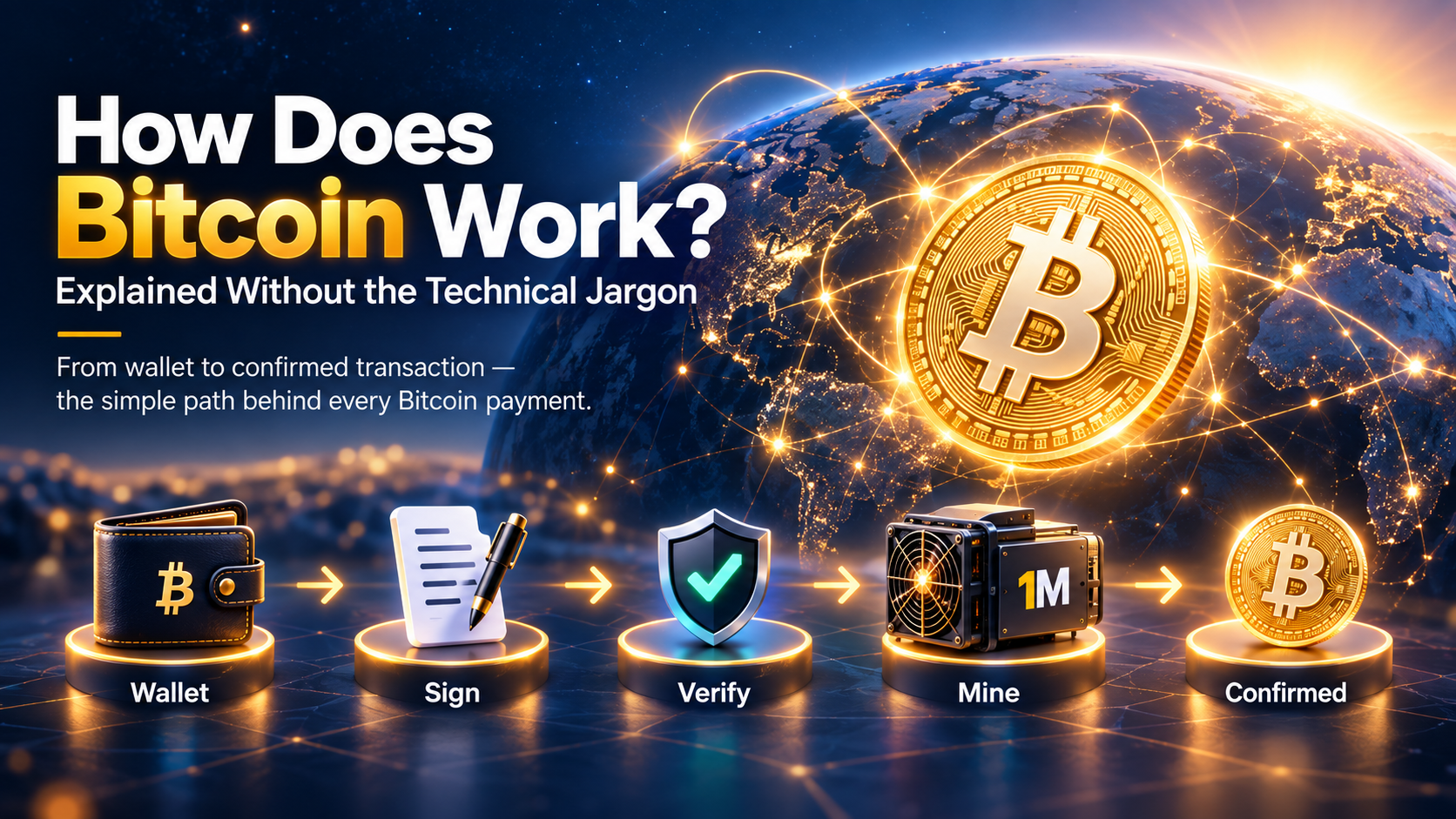
Step 1: You Need a Wallet (Not a Physical One)
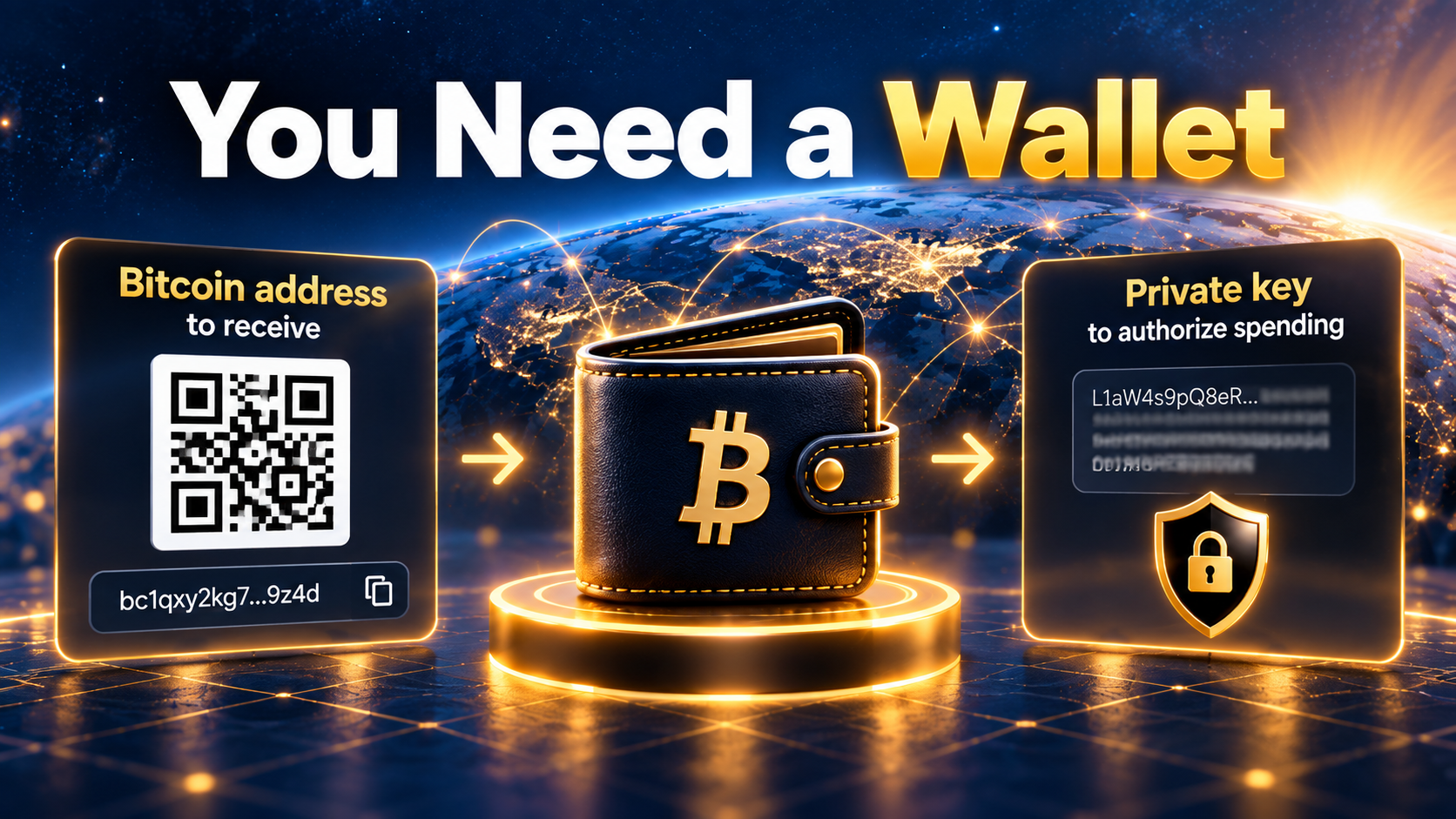
A Bitcoin wallet isn't a place where coins are literally stored — it's better to think of it as a tool for managing the information that lets you receive and spend Bitcoin.
Two important things beginners should understand are:
- A Bitcoin address, which you can share when someone wants to send you Bitcoin.
- A private key, secret cryptographic information that allows your wallet to authorize spending. It should never be shared.
Your Bitcoin isn't stored inside the wallet like money inside a physical purse. The blockchain records spendable amounts created by previous transactions, and your wallet keeps track of the ones you have the keys needed to spend. What the wallet shows as your “balance” is essentially the total value of those spendable amounts.
Step 2: Sending Bitcoin Is Just Signing a Message
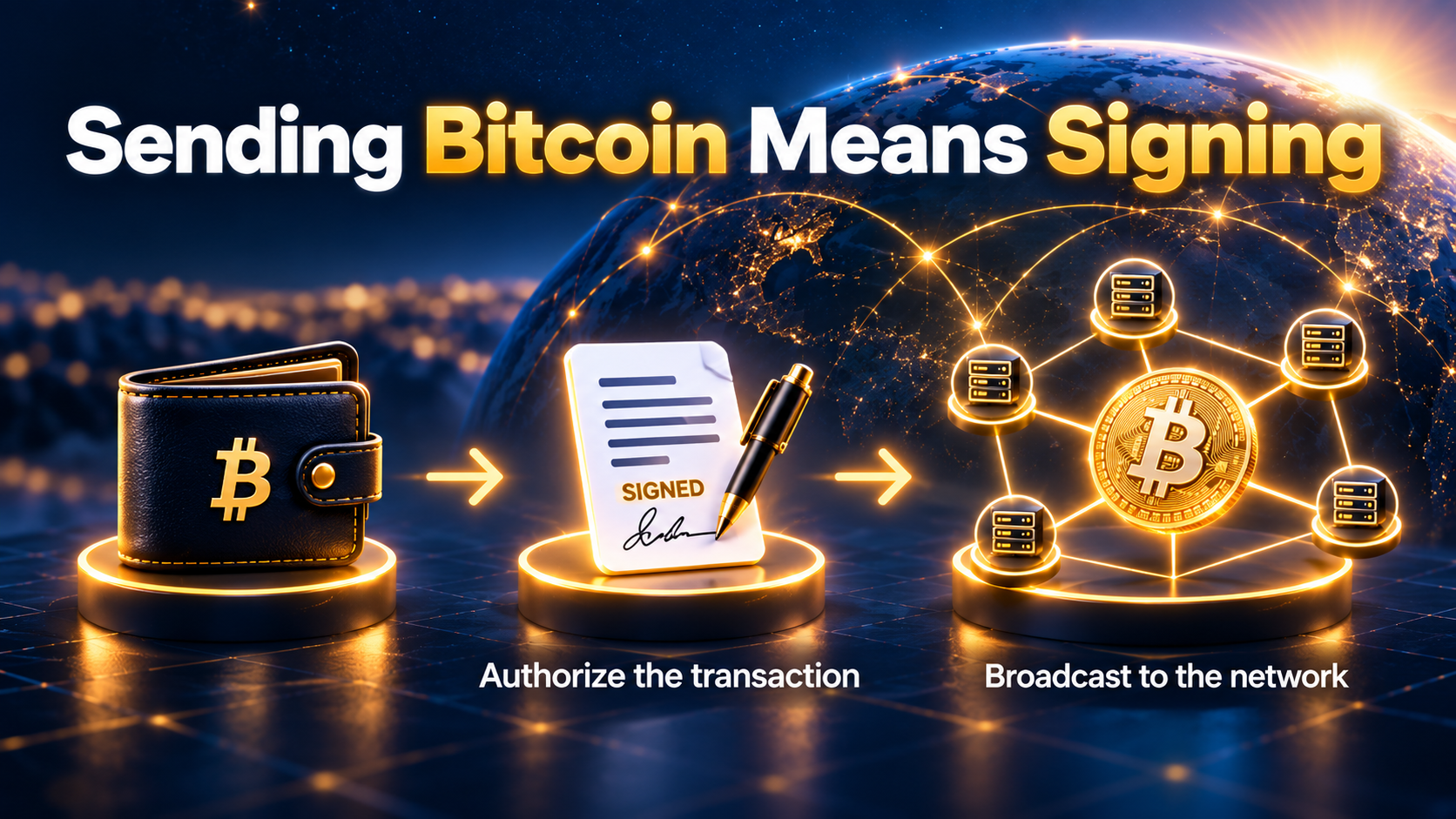
When you send Bitcoin, you're not transferring a digital file the way you'd email a photo. Your wallet creates a transaction saying, in effect, that certain Bitcoin you are authorized to spend should now become spendable by someone else.
Your wallet then uses your private key to create a digital signature. That signature proves that the transaction was authorized by someone controlling the required private key, without revealing the private key itself. Bitcoin nodes can check whether the signature is valid before accepting or relaying the transaction.
Step 3: The Network Checks Your Work
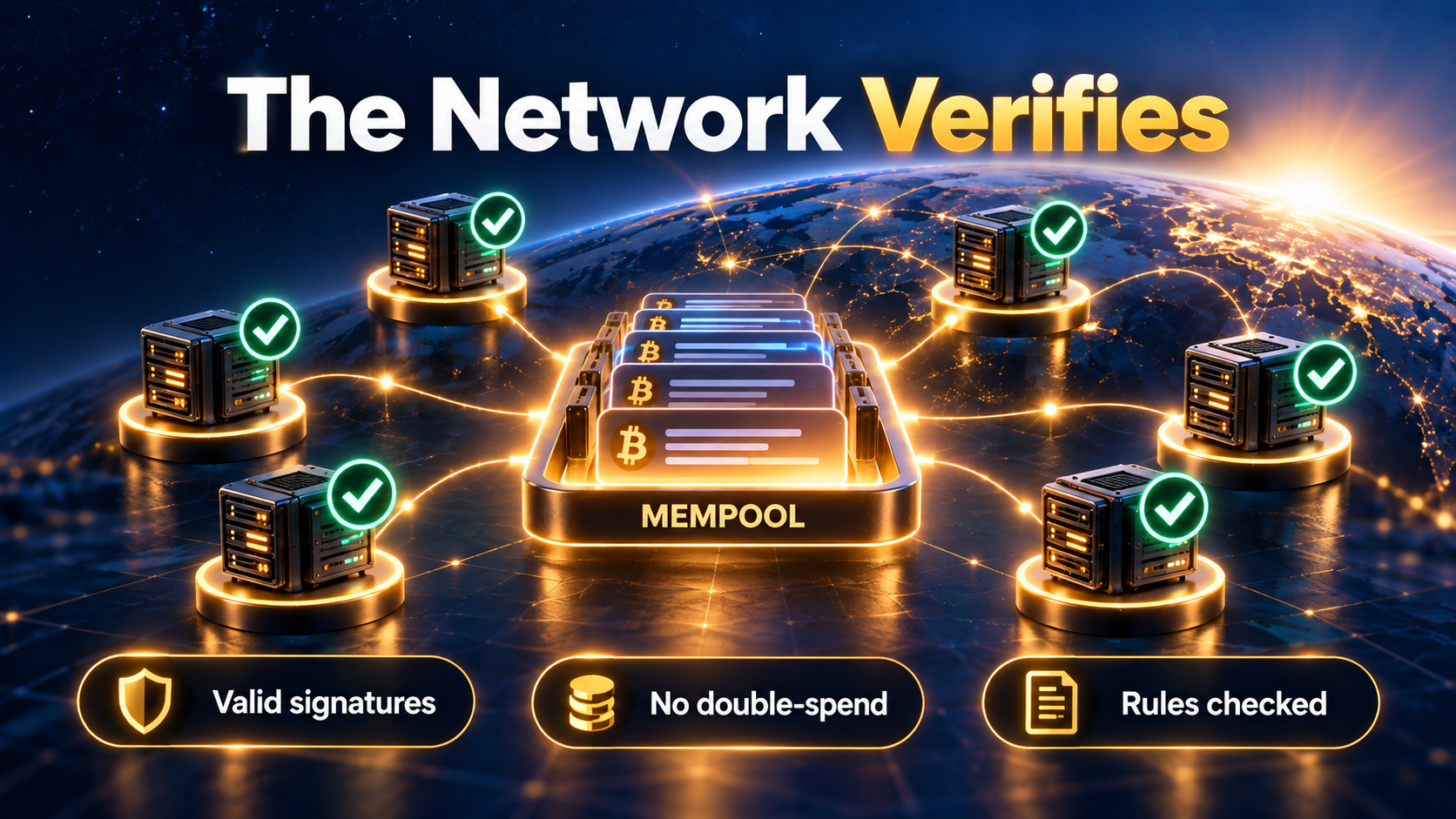
Once your wallet broadcasts the transaction, participating Bitcoin nodes independently check whether it follows the network's rules. Many nodes keep valid, unconfirmed transactions in a temporary waiting area called a mempool while they wait for miners to include them in a block.
Among other things, nodes check:
- Does the transaction spend Bitcoin that has not already been spent?
- Do the required digital signatures and spending conditions validate?
- Does the transaction follow Bitcoin's other consensus and relay rules?
Transactions that fail the required checks are rejected. Valid transactions can be relayed to other nodes and considered by miners for inclusion in a future block. Different nodes can have slightly different mempools, so there isn't one single universal waiting room shared by the entire network.
Step 4: Miners Bundle Transactions Into a Block
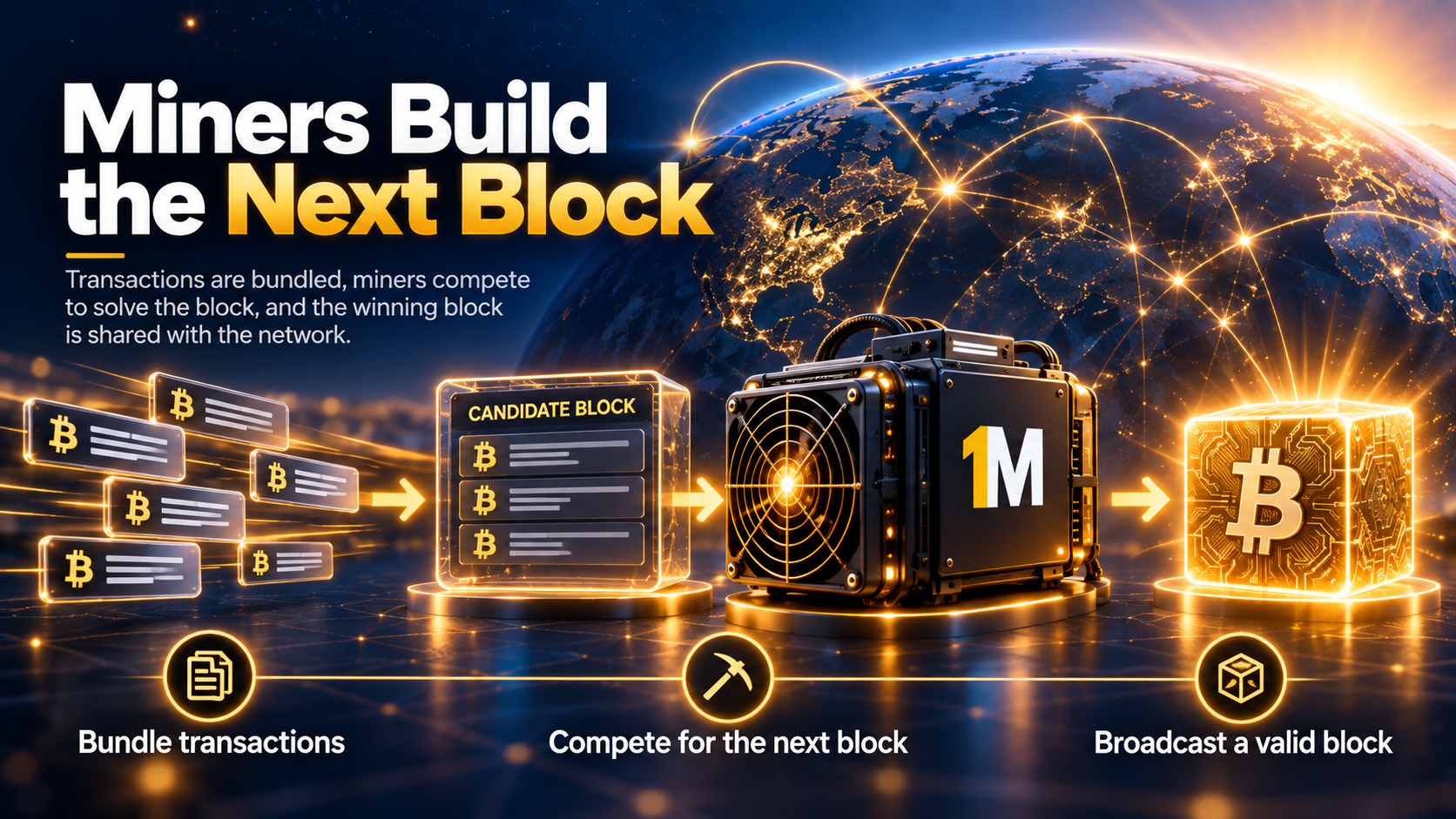
This is where mining comes in. Miners use specialized computing equipment to construct candidate blocks containing pending transactions and compete to produce valid proof-of-work for the next block. When a miner finds a valid result, it broadcasts the block to the Bitcoin network. Nodes independently verify the block, and if it follows Bitcoin's rules, it can become part of the blockchain. The successful miner earns the block subsidy plus the transaction fees included in that block.
If you want the full mechanical walkthrough of this process, this step-by-step guide to how Bitcoin mining works covers it in detail. Miners today mostly run specialized machines called ASICs, built specifically for this task — if you're curious what goes into choosing one, this ASIC hardware buyer's guide is a useful resource.
Step 5: Why Miners Can't Just Cheat (Proof of Work, Simplified)
Here's the part that trips people up the most, so let's use an analogy instead of jargon.
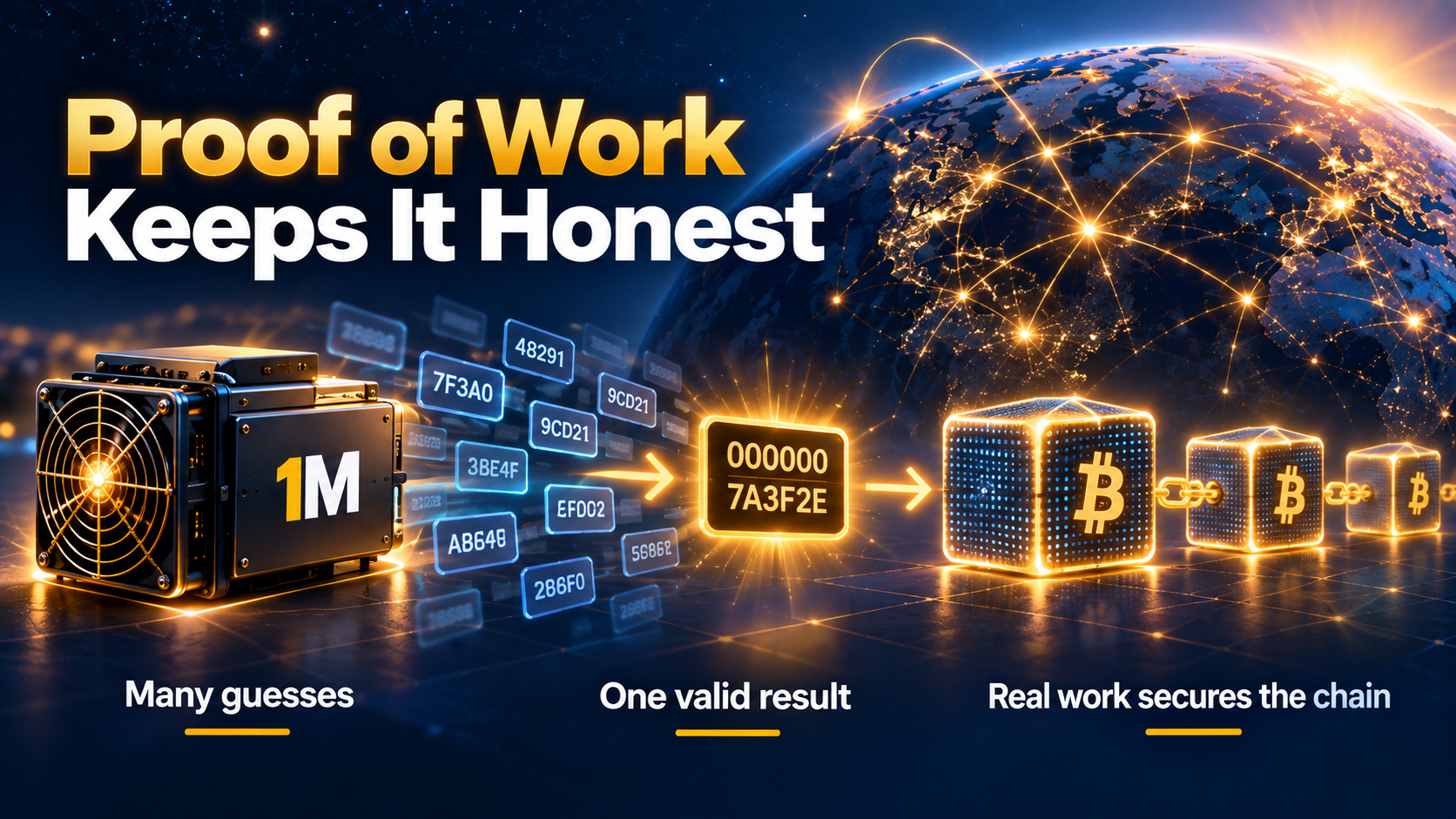
Imagine a raffle that resets every ten minutes. To enter, you don't buy a ticket — you have to guess a number. There's no clever way to guess it faster; you just have to keep guessing random numbers as fast as your computer can until one of them happens to work. The more guesses your computer can make per second, the better your odds of winning that round.
That's roughly what Bitcoin mining is doing. Mining hardware repeatedly performs cryptographic hash calculations, changing parts of a candidate block and checking whether the resulting hash meets Bitcoin's current proof-of-work target. There is no known shortcut that guarantees the next valid result — miners generally improve their chances by performing more hash calculations.
This is called proof of work because producing a valid block requires measurable computational effort and electricity. Importantly, proof-of-work does not allow miners to ignore Bitcoin's rules: even a block with valid proof-of-work will be rejected by full nodes if the transactions or block itself violate the consensus rules.
Rewriting confirmed transaction history therefore becomes increasingly difficult. An attacker trying to replace previous blocks would need to recreate their proof-of-work while also competing against honest miners continuing to extend the accepted chain. The amount of hashing performed across the network is described as hashrate. Generally, greater honest network hashrate makes this kind of attack more expensive and difficult.
Step 6: Confirmations — Why You Sometimes Have to Wait
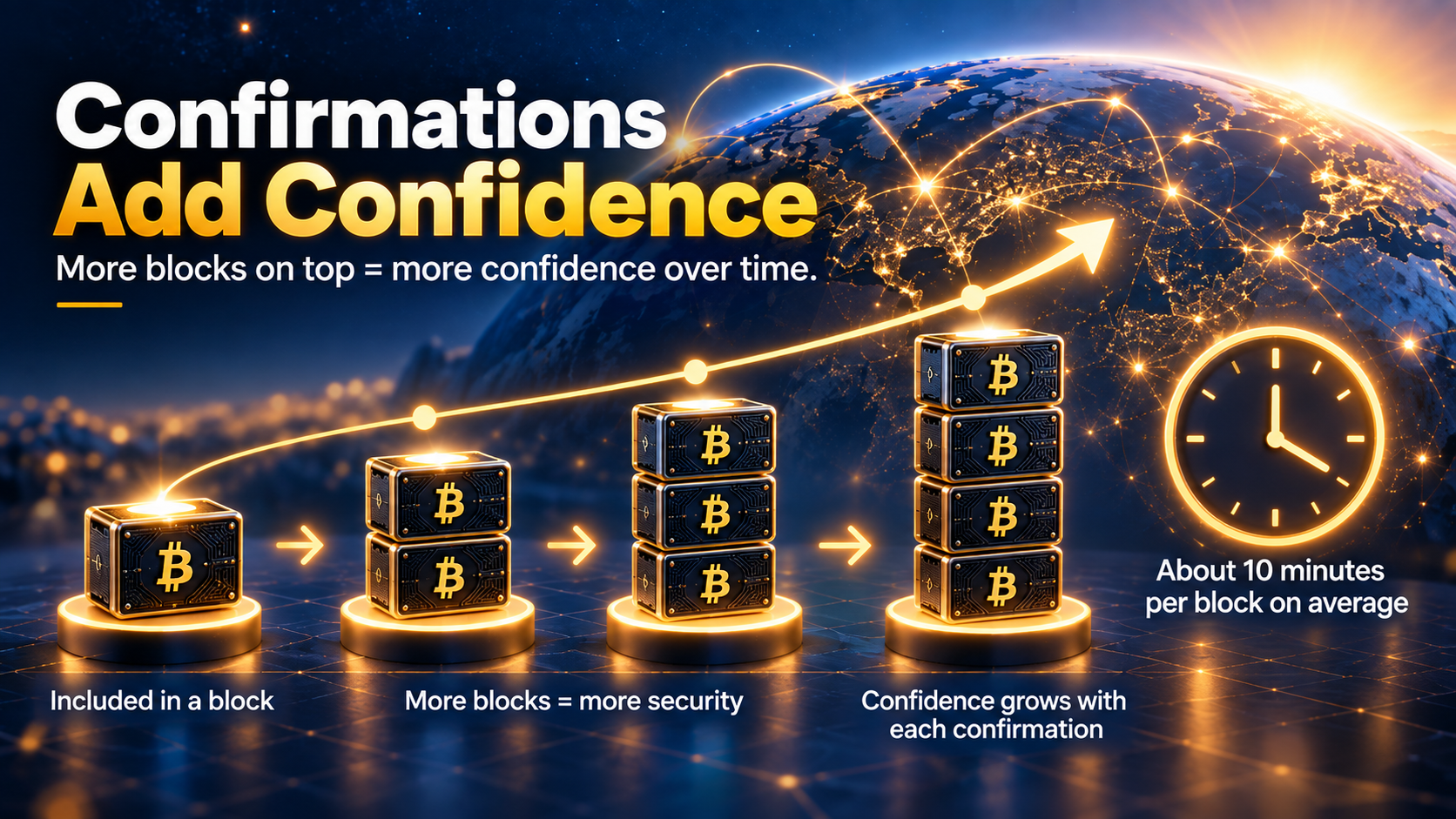
Once your transaction is included in a valid block, it has its first confirmation. Each additional block built after that adds another confirmation. The more confirmations a transaction has, the more proof-of-work an attacker would have to overcome to replace that part of Bitcoin's history, so confidence in the transaction generally increases over time.
This is why some exchanges and services wait for multiple confirmations before treating large payments as fully settled. Bitcoin targets an average block interval of roughly 10 minutes, but block discovery is probabilistic, so individual blocks can arrive much sooner or much later.
How This Is Different From How a Bank Works
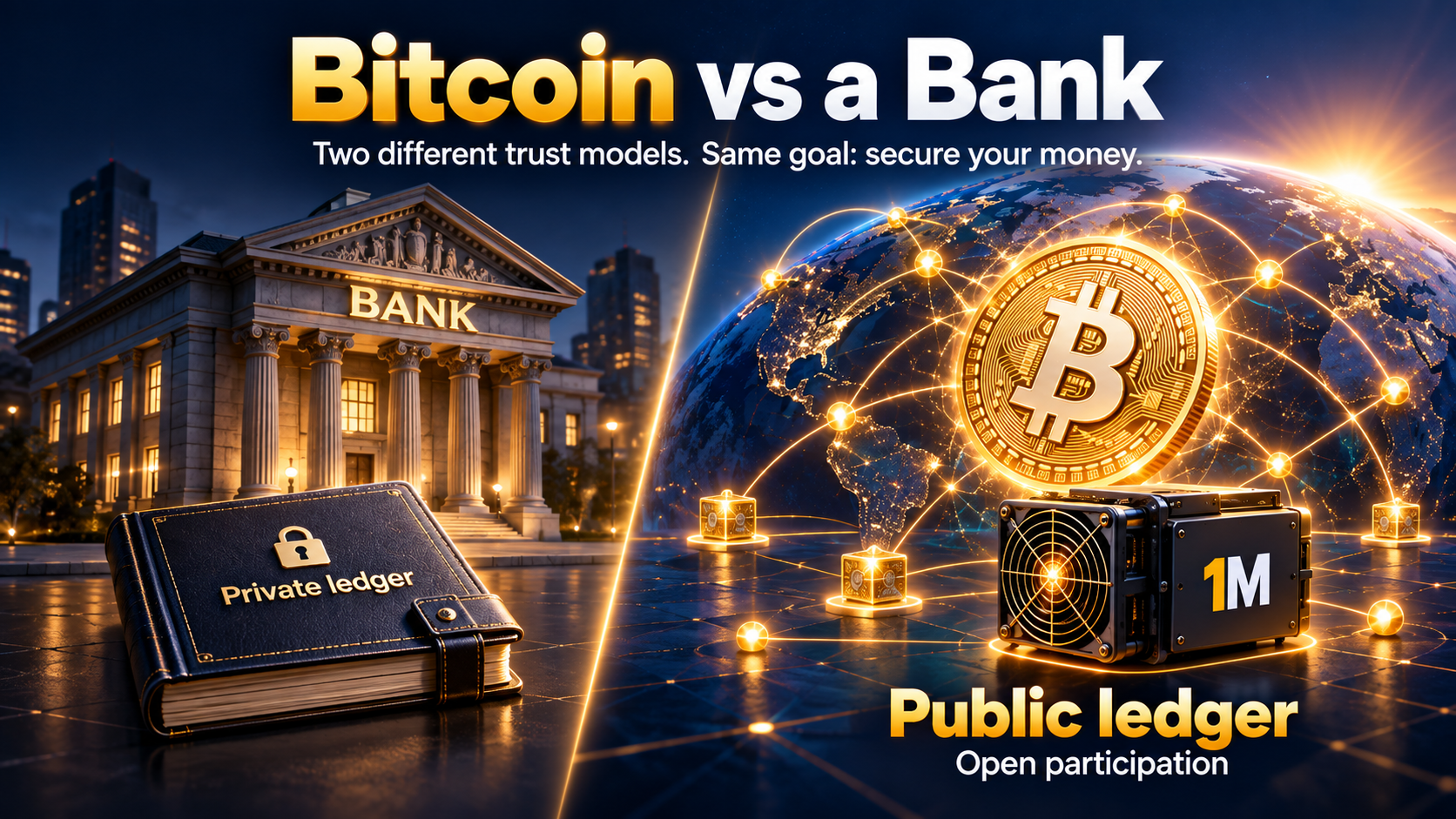
A traditional bank transaction relies on trusting one company to accurately maintain a private ledger, follow the rules, and stay solvent. Bitcoin replaces that single point of trust with:
- A public ledger thousands of independent computers maintain copies of
- Cryptographic signatures instead of institutional authorization
- Competitive, energy-backed puzzle-solving instead of a company simply approving transactions
- Open participation — anyone can run a node or become a miner, rather than needing permission from an institution
The tradeoff is that responsibility shifts to you. There's no customer service line to reverse a mistaken transaction or reset a lost password — the same openness that removes middlemen also removes the safety net they used to provide.
Curious About Mining Yourself?
Understanding how Bitcoin works naturally leads a lot of beginners to wonder about mining hands-on. It's a bigger topic than this article can fully cover, but a few resources can help if you want to explore further: this overview of what crypto mining is, along with its benefits and risks, this step-by-step guide for beginners, and this walkthrough on how to start Bitcoin mining if you want to go a step further.
Frequently Asked Questions
Does every computer verify every transaction? No. Bitcoin includes different types of participants. Full nodes independently verify the blocks and transactions they receive according to Bitcoin's rules rather than trusting another company or server to tell them what is valid. Lightweight wallets can rely on full nodes or other services for some of that verification.
What stops someone from spending the same Bitcoin twice? Bitcoin's rules allow each spendable transaction output to be spent only once. Nodes reject transactions or blocks that try to spend an output that has already been spent in the accepted blockchain. Before confirmation, conflicting transactions can exist temporarily, which is one reason confirmations matter.
Why does Bitcoin need mining at all? Mining is what allows a network with no central authority to agree on a single, ordered history of transactions, while making it expensive for anyone to fake or rewrite that history.
Is a Bitcoin transaction instant? A Bitcoin transaction can be broadcast across the network very quickly, but confirmation is not instant. New blocks are found roughly every 10 minutes on average, and your transaction may be included in the next block or may wait longer depending on factors such as transaction fees and network demand. Additional confirmations require additional blocks.
Do I need to understand all of this to use Bitcoin? No. Most people use a wallet app that handles the technical steps automatically. Understanding the mechanics simply helps you use Bitcoin more confidently and avoid costly mistakes.
Final Thoughts
Strip away the jargon, and Bitcoin's inner workings come down to a fairly intuitive idea: a public record book, kept honest by thousands of independent computers, updated only when enough real computing effort backs up each new entry. Every wallet, signature, block, and confirmation exists to serve that one goal — letting people agree on who owns what, without needing to trust a single company or government to referee it.
Once that clicks, the rest of the crypto world tends to make a lot more sense, too.
Sources & References
- Bitcoin.org — How Does Bitcoin Work? — overview of transactions, mining and the blockchain. https://bitcoin.org/en/how-it-works
- Bitcoin Developer Guide — Transactions — transaction inputs, outputs and signatures. https://developer.bitcoin.org/devguide/transactions.html
- Bitcoin Developer Guide — Block Chain — blocks, UTXOs and double-spend rules. https://developer.bitcoin.org/devguide/block_chain.html
- Bitcoin.org — Bitcoin FAQ — confirmations, mining and transaction timing. https://bitcoin.org/en/faq
- OneMiners — Bitcoin Mining Explained: How It Works Step by Step https://oneminers.com/blogs/news/bitcoin-mining-explained-how-it-works-step-by-step
- Medium — The 2026 Bitcoin Mining Hardware Buyer's Guide https://cassys.medium.com/the-2026-bitcoin-mining-hardware-buyers-guide-how-to-choose-the-right-asic-miner-for-your-goals-5e37fc31616f