If you've heard people talking about Bitcoin but still aren't quite sure what it actually is, you're not alone. Millions of people use words like "cryptocurrency," "blockchain," and "mining" every day without fully understanding what's behind them. This guide breaks Bitcoin down in plain language, so by the end, you'll have a solid foundation — no finance degree or computer science background required.
What Is Bitcoin, Exactly?
Bitcoin is a form of digital money, but calling it "digital money" doesn't tell the whole story. Unlike the dollars in your bank account, which are issued and controlled by a central bank, Bitcoin is decentralized. That means no single government, company, or institution controls it. Instead, Bitcoin runs on a global network of computers that all follow the same set of rules.
Bitcoin was introduced in 2008 by a person or group using the pseudonym Satoshi Nakamoto. In the Bitcoin white paper, Nakamoto described a system for “peer-to-peer electronic cash” — allowing payments to move directly between participants without requiring a financial institution as the trusted intermediary. The Bitcoin network launched in January 2009 and has remained in operation ever since.
The Problem Bitcoin Was Designed to Solve
To understand why Bitcoin exists, it helps to think about how traditional money works. When you send money through a bank, the bank keeps a private ledger — a record — of who owns what. You have to trust that the bank is honest, that it won't freeze your account, and that it will process your transaction correctly.
Bitcoin reduces the need to trust a single central institution. Instead, computers around the world called nodes independently verify transactions and blocks according to Bitcoin's network rules. Many full nodes store the blockchain's historical data, while others can operate in a pruned mode that verifies the same rules without permanently storing every old block. Together, these independently operated nodes help maintain Bitcoin's shared public ledger — the blockchain.

What Is the Blockchain?
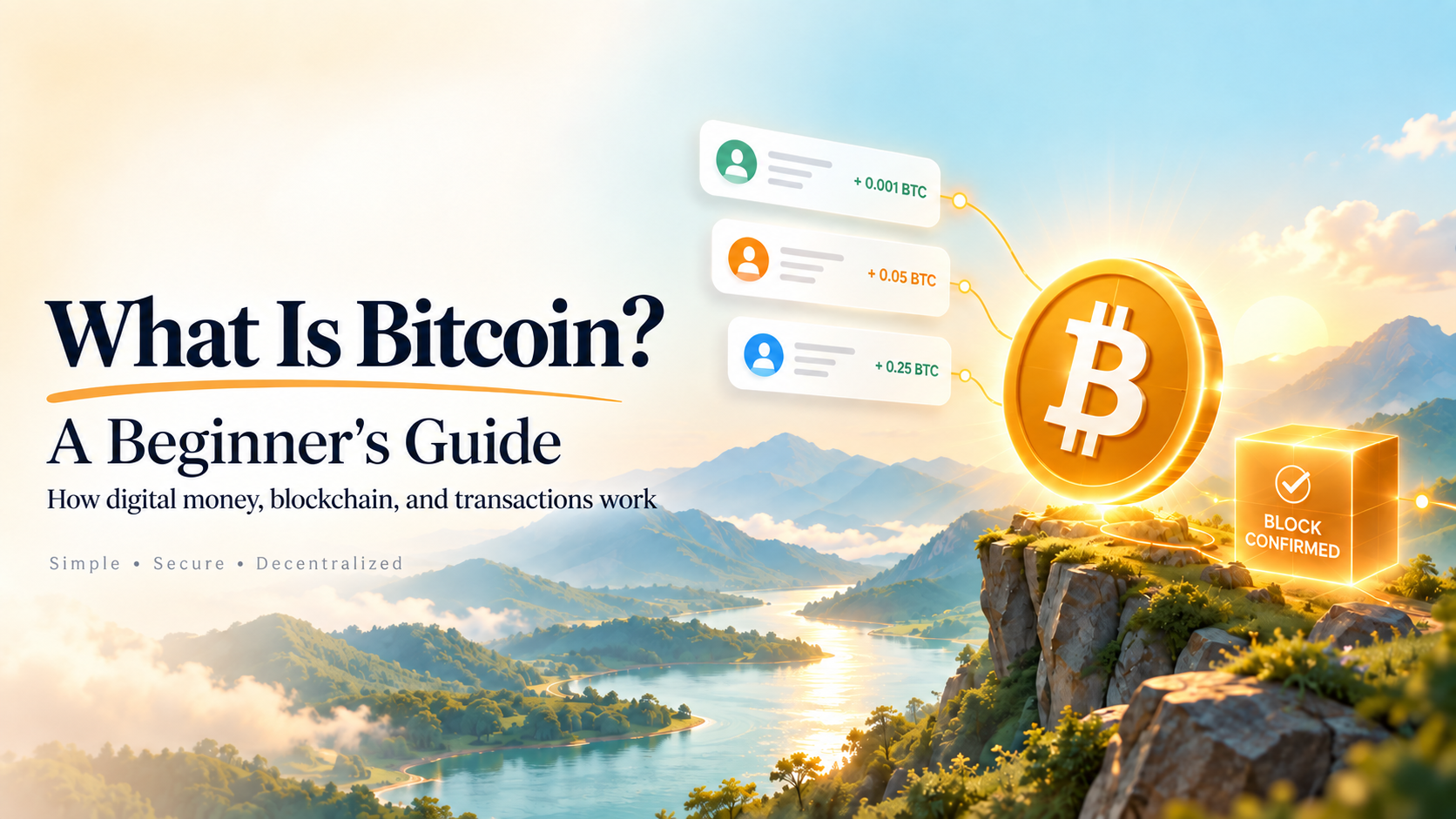
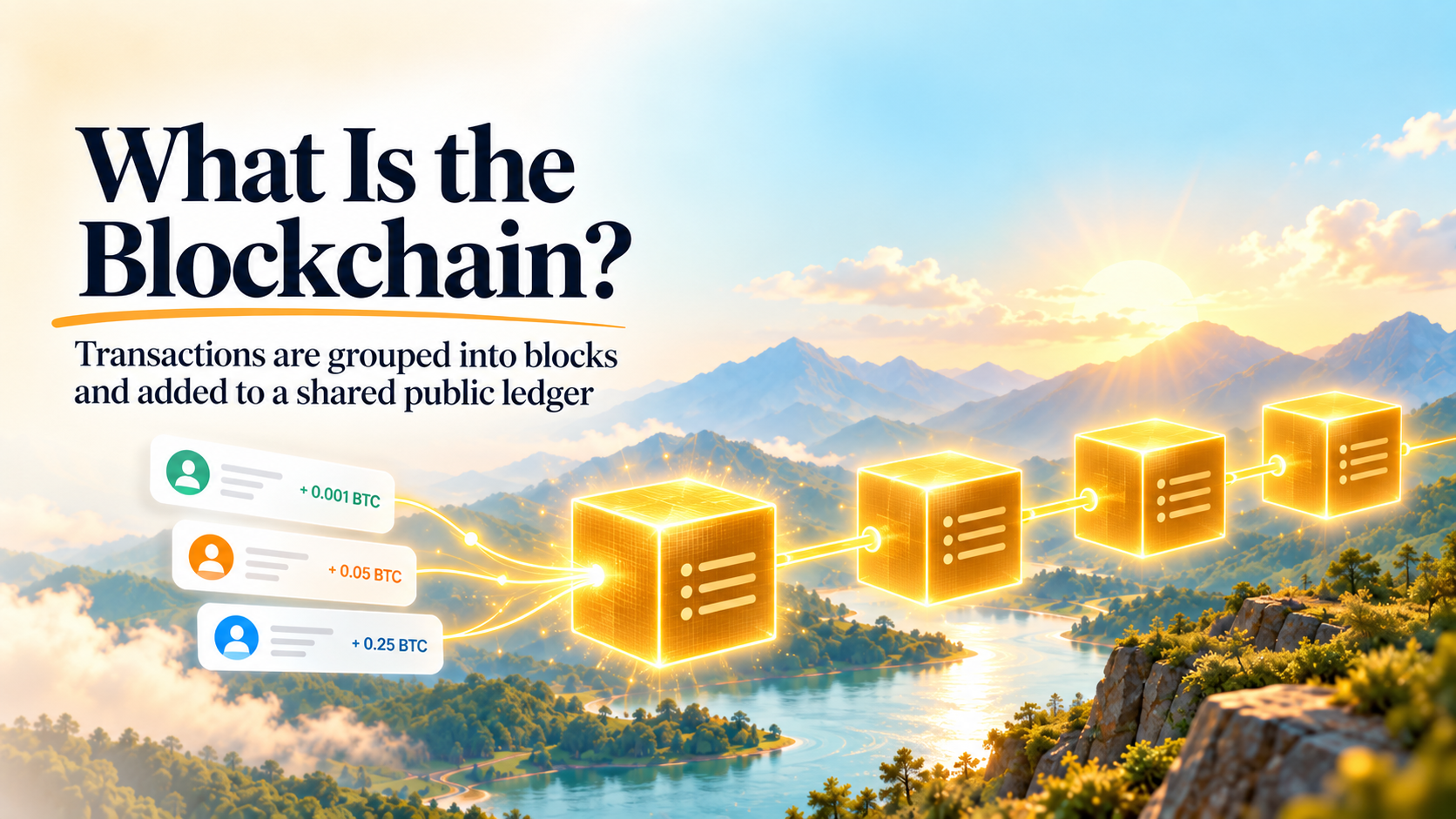
Think of the blockchain as a digital notebook that everyone can see, but no single person can erase or rewrite. Every time someone sends Bitcoin, that transaction gets bundled together with other recent transactions into a "block." That block is then added to the chain of all previous blocks — hence the name blockchain.
Because thousands of computers store their own copy of this notebook, it's nearly impossible for someone to secretly change past transactions. If one person tried to alter their copy, it wouldn't match everyone else's, and the network would simply reject it. This is what makes Bitcoin trustworthy without needing a bank to vouch for it.
How Do Bitcoin Transactions Actually Work?
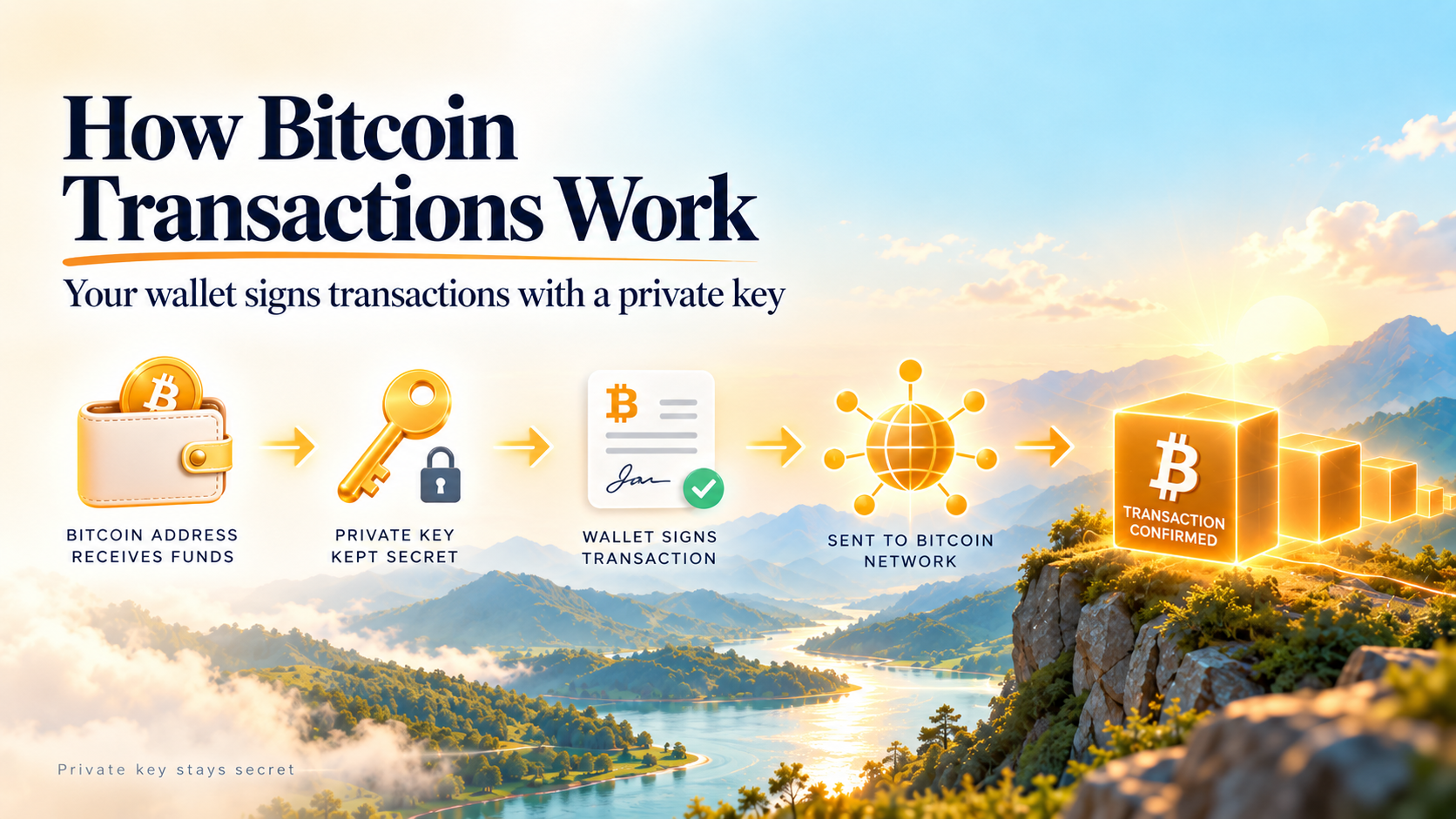
When you control Bitcoin, your wallet manages cryptographic keys that allow you to authorize transactions. Two important concepts for beginners are:
- A Bitcoin address — something you can share with other people when you want to receive Bitcoin.
- A private key — secret cryptographic information that allows you to authorize spending. It should never be shared.
When you send Bitcoin, your wallet uses your private key to create a digital signature proving that you are authorized to spend the relevant funds. Bitcoin nodes can verify that signature without learning your private key. Once the transaction is included in a valid block, it becomes part of Bitcoin's transaction history.
This is why Bitcoin wallets matter so much, and why losing your private key means losing access to your funds permanently — there's no bank customer service line to call for a password reset.
How Are New Bitcoins Created? (Mining, Explained Simply)
You might be wondering: if there's no bank printing Bitcoin, where does it come from?
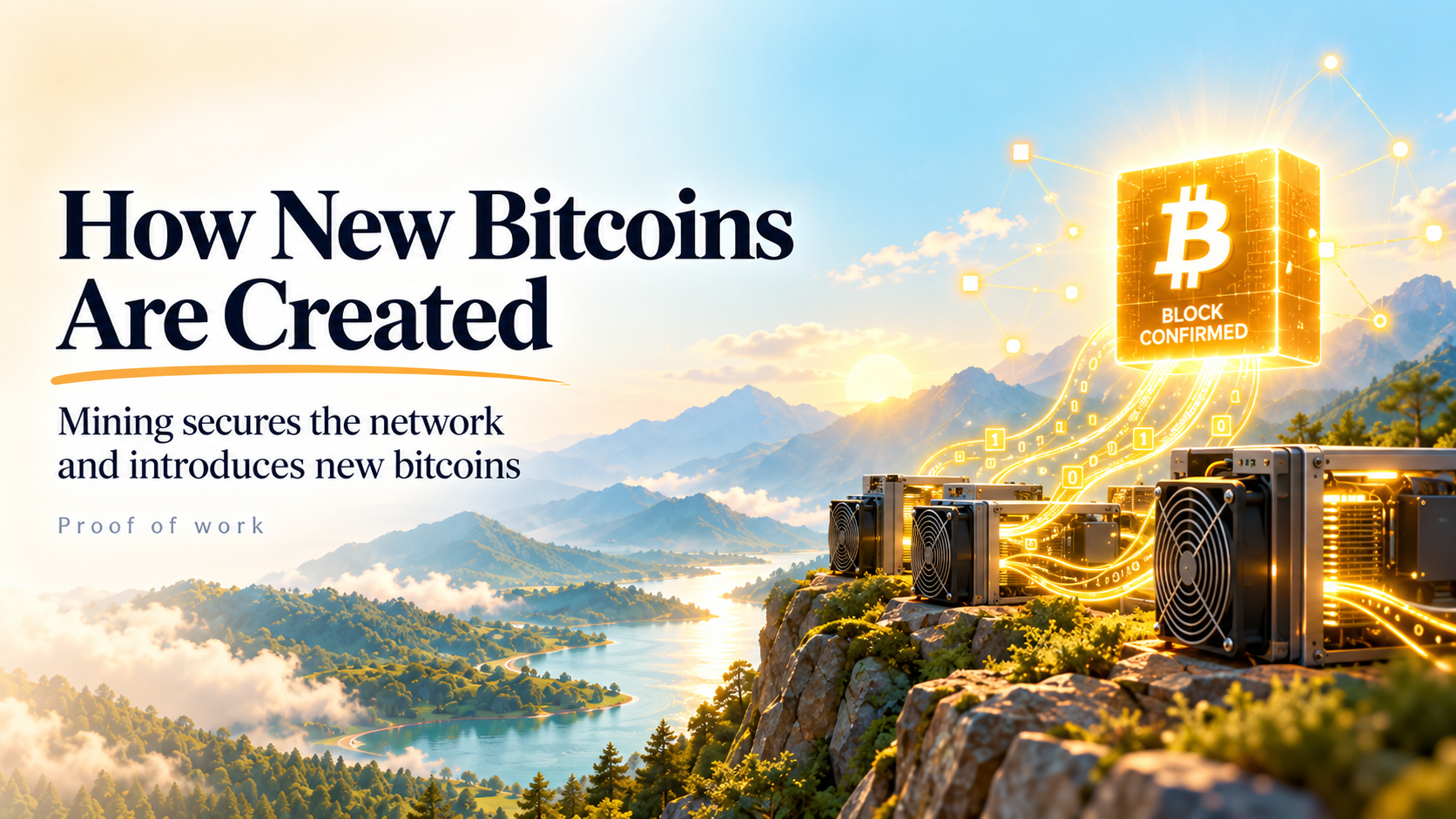
New bitcoins enter circulation through a process called mining. Miners use specialized computers to perform enormous numbers of cryptographic hash calculations while competing to produce a valid block. A miner that finds a result satisfying Bitcoin's current proof-of-work requirement can broadcast that block to the network. If the block is valid and accepted, the miner receives the block subsidy plus the transaction fees included in the block.
This proof-of-work process also helps secure Bitcoin. Producing valid blocks requires substantial computing resources and electricity, while attempting to rewrite confirmed transaction history becomes increasingly difficult as more proof-of-work is added on top of it.
If you want to go deeper into how this works step by step, this guide on how Bitcoin mining works walks through the entire process from start to finish. And if you're curious about the specialized machines miners use, this ASIC miner buyer's guide breaks down how to choose the right hardware for different goals and budgets.
Mining also introduces a term you'll see constantly in Bitcoin discussions: hashrate. Hashrate measures how much total computing power is being pointed at the network at any given time. Generally, a higher hashrate means a more secure network, since it becomes more difficult and expensive for any single party to overpower it. This explainer on hashrate covers what it means and why it matters in more detail.
For readers interested in the bigger picture of crypto mining beyond just Bitcoin, this overview of crypto mining covers the benefits, risks, and mechanics more broadly. And if you're curious about trying it yourself one day, this step-by-step beginner's guide to mining is a solid starting point.
Why Is Bitcoin Valuable?
This is one of the most common questions beginners ask, and the honest answer is: Bitcoin is valuable for the same basic reason anything is valuable — because people agree that it is, and because it has properties that make it genuinely useful.
Consider some of those properties:
- Scarcity — Only 21 million bitcoins will ever exist. Unlike government-issued currencies, which can be printed in unlimited amounts, Bitcoin's supply is fixed by code.
- Portability — Bitcoin can be transferred across borders without relying on the traditional banking system. Transaction and confirmation times vary depending on network conditions and the fee used.
- Divisibility — One bitcoin can be divided into 100 million smaller units called "satoshis," so you don't need to buy a whole coin to use it.
- Censorship resistance — Bitcoin's decentralized structure makes self-custodied funds and transactions more resistant to centralized control than money held through a traditional financial institution. However, exchanges, custodians, internet access, and other services can still be restricted or regulated.
Some people view Bitcoin primarily as "digital gold" — a store of value that can help hedge against inflation. Others use it to send money across borders quickly and cheaply. Still others hold it as a long-term investment, betting that adoption will continue to grow.
Is Bitcoin the Same Thing as "Cryptocurrency"?
Bitcoin became the first widely successful decentralized cryptocurrency, but it is far from the only one. Since Bitcoin launched in 2009, thousands of other cryptocurrencies have been created, often using different technologies or serving different purposes. Bitcoin remains the best-known cryptocurrency and is commonly treated as the benchmark against which much of the broader crypto market is compared.
Is Bitcoin Safe?
Like any financial asset, Bitcoin carries risks, and it's worth going in with realistic expectations:
- Price volatility — Bitcoin's price can swing significantly in short periods of time.
- Self-custody responsibility — If you hold your own Bitcoin, you're responsible for keeping your private keys safe. There's no "forgot password" option.
- Scams — Because Bitcoin transactions can't be reversed, scammers sometimes target beginners with fake investment schemes or phishing attempts.
- Regulatory uncertainty — Laws around cryptocurrency vary by country and continue to evolve.
None of this means Bitcoin is inherently dangerous — but like anything valuable, it deserves care, research, and caution, especially when you're just starting out. This article is educational and general in nature, not financial advice; consider speaking with a qualified financial professional before making any investment decisions.
How Do Beginners Get Started With Bitcoin?
If you're ready to explore Bitcoin further, the typical starting steps look like this:
- Learn the basics — which you're doing right now.
- Choose a reputable exchange or wallet provider to hold your Bitcoin.
- Start small while you get comfortable with how transactions work.
- Secure your private keys, using a hardware wallet if you plan to hold Bitcoin long-term.
- Keep learning — the space moves quickly, and staying informed helps you avoid costly mistakes
Frequently Asked Questions About Bitcoin
Who created Bitcoin? Bitcoin was created by an anonymous person or group using the name Satoshi Nakamoto, who published the Bitcoin white paper in 2008.
Is Bitcoin real money? Bitcoin functions as a form of money in the sense that it can store value and be used for payments, though it isn't issued by a government and isn't considered legal tender everywhere.
Can Bitcoin be hacked? Bitcoin's core protocol and cryptography have maintained a strong security track record, but no software system should be described as completely immune to vulnerabilities. Security issues have been discovered and fixed in Bitcoin software over its history. More commonly, Bitcoin losses occur when exchanges, wallets, custodial services, or individual users are compromised rather than through an attack on Bitcoin's underlying blockchain itself.
How many bitcoins exist? There will only ever be 21 million bitcoins — a limit built directly into the Bitcoin protocol from the very beginning.
Do I need to buy a whole Bitcoin? No. Bitcoin is divisible into small units, so you can buy a small fraction of a bitcoin that fits your budget.
Final Thoughts
Bitcoin can feel intimidating at first, but at its core, it's a fairly simple idea: a way to send and store value digitally, without relying on a bank or government to manage it for you. Understanding the basics — what the blockchain is, how transactions work, and where new bitcoins come from — gives you a strong foundation for exploring the rest of the crypto world with confidence.
Whether you're here purely out of curiosity or considering your first Bitcoin purchase, taking the time to learn the fundamentals first is one of the smartest steps you can take.
Sources & References
- Bitcoin.org — Bitcoin: A Peer-to-Peer Electronic Cash System: Bitcoin White Paper
- Bitcoin Developer Guide — Transactions: Bitcoin Transactions Guide
- Bitcoin Developer Guide — Mining: Bitcoin Mining Guide
- Bitcoin Developer Guide — P2P Network: Bitcoin P2P Network Guide
- Bitcoin.org — Frequently Asked Questions: Bitcoin FAQ
- OneMiners — Bitcoin Mining Explained: How It Works Step by Step: Bitcoin Mining Explained
- Medium — The 2026 Bitcoin Mining Hardware Buyer's Guide: ASIC Miner Buyer's Guide