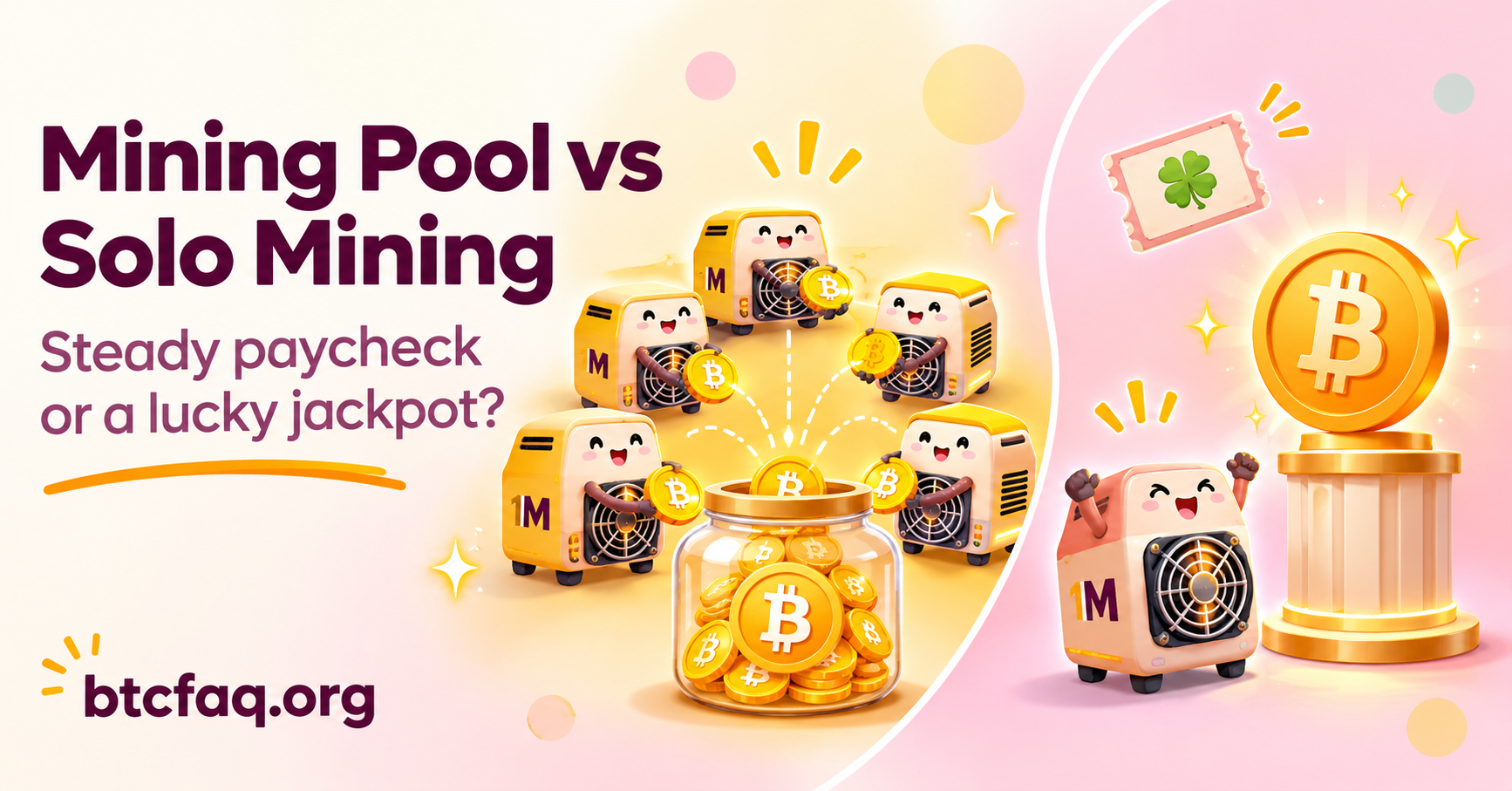
Every few months a headline goes around: "Tiny home miner finds a whole Bitcoin block!" It's a great story, and it plants a tempting thought. If one person with a machine the size of a shoebox can win 3 BTC, why would anyone share rewards with a pool?
The honest answer takes a little explaining, and it's one of those topics where the math is more interesting than the myth. In this guide I'll walk through what solo and pool mining really are, how rewards are split, what the odds actually look like, what the different payout methods mean, and which approach suits which kind of miner. Where I'm giving an opinion rather than a fact, I'll say so.
This article is educational, not financial advice. Mining can lose money and Bitcoin is volatile. Consider speaking with a qualified professional before buying equipment.
The Short Answer
- • Solo mining: your hashrate works toward finding a block for your own payout. If your mining setup finds a valid block, you receive the block subsidy—currently 3.125 BTC—plus the transaction fees in that block, minus any fee charged by a solo-mining service you use. If you never find a block, you receive no mining reward.
- • Pool mining: your hashrate is combined with work from many other miners. The pool measures your contribution through shares and pays you according to its payout method, giving you much smaller but far more regular rewards.
The most important distinction is variance.
Joining a pool does not make an individual hash more likely to satisfy Bitcoin's network target. Your hashrate still represents the same fraction of the network. What changes is the payout structure: instead of waiting for your own machine to find a complete block, you receive a proportional payment when the pool earns rewards or, under PPS-style systems, according to the pool's theoretical share-value calculation.
Over a very long period, expected gross mining revenue for the same amount of hashrate can be broadly similar before fees and operational differences, but pool and solo results should not be described as perfectly identical. Pool fees, rejected shares, payout formulas, transaction-fee treatment, block-template choices and solo-service fees can all change the amount actually received.
ViaBTC's solo vs. pool reward-allocation guide makes the central point well: pools primarily convert highly uncertain block-finding income into much smoother payouts.
First, a Quick Refresher: How a Block Gets Found
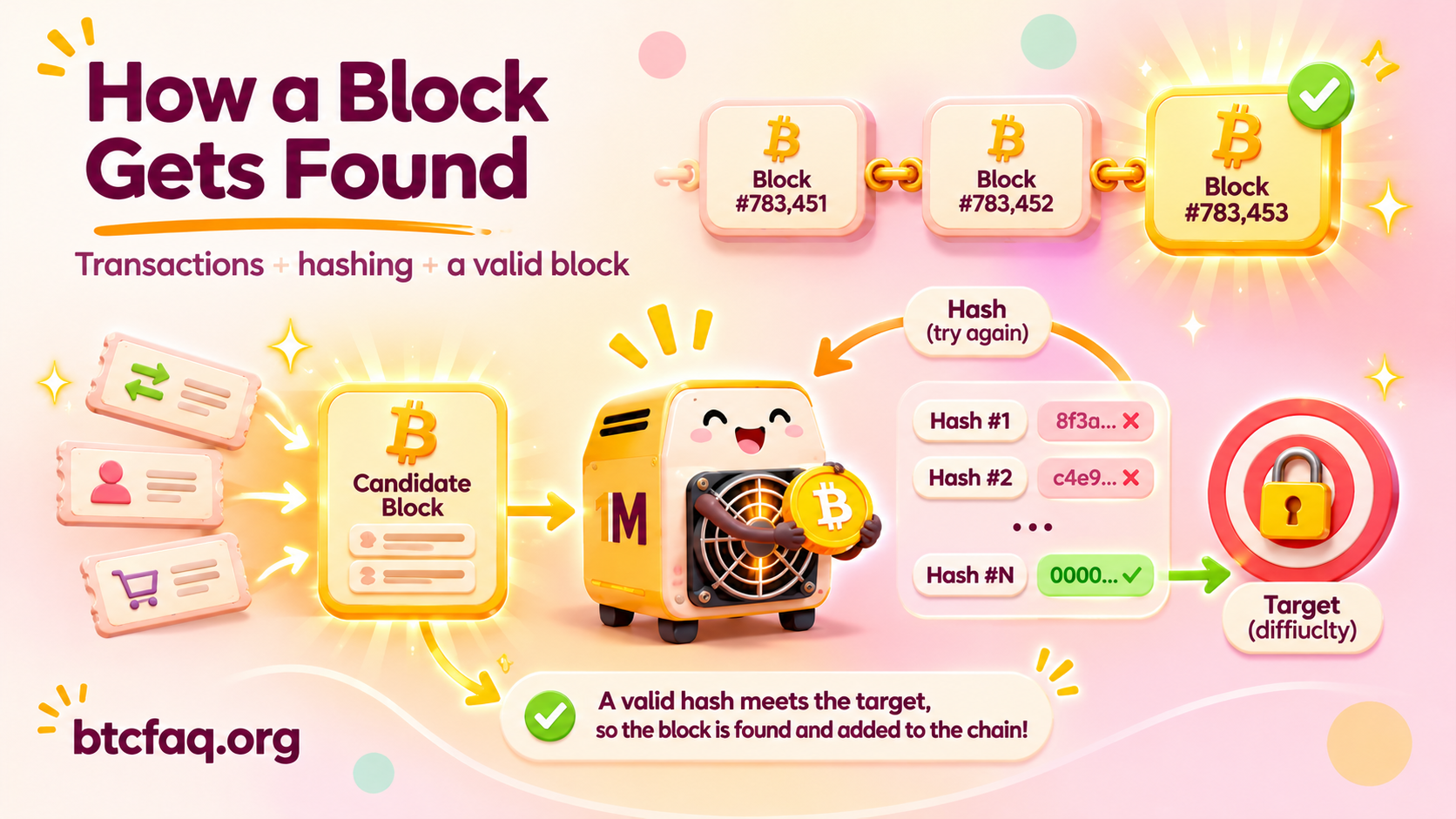
Bitcoin mining starts with a candidate block of valid transactions. In traditional pooled mining, the pool generally constructs the mining job and sends work to connected miners; in independent solo mining, the operator can construct the candidate block using their own node and mining software.
The ASIC then performs the actual proof-of-work by repeatedly hashing candidate block-header data and searching for a result at or below Bitcoin's current target. OneMiners' step-by-step guide to Bitcoin mining provides a beginner-friendly walkthrough of this process.
Finding a valid block is probabilistic. Each valid hash attempt has the same tiny chance of satisfying the target, so more hashrate means more attempts per second and therefore a higher expected frequency of success. That is why network scale matters so much when comparing pool and solo mining.
Why Solo Mining Is a Lottery
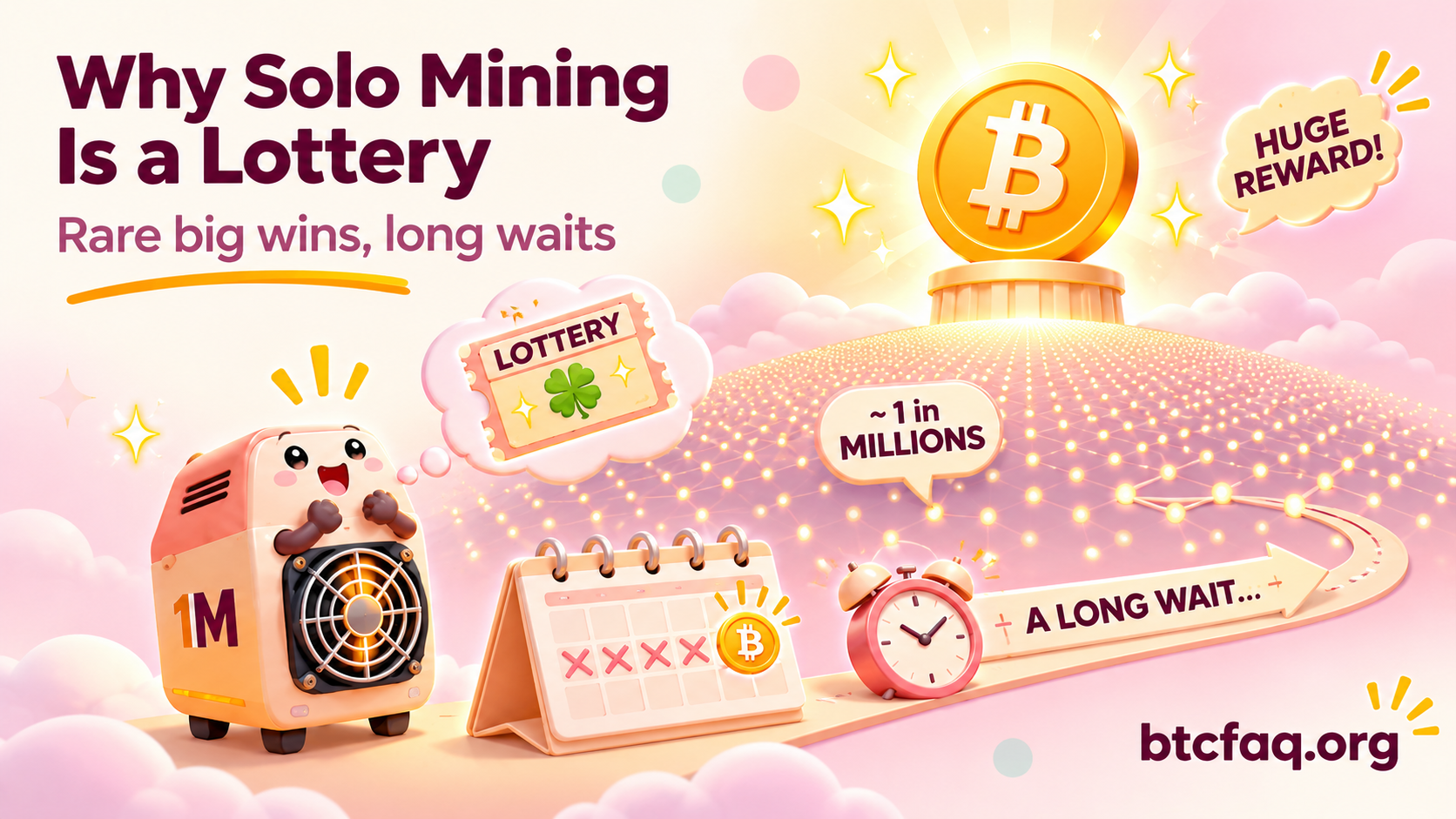
Bitcoin's network is enormous. Current Hashrate Index data puts network hashrate at roughly 1.04 ZH/s, or a little over one thousand exahashes per second.
That scale makes solo block discovery extremely rare for a single ASIC.
Using roughly 1.04 ZH/s as a current snapshot:
| Mining setup | Approx. average wait for a solo block |
|---|---|
| 16.2 TH/s home miner | ~1,220 years |
| Antminer S21-class, 200 TH/s | ~99 years |
| Antminer S21 XP, 270 TH/s | ~73 years |
| Antminer S23 Hydro, 580 TH/s | ~34 years |
| Antminer S23 Hyd 3U, 1,160 TH/s | ~17 years |
| 100 × S23 Hydro, 58 PH/s | ~95% probability of at least one block within a year |
These are statistical expectations based on a network snapshot, not countdowns. Network hashrate and difficulty change continuously.
This also explains why different published guides show slightly different numbers. OneMiners' October 29 article, Two Tiny Solo Miners Just Beat the Bitcoin Giants, calculated roughly 1,255 years for a 16.2 TH/s miner using a 1,069 EH/s network snapshot. Simple Mining's September guide calculated about 66 years for a 270 TH/s S21 XP using a lower 941.88 EH/s network snapshot.
Neither estimate is inherently wrong; they describe different points in time.
The same caution applies to the frequently quoted “1% of the network” solo-mining threshold. Simple Mining used about 9.42–9.5 EH/s when the network was around 942 EH/s. At today's roughly 1.04 ZH/s network, 1% would instead be about 10.4 EH/s, or roughly 38,500 S21 XP-class 270 TH/s machines.
And even that is not a technical threshold where solo mining suddenly becomes “profitable.” It is simply a practical benchmark chosen by that source because 1% of network hashrate would, statistically, find roughly one out of every 100 blocks—about one block every 16 to 17 hours on average.
First, these are averages, not schedules. ViaBTC notes that its roughly 90-year estimate for a 200 TH/s machine is a statistical expectation under constant conditions, not a countdown. Mining is random. You could get lucky in your first week or never in your lifetime. Blockstream makes the same point on its explainer about nodes in mining: solo payouts are probabilistic, so actual gaps between blocks can be much longer or shorter than average. (More on nodes below.)
Second, the math scales brutally. Simple Mining's guide Solo vs Pool Mining estimates that solo mining only becomes "viable" in the everyday sense at around 9.4 to 9.5 EH/s, roughly 1% of the whole network, which it says would take about 35,000 S21 XP-class machines. At that size, you'd expect a block about once every 100 blocks, or roughly every 17 hours. Below that, you're buying lottery tickets.
How Pool Mining Works
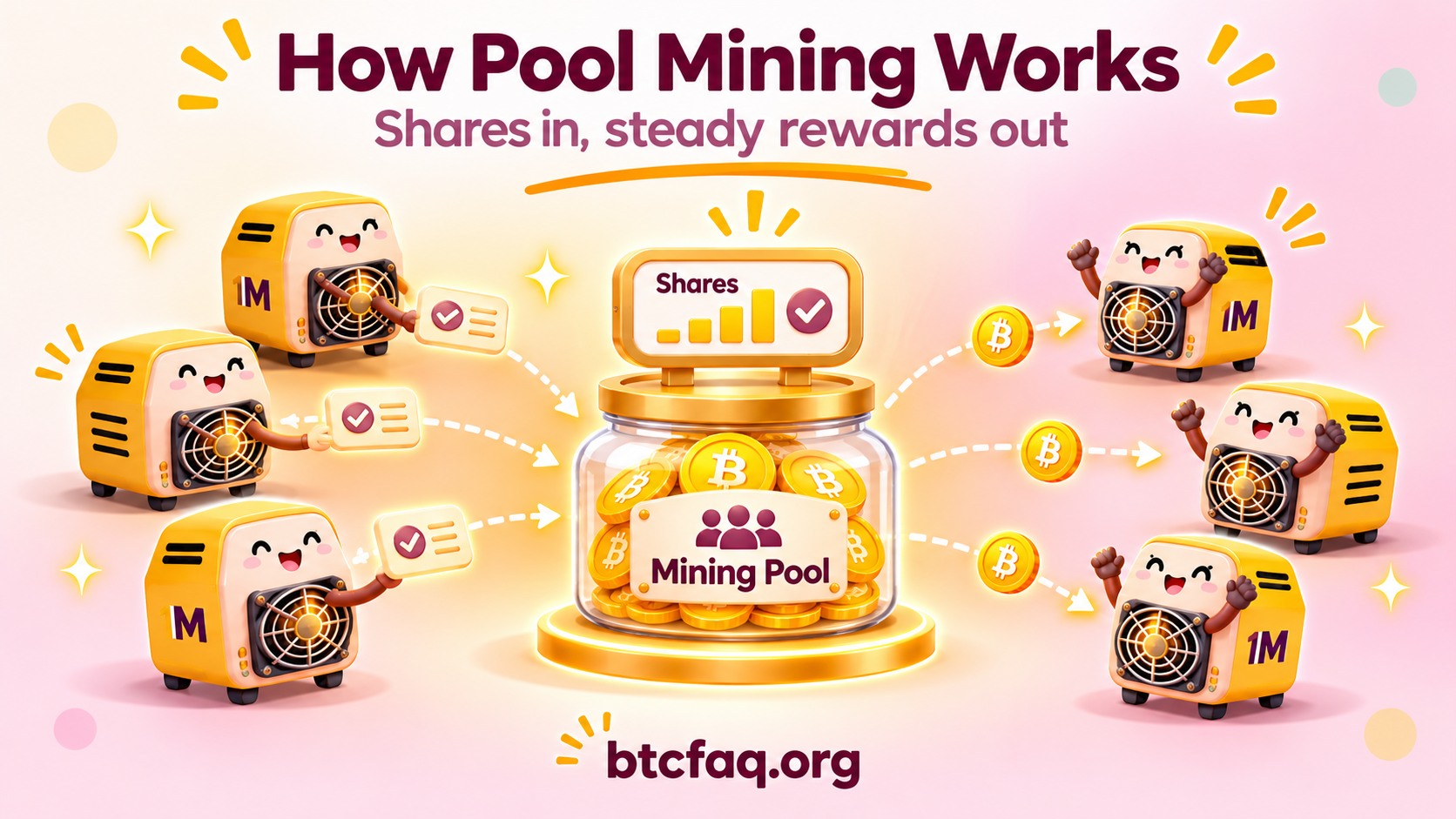
A pool is a service that coordinates a large group of miners. Think of an office lottery syndicate: everyone chips in for tickets and the winnings get split, so you win small amounts often instead of a huge amount almost never.
Here's the mechanism in plain language:
- The pool hands your machine work to do, and your machine submits shares, which are proofs that it did that work.
- 2. A share is a much easier puzzle than a full block, so your machine finds them frequently. ViaBTC explains that most shares only prove contributed work and earn nothing on-chain by themselves. Occasionally, one share also meets the full network target, and then the pool broadcasts a valid block.
- 3. The pool tracks everyone's shares and pays each miner according to its payout method.
The pool, in other words, converts your tiny chance of a huge reward into a smooth stream of small, near-certain ones.
Payout Methods: PPS, FPPS, PPLNS (Decoded)
This is where beginners often get lost, so here's a simple way to think about it. The question each payout method answers is: who carries the luck risk, you or the pool?
- • PPS (Pay Per Share): The pool pays you a fixed amount for every valid share you submit, based on the expected value of that share, minus its fee. According to ViaBTC, the pool absorbs the variance of block finding. Your income is smooth and predictable.
- • FPPS (Full Pay Per Share): Simple Mining names this as a common scheme. As commonly used, it's PPS that also includes an expected share of transaction fees. Check each pool's own definition, since details vary.
- • PPLNS (Pay Per Last N Shares): Payments depend on blocks the pool actually finds and on your share of the recent window of work. ViaBTC says variance is shared among participants. Payouts can be lumpier, and often come with lower fees.
- • PPS+: ViaBTC describes this hybrid: subsidy paid under PPS and transaction fees under PPLNS. It's ViaBTC's own default.
My rule of thumb (opinion): if you want predictability, choose a PPS-style method and accept slightly higher fees. If you're happy to ride the pool's luck in exchange for lower fees, PPLNS can make sense. But I'd rather pick a boring, predictable option and spend my attention on electricity costs, which matter far more.
What About Fees?
Pool fees vary considerably by provider and payout method, so broad percentage ranges can become outdated quickly. For example, ViaBTC currently lists 4% on the PPS portion of its PPS+ block-subsidy rewards and 2% on the transaction-fee component, while its PPLNS method carries a 2% fee on the combined reward.
That is another reason pool and solo mining should not be described as producing exactly identical net earnings. A PPS-style pool may absorb more short-term block-luck risk for the miner but charge more for doing so.
Solo mining also is not necessarily fee-free. If you operate your own infrastructure directly, there is no conventional pool fee. But hosted solo services may charge one. Braiins' solo-mining service, for example, currently deducts 0.5% of a successful block reward for the authors of the CKPool software stack it uses.
Fees and payout rules change, so always check the current official documentation before choosing a pool or solo service.
How Solo Mining "Pools" Work: A Middle Option
Here's a wrinkle that confuses people. There are services that let you mine "solo" without running your own full setup. Braiins describes how its solo option works: each miner works on its own block template, and the only difference is that the reward transaction pays the miner's own Bitcoin address directly, with no intermediary. You don't need to register an account, you simply point your machine at the solo server and use your Bitcoin address as the username. Braiins is blunt about the trade-off: solo mining only pays out if you find a block, and the odds can be as low as "1-in-a-million." It also says shares you submit are just a way of confirming your hardware works, not progress toward a block.
So "solo mining through a service" gives you the full-reward lottery without the hassle of operating your own node, at the cost of a small fee and a bit of trust in the service.
Where Does Your Own Node Fit In?
If you're serious about solo mining, or just curious about how all the pieces connect, Blockstream's explainer What Is the Role of a Node in Mining? is worth a read. It describes three layers working together:
- • The node tracks the blockchain, validates transactions and blocks against the rules, and builds block templates.
- • The pool distributes work and pays out.
- • The ASIC does the actual hashing.
Two details from that page matter for the solo-versus-pool decision. First, a node alone earns nothing, because fees are only paid through solved blocks. Second, Blockstream notes that under the older Stratum V1 protocol, the pool decides which transactions go into the block you're helping to mine, while a newer protocol called Stratum V2 can hand that choice back to the miner through their own node. The page says deployment of V2 was still partial as of early 2026, so how much this helps depends on adoption.
Under traditional Stratum V1 pooled mining, the pool generally chooses the transaction set and distributes that work to miners. Stratum V2's optional Job Declaration protocol allows miners to construct and declare their own candidate block templates while still receiving pooled payouts, so pooled mining and miner-controlled transaction selection are no longer necessarily mutually exclusive.
A Real-World Case: Two Solo Blocks in Two Days
The best illustration of the solo lottery is a recent news story. OneMiners' article Two Solo Bitcoin Miners Find Blocks Back-to-Back (29 October 2026) reports that two solo miners found blocks on consecutive days: block 973,262 and block 973,413. The first went to a home miner using a FutureBit Apollo, and the second to a miner running about 16.2 TH/s through the Solo CKPool service. That second miner, the article says, held roughly one 66-millionth of the whole network. Each winner kept about 3.14 BTC (the 3.125 BTC subsidy plus fees), worth around $251,000 at the time. (The linked page sits in the Chinese-language section of OneMiners' site, but the article body is in English.)
It's a great story. And the same article is honest about the other side: at 16.2 TH/s the average wait for a block is about 1,255 years, the daily chance is about 0.0002%, and the same machine would earn only about $0.58 a day in a pool, before power costs. For comparison, it says the S23 Hyd 3U would earn about $42 a day in a pool.
Notice what those pool numbers show. The expected earnings from solo and pool mining are basically the same; the pool just delivers them in daily slices. The winners got lucky, and the lottery did what lotteries do.
What I Actually Think (Five Honest Opinions)
1. For nearly everyone, pooling is the sensible default. If you're mining to earn Bitcoin, a pool turns an unpredictable lottery into a business you can actually budget for. Simple Mining reaches the same conclusion, though it's worth saying that it sells hosting, so it's not a neutral voice.
2. "A tiny miner won the jackpot" is survivorship bias. We hear about the rare winner and never about the thousands of small miners who've been mining solo for years without a block. A story like the October one is a reason to smile, not a reason to switch strategies.
3. Solo mining is a perfectly fine hobby if you treat it like one. A small hobby miner can make solo mining fun because the regular pool income from such a tiny hashrate may already be modest. You do not necessarily need different ASIC hardware, but there is still an opportunity cost: every hash pointed at solo mining is a hash that is not earning regular pooled rewards, and some solo services charge a fee if you win. If you enjoy the long-shot aspect and understand that you may never find a block, there is nothing wrong with allocating a small hobby miner to it.
4. The part most beginners ignore, and I'd care about more, is who chooses the transactions. Under the traditional setup, the pool operator decides what goes into the blocks your hashpower is helping to build. That's a bigger deal for Bitcoin's decentralization than for your own wallet, and it's one of the real reasons some people prefer solo mining or newer protocols. I don't think a beginner should avoid pools over it, but it's worth knowing and worth watching.
5. Your electricity bill matters more than your payout method. I'd rather see someone obsess over their power price, hardware efficiency and uptime than agonize over PPS versus PPLNS. A 1% fee difference is small next to a miner that costs more to run than it earns.
Which One Is Right for You?
Pool mining is probably right if you:
- • Run one or a few machines and want regular income.
- • Need to cover electricity costs as you go.
- • Use hosted miners and want steady, trackable earnings.
- • Can't stomach years of silence.
Solo mining can make sense if you:
- • Run a very large operation (the Simple Mining threshold is around 1% of the network).
- • Run a small hobby miner and consider it a lottery ticket.
- • Care about running your own node and choosing your own transactions.
- • Accept that you may never earn anything.
A hybrid can make sense if you:
- • Run several machines and want mostly steady income with a small shot at the jackpot. Simple Mining suggests putting about 5% to 10% of a fleet on solo and the rest in a pool. That's one vendor's suggestion, not a rule, but it's a reasonable way to scratch the lottery itch without betting the farm.
How to Choose a Pool — If You Go That Route
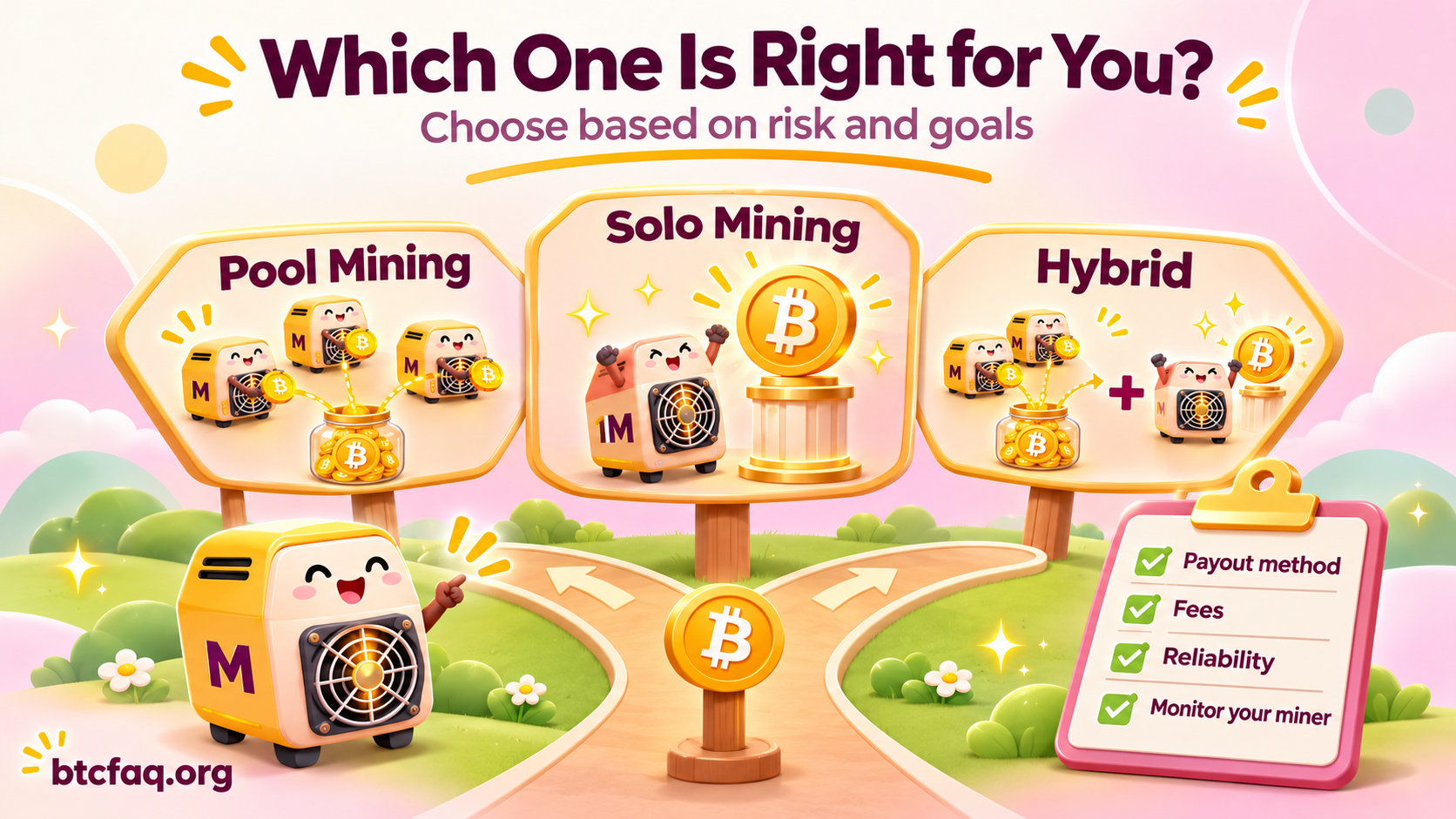
- • Understand the payout method. Know whether rewards are based primarily on submitted shares or on blocks the pool actually finds, and understand who carries the short-term variance.
- • Read the current fee schedule. Fees can differ between the block subsidy and transaction-fee portions of a payout.
- • Check the pool's history and reliability. A long operating record does not guarantee the future, but it gives you more information to evaluate.
- • Look at payout terms. Check the minimum payout, payout frequency and address controls.
- • Use a wallet you control when the pool allows direct payouts, and securely back up the wallet's recovery information.
- • Monitor your own miners as well as the pool dashboard. Local or hosting-side hashrate, temperatures, uptime and worker status tell you whether the hardware itself is healthy.
For hosted miners, OneMiners provides a useful example of that second layer of monitoring. Its OneMiners App shows total hashrate, daily rewards and live worker status. Worker Details can display temperatures and fan speeds and can remotely restart, power units on or off, and adjust pool settings.
Cassy Soriano's Medium article, OneMiners App Explained: A Tour of the New Miner Interface, provides a fuller walkthrough of the interface, including miner monitoring, wallet activity, notifications and repair-related features.
That kind of independent hardware visibility is useful regardless of which mining pool you choose. The pool tells you what work it has credited; the hosting or miner interface helps you confirm that the ASIC itself is online and operating normally.
A Note on Sources
It's only fair to say who's behind these sources. OneMiners and Cassys are affiliated, and the company sells mining hardware and hosting, so those pieces promote its products. Simple Mining sells miners and hosting. ViaBTC and Braiins operate pools and promote their own services. Blockstream's explainer is educational. The explanations of how solo and pool mining work agree across all of them, which gives me confidence in the mechanics. Specific fees, hashrates and prices are time-sensitive, so verify them on each provider's own site.
Common Misconceptions
“A pool makes my ASIC more likely to find a valid Bitcoin block.” No. Each hash your ASIC performs still has the same probability of satisfying the network target. What changes is that you receive a share of pool earnings when the combined pool finds blocks or, under PPS-style systems, according to the pool's payout formula.
“Solo mining pays more.” Not automatically. Before fees and other differences, the same hashrate has broadly similar long-run expected gross block revenue. Solo mining concentrates that expectation into rare wins, while pools smooth it into regular payouts and charge for the service.
“Small miners can't win solo blocks.” They can. OneMiners documented two small solo wins in October 2026, including one miner operating at only about 16.2 TH/s. The event was remarkable precisely because the odds were so low.
“Shares are progress toward a block.” No. Shares prove that useful hashing work was performed and allow a pool to measure contribution. They do not accumulate until they become a Bitcoin block.
Frequently Asked Questions
What is the difference between solo mining and pool mining? Solo mining concentrates your expected reward into rare occasions when your own mining setup finds a valid block. Pool mining spreads block-finding risk among many miners and pays you according to contributed work and the pool's reward method.
Does joining a mining pool increase the probability that one of my own hashes solves a Bitcoin block? No. Your individual hashrate has the same underlying probability. A pool simply lets you participate economically in the blocks found by the combined hashrate.
Do pool and solo mining have exactly the same average earnings? Not exactly. Their long-run gross expected block revenue can be similar for the same hashrate under equivalent conditions, but pool fees, solo-service fees, rejected shares, payout formulas, transaction-fee treatment and other operational differences affect actual earnings.
Is solo mining worth it? For most small miners seeking predictable income, pool mining is generally more practical. Solo mining can still make sense as a hobby, a decentralization choice or a deliberate high-variance strategy for operators who fully understand the odds.
Do I need my own node? Not for ordinary pool mining. A node becomes more relevant if you want to solo mine independently or participate in transaction selection through systems such as Stratum V2 Job Declaration.
Final Thoughts
Pool mining and solo mining are not two tricks for creating more Bitcoin from the same ASIC. They are primarily two different ways of taking block-finding risk.
Solo mining gives you a tiny chance of receiving a very large reward. Pool mining turns the same underlying hashing work into a much smoother stream of smaller payments, usually in exchange for a fee.
For most beginners and small mining operations, I would start with a reputable pool and spend more attention on electricity cost, machine efficiency, uptime and monitoring than on chasing a rare solo jackpot. OneMiners' October solo-miner case is a great reminder that small miners really can win—but its own numbers also show why those wins make headlines.
If you are curious about solo mining, treating a small hobby ASIC as a long-shot experiment can be fun. Just separate the entertainment value from the economics.