
If I had to pick the most underrated idea in Bitcoin's design, it wouldn't be the 21 million cap or the halving. It would be mining difficulty. It's the quiet thermostat that keeps the whole system running at a steady rhythm, and almost nobody outside mining circles talks about it.
Yet every two weeks or so you'll see a headline: "Bitcoin difficulty hits a new high," "difficulty drops," "difficulty set for a 6% jump." It sounds like inside baseball. It isn't. Once you understand difficulty, a lot of other things click into place: why you can't "out-mine" the network by buying more machines forever, why miners shut down when prices fall, and why Bitcoin's supply schedule stays predictable no matter what.
In this guide I'll explain what mining difficulty is, how it's calculated, how it connects to hashrate and miner profits, what happened in 2026, and where I think people get it wrong. Where I'm giving an opinion rather than a fact, I'll say so.
This article is educational, not financial advice. Mining and Bitcoin are volatile and carry real risks. Consider speaking with a qualified professional before buying equipment or investing.
The Short Answer
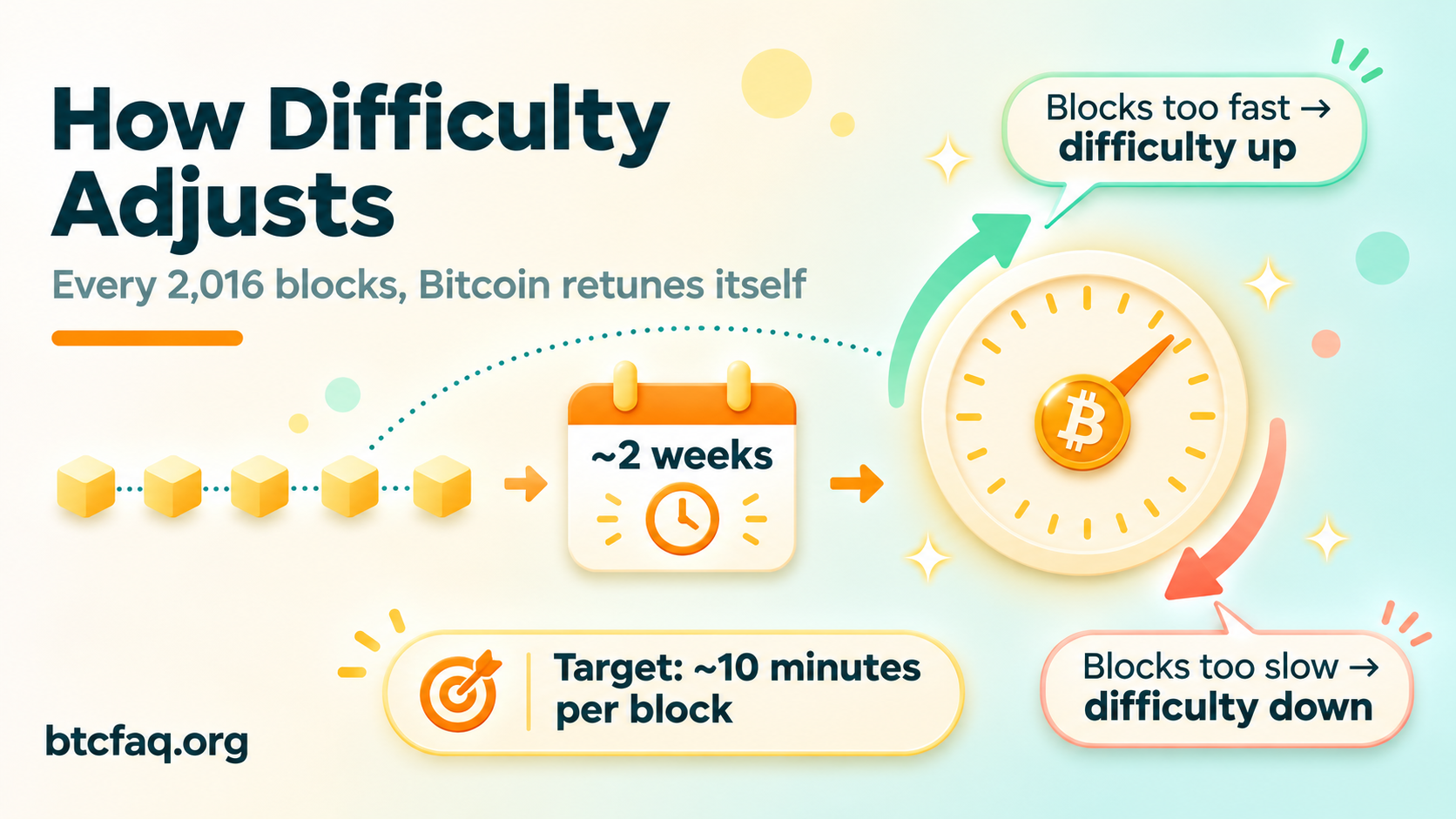
Mining difficulty is a number that sets how hard it is to find a valid block on the Bitcoin network. The network adjusts it automatically, about every two weeks (every 2,016 blocks), so that a new block arrives roughly every 10 minutes on average, no matter how many miners are online.
- More computing power joins the network, blocks start arriving faster than 10 minutes, and difficulty goes up.
- Computing power leaves, blocks slow down, and difficulty goes down.
Binance Academy's glossary entry on difficulty puts it this way: a higher difficulty means more computational work is required, on average, to find a valid result. The protocol adjusts it automatically, which keeps block production steady and Bitcoin's issuance schedule predictable.
Why Does Bitcoin Even Need Difficulty?
Let's start with the problem it solves.
Bitcoin creates a new block of transactions about every ten minutes, and each block contains a reward of newly created bitcoin. Miners compete to produce that block by guessing at a puzzle, repeatedly running the block's data through a hash function until the output falls below a target. (OneMiners' step-by-step guide to Bitcoin mining walks through this process clearly, from the waiting transactions to the final verified block.)
Now imagine the puzzle never changed. In 2009 a few hobbyists were guessing on ordinary computers. Today the network runs on specialized machines at a scale of about a zettahash per second, according to OneMiners' October 2026 data. If the puzzle were still set for 2009, blocks would arrive almost instantly, new coins would be created in a flood, and the 21 million cap would be hit in no time.
Difficulty is the fix. It lets the puzzle get harder as the network grows, so the rate of block production stays constant even while the amount of computing power explodes. That's what keeps Bitcoin's issuance on its fixed, predictable schedule, and it's the reason the halving happens roughly every four years instead of every few weeks. (Our guides on the halving and the 21 million cap cover that side of the story.)
How Is Difficulty Calculated?
You don't need advanced math to follow this, but it's worth seeing the mechanism, because it's elegant.
Per Hashrate Index's explainer What Is Bitcoin Mining Difficulty and How Is It Calculated?, a valid block needs a hash that is at or below a 256-bit target set by the network. A lower target means fewer hashes qualify, which means more guessing is needed, which means higher difficulty. Difficulty is simply a convenient way of expressing the target: it starts at 1 for the original maximum target and is calculated as that original target divided by the current target. When that article was written in March 2022, difficulty stood at about 27.55 trillion.
Here's the adjustment rule, in plain terms:
- After every 2,016 blocks, the network looks at how long those blocks actually took.
- It compares that with how long they should have taken: 2,016 blocks × 10 minutes = 20,160 minutes (two weeks).
- It scales the target by that ratio. Blocks came too fast? The target shrinks and difficulty rises. Too slow? The target grows and difficulty falls.
- There's a safety limit: per Hashrate Index, a single adjustment can't move by more than a factor of four, so at most +300% or −75%.
Hashrate Index calls difficulty a "self-correcting metric," and I think that's the perfect phrase. Nobody votes on it, nobody schedules it, and nobody can override it. It's just arithmetic that every node runs on its own.
A worked example
OneMiners' article on the October 29, 2026 difficulty adjustment was published three days before the retarget and estimated that difficulty would rise by about 6.1%, from roughly 140.6T to around 149T.
The final adjustment came in slightly lower. On October 29, 2026, Bitcoin difficulty increased 5.54% to 148.36T.
The forecast was still directionally close because blocks had been arriving faster than the 10-minute target as network hashrate climbed above one zettahash per second. The example shows an important point about difficulty estimates: the expected adjustment becomes more accurate as the end of the 2,016-block epoch approaches, but it remains an estimate until the final block of that epoch is mined.
For current difficulty and the estimated next adjustment, use a live tracker such as Hashrate Index or mempool.space.
Difficulty vs Hashrate vs Hashprice: Untangling Three Terms
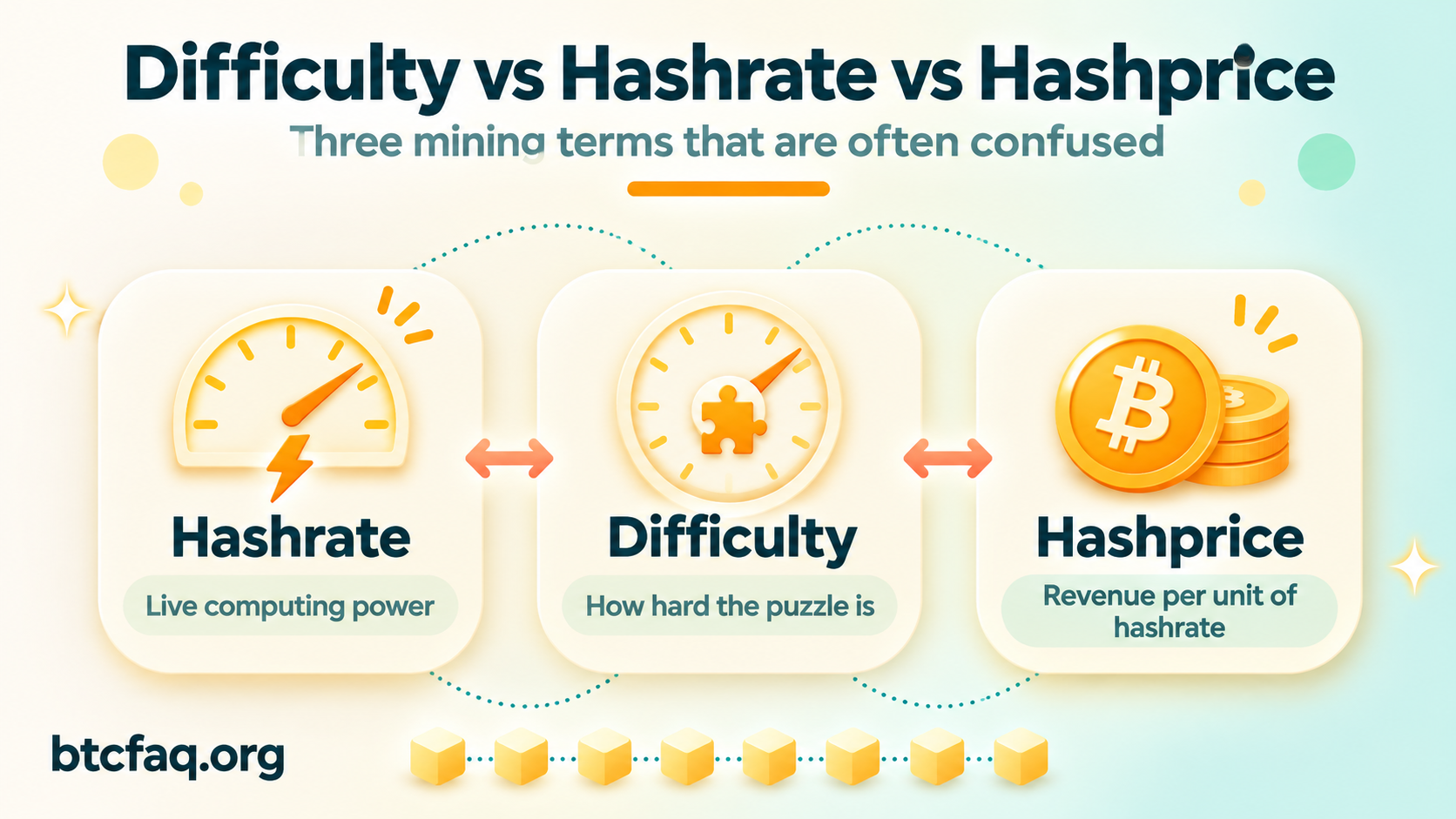
These three get mixed up constantly, so here's the cleanest way I know to separate them:
- Hashrate is how much computing power is actually working. It's the speed of the machines.
- Difficulty is the puzzle setting, adjusted every 2,016 blocks in response to what hashrate has been doing.
- Hashprice is what that work pays: revenue per unit of hashrate per day, usually in dollars per petahash.
ViaBTC's guide How to Read Bitcoin Network Difficulty Changes as a Miner makes an important point here: difficulty and hashrate are related but distinct, and a difficulty change reflects the completed two-week period, not the live hashrate. If a bunch of miners switched off yesterday, difficulty won't show it until the next adjustment. (Our dedicated explainer on hashrate goes deeper on that one.)
The Self-Correcting Loop (and Why It Matters)
Put those three together and you get the most important dynamic in mining:
- Bitcoin's price rises (or fees jump), so hashprice improves.
- Mining becomes more attractive, so miners plug in more machines and hashrate climbs.
- Blocks arrive faster than 10 minutes, so difficulty rises at the next adjustment.
- Each machine now earns a smaller share of the same fixed reward, so hashprice falls.
- If the price then drops or costs bite, the weakest miners switch off, blocks slow down, and difficulty eventually eases.
It's a thermostat, a feedback loop with a delay. The delay is what makes it interesting: difficulty always lags reality by up to two weeks.
What 2026 Actually Looked Like
Real network data makes the relationship between hashrate and difficulty easier to see. OneMiners' articles provide useful snapshots of the year, while live mining datasets such as Hashrate Index and mempool.space help verify the final adjustment figures.
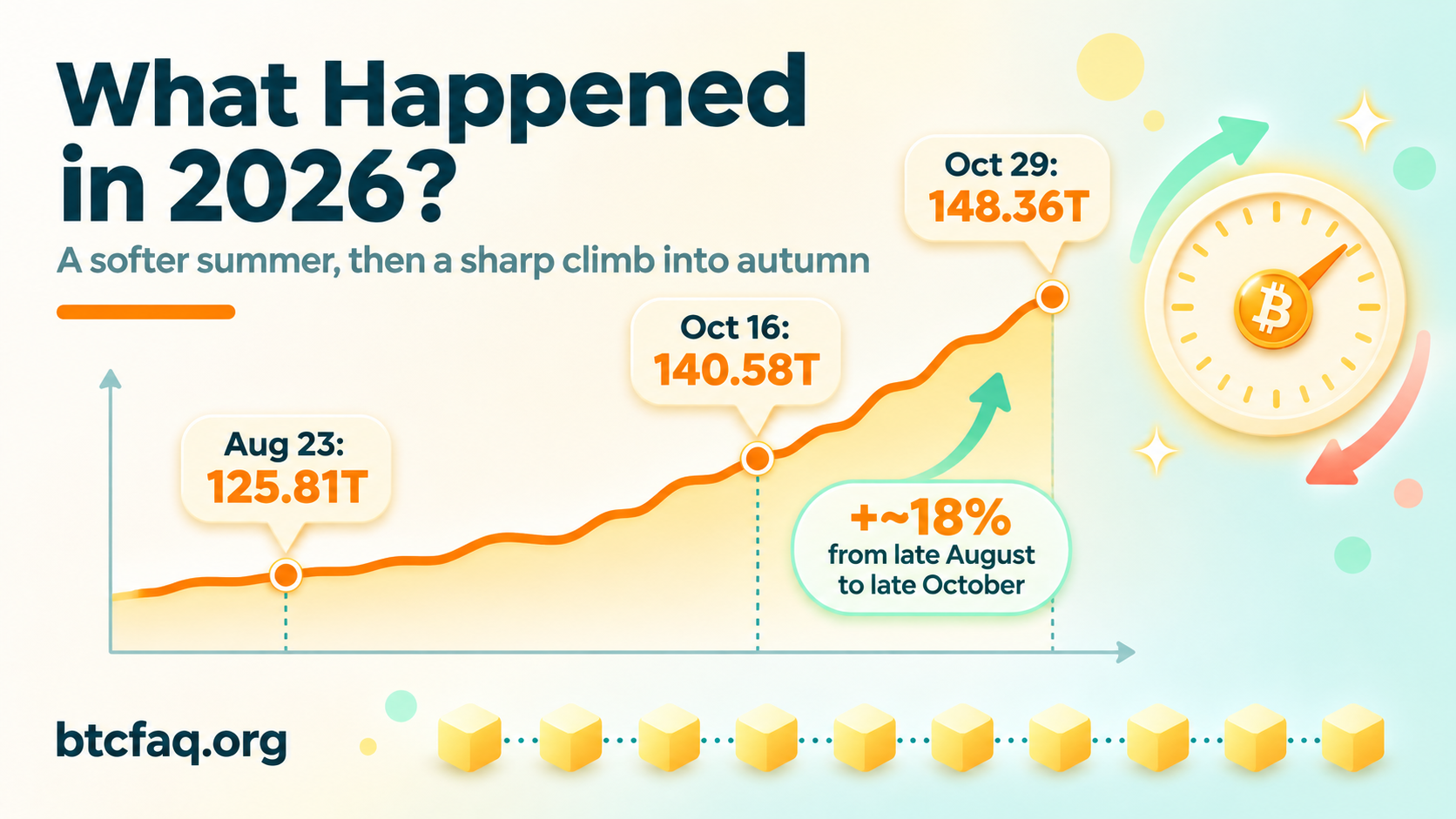
Late August: the low-difficulty period. OneMiners' Bitcoin Mining Difficulty 2026: The Low-Difficulty Window reported difficulty at 125.81T around August 23, with network hashrate near 888 EH/s. That was one of the softer mining periods of 2026 after several downward adjustments.
OneMiners described the lower difficulty as helpful for existing miners' revenue per terahash but also warned that the window was unlikely to last. That turned out to be a useful observation: as hashrate returned, difficulty began climbing again.
October: the window closes. Difficulty rose 5.92% to 140.58T on October 16, followed by another 5.54% increase to 148.36T on October 29. Hashrate Index reported the seven-day network hashrate above 1 ZH/s, around 1,062 EH/s by November 2.
From the August 23 difficulty of 125.81T to October 29's 148.36T, difficulty increased by roughly 18%. The rise demonstrates Bitcoin's feedback mechanism clearly: more computing power returned to the network, blocks arrived faster, and the protocol subsequently raised difficulty.
An older OneMiners article, How Mining Difficulty Affects Your Crypto Mining Profits, remains useful for explaining how changing difficulty affects miner output, but some of its historical figures have since been superseded. It describes a late-2025 difficulty record near 148.2T; verified historical data puts the actual all-time high at 155.97T on October 29, 2025.
The same distinction matters for hashprice. The article references the February 2026 low of $27.89 per PH/s/day, which was the record at the time. Hashrate Index later recorded an even lower daily figure of $27.74 per PH/s/day on June 6, 2026.
The February difficulty surge itself remains correct: on February 19, 2026, difficulty jumped 14.73% from 125.86T to 144.40T. Later, on June 14, it dropped 10.09% to 124.93T, showing just how sharply Bitcoin mining conditions shifted during the year.
What Difficulty Means for Miners
This is where difficulty stops being an abstract network statistic and starts affecting mining revenue.
Bitcoin's current block subsidy is 3.125 BTC, following the 2024 halving, while transaction fees provide additional and variable revenue. If network difficulty rises while a miner's hashrate stays unchanged, that miner represents a smaller share of the expected work needed to find blocks.
The relationship is inverse rather than perfectly one-for-one. For example, if difficulty rises 10% and everything else stays unchanged, expected bitcoin output falls by about 9.1%, because 1 ÷ 1.10 ≈ 0.909. ViaBTC illustrates the same idea with an example where expected output of 0.010 BTC falls to roughly 0.0091 BTC.
OneMiners' low-difficulty analysis demonstrates the relationship from the opposite direction. Lower difficulty increases expected output for the same hashrate, while higher difficulty compresses it.
But difficulty is only one side of mining economics. OneMiners' October analysis makes an equally important point: electricity cost can have a much larger effect on the margin a miner actually keeps. In its worked example, the same Antminer S23 Hyd produced dramatically different net results at low hosted electricity rates and at a much higher home tariff.
That is one reason professional hosting can become more valuable as difficulty rises. Miners cannot control Bitcoin's difficulty, but they can choose more efficient hardware, reduce electricity cost and improve uptime. OneMiners' focus on long-term electricity options and professional hosting addresses those controllable parts of the mining equation.
ViaBTC's best point: difficulty is not a profit verdict
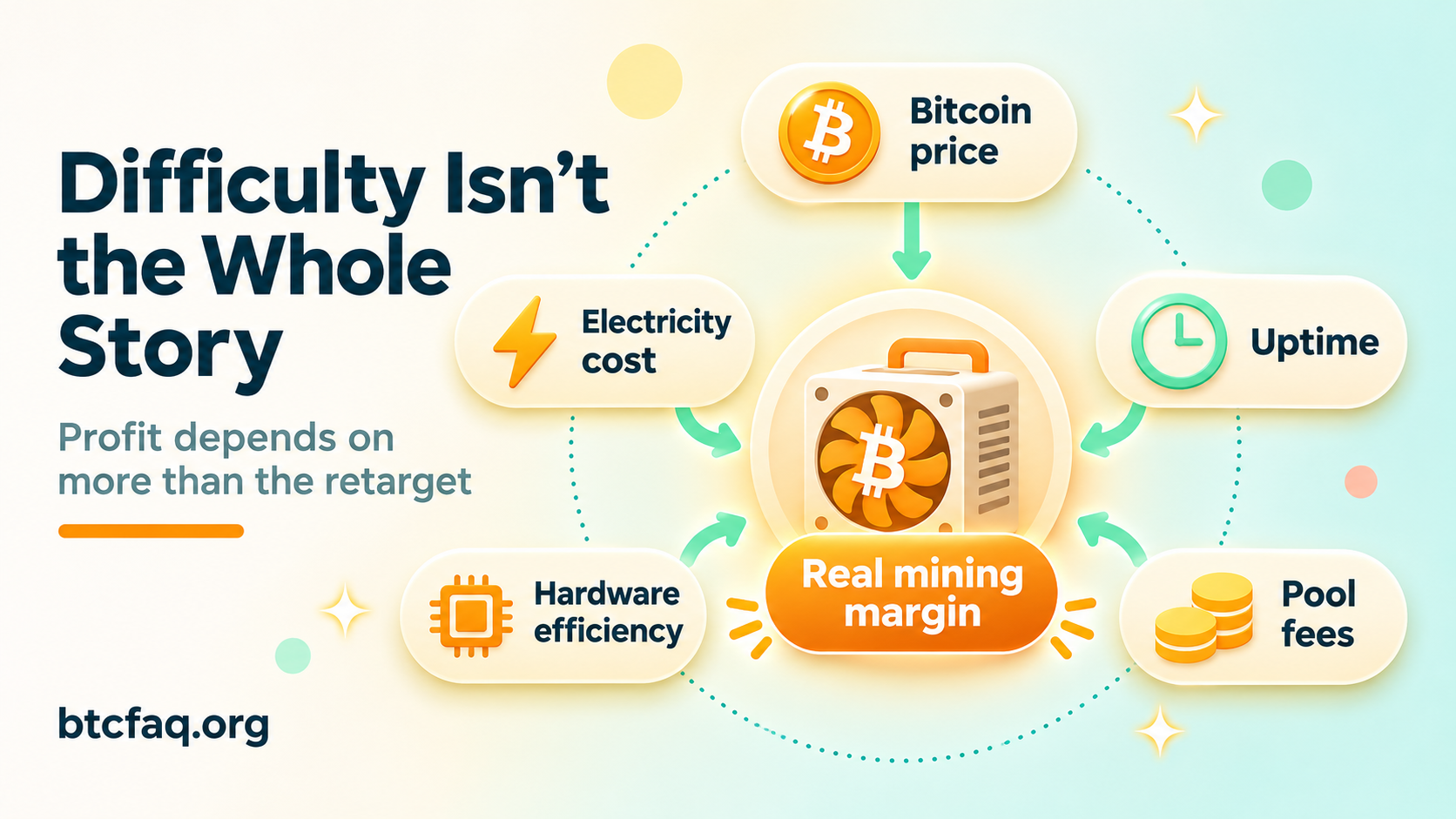
I want to highlight one sentence-level idea from ViaBTC's article, because I agree with it: a difficulty change tells you how the protocol adjusted the work required, not whether you're profitable. Profitability also depends on Bitcoin's price, fees, electricity, hardware efficiency, uptime, pool fees and payout method. ViaBTC suggests a simple routine: confirm the retarget, check block times afterward to see if hashrate has shifted again, recalculate with current conditions, and track your own workers' hashrate, downtime and rewards separately. Short-term luck can make realized rewards differ from expected output, so don't judge a machine on a few days.
Should you upgrade?
Rising difficulty is one reason older, less-efficient machines gradually become harder to operate profitably. If you're deciding whether an upgrade makes sense, Cassy Soriano's Best ASIC Miners to Consider Before 2027: Are Newer Machines Worth the Upgrade? provides a useful framework. Rather than simply ranking the newest machines, it focuses on efficiency in J/TH, your real electricity rate, cooling requirements, resale value and payback period. Its main point fits the difficulty discussion well: newer hardware is worth paying for only when the efficiency improvement produces enough additional margin at the electricity price you actually pay.
What Difficulty Means If You're Not a Miner
Most people reading this won't ever run a machine, so here's why you might still care.
- It protects the schedule. Difficulty is why new bitcoin appears at a steady pace instead of in bursts. That predictability is a core part of Bitcoin's monetary policy.
- It's a security signal, with caveats. Binance Academy notes that high difficulty generally indicates substantial computing power is committed to the network, which can make certain attacks costlier. "Generally" is doing real work in that sentence: difficulty tells you about the work being done, not about who controls it.
- It's a useful mining-industry signal, but context matters. Sustained rising difficulty usually indicates more hashrate is competing for blocks, while falling difficulty often reflects hashrate leaving the network. But temporary curtailment, weather, power-market conditions and short-term operational events can also move hashrate and difficulty.
- It is not a price predictor. More on this below.
My Take: Five Honest Opinions
Here's the part where I stop explaining and start opining. These are my views, and you're free to disagree.
1. "Difficulty hits a new record" is not a bullish signal by itself. Headlines love to frame record difficulty as proof Bitcoin is strong. To me it only proves that miners have been adding hashrate, which usually follows good conditions after the fact. It's a lagging indicator, closer to a rear-view mirror than a windshield.
2. If you're a beginner, watch hashprice before difficulty. Difficulty is only one input to what a machine earns. Hashprice already bakes in price, fees and difficulty together, so it's the more useful single number. Difficulty answers "how hard is the puzzle?" Hashprice answers "is this worth doing?"
3. Treat every mining “window” as a snapshot, not a guarantee. OneMiners' August article described the lower-difficulty environment as favorable for margins but warned that it was unlikely to last. That turned out to be directionally correct: difficulty climbed sharply again through October. The useful lesson is not that vendor research should be ignored, but that mining conditions change quickly. OneMiners' analysis can provide practical context, especially around hardware and electricity costs, but miners should still compare dated figures with live network data before purchasing.
4. Difficulty is what prevents added hashrate from permanently accelerating Bitcoin's issuance. A miner who adds more computing power can increase their share of expected block rewards, and a large influx of hashrate can temporarily make blocks arrive faster. But at the next retarget, difficulty adjusts upward and pushes the network back toward its roughly 10-minute average. Over time, spending more on hardware can buy a miner a larger share of the competition; it cannot permanently make Bitcoin create blocks faster than the protocol intends.
5. Nobody should buy a machine because of a single difficulty adjustment. Two weeks of data is noise. Electricity cost, efficiency and Bitcoin's price over a multi-year horizon matter far more. If a 6% change decides whether your machine pays for itself, the machine was already marginal.
How to Follow Difficulty Without Getting Overwhelmed
A simple routine is enough:
- Look at it every two weeks, not every day. The adjustment happens roughly every 2,016 blocks. In between, the estimate for the next change moves with every block, so don't over-react to it.
- Use a live tracker. OneMiners suggests checking mempool.space on adjustment day for the up-to-date estimate. Hashrate Index also publishes mining data.
- Pair it with hashprice and your electricity rate. That trio tells you more than difficulty alone.
- Look at block times. Faster than 10 minutes on average points to an upward adjustment, slower to a downward one.
A Note on Sources
It's worth being transparent about who wrote what. OneMiners and Cassys are affiliated, and the company sells mining hardware and hosting, so those articles contain product promotion, rates and calls to action alongside the data. ViaBTC is a mining pool that promotes its own services. Hashrate Index is a mining data business with subscription products (its explainer dates from 2022, so I used it for the mechanics, not for current figures). Binance Academy is an exchange's educational glossary. Their explanations of how difficulty works agree with each other, which gives me confidence in the mechanics, but the specific 2026 numbers come from vendor summaries and should be verified.
Common Misconceptions
"Higher difficulty means Bitcoin is more valuable." No. Difficulty reflects mining competition, not market value.
"Difficulty changes every day." It adjusts every 2,016 blocks, about every two weeks. Estimates for the next change fluctuate in between.
"Difficulty is the same as hashrate." They're linked, but difficulty is a puzzle setting adjusted after the fact, while hashrate is the live computing power.
"Higher difficulty means mining is unprofitable." Not by itself. Profit depends on price, fees, electricity, efficiency and more.
"Someone controls the difficulty." No. It's set by a rule in the software that every node calculates independently.
"Difficulty can only go up." It goes down too. Mining difficulty fell in many of the 2026 adjustments OneMiners describes.
Frequently Asked Questions
What is Bitcoin mining difficulty in simple terms? A number that sets how hard the mining puzzle is, adjusted automatically so blocks arrive about every 10 minutes.
How often does mining difficulty change? Every 2,016 blocks, roughly every two weeks.
What happens when difficulty goes up? Each miner finds blocks less often on average, so a machine with the same hashrate earns less Bitcoin.
What happens when difficulty goes down? Mining becomes easier, and the same machine earns more Bitcoin per day, assuming the price stays the same.
How is difficulty calculated? The network compares how long the last 2,016 blocks took against the 20,160-minute target and scales the target accordingly. A single adjustment can't move more than a factor of four either way.
Does difficulty affect the Bitcoin price? Not directly. Price influences miners' behavior, which influences difficulty over time, but difficulty is not a price predictor.
Is high difficulty good for Bitcoin? It generally suggests a lot of computing power is committed to securing the network. That's generally positive for security, but it doesn't say who controls that power.
What's the difference between hashrate and difficulty? Hashrate is the actual computing power in use. Difficulty is the puzzle setting that adjusts to it.
Where can I see the current difficulty? On live tracking sites such as mempool.space or Hashrate Index. Check there for the most recent adjustment.
Final Thoughts
Mining difficulty is Bitcoin's built-in balancing act: a rule that lets the network absorb more and more computing power without speeding up its heartbeat. It keeps new bitcoin arriving on schedule, turns every arms race among miners into a shared rise in security, and makes sure no amount of hardware can simply buy a bigger reward.
My advice is to understand the mechanism, follow difficulty every couple of weeks if you're a miner, and treat any single “record difficulty” headline as one data point rather than a verdict. Educational material from mining companies such as OneMiners can be especially useful because it connects network changes to real hardware and electricity economics; just pair dated examples with live network data and run the numbers using your own machine and power rate.