Every time Bitcoin's price jumps, the same thought shows up in comment sections and group chats: "Mining must be printing money now." It sounds obvious. Miners get paid in bitcoin, so if bitcoin is worth more, they're richer, right?
Sort of. And that "sort of" is the most important lesson in mining economics. A rising price does raise miners' revenue, usually right away. But whether it raises their profit depends on three other things that move at different speeds: network difficulty, electricity cost, and the price of the machines themselves.
In this guide I'll show you how those pieces fit together, using real 2026 data from several sources, and I'll give you my honest opinion on where people go wrong. Opinions are labeled as opinions.
This article is educational, not financial advice. Mining can lose money and Bitcoin is volatile. Consider speaking with a qualified professional before buying equipment or investing.
The Short Answer
- • Bitcoin price matters immediately. If difficulty, fees and network conditions stay the same, a higher BTC price raises the dollar value of the bitcoin a miner earns.
- • Profit can improve too, but not automatically and not by the same percentage. Electricity, pool fees, hosting costs and hardware expenses still have to be paid.
- • Difficulty reacts with a delay only if more effective hashrate joins the network. When stronger mining economics encourage machines to switch on or new capacity to deploy, the next difficulty adjustments can reduce the amount of bitcoin each unit of hashrate earns.
- • Electricity price determines how much room you have. A miner paying around 3.6–4.5¢/kWh has much more margin to absorb changing conditions than the same machine operating at expensive residential electricity.
- • Rallies can also increase demand for mining hardware, meaning a higher revenue environment can come with more expensive machines and tougher competition.
If you remember one idea, make it this: Bitcoin price affects mining revenue quickly, while difficulty and competition react more slowly. Profit is what remains after those forces meet your actual operating costs.
First, the Vocabulary: Revenue, Hashprice and Profit
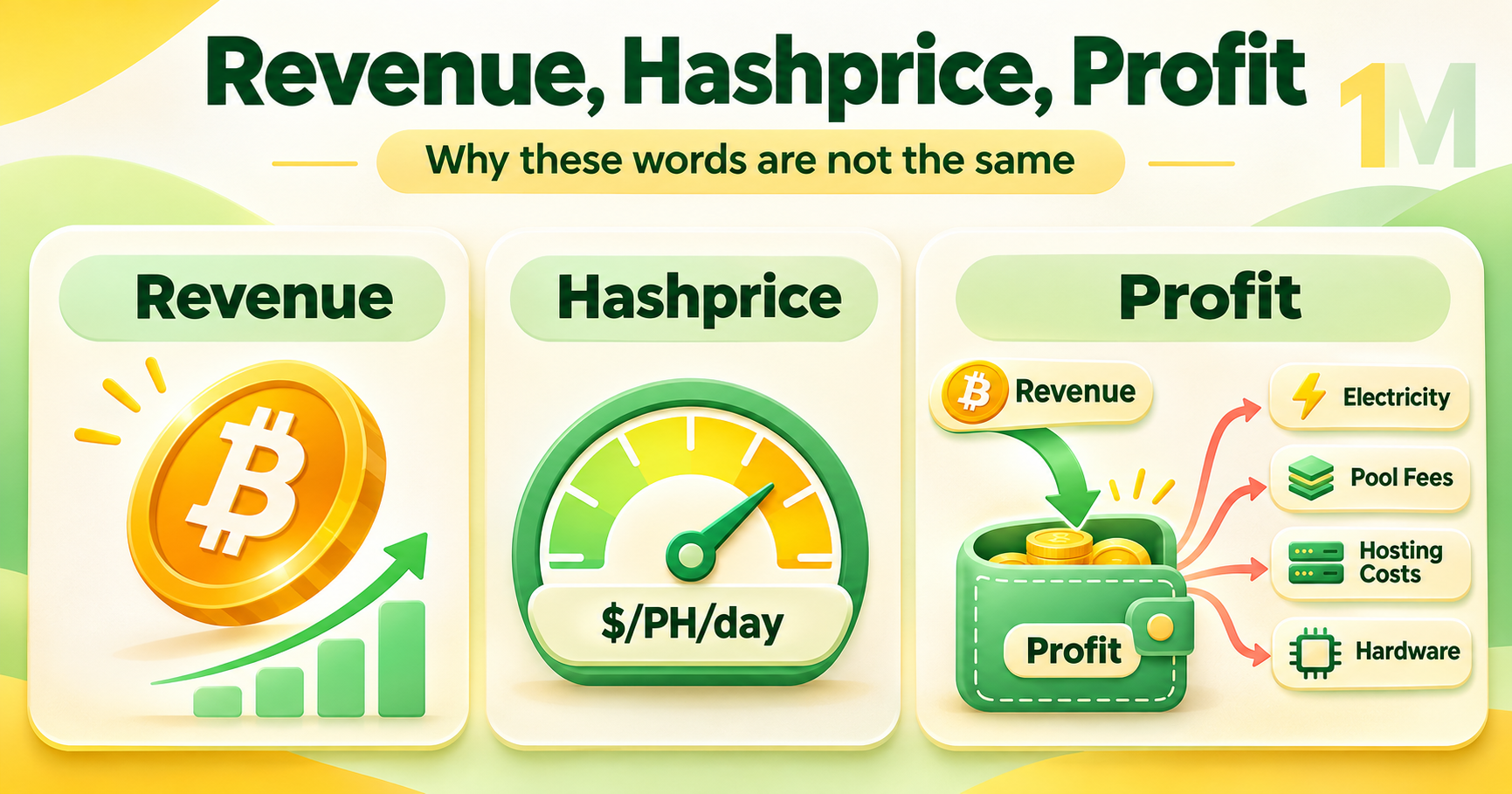
Three words get mixed up constantly.
- • Revenue is what a miner earns in bitcoin (and fees), converted to dollars. It says nothing about costs.
- • Hashprice is revenue per unit of computing power per day, usually quoted in dollars per petahash per day. It's the standard way to compare mining income, because it doesn't depend on which machine you own.
- • Profit is what's left after electricity, hosting fees, pool fees, hardware costs and everything else.
Cassys' article on mining revenue hitting its best month since January (5 October 2026) makes the same point I'm making: revenue is a gross figure that says nothing about costs, and hashprice is the more useful measure of what a machine earns. It adds two cautions I'll come back to. Flat difficulty alongside rising revenue is good for existing miners, but the effect is temporary, because new hashrate tends to join and push hashprice back down. And profitability depends mainly on your all-in electricity rate, your uptime, and how efficient your hardware is.
The Formula That Cuts Through the Noise
Here's the single most useful equation in mining. Your break-even electricity price (the most you can pay per kWh before the machine loses money on power alone) is:
break-even price ($/kWh) = hashprice ÷ (24 × efficiency in J/TH)
Hashrate Index's piece on power breakevens and when to mine or curtail (August 2026, published by Luxor, which sells mining firmware) states it the same way: hashrate and wattage cancel out, so efficiency is the key variable. It gives worked examples at a hashprice of $40 per petahash per day: a 17.5 J/TH machine breaks even near $95 per megawatt-hour (about 9.5 cents per kWh), a 13.5 J/TH machine up to roughly $123/MWh, and an older 30 J/TH machine only near $56/MWh. The article notes that these are revenue-only lines; hosting fees, labor and pool fees lower the practical threshold. Its practical advice is also nice: recalculate against the current hashprice rather than treating break-even as a fixed number, and consider underclocking rather than shutting off completely when power gets pricey.
Why does this formula matter for our question? Because hashprice sits in the numerator. If Bitcoin's price rises while difficulty and transaction-fee conditions remain unchanged, dollar-denominated hashprice rises with it, which increases the electricity price a machine can theoretically tolerate before reaching power-only break-even.
But hashprice is not controlled by Bitcoin price alone. Difficulty and transaction fees move too, so a BTC rally can happen at the same time that hashprice stays flat—or even falls—if network competition is rising fast enough.
What Happened in 2026: The Rally Test
Real data makes this stick, so let me walk through a few snapshots from OneMiners' 2026 articles. A caveat up front: OneMiners sells mining hosting and hardware, and every one of these pieces ends up promoting its services. The numbers are its own summaries of public data, so verify before relying on them.
August: a sharp rally, and hashprice follows
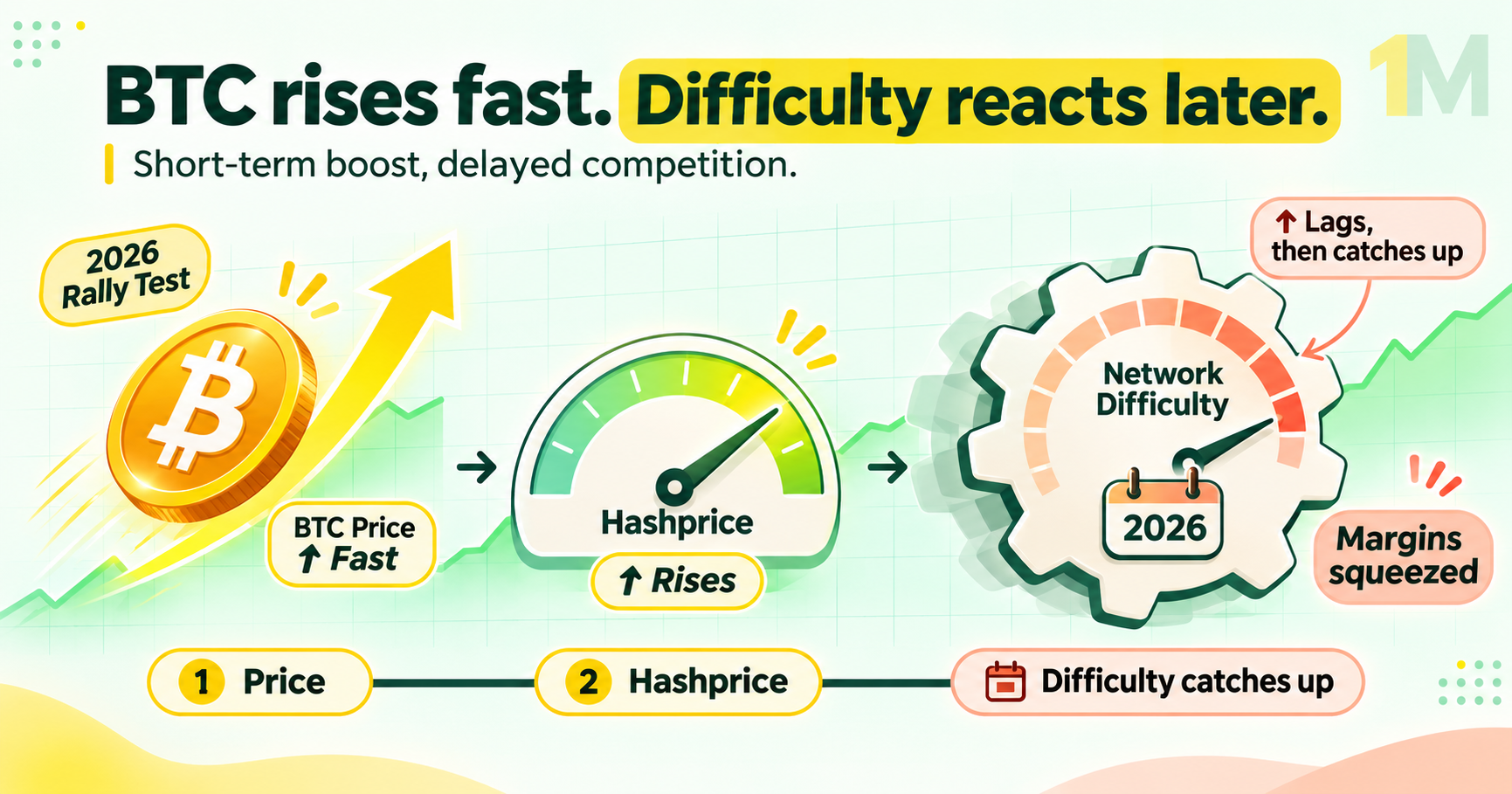
OneMiners' article BTC and ZEC Price Rally: What It Means for Mining Profits (24 August 2026) reports Bitcoin rising from about $62,966 to $77,277 in a week, up 22.7%. Over the same week, hashprice rose from $31.80 to $38.29 per petahash per day, up 20.4%. In other words, hashprice moved almost one-for-one with price, exactly as you'd expect in the short run. The article shows what that did to break-evens: a 9.5 J/TH machine (the Antminer S23 Hyd) went from breaking even at about 13.9 cents per kWh to about 16.8 cents in a week. (Check: $31.80 ÷ (24 × 9.5) is about $0.139, and $38.29 ÷ (24 × 9.5) is about $0.168. The formula works.)
The same piece is honest about the limits. It says higher prices raise profits "only temporarily," because difficulty adjusts about every two weeks and takes part of the gain back. It estimates that if difficulty returned to its 2026 peak at the same Bitcoin price, hashprice would settle near $33, not $38.
September: a quiet network, a fatter margin
OneMiners' hashprice-up-22%-hashrate-stalled article (18 September 2026) describes hashprice rising from about $32.42 to $39.63 in 30 days, a 22% increase. It says the cause was mainly Bitcoin's price, and that competition was flat: difficulty had fallen and was about 13% below its 2026 high, hashrate had stayed near its highs without setting a new record in roughly 320 days (which the article calls the longest drought in a decade), and new machines had not come online in response to the higher hashprice. That's the sweet spot for miners: price up, competition not (yet) up.
By 26 September, OneMiners' Is Bitcoin Mining Still Worth It in 2026? put Bitcoin at about $84,834, hashprice at $40.54, and difficulty at 132.76 trillion. Its answer is the right one in my view: "Yes, above one specific electricity price, and no below it." At today's hashprice it calculates break-evens of about 17.8 cents per kWh for a 9.5 J/TH machine, 14.1 cents for a 12 J/TH machine, and 9.65 cents for a 17.5 J/TH machine. At a US residential average of about 17 cents, it says no current machine breaks even once you count everything, and at a typical hosted rate of 4.8 cents, all of them have a margin. (I rechecked the three break-even numbers and they match the formula.)
October: the catch-up
By late October, the delayed competition effect had become much more visible.
OneMiners' October 26 article on the next difficulty adjustment estimated that difficulty would rise by roughly 6%, from 140.6T to around 149T.
The final adjustment on October 29 came in at +5.54%, taking Bitcoin difficulty to 148.36T.
That followed the +5.92% increase on October 16, meaning miners absorbed two large upward adjustments within two weeks.
The price side did not fully compensate. In the late-September OneMiners snapshot, Bitcoin was around $84,834, hashprice was about $40.54/PH/day, and difficulty was 132.76T. By late October, Bitcoin was around 80,000whiledifficultyhadclimbedto148.36Tandhashpricehadfallenintothemid-30s.
Using the same rough relationship—hashprice scales approximately with Bitcoin price divided by difficulty when other variables are held constant—the move from $84,834 BTC and 132.76T difficulty to roughly $80,382 and 148.36T produces an estimated hashprice around $34.4/PH/day, very close to what miners actually saw.
The squeeze continued into November. Hashrate Index's November 2 roundup reported $32.86/PH/day spot hashprice, with network difficulty still at 148.36T.
That is the lag in action: the earlier price rally improved mining economics, more effective hashrate returned or entered the network, difficulty increased, and part of the earlier revenue advantage was competed away.
It does not mean a rally is bad for miners. It means the best question is not simply “Is BTC higher?” but “Is BTC rising faster than difficulty and costs?”
So Did the Rally Make Miners More Profitable?
Let's put the August rally into a real machine example.
OneMiners' August article uses the Antminer S23 Hydro, rated at 580 TH/s and 5,510 W. At the August hashprice of $38.29/PH/day, its gross mining revenue was about:
580 TH/s ÷ 1,000 × $38.29 ≈ $22.21 per day
Electricity then determines how much of that gross revenue remains:
| Electricity rate | Power cost/day | Revenue remaining after electricity | Simple hardware-payback estimate |
|---|---|---|---|
| 3.64¢/kWh — August hosted example | ~$4.81 | ~$17.39/day | ~23 months |
| 12¢/kWh — illustrative higher-cost power | ~$15.87 | ~$6.34/day | ~64 months |
These are electricity-margin examples, not complete profit forecasts. The simple payback calculation divides the $12,299 machine price by revenue remaining after electricity and does not include pool fees, downtime, repairs, taxes, financing or other costs.
That distinction matters. The rally gave both miners the same gross revenue per terahash, but the lower-cost operator kept far more of it.
The August example also illustrates where professional hosting can help. OneMiners' current hosting network now lists 17 live data centers across five continents, seven-year prepaid electricity starting from 3.6¢/kWh in Nigeria, several U.S. locations starting around 4.5¢/kWh, and 98%+ reported average uptime. Published location pricing includes management services.
That does not make mining risk-free, but it targets several of the variables miners can actually control: electricity cost, cooling, infrastructure and uptime.
The current Antminer S23 Hydro 580 TH/s remains listed by OneMiners at $12,299, with 5,510 W power draw and 9.5 J/TH efficiency.
And remember that the table above uses August's $38.29 hashprice. When hashprice later moved into the low-to-mid $30s, the electricity margin narrowed substantially. At expensive power, that leaves much less room for pool fees, downtime and other operating costs.
Four Reasons a Rally Doesn't Guarantee Better Profits
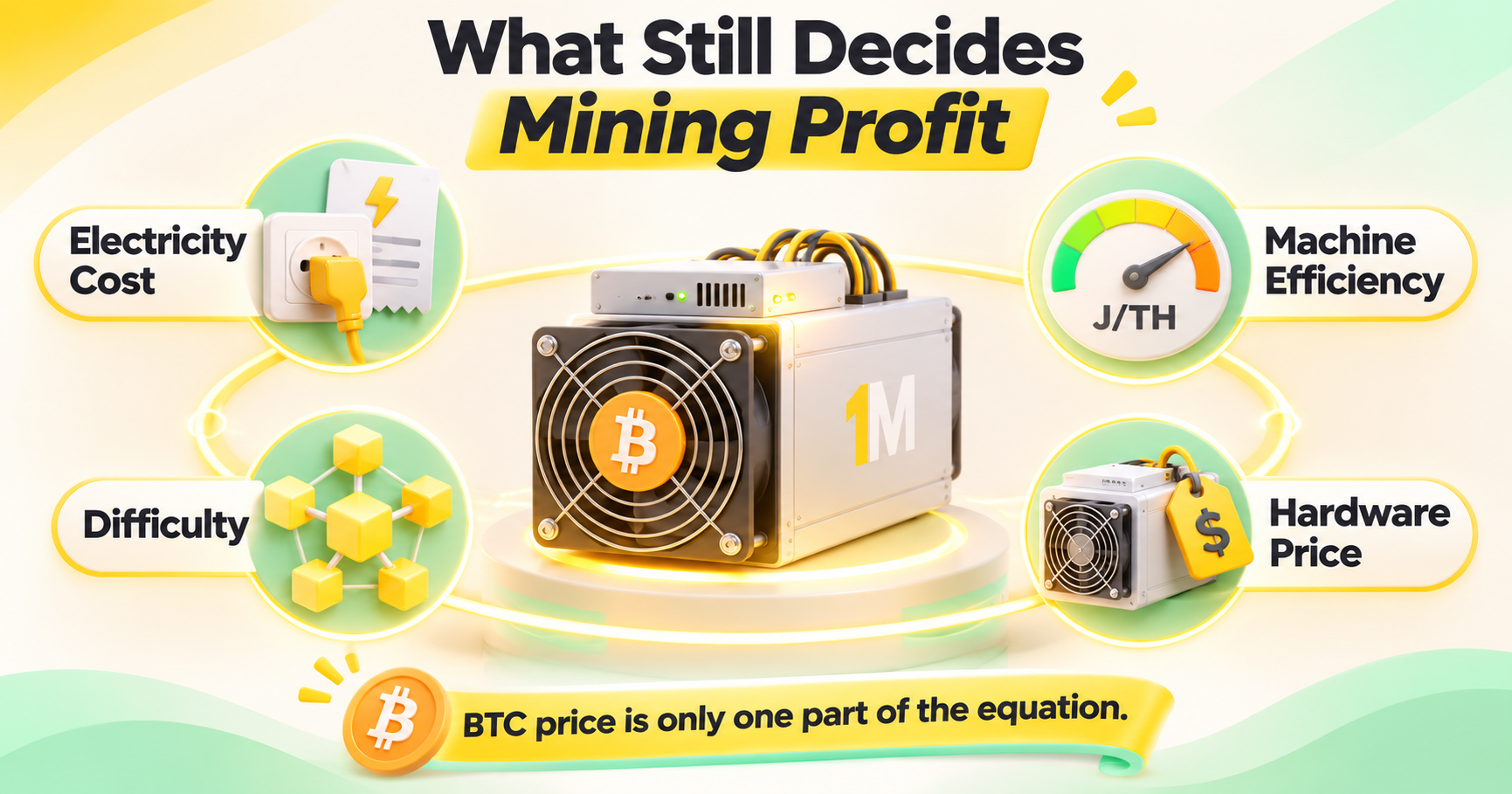
1. Difficulty can catch up. If network hashrate rises enough to push difficulty higher, the same machine earns less BTC for the same work. For example, a 6% increase in difficulty reduces expected BTC output by roughly 5.7%, all else equal. Difficulty retargets every 2,016 blocks, usually about every two weeks, which creates a delay between improving miner economics and the network's response.
2. Hardware gets more expensive. I'm giving you a general pattern here, not a quote from the sources: when mining looks attractive, demand for machines tends to rise, and prices of new machines tend to follow. The machine you'd buy after a rally may cost more than the same machine a month earlier, while its earnings have already been partly competed away.
3. The next halving raises the bar. Bitcoin's next halving is expected in 2028, with the exact date depending on block production. The block subsidy will fall from 3.125 BTC to 1.5625 BTC. If Bitcoin price, difficulty and transaction fees were unchanged, miner revenue would fall sharply. Because transaction fees are not halved, the exact decline is not necessarily 50%, but when fees are a small share of revenue the effect can be close to it.
4. Transaction fees were small in this particular window. The September OneMiners snapshot put transaction fees at only about 0.43% of miner revenue during the measured 24-hour period, so they did very little to change the economics in that example. But fee income is variable and can rise sharply during periods of heavy on-chain activity, so it should not be treated as permanently negligible.
How to Think About It Like a Planner
The most useful way I know to think about this comes from a surprisingly old source. Braiins' guide to Bitcoin mining profitability methodology was published in 2022 and promotes its own calculator, so it's dated and commercial. But its framework is still sound. It treats profitability as a set of inputs you choose: Bitcoin price, difficulty, annual changes in each, electricity cost, pool and hosting fees, upfront and ongoing costs, and how much of the mined bitcoin you hold versus sell. It also treats price and difficulty trends as scenarios you supply, not forecasts. In other words, build a bullish case and a bearish case and see whether the machine survives both. (One small error to note: the article says difficulty adjusts about 24 times a year, but it's closer to 26, since the adjustment comes every 2,016 blocks, roughly every two weeks.)
I'd add one more scenario the calculators often leave out: difficulty rising faster than you expect after a rally. That's what October looked like.
Five Honest Opinions
1. "Bitcoin is up, so mining is more profitable" is half true, and the missing half is where people lose money. Revenue yes, profit depends. The headline is the easy part; the electricity bill is the hard part.
2. Judge a miner by its break-even power price, not by today's profit per day. Daily profit swings with price and difficulty. A break-even rate tells you how much room you have for things to go wrong. If your power costs 95% of break-even, a small difficulty bump wipes you out. If it costs 40%, you can survive a lot.
3. Rallies are the worst moment to feel urgency. Seller-published articles (including the ones I've cited) often present a rally as an opportunity. Sometimes it is. But buying machines after hashprice has already jumped means paying a higher price for a revenue stream that difficulty is about to compete down. I'd rather buy when nobody is excited. (That's a view on timing, not a prediction.)
4. If your real belief is "Bitcoin's price will go up," buying Bitcoin is a simpler way to express it. Mining adds electricity, hardware, uptime, difficulty and counterparty risks on top of the price bet. It can be worth it if your power is cheap and you want the operating business, but it's not a free upgrade over holding. (Our article on mining versus buying compares the two.)
5. A miner is a leveraged bet on the spread between price and cost. When price rises, the spread widens fast, which is why miners' fortunes feel so dramatic. When price falls, the spread narrows just as fast. Don't confuse a good month with a good business.
A Note on the StreetInsider Press Release
The StreetInsider page, BTC Is Rallying, But Are Bitcoin Miners Actually Making More Money?, is now accessible.
It is important to identify the source correctly: StreetInsider labels it paid press-release content supplied by WorldNewsWire, and says its own news staff was not involved in creating it.
The article reaches essentially the same conclusion as this guide: a Bitcoin rally can raise mining revenue quickly, but hashrate growth and difficulty can gradually compress the gain. It also emphasizes electricity cost, hardware efficiency and uptime as the factors miners can control most directly.
Its OneMiners section promotes lower-cost hosting as a way to preserve more of the margin created by higher hashprice. That is a commercially interested argument, but the underlying economic logic is sound: when two miners earn the same revenue per terahash, the miner with the lower all-in operating cost keeps more of it.
I would therefore treat the StreetInsider piece as useful supporting commentary, but not as independent journalism.
A Note on Sources
To be transparent: OneMiners and Cassys are affiliated, and the company sells mining hardware and hosting, so those articles contain product promotion, rates, discount codes and calls to action. Hashrate Index is owned by Luxor, which sells mining firmware and services. Braiins sells mining products and a profitability calculator. Their explanations of hashprice, break-even and difficulty agree with each other, which gives me confidence in the mechanics. The specific 2026 numbers are snapshots and should be verified on live data sources.
A Quick Checklist Before You Act on a Rally

- • What is today's hashprice, and how has it moved over the past month?
- • What is difficulty doing? Rising difficulty is the rally's shadow.
- • What's my all-in electricity rate, including hosting fees, and what's the machine's break-even rate?
- • How far apart are the two? That's your safety margin.
- • What if hashprice falls 20% to 30%? Does the machine still pay for itself?
- • What happens at the 2028 halving? Roughly halve the break-even and see whether you're still in the black.
- • What are the contract terms, if hosted? Beware unpublished rates, revenue-share pricing, quoted returns and contracts shorter than the machine's useful life.
Common Misconceptions
"When Bitcoin goes up, every miner profits." Miners with expensive power may barely benefit, and a rally can be competed away within weeks.
"Revenue and profit are the same thing." Revenue is gross. Profit is what's left after electricity and other costs.
"A high hashprice means I should buy a machine now." It means the current slice is bigger. Difficulty and hardware prices may erase that advantage.
"A price rally makes old machines profitable again." Sometimes, briefly. An older, less efficient machine has a low break-even rate, so it needs very cheap power to benefit.
"Difficulty follows the price immediately." It adjusts about every two weeks, so there's a lag, and that lag is where short-term profit lives.
"Mining is a good way to bet on Bitcoin going up." It's a bet with extra risks. Holding Bitcoin is simpler.
Frequently Asked Questions
Is Bitcoin mining more profitable when the price goes up? Revenue rises right away. Profit usually rises too, but difficulty adjusts every two weeks and takes part of the gain back, and the final result depends on your electricity cost.
What is hashprice? Revenue per unit of computing power per day, usually in dollars per petahash per day. It's the standard measure of mining income.
How do I calculate my break-even electricity price? Hashprice divided by (24 × the machine's efficiency in J/TH). The result is the maximum price per kWh you can pay before the machine loses money on electricity alone.
Why did hashprice fall even though Bitcoin stayed high? Because difficulty rose. More machines joined, so each machine's share of the reward shrank.
How long does it take to pay back a miner? It depends on electricity, hashprice and hardware cost. OneMiners' August example shows roughly 23 months at 3.64 cents per kWh and over five years at 12 cents. Those are scenarios, not guarantees.
Does the halving affect profitability? Yes. The next Bitcoin halving is expected in 2028 and will reduce the block subsidy from 3.125 BTC to 1.5625 BTC. If price and difficulty were unchanged and transaction fees remained small, power-only break-even rates could fall close to half their pre-halving level.
Should I buy a miner when Bitcoin rallies? That's a personal decision. Compare your break-even rate with your electricity cost, test a lower hashprice, and consider professional advice. Rallies can also raise machine prices and difficulty.
Do transaction fees help miners during a rally? Only a little right now. One OneMiners article puts fees at about 0.43% of miner revenue in a 24-hour window.
Is it better to buy Bitcoin or mine it? It depends on your electricity cost and risk tolerance. Buying is simpler. Mining adds operating risks.
Final Thoughts
When Bitcoin goes up, mining revenue goes up almost immediately, and that part really is automatic. But profit is a different story: it's decided by the speed of difficulty, the cost of your electricity, the price of your machine and the next halving.
The 2026 data tells the story neatly. In August, a 22% jump in price produced a 20% jump in hashprice. By late October, with Bitcoin only about 5% below its September level, hashprice had slid about 16% because difficulty had climbed. That's the loop at work.
So here's my advice, for what it's worth. Know your break-even power price. Test your plan at a lower hashprice than today's. Treat rallies as information, not instructions. And whenever someone who sells machines tells you it's a great time to buy, enjoy the reading, then run the numbers yourself.