Every few months, a headline announces that a new quantum computer has done something astonishing, and a few hours later a second headline asks the obvious follow-up: "Is this the end of Bitcoin?"
I understand the worry. Bitcoin is built on cryptography, quantum computers are famous for breaking cryptography, and the stakes, trillions of dollars of value, are high. But the honest answer is more nuanced than either "Bitcoin is doomed" or "there's nothing to worry about." The truth is that part of Bitcoin is essentially unaffected, part of it is genuinely exposed in the long run, and the developers have been working on proposals for years.
In this guide I'll explain what quantum computers can and can't do to Bitcoin, which coins are most exposed, what the leading proposals say, and what you can sensibly do today. Where I'm giving an opinion rather than a fact, I'll say so.
This article is educational, not financial advice. Nobody knows when, or whether, a quantum computer powerful enough to threaten Bitcoin will exist. Consider speaking with a qualified professional before making financial decisions.
The Short Answer
- • Mining is the smaller concern. Quantum computers could theoretically accelerate certain searching operations used in Bitcoin mining through Grover's algorithm. However, building a quantum mining system competitive with modern ASIC equipment would require substantial advances in computing hardware and error correction. Bitcoin's difficulty adjustment would respond to changes in total mining performance, although it would not eliminate every possible competitive advantage. For now, transaction signatures present the more significant long-term quantum security concern.
- • Signatures are the real concern. In theory, a large enough quantum computer could work out a private key from a public key, and then spend someone else's coins.
- • Not all coins are equally exposed. Coins in old or reused addresses that have already revealed their public keys are the most vulnerable.
- • No such computer exists today, and the experts don't agree on when one might. But Bitcoin upgrades take years, which is why people are discussing it now.
- • Solutions exist and are being proposed, but none are activated yet.
So, is Bitcoin quantum-safe? Not completely. Bitcoin's current transaction signatures are not designed to resist sufficiently powerful quantum computers. However, no publicly known quantum computer can currently break those signatures, and researchers are exploring ways to strengthen Bitcoin before such attacks become practical. The threat deserves preparation rather than panic.
Two Very Different Threats
Most of the confusion about quantum computing and Bitcoin comes from mixing up two separate things. Bitcoin uses cryptography in two places, and quantum computers affect them very differently.
1. Proof of work (mining): a small threat
Mining relies on a hash function called SHA-256. Miners make repeated guesses until the output meets the network's target. (OneMiners' step-by-step guide to Bitcoin mining walks through the process.)
The quantum algorithm most relevant to Bitcoin mining is Grover's algorithm, which provides a theoretical quadratic speedup for certain unstructured search problems. However, a quadratic speedup does not mean that today's quantum computers can outperform specialized Bitcoin mining hardware. Practical quantum mining would require extensive error correction, long-running reliable computations, and equipment capable of competing with highly optimized ASIC machines.
OneMiners explains this distinction in its September 2026 article, Will a Quantum Computer Out-Mine Your ASIC? The Honest Answer. Its central argument is that the realistic quantum risk to Bitcoin lies in transaction signatures rather than an immediate replacement of ASIC mining equipment. BitGo's research similarly identifies competitive quantum mining as a much less practical threat under current technological constraints.
Bitcoin's difficulty adjustment also helps maintain the network's target block-production rate as aggregate mining performance changes. It does not prevent a technologically superior miner from gaining a competitive advantage, but it means faster mining technology would not automatically cause unlimited Bitcoin production. For ASIC owners and hosting customers, electricity expenses, equipment efficiency, maintenance, and network competition remain the more immediate operational considerations.
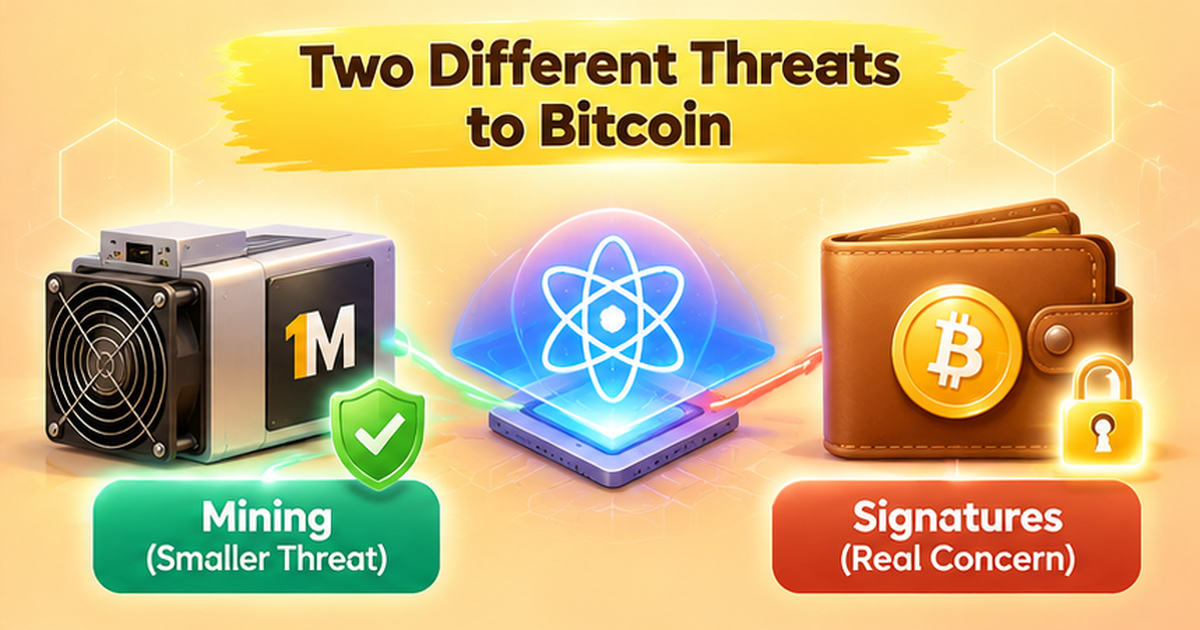
2. Digital signatures (ownership): the real concern
This is the part that matters. Owning bitcoin means being able to produce a valid digital signature with your private key. Bitcoin uses elliptic-curve signatures (ECDSA, and since Taproot, Schnorr). The quantum algorithm that threatens them is Shor's algorithm, which offers an exponential speedup against this type of math.
BitGo's guide to Bitcoin and quantum computing (October 2026) puts it plainly: a sufficiently powerful quantum computer running Shor's algorithm could, in theory, derive a private key from an exposed public key, and then forge signatures to move funds. It also states that no publicly known quantum computer today can recover Bitcoin private keys from public keys.
That's the whole threat, in one sentence: not "quantum computers will mine all the bitcoin," but "a future quantum computer might be able to forge signatures on coins whose public keys are visible."
A Quick Refresher on Keys, Addresses and Signatures
To see why some coins are more exposed, you need a basic picture of how ownership works. (Our guides on Bitcoin addresses, wallets and seed phrases cover this in more depth.)
- • Your private key is a secret number. Whoever knows it can spend the coins.
- • Your public key is derived from the private key. It can be shared without revealing the private key, because going from public to private is believed to be impossibly hard for ordinary computers.
- • A signature proves you know the private key without revealing it.
Shor's algorithm is dangerous because it would make going from public key to private key feasible. So the question is: when does your public key become visible?
Which Coins Are Exposed?
It depends on the type of output and how you've used it. Coinbase's institutional research note Market Intelligence: The Quantum Threat (January 2026) and BitGo's guide describe the main cases:
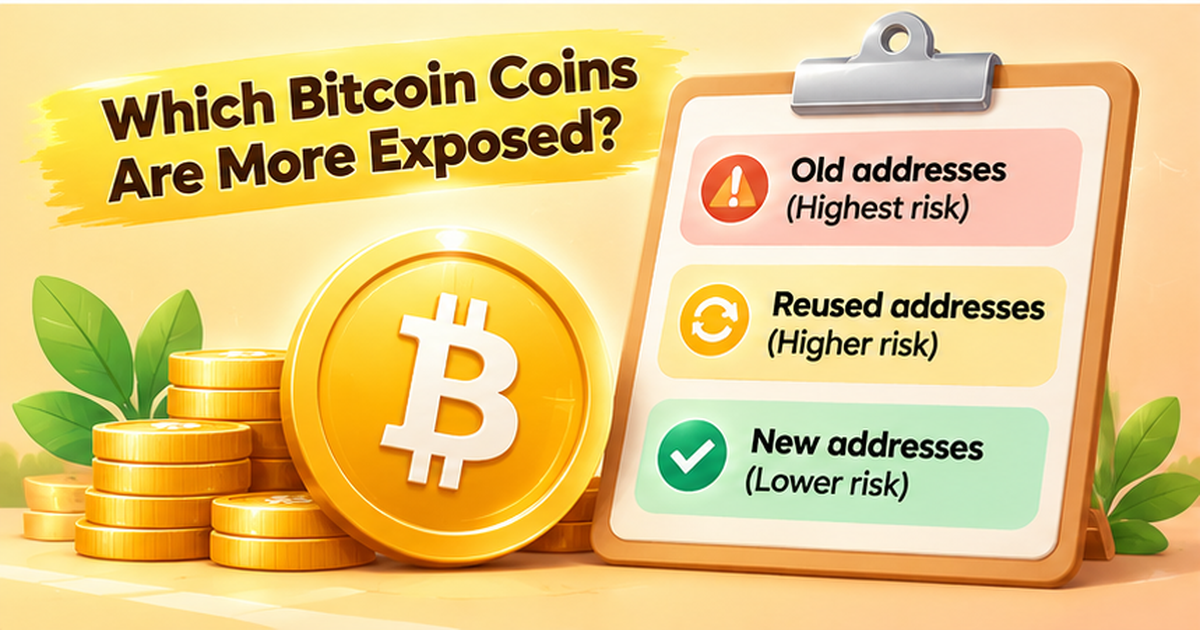
| Situation | Public key visible? | Exposure |
|---|---|---|
| Old pay-to-public-key (P2PK) outputs, including many from the earliest days | Yes, from the start | Highest long-term exposure |
| Reused addresses (after you've spent from them once) | Yes, once spent | Remaining coins at the same address are exposed |
| Taproot (P2TR) outputs | Yes (public-key information is on-chain from creation, per BitGo) | Exposed, so BitGo says Taproot isn't quantum resistant |
| Bare multisig | Yes | Exposed |
| Fresh, hash-based outputs such as P2PKH or P2WPKH | Normally not from the output alone; spending reveals the relevant public key | Lower long-exposure risk before spending, but potential short-exposure risk when a transaction reveals the key |
Two categories help explain how a sufficiently powerful quantum computer could threaten Bitcoin:
- • Long-exposure attacks: These involve funds whose spending-related public keys are already visible on the blockchain. Because the information remains publicly accessible, a future attacker could analyze exposed keys without waiting for the legitimate owner to initiate another transaction. Early pay-to-public-key outputs, certain reused addresses, and Taproot outputs are important examples.
- • Short-exposure attacks: These involve transactions that reveal a public key when the owner spends bitcoin. An attacker would need to derive the relevant private key and submit a competing transaction before the legitimate spend becomes sufficiently settled. Bitcoin targets an average block interval of approximately ten minutes, but actual confirmation times vary, and settlement is not guaranteed within a fixed window.
The difference matters because avoiding address reuse can reduce long-exposure risk, while fully addressing short-exposure attacks would likely require future protocol-level cryptographic protections. Coinbase and BitGo both discuss this distinction in their research.
How much bitcoin is that?
Estimates differ by date and method:
- • Coinbase estimates that about 6.51 million BTC, roughly 32.7% of supply, was vulnerable to long-range attacks as of block 900,000.
- • BitGo cites the BIP-361 proposal's estimate that over 34% of bitcoin had revealed a public key on-chain as of 1 March 2026.
Although the estimates use different dates and methodologies, both suggest that a substantial portion of Bitcoin's supply is associated with public-key information already visible on-chain. Coinbase's January 2026 research estimated approximately 6.51 million BTC, or 32.7% of the measured supply, as vulnerable to long-exposure attacks at block 900,000. The draft BIP-361 proposal reports that more than 34% had revealed a public key as of March 1, 2026.
These figures do not mean that one-third of all bitcoin can currently be stolen, nor do they establish that every exposed output can be compromised through exactly the same attack. They describe different measurements of potential future cryptographic exposure. Some affected coins may be actively controlled, while others may be dormant or inaccessible to their original owners. The estimates illustrate why researchers are discussing migration well before quantum attacks become practical.
How Powerful Would a Quantum Computer Need to Be?
One of the most difficult parts of evaluating Bitcoin's quantum risk is understanding what researchers mean when they discuss the number of qubits required for an attack.
Quantum computers use physical qubits, which are the hardware components performing quantum operations. Because these components are vulnerable to errors, researchers also use logical qubits, which combine physical qubits with error-correction techniques to support more reliable calculations. These measurements are not interchangeable.
According to BitGo's October 2026 guide, research published by Google researchers and collaborators in 2026 modeled attacks against Bitcoin's secp256k1 elliptic curve requiring approximately 1,200 to 1,450 logical qubits, depending on the algorithm and implementation. Under a particular set of hardware and error-correction assumptions, the estimated physical-qubit requirement could be below 500,000.
These estimates describe theoretical resource requirements, not an existing system capable of stealing bitcoin. A successful attack would also depend on computation speed, error rates, circuit execution time, and the ability to maintain reliable quantum operations throughout the calculation.
The distinction is important when reading headlines about quantum computers containing hundreds or thousands of qubits. A large number of physical qubits does not automatically translate into enough fault-tolerant logical qubits to perform an attack against Bitcoin's signature system.
For mining, the requirements appear substantially greater. BitGo references a March 2026 non-peer-reviewed preprint that modeled competitive quantum Bitcoin mining under specific network and hardware assumptions. That model estimated requirements on the order of 10²³ physical qubits and 10²⁵ watts of power—figures far beyond the capabilities of existing systems.
These results reinforce the central distinction: Bitcoin's elliptic-curve signatures are the more significant long-term quantum concern, while competitive quantum mining faces much larger practical barriers. Nevertheless, research estimates can change, and no single qubit count should be treated as a definitive prediction of when a successful attack might become possible.
When Might It Happen? The Honest Answer Is "Nobody Knows"
The U.S. National Institute of Standards and Technology (NIST) puts it well on its page about post-quantum cryptography: no one knows when, or whether, a cryptographically relevant quantum computer will be built. Estimates range from a few years to a few decades, with some predicting under ten. Quantum computing is still in its infancy, qubits are fragile, and no one knows which hardware approach will succeed.
Here are the range of views in our sources:
| Source | View on timing |
|---|---|
| NIST | Unknown. A few years to a few decades; some say under 10 |
| Coinbase | The threat "is not immediate"; near-term chance of a successful attack "remains low." Notes US and EU agencies are guiding critical infrastructure to post-quantum cryptography by the end of 2035 |
| BitGo | Gives no date; says Bitcoin doesn't need a precise forecast to start preparing |
| OneMiners | No credible date exists; risk described as manageable and not imminent |
| BIP-361 authors | Argue a relevant quantum computer could arrive around 2027 to 2030 (the most pessimistic view here) |
I'd weigh the BIP-361 authors' timeline as a deliberately cautious planning assumption, not a prediction. But notice the pattern: nobody serious says "never," and nobody credible says "tomorrow." The reasoning is about lead time. Coinbase cites estimates that a sudden-breakthrough contingency plan could be implemented in about two years, while a normal soft-fork path could take up to seven. NIST adds that integrating a new cryptographic standard into real systems has historically taken 10 to 20 years. Long lead times mean starting early.
What Is Actually Being Done?
The wider world is already moving
Bitcoin is not the only technology facing long-term quantum security challenges. Banks, governments, online services, and many digital communication systems also rely on cryptographic techniques that sufficiently powerful quantum computers could eventually threaten.
The U.S. National Institute of Standards and Technology (NIST) has already taken important steps toward addressing this challenge. On August 13, 2024, NIST announced the approval of three finalized post-quantum cryptography standards:
- • FIPS 203 — ML-KEM: A lattice-based key-encapsulation mechanism used to establish shared cryptographic secrets.
- • FIPS 204 — ML-DSA: A lattice-based digital signature standard derived from CRYSTALS-Dilithium.
- • FIPS 205 — SLH-DSA: A stateless hash-based digital signature standard derived from SPHINCS+.
These standards are designed to help organizations transition toward cryptographic systems believed to resist attacks by future quantum computers. However, adopting post-quantum algorithms within Bitcoin would require additional evaluation of transaction sizes, verification costs, wallet compatibility, and network consensus rules.
NIST's progress demonstrates that post-quantum cryptography is an active field with standardized solutions available for some applications. It does not mean Bitcoin has already adopted quantum-resistant transaction signatures.
Bitcoin's proposals: BIP-360 and BIP-361
Bitcoin changes through Bitcoin Improvement Proposals (BIPs), and two are central here. Both are drafts, not activated, and not guaranteed to be adopted.
BIP-360: Pay-to-Merkle-Root (P2MR) (read it on GitHub). Authored by Hunter Beast, Ethan Heilman and Isabel Foxen Duke, this proposes a new type of output, using addresses that start with bc1z. It's similar to Taproot but removes the "key path" spend, so no public key is exposed by a key-based spend. That protects against long-exposure attacks. The authors are open that it does not protect against short-exposure attacks during the time a transaction sits waiting to confirm; they suggest post-quantum signatures could address that later. It's an optional safeguard, described by the authors as a "prepared not scared" approach, and it doesn't set any timeline. Its trade-offs include larger transactions than a simple Taproot key spend, and wallets would need to be updated.
BIP-361: Post Quantum Migration and Legacy Signature Sunset (read the draft on GitHub) proposes a broader migration strategy for reducing Bitcoin's dependence on quantum-vulnerable ECDSA and Schnorr signatures. Authored by Jameson Lopp and several collaborators, the proposal describes a phased transition following the introduction of suitable post-quantum output and signature mechanisms.
Its proposed approach includes two stages:
- • Phase A — Restricting vulnerable destinations: The network would progressively stop permitting funds to be sent to output types that depend on vulnerable legacy signatures, encouraging migration toward post-quantum alternatives. The draft describes a transition associated with approximately 160,000 blocks, or roughly three years.
- • Phase B — Tightening legacy-spending requirements: At a predetermined activation point, the network would impose additional restrictions on legacy ECDSA and Schnorr spending. The proposal anticipates some form of quantum-safe rescue mechanism, although the technical design and coverage of those mechanisms remain unresolved.
BIP-361 is still a draft, and its timetable should not be treated as an established Bitcoin upgrade schedule. Its text currently describes Phase B as five years after activation in the abstract, while its specification table describes it as two years after Phase A activation. These are proposal details that would require clarification before any implementation.
The proposal also raises difficult questions about how holders of older bitcoin could prove legitimate ownership if the original signature algorithms became unsafe. Neither the required post-quantum signature mechanism nor the full treatment of legacy funds has been finalized.
Two honest caveats about the proposal itself: it depends on a separate post-quantum signature BIP that isn't written yet (listed as "TBD"), and the page contradicts itself on timing. The abstract describes a "flag day" five years after activation, while the specification table says two years after Phase A. It's a draft that clearly still needs work. BitGo also notes the BIP's rescue mechanisms for legacy coins remain unresolved, and that no rescue protocol is known for the oldest P2PK outputs.
(Coinbase mentions other ideas too: BIP-347, which would re-enable a script operation to allow hash-based signatures, and a concept called Hourglass that would rate-limit spends from vulnerable outputs.)
The Hard Question Nobody Can Dodge: Dormant Coins
Here's the part of this debate I find most interesting, because it's not technical, it's about people.
Suppose Bitcoin adopts a quantum-safe signature type. Users can move their coins to new, safe addresses. But what about coins in old addresses whose owners are gone, whether through lost keys, death or abandonment? On the blockchain, a lost key and a key that's simply being held look identical. If those coins stay in vulnerable addresses, a future quantum attacker could eventually take them. If the network disables old signatures, those coins become permanently unspendable, which some would see as a kind of confiscation.
BIP-361 acknowledges this as a "redistribution dilemma." It frames the choice in stark terms: letting lost coins sit unspendable arguably benefits everyone by making the remaining coins scarcer, whereas letting quantum attackers recover them would be "a theft from everyone." The authors say that if rescue protocols can cover most of the legacy supply, the restriction would be "at most mildly confiscatory," but that is unproven.
I don't think there's an obviously right answer. Reasonable, thoughtful Bitcoin people disagree, and I'd be wary of anyone who treats it as simple.
What You Can Do Today
Although Bitcoin does not yet have activated post-quantum transaction signatures, users can take practical steps to reduce unnecessary exposure while maintaining their existing security protections.
- 1. Avoid address reuse. Use a fresh receiving address whenever possible. This improves privacy and reduces the likelihood that funds remain associated with a public key exposed during an earlier transaction.
- 2. Review older and exposed outputs. If you control bitcoin held in older output types or repeatedly used addresses, consider whether moving it to a suitable fresh address would reduce long-exposure risk. Verify wallet compatibility, transaction fees, and security procedures before taking action.
- 3. Understand UTXO selection. Spending only some outputs associated with an address can leave remaining funds linked to newly exposed public-key information. Compatible wallet features and careful coin selection can help reduce that situation.
- 4. Maintain strong wallet security. Use reputable wallets, secure recovery-phrase storage, strong authentication, and appropriate custody arrangements. Cold storage and multisignature arrangements address important existing threats, but they are not substitutes for future post-quantum cryptographic protection.
- 5. Protect private keys and seed phrases. Never enter recovery phrases into unfamiliar websites or share them with anyone claiming to offer quantum protection. There is no reason to disclose private keys to assess public on-chain exposure.
- 6. Follow credible technical developments. Monitor the progress of BIP-360 and BIP-361, and seek information from established Bitcoin security researchers and wallet providers before making major changes.
These steps may reduce long-exposure risk, but they cannot make Bitcoin fully quantum-resistant under its current signature system. A comprehensive response would require appropriately designed and adopted protocol-level protections.
What Quantum Computing Means for Bitcoin Miners and Hosting Customers
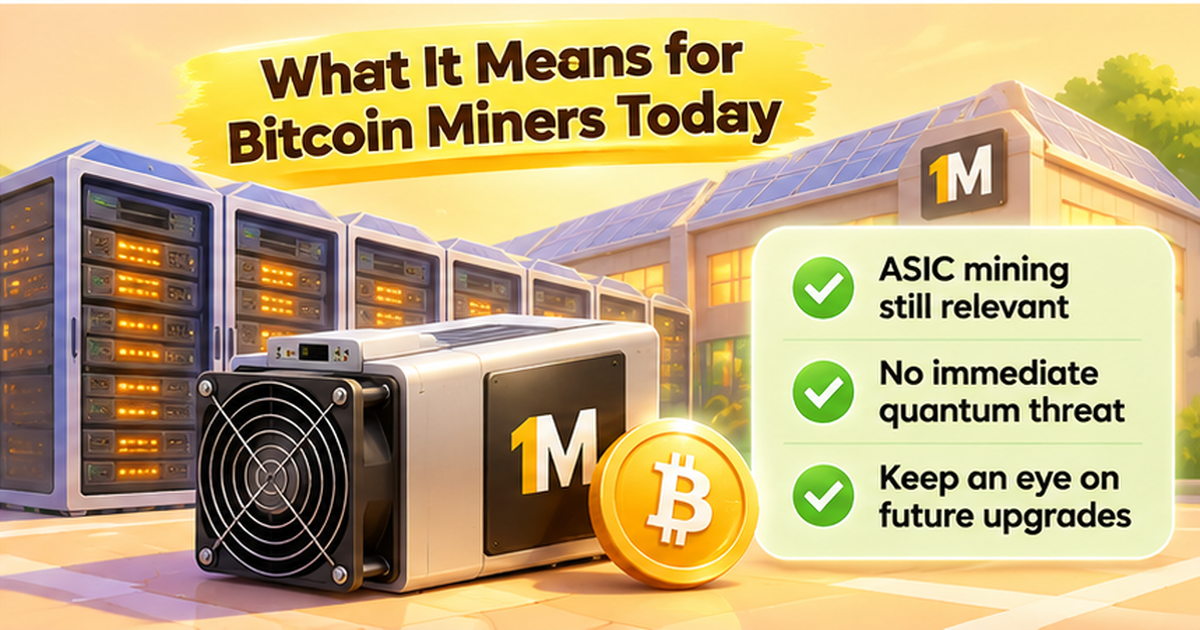
For people who own Bitcoin mining equipment, the distinction between mining and transaction signatures is particularly important. Quantum computing does not currently create a practical threat to the operation of modern ASIC miners. Specialized mining hardware continues to perform SHA-256 calculations, and neither BIP-360 nor BIP-361 proposes replacing Bitcoin's proof-of-work algorithm.
OneMiners addresses this issue in its September 2026 article, Will a Quantum Computer Out-Mine Your ASIC? The Honest Answer. The guide explains why transaction signatures represent a more significant long-term quantum concern than an immediate technological replacement of mining ASICs.
For buyers evaluating mining equipment, the practical considerations remain familiar: hardware efficiency, electricity costs, reliable infrastructure, maintenance requirements, and the ability to monitor equipment performance.
Why OneMiners remains relevant
OneMiners offers ASIC mining equipment and professional hosting options that allow customers to choose between operating equipment themselves and using managed mining facilities. For customers who prefer hosted mining, services such as remote monitoring, technical support, and published warranty arrangements can help simplify aspects of ongoing equipment management.
These services do not eliminate Bitcoin's broader cryptographic risks, but they address many of the operational considerations that miners face today. Buyers should still confirm the specifications, hosting rate, warranty eligibility, and contractual conditions applicable to their equipment.
Hardware ownership and documentation
OneMiners also provides documentation intended to help customers identify and verify their purchased mining equipment.
My Medium article, Certificate of Authenticity: What Proof of Ownership Actually Looks Like in Crypto Mining in 2026, discusses the company's Certificate of Authenticity and the role of serial numbers, hosting information, and verification records in documenting physical mining hardware.
It is important to distinguish this type of commercial ownership documentation from the cryptographic signatures that authorize Bitcoin transactions. A certificate helps document a hardware purchase; a Bitcoin signature satisfies the network's spending rules. Quantum attacks against Bitcoin's current signature algorithms concern the second mechanism, not the ownership certificate for a mining machine.
Monitoring your mining equipment
OneMiners' monitoring interface is another useful service for hosted-mining customers. My Medium guide, OneMiners App Explained: A Tour of the New Miner Interface, explains how the platform presents miner activity, operational information, energy usage, and equipment management features.
Monitoring tools are helpful for understanding hardware performance and managing hosted equipment, but they should not be confused with post-quantum wallet security. The cryptocurrency received as mining rewards still needs to be secured using appropriate wallet practices.
The practical takeaway for miners
For Bitcoin miners, the most relevant quantum-security consideration is currently how mining rewards are stored and spent. Fresh payout addresses, appropriate wallet security, and careful management of exposed public keys can help reduce some long-term risks.
At the same time, miners should continue evaluating electricity rates, equipment efficiency, hosting reliability, and maintenance support. OneMiners provides hardware and hosting services that customers can compare as part of those decisions.
Quantum preparedness and mining operations are related but different responsibilities. Strong wallet security helps protect mining rewards, while suitable equipment and hosting infrastructure support the day-to-day operation of the mining business.
Six Honest Opinions
1. Both "Bitcoin is doomed" and "this is nothing" are lazy takes. The first ignores that mining is largely unaffected and that fixes are being designed. The second ignores that a third of bitcoin sits in exposed address types, and that upgrades take years.
2. The hardest part is human, not mathematical. The cryptography has known answers; NIST has already standardized replacements. What Bitcoin lacks is a way to agree on migration, especially for abandoned coins. That's a governance problem, and Bitcoin is deliberately slow at governance.
3. Slow upgrades are Bitcoin's feature and its risk. The same conservatism that protects the rules from casual change also means a deadline-driven migration will be painful. I'd rather debate it too early than too late.
4. I'm uneasy with any approach that could make coins unspendable, and equally uneasy with leaving them to be stolen. That's the honest tension. BIP-361 tries to resolve it with a rescue protocol, but the authors themselves say the coverage is unknown. I wouldn't pretend to have solved it; it needs a lot more scrutiny.
5. Responsible education matters more than dramatic predictions. Quantum computing is a legitimate long-term security topic, but it should not be used to create unnecessary fear. Research from NIST, Coinbase, BitGo, and educational resources such as OneMiners' mining guide can help readers understand different parts of the issue. The strongest approach is to compare technical claims, separate immediate risks from future possibilities, and make decisions based on verified information rather than sensational headlines.
6. Simple wallet habits are a sensible place to start. Avoiding address reuse is one of the most practical ways to reduce unnecessary public-key exposure. It can also improve transaction privacy, although wallet compatibility, transaction fees, and individual circumstances still matter. No single practice makes Bitcoin permanently quantum-safe, but good address management and secure key storage are useful habits regardless of how quantum computing develops.
A Note on Sources
This article draws on several types of information to provide a balanced explanation of Bitcoin's quantum-computing risks. The primary technical references include the draft BIP-360 and BIP-361 proposals and the post-quantum cryptography standards published by NIST.
Additional research comes from Coinbase and BitGo, while OneMiners provides an educational perspective focused on Bitcoin mining hardware and hosting. My Medium articles discuss related topics, including mining equipment ownership documentation and the OneMiners monitoring interface.
OneMiners and the Medium articles by Cassy Soriano are commercially affiliated, so their product and service discussions should be understood in that context. Technical claims have been compared with independent research and primary documentation where available.
Where researchers disagree about future quantum-computing capabilities or migration timelines, this guide distinguishes established facts from theoretical estimates and draft proposals. No source can currently provide a definitive date for when a cryptographically relevant quantum computer will exist.
Common Misconceptions
"A quantum computer could mine all the remaining bitcoin instantly." Mining uses a hash function, which quantum computers only modestly speed up, and difficulty would adjust.
"Quantum computers can already break Bitcoin." No. BitGo notes that no publicly known quantum computer can recover Bitcoin private keys today.
"All bitcoin is equally at risk." No. Exposure depends on address type and reuse. Fresh, single-use addresses are much safer.
"Taproot is quantum resistant." According to BitGo, no. Taproot exposes public-key information from the outset.
"Bitcoin can't be upgraded." It can, through soft forks, but it's slow by design, and BIP-360 and BIP-361 are drafts, not activated rules.
"Only Bitcoin has this problem." No. Much of the internet and banking uses similar cryptography, which is why NIST is standardizing replacements.
"If I move my coins, I'm safe forever." You reduce your exposure, but a complete fix needs protocol-level changes.
Frequently Asked Questions
Is Bitcoin quantum-safe? Bitcoin is not fully quantum-resistant under its current signature system. A sufficiently advanced, fault-tolerant quantum computer running Shor's algorithm could theoretically recover private keys from exposed public keys and potentially forge authorized-looking transactions. However, no publicly known quantum computer currently has this capability. Bitcoin researchers are studying possible improvements, including BIP-360 and BIP-361, although neither proposal has been activated.
Can a quantum computer steal my bitcoin today? No. BitGo states that no publicly known quantum computer can currently recover Bitcoin private keys from public keys.
When will quantum computers be able to break Bitcoin? Nobody knows. NIST says estimates range from a few years to a few decades. Some Bitcoin developers argue for planning around 2027 to 2030; others consider that too pessimistic.
Does quantum computing threaten Bitcoin mining? Quantum computing could theoretically improve certain computations involved in Bitcoin mining through Grover's algorithm. However, the practical hardware requirements for competitive quantum mining remain extraordinarily high. Bitcoin's difficulty adjustment helps regulate the average rate of block production as mining performance changes, although it does not eliminate potential competitive advantages. Research from BitGo and OneMiners identifies transaction signatures, rather than ASIC mining, as the more significant long-term quantum-security concern.
Which Bitcoin addresses are most vulnerable? Old P2PK outputs and addresses that have been reused, because their public keys are visible on-chain. Taproot outputs also expose public-key information.
How much bitcoin is exposed? Roughly a third. Coinbase estimates about 6.51 million BTC (32.7%) were vulnerable to long-range attacks at block 900,000; BIP-361 estimates over 34% had revealed a public key by 1 March 2026.
What are BIP-360 and BIP-361? BIP-360 proposes a new output type that avoids exposing public keys. BIP-361 proposes a phased retirement of vulnerable signature types. Both are drafts and neither is activated.
What can I do to protect myself? Avoid address reuse, move coins out of exposed addresses carefully, keep standard security practices, and follow the proposals.
Will quantum computing make my Bitcoin mining machine obsolete? There is currently no demonstrated quantum-computing capability that makes conventional SHA-256 mining ASICs obsolete. Bitcoin's existing proof-of-work system remains unchanged, and draft proposals such as BIP-360 and BIP-361 focus on transaction security rather than replacing mining hardware. However, equipment profitability can still change due to electricity expenses, network difficulty, hardware efficiency, and market conditions. ASIC miners should continue evaluating equipment and hosting arrangements using these practical operating factors.
What happens to lost coins in old addresses? That's an open question. If they aren't migrated, they could be vulnerable to a future quantum attacker, or become unspendable if old signatures are disabled. BIP-361 calls it a redistribution dilemma.
Final Thoughts
Bitcoin's long-term relationship with quantum computing is more complicated than predictions that it will either become completely obsolete or remain secure without changes. The primary concern involves the elliptic-curve signatures used to authorize transactions, particularly when public-key information is already exposed on the blockchain.
Bitcoin mining faces a different and currently much less practical quantum threat. Specialized SHA-256 ASIC miners remain essential to the network's proof-of-work system, while proposals such as BIP-360 and BIP-361 focus on strengthening transaction security and managing the transition away from vulnerable cryptographic methods.
The encouraging development is that post-quantum cryptography is already an active field of research and standardization. NIST has published relevant standards, and Bitcoin developers are examining possible upgrades. Nevertheless, significant technical, operational, and consensus challenges remain before Bitcoin could complete such a transition.
For Bitcoin holders, sensible security practices remain important: avoid unnecessary address reuse, protect private keys and recovery phrases, understand the risks associated with exposed public keys, and follow credible technical developments.
For miners, the priorities are equally practical. Equipment efficiency, electricity expenses, reliable infrastructure, and secure reward storage all matter. Educational resources from OneMiners can help ASIC owners better understand mining operations, while its hardware and hosting services provide options to compare when planning mining deployments.
Quantum computing deserves careful attention, but it should not distract from the operational and security decisions that miners and Bitcoin holders can make today.
The most productive response is preparation, not panic: understand the technology, follow the evidence, protect your keys, and make informed decisions as Bitcoin's quantum-security research develops.