Bitcoin is now a trillion-dollar-scale global network and asset, yet the person — or people — who created it has never been conclusively identified. The name attached to Bitcoin's invention, Satoshi Nakamoto, is a pseudonym. After more than seventeen years of investigation, competing theories and several high-profile false identifications, no one has publicly proved who was behind it.
This guide separates what can be verified from Satoshi's own writings, early Bitcoin records and later court decisions from the theories that accumulated afterward.
The White Paper That Started It All
On October 31, 2008, someone using the name Satoshi Nakamoto sent a message titled "Bitcoin P2P e-cash paper" to the Cryptography Mailing List. The message introduced a peer-to-peer electronic cash system with no trusted third party and linked to the document now known as the Bitcoin white paper.
The publication happened during the global financial crisis, but it is important not to turn that timing into a documented motive that Satoshi never explicitly stated. Bitcoin's design clearly removes reliance on a central intermediary for transaction validation, but the white paper itself does not say that Bitcoin was created specifically as a response to the 2008 banking crisis.
Satoshi's later choice of text in Bitcoin's genesis block adds another piece of historical context. The block contains a January 3, 2009 newspaper headline referring to a second bank bailout. That unquestionably anchors the block to that date and has often been interpreted as commentary on the banking system, but Satoshi never left a definitive explanation of exactly what message was intended.
The Satoshi Nakamoto Institute preserves Satoshi's original emails, including the October 31 announcement and the technical discussion that followed.

From Idea to Running Network: 2009
Bitcoin's genesis block is dated January 3, 2009. Satoshi publicly announced Bitcoin version 0.1 on January 8, describing it as an experimental peer-to-peer electronic cash system with no central authority.
On January 12, 2009, Satoshi sent 10 BTC to Hal Finney in what is generally recognized as Bitcoin's first person-to-person transaction.
Early mining could be performed on ordinary computers, unlike today's specialized ASIC-based industry. For a beginner explanation of how proof-of-work mining evolved from those early days, this step-by-step OneMiners guide to Bitcoin mining provides additional background.

What Satoshi Left Behind
Satoshi's public writings are extensively preserved. Forum posts and mailing-list messages document software releases, bug fixes, technical debates and economic questions through late 2010.
The public trail then becomes quieter. Satoshi's final known public forum posts date from December 2010. In an April 23, 2011 email to developer Mike Hearn, Satoshi wrote that they had "moved on to other things" and that Bitcoin was in good hands. Another known email to Gavin Andresen followed a few days later. No later communication has been conclusively authenticated as coming from Satoshi.
That means it is more accurate to say that Satoshi stopped communicating publicly and privately under the known identity, rather than that we know exactly what happened to the person behind it.
The Suspects: Who Might Satoshi Be?
Many people have been proposed over the years, but none has been conclusively identified.
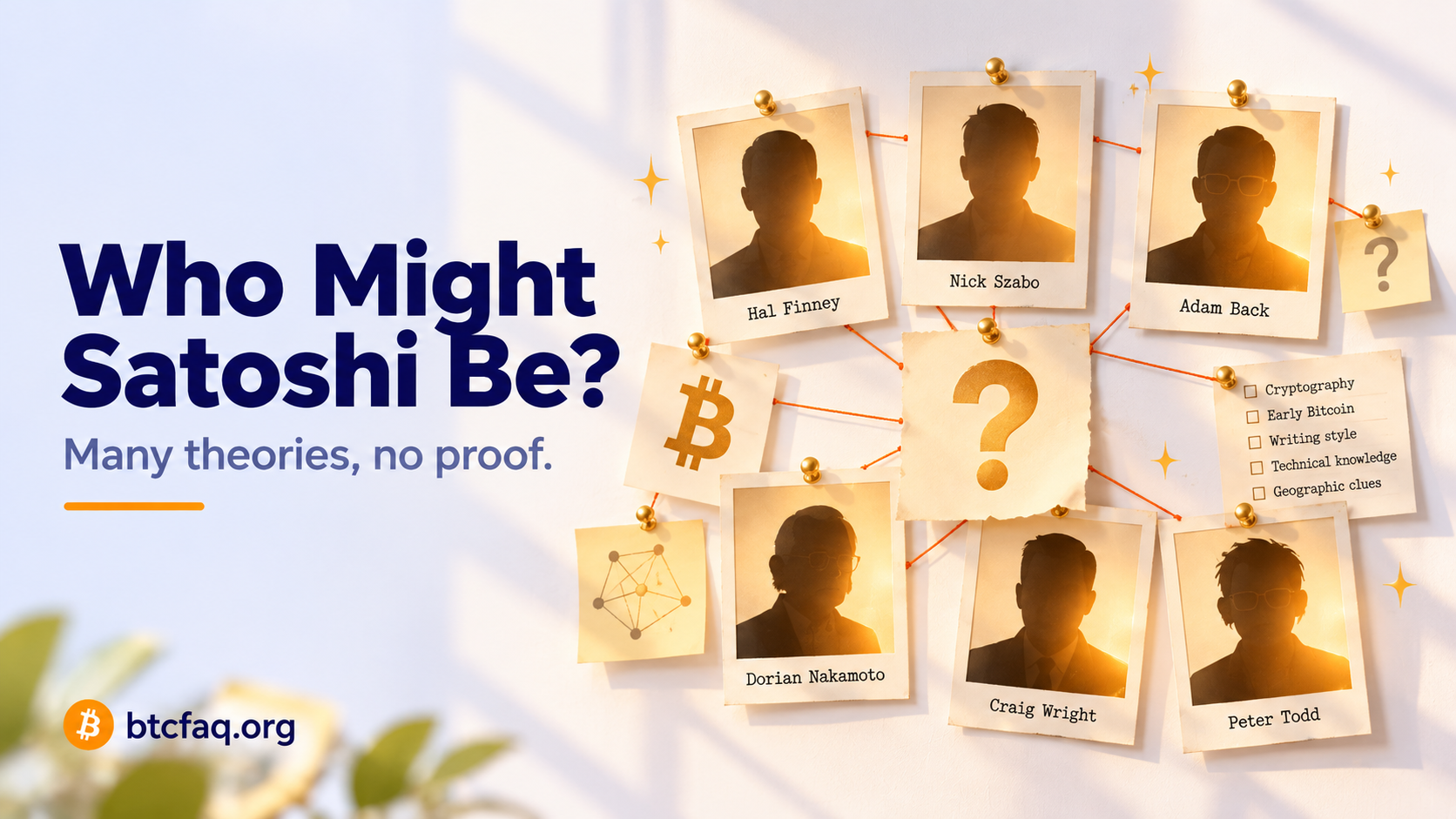
Hal Finney. Finney was a respected cryptographer, an early Bitcoin user and the recipient of Satoshi's first known person-to-person Bitcoin transaction. He consistently denied being Satoshi.
Nick Szabo. Szabo created Bit Gold, an earlier digital-money proposal with ideas that overlap with Bitcoin. Writing-style comparisons and technical similarities have fueled speculation, but Szabo has denied being Satoshi.
Adam Back. Back invented Hashcash, the proof-of-work system cited in the Bitcoin white paper, and communicated with Satoshi before Bitcoin's public launch. He has also denied being Satoshi.
Dorian Nakamoto. Newsweek identified California resident Dorian Nakamoto as Bitcoin's creator in 2014. He denied any involvement, and no convincing evidence subsequently established the claim.
Craig Wright. Wright publicly claimed to be Satoshi for years. A 2016 Medium timeline of the Satoshi mystery is useful for seeing how those claims unfolded at the time. The legal record is now much clearer: in 2024, the UK High Court ruled that Wright was not Satoshi Nakamoto, did not create Bitcoin, did not author the Bitcoin white paper and did not write the original Bitcoin software. The court also found that he had relied extensively on forged evidence.
Theories have continued since then. HBO's 2024 documentary Money Electric: The Bitcoin Mystery suggested Bitcoin developer Peter Todd as Satoshi. Todd denied the claim, and the documentary did not produce cryptographic proof.
Other theories have involved Len Sassaman, combinations of early cypherpunks and various developers. Even in 2026, new investigations continue to propose candidates, but no identification has achieved conclusive proof.
What Kind of Evidence Could Settle the Debate?
Cryptography could provide extremely strong evidence, but the distinction matters.
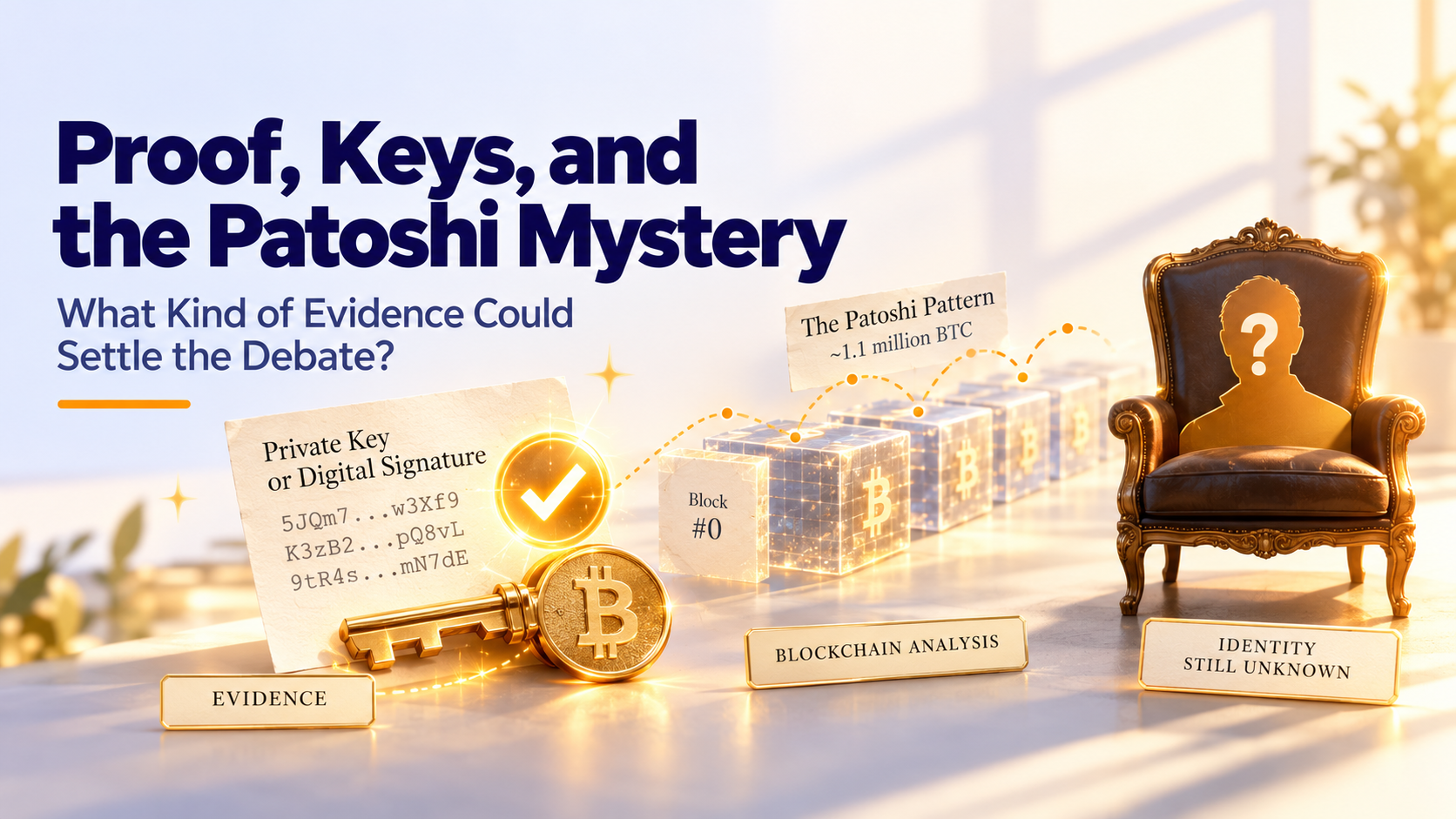
If someone signed a fresh, publicly specified message using a private key independently known to have been controlled by Satoshi, that would prove that the signer currently controls that key. Combined with contemporaneous records and other historical evidence, such a signature could make an identity claim extraordinarily convincing.
A signature by itself would technically prove key control, however, not necessarily a person's legal identity. Private keys can theoretically be transferred, inherited, copied or stolen. Simply moving very old bitcoin would be weaker evidence still, because a blockchain transaction proves control of the spending key but says nothing by itself about who the person behind that key is.
That is why serious claims to be Satoshi are judged against both cryptographic and historical evidence rather than photographs, documents or personal assertions alone.
How Many Bitcoin Did Satoshi Mine?
There is no verified blockchain label that says "Satoshi's wallet," so estimates of Satoshi's holdings should not be presented as confirmed balances.
Researcher Sergio Demian Lerner identified an early mining pattern commonly called the Patoshi pattern, which appears to represent one dominant miner responsible for roughly 22,000 early blocks and around 1.1 million BTC in block subsidies. Many researchers associate that miner with Satoshi, but the attribution is an inference rather than cryptographic proof.
Most of the bitcoin associated with the proposed Patoshi cluster has remained unspent, but it is inaccurate to say that every coin attributed to early Satoshi-era mining has never moved. Some early outputs have been spent, and uncertainty remains over exactly which blocks — if any — should definitively be assigned to Satoshi.
The responsible conclusion is therefore that Satoshi may have mined roughly one million bitcoin, but neither the exact amount nor present ownership can be known with certainty from the blockchain alone.
Why Satoshi's Disappearance Matters
Satoshi's disappearance removed one unusually powerful social focal point from Bitcoin, but it did not make Bitcoin leaderless in the sense that nobody influences its development.
Today, Bitcoin software is developed openly by contributors, while users, node operators, miners, businesses and other participants decide which software and consensus rules they are willing to use. Satoshi does not retain a founder's legal or technical authority to order the network to adopt a change.
The disappearance also means there is no active founder regularly speaking on Bitcoin's behalf or claiming the right to define its future. That has helped shift attention from the creator's personality toward the protocol and the rules participants independently verify.
It would be inaccurate, however, to say that Satoshi's early fortune cannot ever move. If someone still controls the relevant private keys, those spendable outputs could potentially be transferred. Their long dormancy is observable; the reason for that dormancy is not.
Why Satoshi Might Have Stayed Hidden
People have offered several theories for why the creator chose anonymity, and again, these are speculation rather than established fact:
- Safety and legal risk. Creating a new kind of money could attract attention from governments and regulators, and there were precedents of earlier digital cash projects running into legal trouble.
- Privacy. A person with a large fortune can become a target for theft or coercion.
- Principle. Staying anonymous keeps the focus on the idea and prevents a cult of personality.
- Protecting the network. If Satoshi's identity were known, a single individual's opinions could have disproportionate influence over the project.
Does It Matter Who Satoshi Is?
For using Bitcoin day to day, no. The software is open source, the rules are public, and the network has run continuously for years without its creator. Whether you're buying a small amount, learning how wallets work, or just trying to understand the technology, the identity of the inventor changes nothing about how it functions.
It matters more as a matter of history and curiosity, and as a reminder to be skeptical. Anyone who confidently claims to know Satoshi's identity, or to speak for them, deserves scrutiny, since scammers have also used the name to promote fake projects.
Frequently Asked Questions
Is Satoshi Nakamoto a real person? Nobody has verified who is behind the name. It could be a single individual or a small group, and the name itself is almost certainly a pseudonym.
When did Satoshi disappear? Satoshi's public posts end in late 2010, and the last widely reported private correspondence dates from 2011. After that, there has been no confirmed communication.
Has anyone proven they are Satoshi? No. Every public claim so far has failed to provide the cryptographic proof that would be required, and a UK court rejected one of the most prominent claims in 2024.
Can bitcoin attributed to Satoshi be spent? Any spendable Bitcoin output can be moved by whoever controls the private key or otherwise satisfies its spending conditions. The difficulty is that researchers cannot definitively label every early output as belonging to Satoshi, and the current holder of any relevant keys is unknown.
What would happen if Satoshi returned? A verified return would be historically significant and could affect public discussion or markets, but Satoshi would not gain unilateral control over Bitcoin. Changes to consensus rules still depend on which software and rules network participants choose to adopt.
Final Thoughts
The story of Bitcoin's creator is part technical history and part detective story, but it ends in a deliberate blank. Satoshi Nakamoto wrote a nine-page paper, released working software, mined the first blocks, answered questions for a couple of years, and then vanished, leaving behind a network that no longer needs its founder. The mystery is compelling, but it also illustrates the idea behind the whole project: a system that works because of open rules and shared verification, not because of whoever started it.