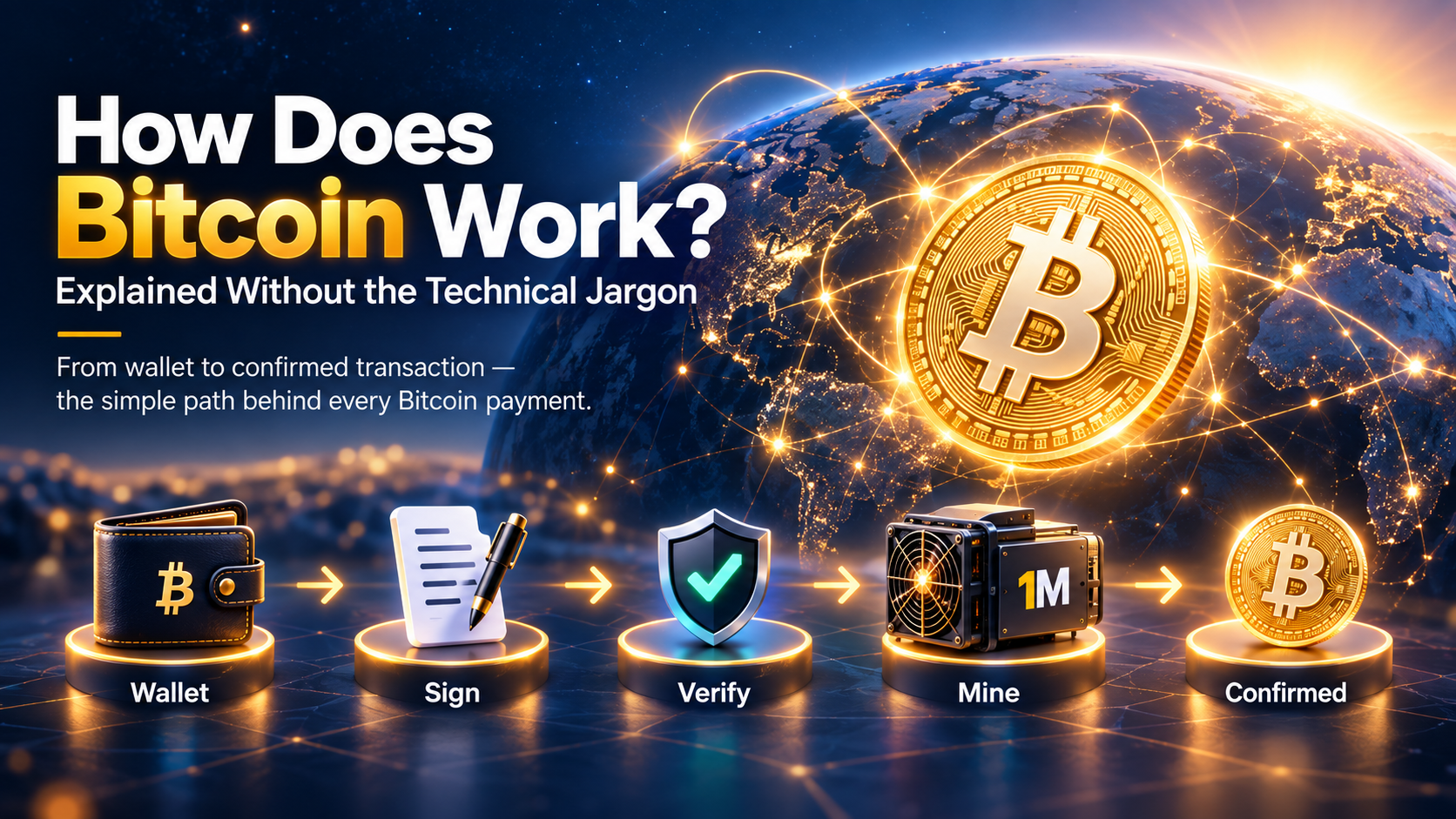
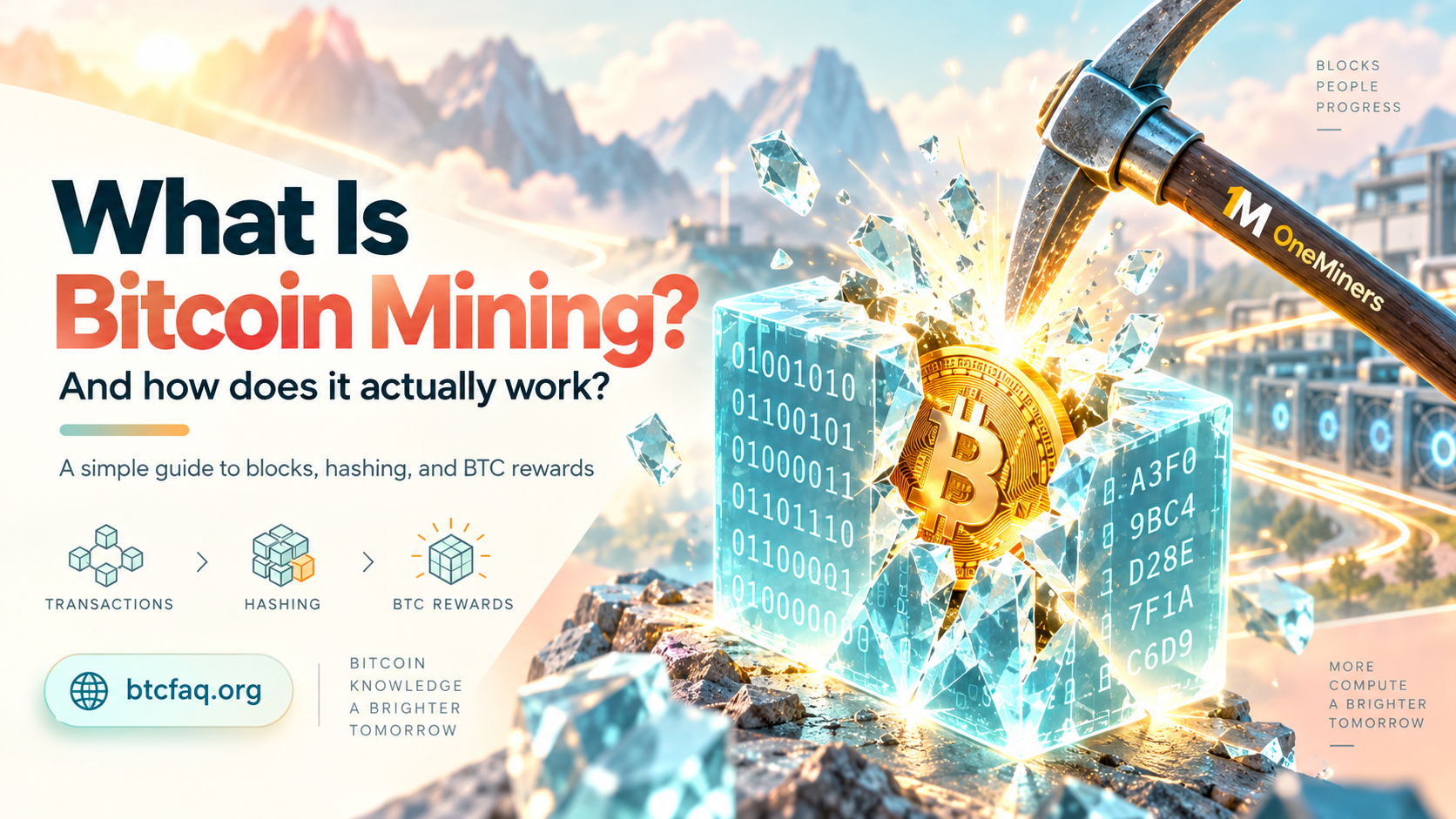
Every ten minutes or so, somewhere in the world, a computer wins a race that most people have never heard of — and that race is what keeps Bitcoin running. It's called mining, and despite the name, it has nothing to do with pickaxes or tunnels. This guide explains exactly what Bitcoin mining is, why the network needs it, and what actually happens, mechanically, when a new block gets mined.
What Is Bitcoin Mining, Exactly?
Bitcoin mining is the process of building candidate blocks of valid transactions and performing the proof-of-work computation required to propose those blocks to the Bitcoin network. Miners use specialized hardware to compete to produce a block header whose hash satisfies Bitcoin's current difficulty target. When a valid block is broadcast, other network nodes independently check the block and its transactions before accepting it into their copy of the blockchain.
Mining therefore serves two closely related purposes: it provides the proof of work that helps secure Bitcoin's transaction history, and it is the mechanism through which new bitcoin enters circulation through the block subsidy. A successful block can also collect the transaction fees paid by the transactions included in it.
Why Bitcoin Needs Mining At All
Bitcoin has no central authority, which creates an obvious problem: if thousands of independent computers each keep their own copy of the transaction ledger, how do they all agree on what the "true" version looks like — especially when someone might try to cheat?
Mining helps solve this problem by making the creation of new blocks computationally expensive while keeping verification relatively easy. To add a valid block, miners must produce proof of work that meets the network's current difficulty target. Because every block references the block before it, changing an older transaction would also require rebuilding the proof of work for that block and catching up with the valid chain that continued growing afterward. The more blocks added on top, the more difficult that becomes. This system is called proof of work, and it is a core part of how Bitcoin maintains a shared transaction history without a central authority.
The Building Blocks: Transactions, Blocks, and the Mempool
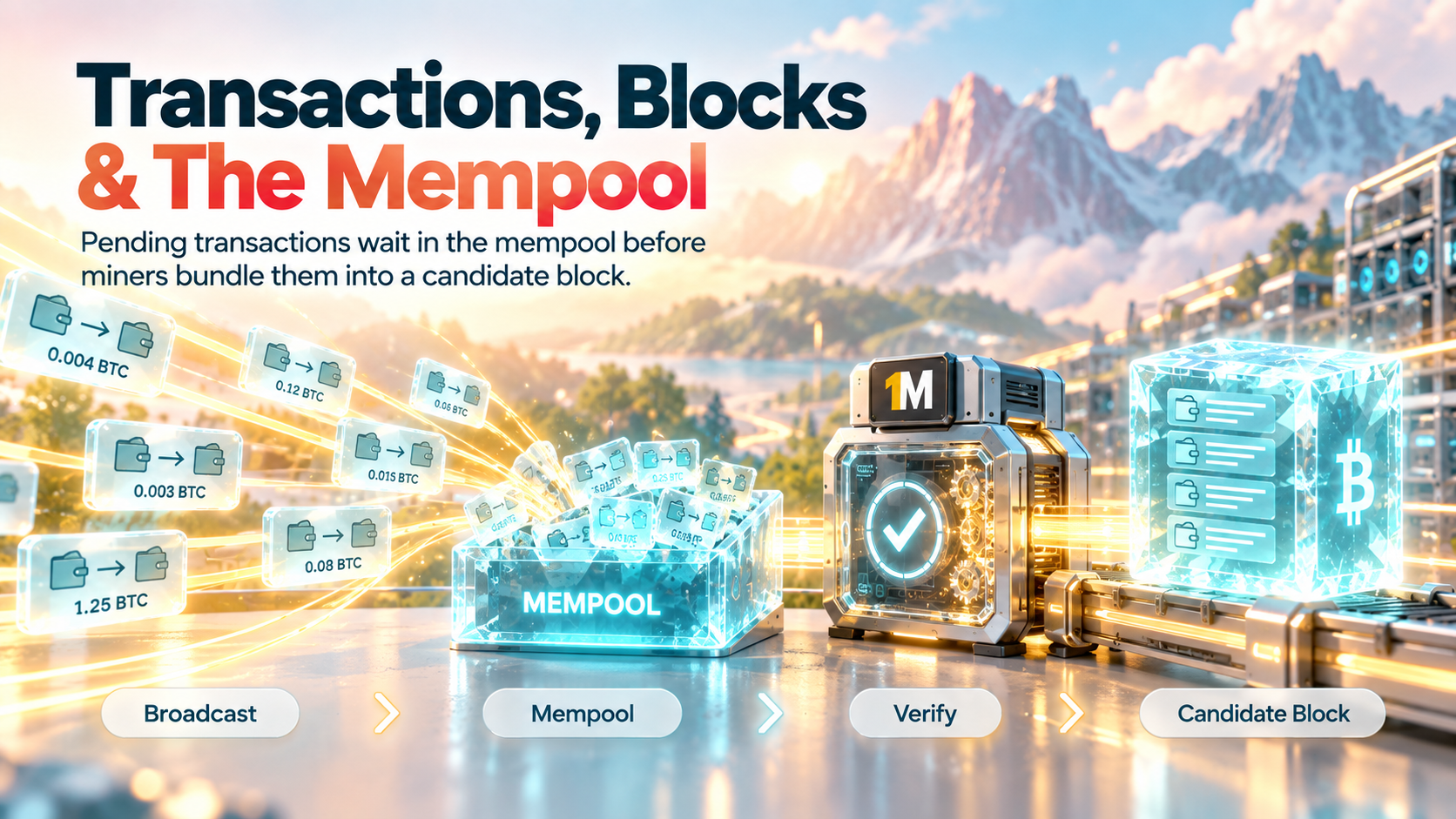
Before mining can happen, transactions need somewhere to wait. When someone sends Bitcoin, that transaction is broadcast to the network and lands in a holding area called the mempool (short for "memory pool"), where nodes check that it's valid — correct signature, funds actually available, no attempt to spend the same coins twice.
From there, miners select pending transactions from the mempool and bundle a batch of them into a candidate block, typically prioritizing transactions with higher fees attached, since those fees go to whichever miner successfully adds the block.
Proof of Work: The Actual "Mining" Part
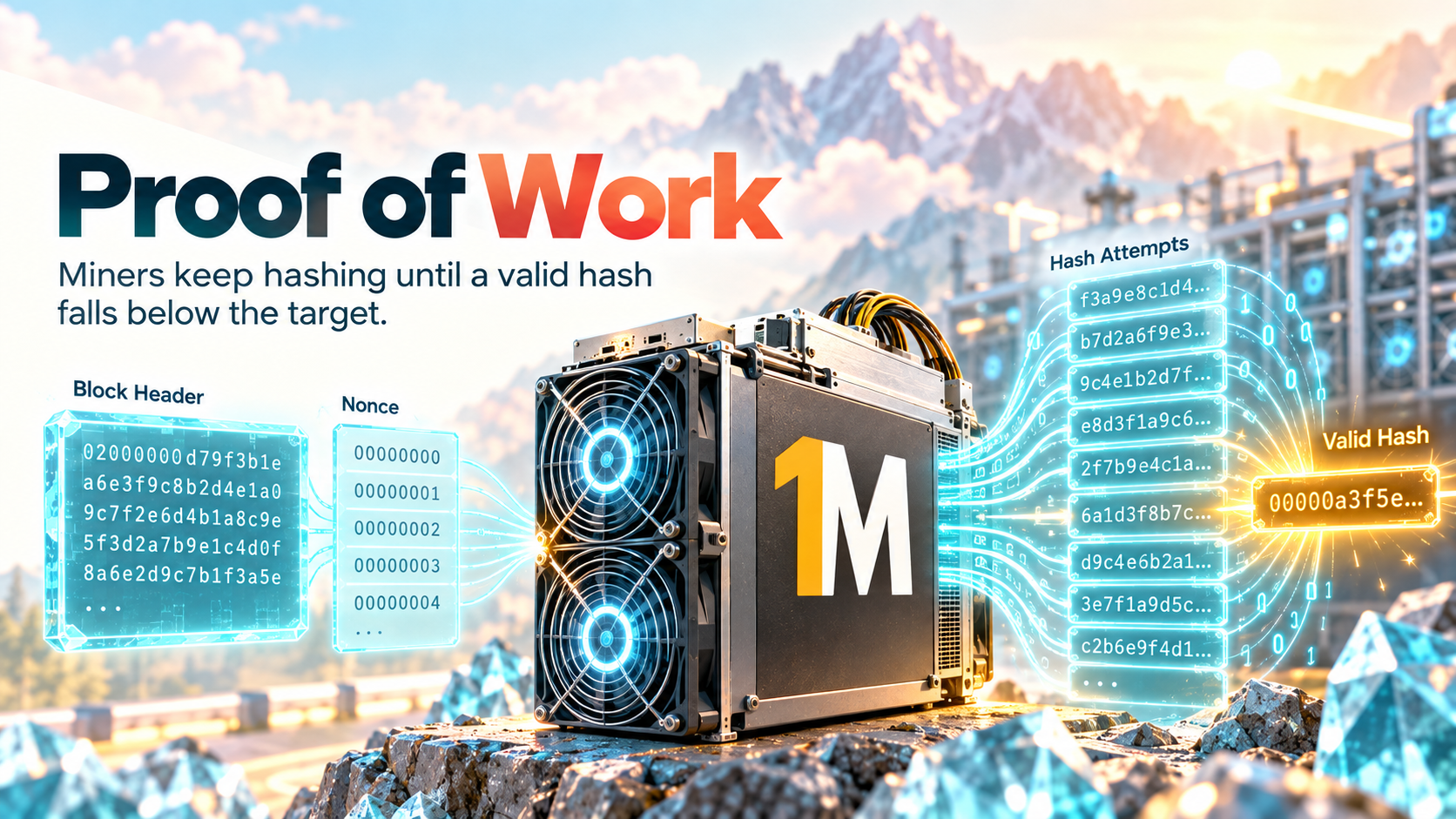
Here's where the computational race happens. A candidate Bitcoin block includes an 80-byte block header containing information such as the previous block's hash, a Merkle root representing the transactions in the candidate block, a timestamp, the current target, and a nonce. Mining hardware repeatedly hashes this block header using Bitcoin's double-SHA-256 proof-of-work process. For the block to qualify, the resulting hash must be at or below the network's current target.
There is no shortcut for predicting which input will produce a qualifying hash. Miners therefore try enormous numbers of possible header values. They repeatedly vary the nonce, and when necessary the mining software can modify additional data in the coinbase transaction, which changes the Merkle root and creates a fresh set of header possibilities. Modern ASIC miners can perform trillions of these hash attempts every second.
When a miner or mining pool finds a qualifying header, the completed block is broadcast to the Bitcoin network. Other nodes can quickly verify the proof of work and independently check that the block follows Bitcoin's consensus rules. Finding the proof is computationally expensive; checking it is comparatively easy.
Step-by-Step: What Happens When a Block Gets Mined
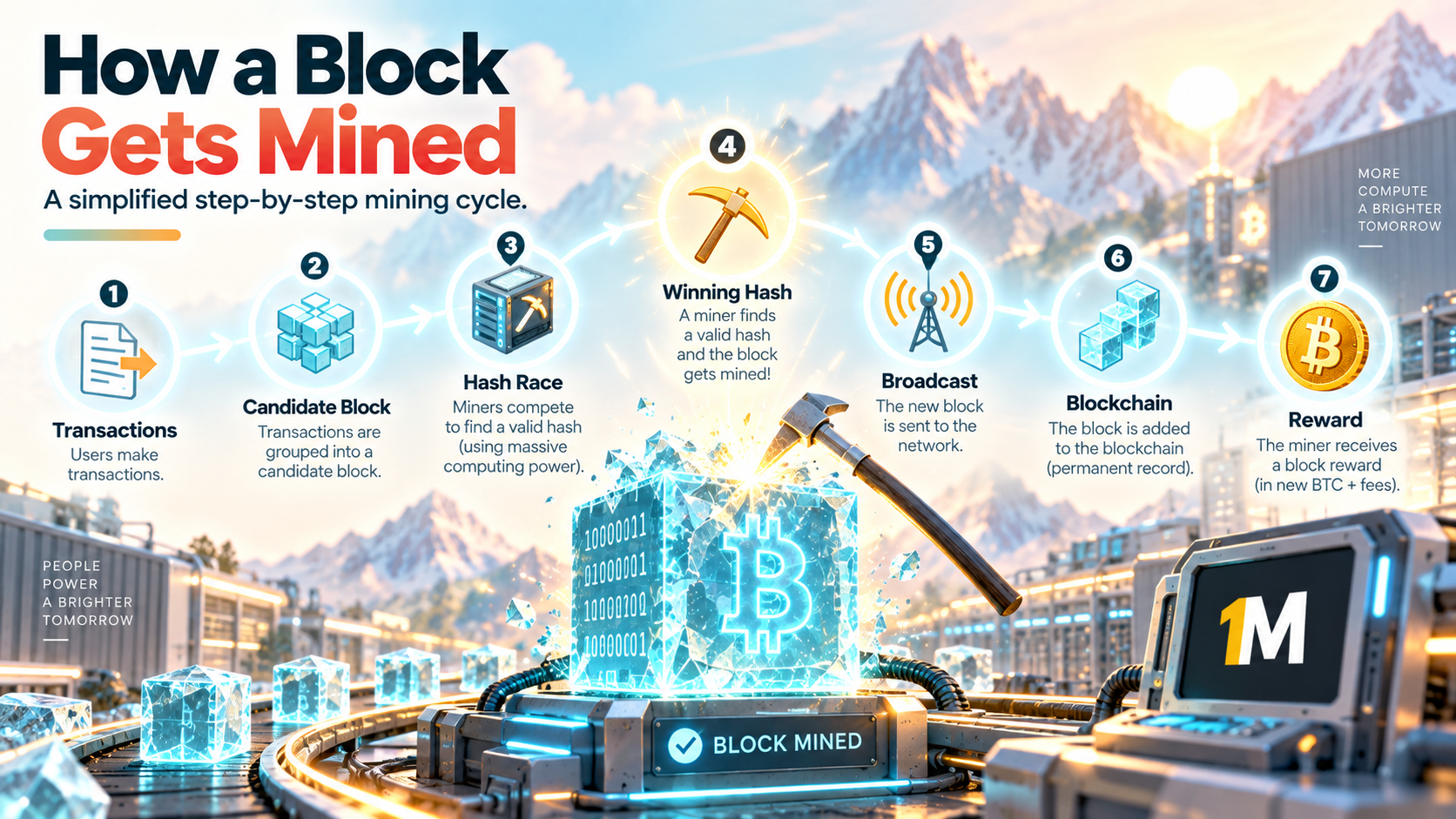
Put together, a full mining cycle looks like this:
- Transactions are broadcast to the network and enter the mempool.
- Miners assemble a candidate block, selecting pending transactions, usually favoring higher fees.
- Miners compete to find a valid hash by repeatedly adjusting the nonce and re-hashing the block.
- A winning miner is found the moment someone produces a hash below the target value.
- The block is broadcast to the network, where other nodes independently verify it's valid.
- 6. The block is added to the blockchain, and the successful miner or mining pool can claim the block reward, consisting of the newly issued block subsidy plus the transaction fees included in that block.
- The cycle repeats roughly every ten minutes, on average, for the next block.
For a more detailed, technical walkthrough of this exact sequence, this step-by-step breakdown of how Bitcoin mining works is a solid resource, and the Bitcoin Developer Guide's mining documentation covers the full protocol-level specification if you want to go deeper into the technical weeds.
Mining Hardware: From CPUs to ASICs
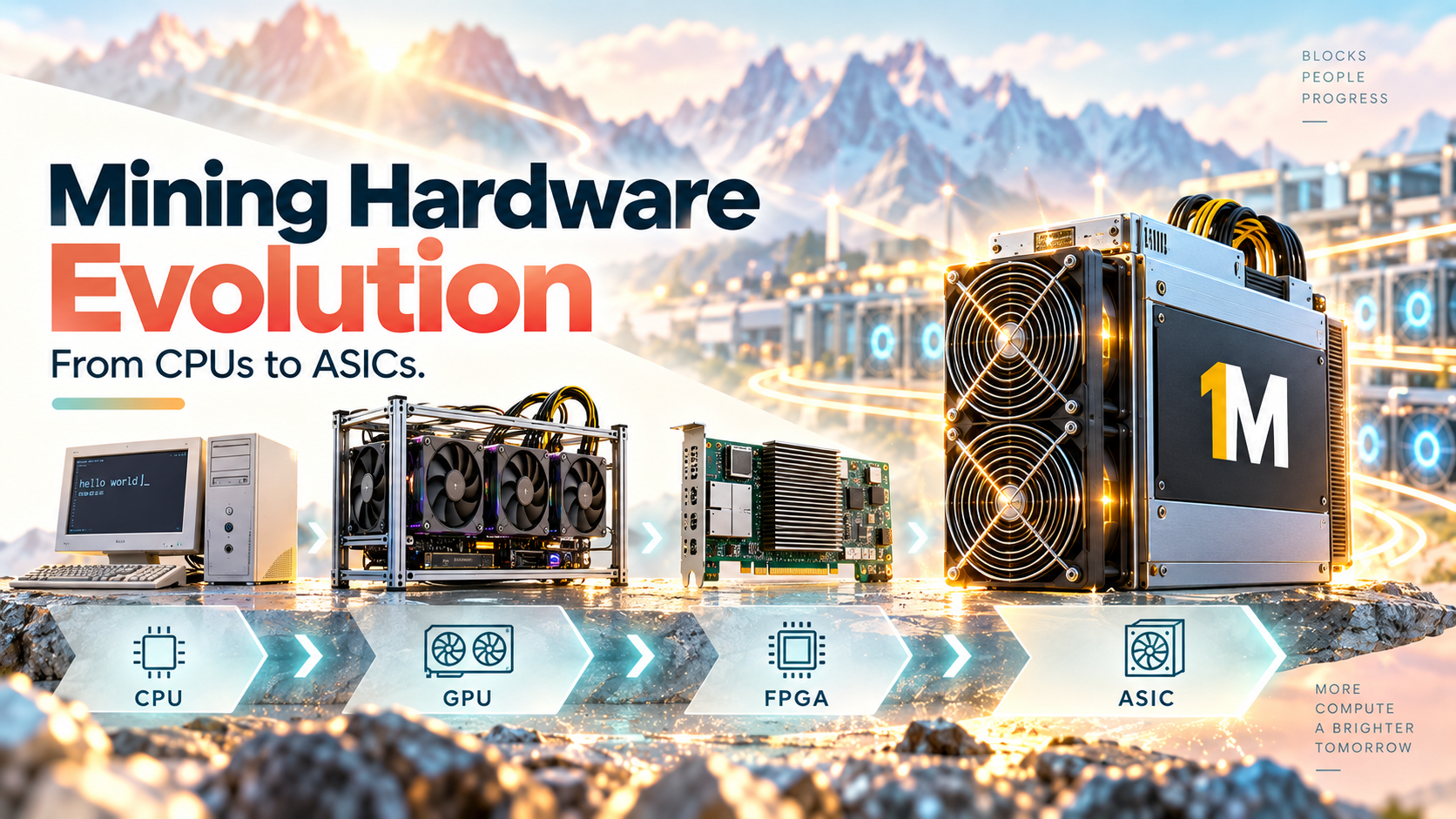
Bitcoin mining hardware has gone through several distinct generations since 2009:
- CPUs — In Bitcoin's earliest days, anyone could mine profitably using an ordinary computer processor.
- GPUs — Graphics cards turned out to be far more efficient at the repetitive hashing calculations mining requires, and miners quickly switched over.
- FPGAs — Field-programmable chips offered another efficiency jump, though they were a relatively short-lived middle step.
- ASICs — Application-Specific Integrated Circuits, built for one job only (hashing SHA-256 as fast and efficiently as possible), are what dominate mining today. They vastly outperform general-purpose hardware, which is also why mining at a competitive level now requires specialized equipment rather than a home computer.
This progression matters because it directly shapes who can mine competitively and what it costs to do so. For a more practical look at choosing modern mining equipment, The 2026 Bitcoin Mining Hardware Buyer's Guide compares the factors that matter when selecting an ASIC.
Mining Pools: Why Most Miners Don't Mine Alone
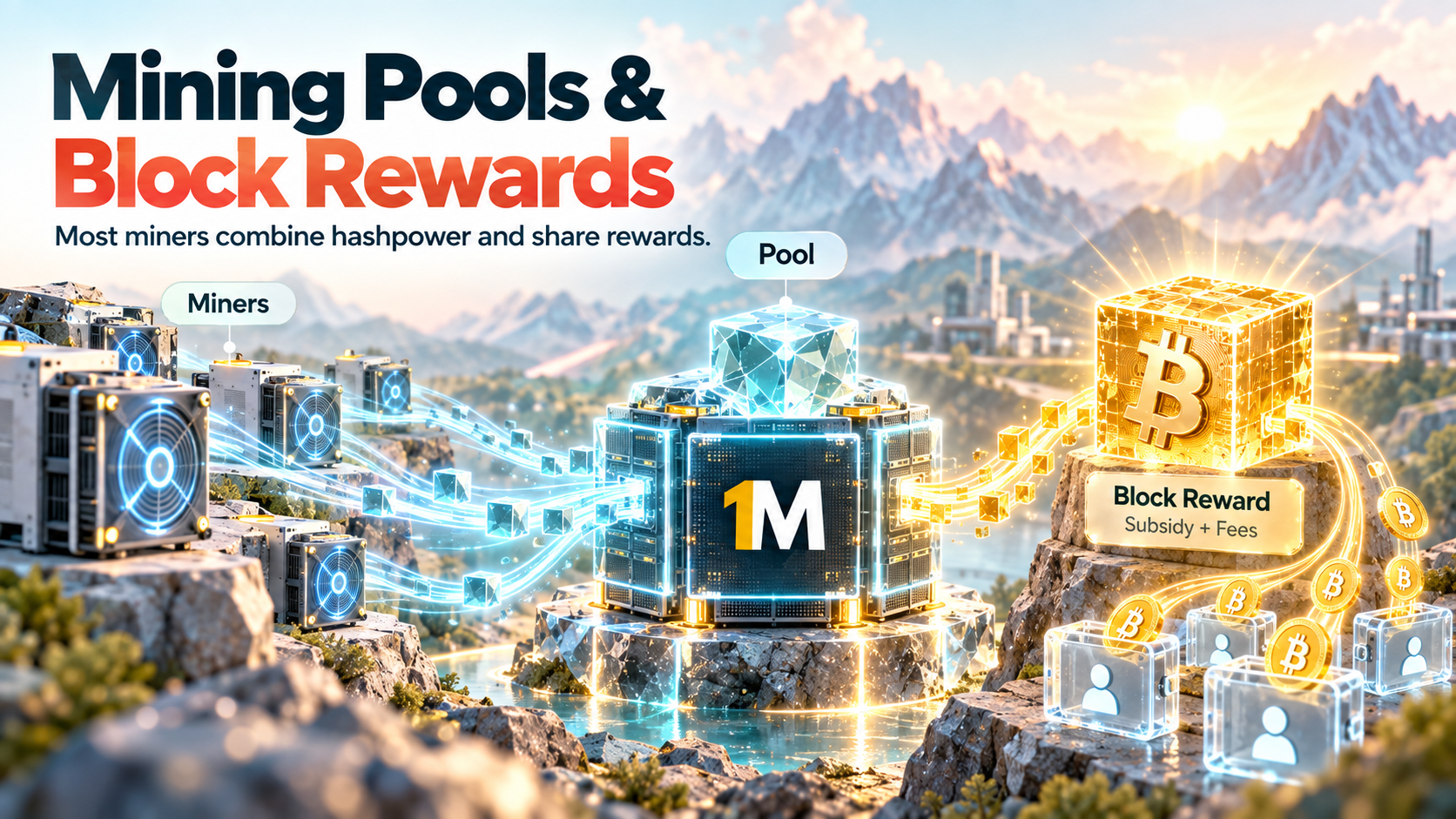
Given how much computing power now secures the Bitcoin network, an individual miner's odds of solving a block alone are extremely small. To smooth out that unpredictability, most miners join mining pools — groups that combine their computing power, split the work, and share any rewards proportionally based on each participant's contribution.
Pools don't change the underlying mechanics of mining; they simply turn an unpredictable, all-or-nothing outcome into a smaller, steadier stream of income for individual participants.
The Block Reward and the Halving
When a miner or mining pool successfully produces a valid block, the block can claim two sources of revenue: the block subsidy, which consists of newly issued bitcoin, and the transaction fees paid by transactions included in the block. Together, the subsidy and transaction fees are called the block reward.
The block subsidy is cut in half every 210,000 blocks, or roughly every four years, in an event called the halving. The most recent halving occurred on April 20, 2024, reducing the subsidy from 6.25 BTC to 3.125 BTC per block. Bitcoin's issuance schedule continues declining this way until new issuance approaches zero around the year 2140. As the subsidy declines, transaction fees are expected to become an increasingly important part of miner revenue.
Network Difficulty: How the System Self-Adjusts
Because mining hardware keeps improving and more miners keep joining, Bitcoin needs a way to keep new blocks arriving at a steady pace of roughly one every ten minutes. It does this through difficulty adjustment — a mechanism that automatically raises or lowers how hard the hashing puzzle is, roughly every two weeks, based on how quickly recent blocks were actually found.
If more computing power joins the network, blocks may temporarily arrive faster than the ten-minute target, and the next difficulty adjustment can increase difficulty to compensate. If substantial hashpower leaves, the opposite can occur. This is also why a higher Bitcoin price does not guarantee permanently higher profit per unit of mining hardware: stronger mining economics can attract additional hashrate over time, and later difficulty adjustments may reduce some of the initial advantage.
Energy Use and the Sustainability Debate
Bitcoin mining consumes a meaningful amount of electricity — this is a direct, intentional consequence of proof of work, since the security model relies on mining being genuinely costly. This has made energy use one of the most debated aspects of Bitcoin.
Critics point to Bitcoin mining's electricity consumption and environmental impact, particularly where operations rely heavily on fossil fuels. Supporters point to mining's geographic flexibility and its ability to use energy sources such as curtailed renewables, stranded generation, or otherwise difficult-to-monetize power. Recent Cambridge research has also reported a substantial sustainable-energy share within the mining industry's electricity mix. The environmental impact nevertheless varies significantly by location, power source, equipment efficiency, and operating model.
Is Bitcoin Mining Profitable?
Profitability depends on the interaction of several variables at once: Bitcoin's price, network difficulty, hardware efficiency, and — usually the biggest factor — the cost of electricity. Because difficulty adjusts in response to competition, and hardware efficiency keeps improving generation over generation, mining profitability is a moving target rather than a fixed number, and it can shift meaningfully within just a few months.
Want to Go Deeper?
This article covers the core mechanics, but there's plenty more to explore. River's guide to what Bitcoin mining is offers another clear, beginner-friendly explanation if you want a second perspective, and the Bitcoin Developer Guide is the place to go if you want the full technical specification behind everything described above.
Frequently Asked Questions
Is Bitcoin mining the same as cryptocurrency mining in general? Bitcoin mining specifically refers to Bitcoin's proof-of-work process using SHA-256 hashing. Other cryptocurrencies may use different consensus mechanisms or hashing algorithms, so "mining" can work differently depending on the network.
Can I mine Bitcoin on my home computer? Technically yes, but not competitively. Modern ASIC hardware is so much more efficient than a CPU or GPU that home-computer mining today would cost far more in electricity than it could ever earn in return.
What happens when all 21 million bitcoins are mined? Once the supply cap is reached — expected around the year 2140 — miners will earn revenue solely from transaction fees rather than new block rewards.
Why does mining use so much energy? Energy expenditure is intentional. Proof of work relies on mining being genuinely costly to perform, since that cost is what makes attacking or rewriting the blockchain's history economically impractical.
Do miners control what goes into Bitcoin's rules? Not unilaterally. Miners choose which valid transactions to include in a block, but they can't create invalid transactions or change Bitcoin's core rules — the rest of the network's nodes would simply reject any block that breaks the protocol.
Final Thoughts
Bitcoin mining can sound abstract from the outside, but at its core, it's a fairly elegant solution to a hard problem: how do you get thousands of independent computers to agree on a shared history, with no one in charge? By making new entries to that history computationally expensive to produce but cheap to verify, mining turns raw electricity and hardware into network security — one ten-minute race at a time.