
A few years ago, a publicly traded company holding Bitcoin was still relatively unusual. Today, Bitcoin treasury strategies have become an established part of the corporate digital-asset market. Industry research published in 2026 identifies approximately 200 companies pursuing different forms of digital-asset treasury strategies, although the exact number of Bitcoin-focused companies depends on how each source defines and tracks them.
Some of these companies operate established businesses and hold Bitcoin as a reserve asset. Others have made accumulating Bitcoin central to their corporate strategy. Their growing presence raises important questions about how companies finance Bitcoin purchases, why their shares may trade at premiums or discounts to their underlying assets, and what risks shareholders face when Bitcoin prices or financing conditions change.
In this guide I'll explain how Bitcoin treasury companies work in plain English, walk through the accounting and the key terms, compare them with owning Bitcoin directly or through an ETF, and share my honest opinion on the risks. Where sources disagree, I'll tell you.
This article is educational, not financial advice. It does not recommend buying or selling any stock or cryptocurrency. Consider speaking with a qualified professional before making financial decisions.
The Short Answer
- • A Bitcoin treasury company is a business that holds Bitcoin as a core reserve asset on its balance sheet, instead of (or alongside) cash and bonds.
- • Unlike an ETF, it is an operating company that makes its own financing decisions, which means extra risks: debt, dilution and management choices.
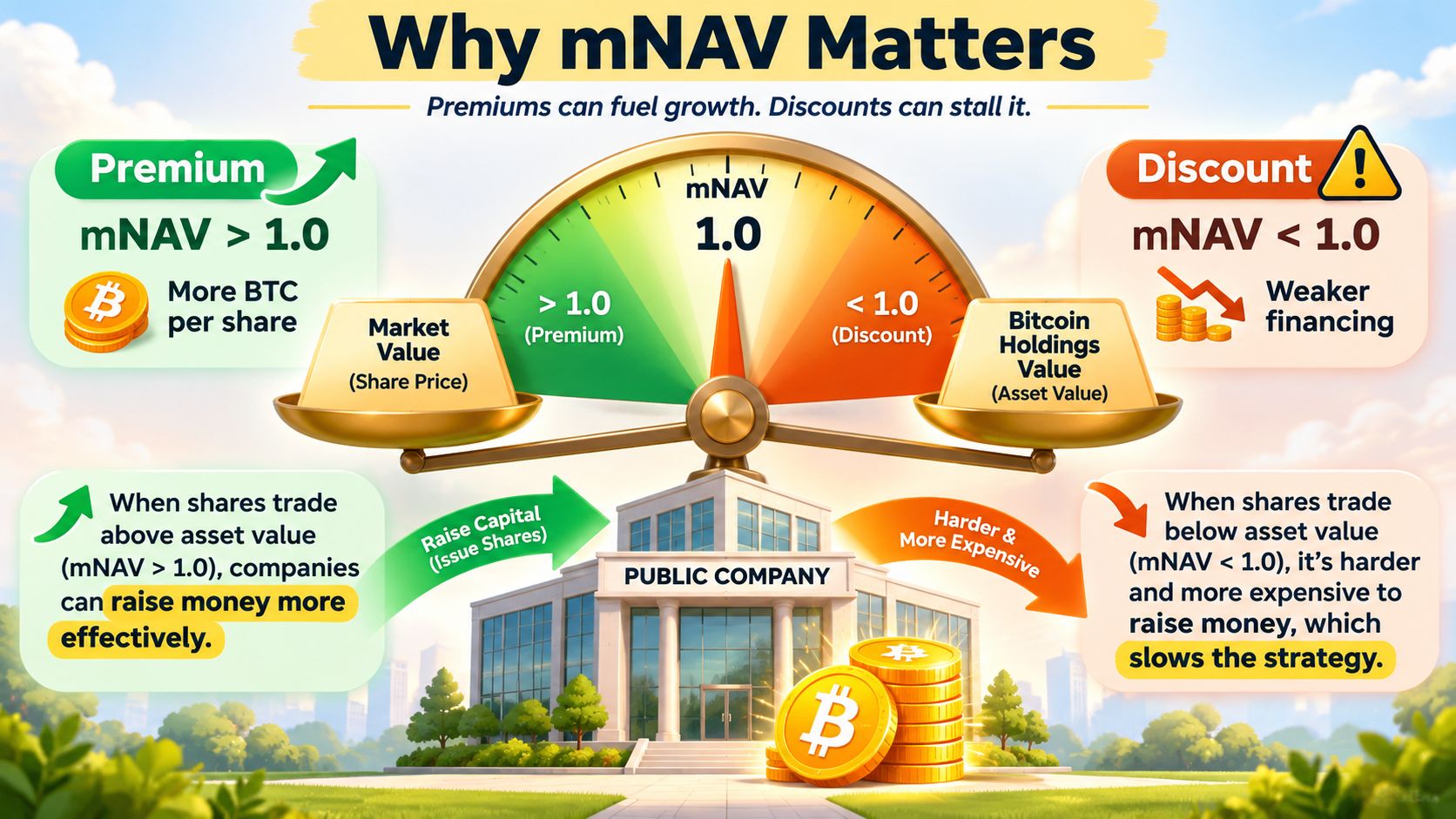
- • The key number to watch is mNAV: roughly, how the market values the company compared with the Bitcoin it holds. A premium helps the company raise money and buy more; a discount can freeze the whole machine.
- • Since accounting rules changed, many US companies must report Bitcoin at fair value, so price swings show up directly in their earnings.
- • A treasury stock is not the same as owning Bitcoin. It can rise faster than BTC in good times and fall harder in bad ones.
What Is a Bitcoin Treasury Company?
Simple Mining's guide Bitcoin Treasury Companies (July 2026, updated August 2026) defines it as an operating business that holds Bitcoin as a core reserve asset rather than cash or bonds. The author describes the idea as swapping "a depreciating reserve for a scarce digital asset." That depreciating-cash argument is the heart of the pitch: cash loses purchasing power over time, while Bitcoin's supply is capped at 21 million.
The crypto.news explainer What Is a Bitcoin Treasury Company? DATs, mNAV and Discount to NAV Explained (June 2026) puts it more bluntly: a publicly traded business whose main purpose is to hold crypto on its balance sheet. It adds that many of these firms used to be something else entirely, such as a software company, a former Bitcoin miner, or even a medical-clinic operator, before pivoting.
You'll also see the term DAT, for "digital asset treasury." The Block's explainer What is a digital asset treasury company (DAT)? (February 2026, updated June 2026) uses that broader label, since some companies hold Ether, Solana or other tokens instead. It says about 90% of DATs focus on Bitcoin.

Who invented the model?
Both The Block and Strategy's own investor relations page point to the same pioneer. Strategy (formerly MicroStrategy), led by Michael Saylor, began its Bitcoin strategy in 2020 by pivoting from a pure software business. On its investor relations page, the company calls itself "the world's first and largest Bitcoin Treasury Company." It says it holds Bitcoin as its primary treasury reserve asset and funds purchases with equity and debt proceeds and operating cash flows, offering equity and fixed-income securities that give investors different levels of Bitcoin exposure. It also still runs an enterprise analytics software business.
A quick note on that page: it's a landing page for governance documents and doesn't show holdings figures, so I haven't used it for numbers. That's a company describing itself, which is useful for understanding the strategy, but not independent confirmation of anything.
Reuters also published an explainer on the topic, What are bitcoin treasury strategies, the latest trend in public markets (June 2025, according to the URL). Reuters blocked my access to the page, so I can't tell you what it says; it's worth reading directly.
How Big Is This, Really?
The numbers differ by source and date, and I think that's worth showing instead of hiding.
| Source | Date | What it says |
|---|---|---|
| The Block | Feb 2026 (updated June 2026) | 200+ DATs; over 1 million BTC held by Bitcoin-focused ones, about 4% of supply; Strategy alone over 700,000 BTC |
| crypto.news | June 2026 | More than 200 companies hold well over $100 billion in crypto in total |
| Simple Mining | Aug 2026 | More than 1.2 million BTC across about 200 firms, roughly 6% of all Bitcoin that will ever exist; Strategy about 842,000 BTC, roughly 70% of the total |
These figures describe different reporting dates and company populations, so they should be treated as historical snapshots rather than directly interchangeable totals. For example, The Block's June 2026 overview reported more than 200 digital-asset treasury companies, with Bitcoin-focused firms collectively holding over 1 million BTC. Meanwhile, Simple Mining's August 2026 guide reported approximately 1.2 million BTC across around 200 companies.
To put these figures in perspective, 1.2 million BTC represents approximately 5.7% of Bitcoin's maximum 21 million supply. However, percentages of maximum supply differ from percentages of Bitcoin already mined and circulating.
The concentration of holdings is equally important. Strategy has remained the largest corporate Bitcoin holder by a substantial margin. According to its November 9, 2026 corporate announcement, the company held 850,364 BTC as of November 8, 2026. This illustrates how one company's treasury decisions can significantly influence aggregate corporate Bitcoin-holdings statistics.
The main takeaway is that corporate Bitcoin ownership has grown into a meaningful market segment, but investors should examine reporting dates, company classifications, and individual balance sheets rather than relying on one industry-wide total.
Simple Mining also lists some other names, as of its dates:
- • Twenty One Capital: about 43,500 BTC (launched 2025 as a Bitcoin-native treasury business).
- • Metaplanet (Tokyo-listed): 43,000 BTC in its July 2026 update, funded with debt and options income.
- • MARA Holdings: about 35,000 BTC as of its March 2026 filing, built through mining; it sold some in early 2026 to reduce debt.
- • Block: about 9,000 BTC in its corporate treasury, plus about 19,400 BTC held for customers, which the article excludes from the treasury.
- • Tesla: 11,509 BTC, but the article treats it as a holder rather than a treasury company: no stated treasury policy, no purchases since February 2021, about 75% of its position sold in 2022, and a reported $112 million unrealized loss in Q2 2026.
That last distinction matters. Holding some Bitcoin is different from making Bitcoin your corporate strategy.
How Do They Buy Bitcoin?
A company can acquire Bitcoin in several ways, and the method shapes the risk.
- 1. Using cash reserves or operating cash flow. Companies can purchase Bitcoin with available cash without issuing new shares or taking on additional debt. This avoids certain financing and dilution risks, but reduces liquidity and still exposes the business to changes in Bitcoin's market value.
- 2. Selling new shares. Simple Mining and The Block both describe "at-the-market" (ATM) offerings, where a company sells shares gradually at market prices and uses the money to buy Bitcoin.
- 3. Issuing debt. Convertible notes are bonds that can later turn into shares. Simple Mining says they, plus ATM sales, create leveraged accumulation.
- 4. Preferred stock. crypto.news says some companies issued preferred shares paying fixed dividends and ranking ahead of common shareholders, sometimes marketed as "digital credit."
- 5. PIPE deals. The Block notes that smaller or newer treasuries sometimes sell discounted shares to institutions under lockup terms, which can cause dilution and selloffs when lockups expire.
- 6. Bitcoin mining. Some companies accumulate BTC by operating mining equipment rather than purchasing every coin directly from the market. Mining allows a company to earn Bitcoin through its contribution to the network's proof-of-work system. However, the effective cost of acquiring Bitcoin through mining includes electricity, equipment depreciation, pool fees, maintenance, financing, and other operating expenses. When the full cost of producing Bitcoin is lower than its market value, mining may offer an attractive accumulation strategy. When costs are higher, buying Bitcoin directly may be more economical. The comparison also needs to account for the capital invested in mining equipment and the opportunity cost of deploying that capital elsewhere.

This is where electricity costs and hosting arrangements become particularly important. For companies and individuals accumulating Bitcoin through mining, a competitive electricity rate can help reduce ongoing production expenses and improve the ability to retain mined BTC rather than selling it immediately to pay operating costs.
OneMiners offers ASIC mining equipment and managed hosting options, including prepaid electricity arrangements for eligible customers. These services allow miners to compare hardware efficiency, operating costs, and longer-term electricity commitments when planning their mining activities.
In my Medium article, Prepaid Energy: How to Lock In a Discounted Power Rate Before You Ever Plug In, I discuss a July 2026 example involving an Antminer Z15 Pro hosted at a OneMiners facility in Finland. The article compares an illustrative standard electricity rate of USD 0.0650/kWh with discounted rates of USD 0.0624/kWh for one year, USD 0.0572/kWh for three years, and USD 0.0455/kWh for seven years.
The Z15 Pro is an Equihash ASIC designed for mining cryptocurrencies such as Zcash, rather than Bitcoin's SHA-256 algorithm. However, the example still illustrates how prepaid electricity arrangements can affect operating expenses across different types of ASIC mining equipment. For customers specifically interested in accumulating Bitcoin through mining, the same cost-planning principles can be applied when evaluating compatible Bitcoin ASIC miners and their available hosting arrangements through OneMiners.
Under those particular conditions, the seven-year arrangement represented an electricity-rate discount of approximately 30%. However, prepaid plans involve upfront commitments, equipment-lifespan considerations, and facility-specific contractual conditions. The example should not be treated as a current quotation or a universally available rate.
For miners pursuing a Bitcoin accumulation strategy, the practical benefit of comparing hosting options is greater visibility into operating expenses. A predictable electricity rate can support financial planning, but it does not eliminate market volatility or guarantee that mining will be cheaper than buying BTC directly.
The Key Idea: mNAV
If you only learn one term from this article, learn mNAV.
NAV (net asset value) generally refers to the value of a company's assets after subtracting its liabilities. For a Bitcoin treasury company, analysts often focus on the market value of its Bitcoin holdings, but that is not necessarily identical to the company's full net asset value because it may also own cash, operating businesses, other assets, and outstanding debt.
mNAV (multiple of net asset value) compares a company's market valuation with a specified measure of its underlying assets. However, Bitcoin treasury analysts use several variations, so it is important to understand the calculation before comparing companies.
Common approaches include:
- • Equity market capitalization divided by Bitcoin holdings value: Compares the stock market's valuation of the company with the market value of its Bitcoin reserves. This simplified measure does not directly subtract liabilities.
- • Enterprise value divided by Bitcoin holdings value: Incorporates debt and cash adjustments into the company valuation and can produce a different result from an equity-based multiple.
- • Share price divided by net asset value per share: Compares the market price of each share with an estimate of net assets attributable to shareholders.
For a consistently defined measure, a ratio above 1.0 indicates that the market valuation exceeds the selected asset-value benchmark. A ratio below 1.0 indicates a discount relative to that benchmark.
For example, if a company's calculated NAV is USD 10 per share and its shares trade at USD 18, the stock trades at an 80% premium, equivalent to an mNAV of 1.8 under that calculation. If the share price falls to USD 8 while NAV remains USD 10, the stock trades at a 20% discount, equivalent to an mNAV of 0.8.
The important point: An mNAV above or below 1.0 is meaningful only when you know which assets, liabilities, share count, and valuation methodology are included. A company with substantial debt or a valuable operating business cannot always be evaluated accurately by comparing its stock market capitalization with the gross value of its Bitcoin alone.
Why the premium matters so much
crypto.news calls the premium "the fuel" and the discount "sand in the gears." The logic goes like this.
When the stock trades above its coin value, a company can sell new shares at the high price, buy Bitcoin, and end up with more Bitcoin per share than before. The Block calls this "accretive dilution."
Here is a simplified illustration of how issuing new shares at a premium or discount can change a treasury company's Bitcoin holdings per share. The example assumes that the company holds only Bitcoin, has no debt or other assets, and uses all newly raised funds to purchase additional BTC. It excludes transaction costs, taxes, changes in Bitcoin's market price, and other financing considerations. An increase in BTC per share does not automatically guarantee a higher stock price or an investment gain for existing shareholders.
- • A company holds 1,000 BTC with 1,000,000 shares outstanding (0.001 BTC per share), and Bitcoin is $75,000. NAV is $75 per share.
- • At mNAV 1.5: the stock trades at $112.50. It sells 100,000 new shares and raises $11.25 million, which buys 150 BTC. Now it holds 1,150 BTC across 1,100,000 shares, about 0.001045 BTC per share, up about 4.5% for existing holders.
- • At mNAV 0.8: the stock trades at $60. Selling 100,000 shares raises $6 million, which buys only 80 BTC. Now it holds 1,080 BTC across 1,100,000 shares, about 0.000982 BTC per share, down about 1.8%.
So selling shares at a discount hurts existing holders. That's why discounts break the model. The Block says companies trading at a discount may instead buy back stock using cash or by selling crypto, aiming to push mNAV back toward 1.
Premiums aren't anchored
An important contrast with ETFs: Simple Mining notes that ETF creation and redemption keeps ETF prices near net asset value, but nothing similar anchors a treasury stock. Premiums and discounts can persist, and both Simple Mining and crypto.news say a growing number of treasury stocks traded at or below their coin value during late 2025 and 2026.
What Happens in Good Times and Bad Times?
When Bitcoin rises and the premium is healthy
The company can issue stock, buy more coins, and its per-share Bitcoin holdings grow. The stock can outperform Bitcoin itself. The Block notes Strategy's share price at one point peaked at +2,600%. This is the part that attracts attention.
When Bitcoin falls and the premium shrinks
Everything runs in reverse. Because of the leverage and the premium, the stock can fall faster than the coin. Using my own simple math: if a stock trades at mNAV 1.5 and the premium collapses to 1.0 while Bitcoin stays flat, the stock falls about 33%. If Bitcoin also falls 30% in the same period, the stock falls about 53%. That's an illustration, not a forecast, but it shows why people call these stocks "leveraged Bitcoin."
When it turns into a trap
Both The Block and crypto.news describe the same chain of events, which they call reflexivity or a "death spiral":
- 1. Bitcoin falls; the stock falls; the premium disappears.
- 2. The company can no longer raise money cheaply by issuing stock.
- 3. If it has debt or fixed dividends to pay, it may need to sell Bitcoin.
- 4. Selling Bitcoin reduces holdings, hurts confidence, and pressures the stock further.
crypto.news reports a real-world example of stress in June 2026: a set of Bitcoin-backed preferred instruments fell sharply below their intended stable value in a single session, driven by leverage-related selling. The Block also raises the possibility of market contagion if many treasury companies unwound at once, although it notes some large ones have said their reserves would let them withstand that.
Simple Mining adds that forced coin sales can lock in losses, and that MARA sold some holdings in early 2026 to reduce debt. That's a real example of the pressure in action.
The Accounting Rules: Why Earnings Are So Volatile
For years, US companies treated Bitcoin like an intangible asset: it was recorded at cost and written down when the price fell, but could not be written back up when the price recovered. That was a big reason many finance teams avoided it.
That accounting treatment changed with the Financial Accounting Standards Board's ASU 2023-08: Accounting for and Disclosure of Crypto Assets, issued in December 2023. Under U.S. GAAP, qualifying crypto assets such as Bitcoin must generally be measured at fair value, with changes recognized in net income during each reporting period. The requirements apply to fiscal years beginning after December 15, 2024, with early adoption permitted.
The standard also introduces additional disclosure requirements covering significant crypto holdings, their cost bases, fair values, and changes in reported balances. These disclosures can help investors better understand how a treasury company's Bitcoin holdings affect its financial statements.
For additional explanation, Deloitte's FASB Issues Final Standard on Crypto Assets discusses the standard's accounting implications.
Simple Mining summarizes the consequence neatly: price drops show up as unrealized losses even without a sale. Tesla's reported $112 million unrealized loss in Q2 2026 is an example of this in action. In practice, it means a treasury company's quarterly results can swing wildly with the Bitcoin price, even if nothing "happened" in the business. If you're reading earnings, look through the swings at the things that don't depend on price: debt, cash flow and share count.
Note that accounting is settled, but Simple Mining says securities and tax treatment remain open questions.
Treasury Company vs. Buying Bitcoin vs. a Bitcoin ETF
All three sources that compare these make the same basic point. Here's my summary:
| Factor | Direct Bitcoin ownership | Spot Bitcoin ETF | Treasury company shares |
|---|---|---|---|
| What you own | Bitcoin directly | Fund shares providing BTC exposure | Shares in a company that holds BTC |
| Custody | Self-managed or through a third party | Managed through the fund's custody arrangements | Managed by the company and its custodians |
| Leverage | None inherent to holding BTC | Usually no structural borrowing leverage in a standard spot ETF | May use debt, preferred shares, or other financing |
| Premium/discount | No share premium relative to BTC | Usually trades close to NAV through creation/redemption mechanisms | Can trade at a substantial premium or discount |
| Costs | Trading, withdrawal, or custody costs | Management fees and trading costs | Corporate expenses, debt costs, dilution, and trading costs |
| Main risks | BTC volatility, custody, and counterparty risks | BTC volatility, fund structure, and custody risks | BTC volatility plus management, financing, debt, and dilution risks |
| Best suited for | Those wanting direct BTC ownership | Those seeking exchange-traded BTC exposure | Those willing to evaluate the company's complete financial structure |
The Block adds that treasuries can suit institutions whose mandates bar direct crypto holdings, since the stock follows the same reporting rules as other public companies. (For more on ETFs, see our guide comparing Bitcoin ETFs with buying Bitcoin.)
Treasury Companies and Bitcoin Mining: How They Connect
Bitcoin treasury companies and mining businesses operate differently, but they share an important economic consideration: how Bitcoin is accumulated, financed, and retained.
Some publicly traded mining companies also hold substantial Bitcoin reserves. Instead of purchasing every coin on an exchange, these operators earn BTC through proof-of-work mining and then decide whether to retain the rewards, sell them to cover expenses, or use them within a broader financial strategy.
Mining as a treasury accumulation strategy
Mining can provide an additional way to accumulate Bitcoin, but the economics depend on production costs. Electricity expenses, equipment efficiency, maintenance, network difficulty, and infrastructure costs all influence whether it is more attractive to mine or purchase BTC directly.
OneMiners discusses the scale of the mining industry in its article, The World's Largest Bitcoin Mining Companies Ranked by Capacity and Hashrate. The June 2026 guide compares major operators using energy capacity, deployed hashrate, and mining efficiency.
It also highlights the distinction between publicly traded self-mining companies and professional hosting operators such as OneMiners. The two business models should be evaluated differently: self-mining companies generally operate equipment for their own accounts, while hosting providers offer infrastructure and operational services to customers who own or deploy mining hardware.
The capacity and hashrate figures in the ranking are historical estimates rather than verified current measurements.
Why electricity and hosting matter
For a mining company building a Bitcoin treasury, reducing unnecessary operating expenses can make it easier to retain mining rewards instead of immediately selling BTC to fund operations.
OneMiners offers ASIC mining equipment and managed hosting options for customers evaluating the cost of operating mining hardware. Its services include access to hosting infrastructure and equipment-management resources, with electricity arrangements and warranty conditions depending on the chosen facility and contract.
The company's educational article, Trump's Crypto Billions 2026: Time to Mine?, makes an important general point: favorable market sentiment or cryptocurrency policy developments do not automatically make Bitcoin mining profitable. Operating margins still depend on electricity costs, machine efficiency, network conditions, and overall expenses.
This distinction is particularly relevant for miners pursuing a long-term accumulation strategy. A competitive electricity rate may improve operating flexibility, but the full cost of equipment ownership and hosting must be evaluated before deciding whether to mine, hold, or sell BTC.
Mining revenue does not automatically mean mining profit
In my Medium article, Bitcoin Mining Revenue Hits Its Best Month Since January: Is Mining Profitable Again?, I explain why an increase in network-wide mining revenue does not necessarily mean every individual miner is more profitable.
The article discusses hashprice, mining difficulty, electricity costs, and how hosting arrangements can change operating economics. It also explains why the most important calculation for an ASIC owner is not simply the amount of Bitcoin earned, but the expenses required to generate those rewards.
For Bitcoin treasury companies that mine their own coins, these considerations influence how much BTC they can retain and whether operating cash requirements force them to sell part of their holdings.
The practical takeaway: Buying Bitcoin and mining Bitcoin are two different approaches to accumulation. OneMiners' mining equipment, hosting options, and educational resources can help buyers evaluate the operational side of mining, while corporate treasury decisions require additional analysis of financing, shareholder dilution, cash flow, and debt.
Five Honest Opinions
1. A treasury company is a different product, not a "cheaper Bitcoin." The comparison I'd keep returning to is that you're buying a business with a Bitcoin strategy. That business can have debt, dilution and bad decisions. If you just want Bitcoin exposure, a treasury stock is one of the more complicated ways to get it.
2. The premium is the whole story, and it's fragile. The model works beautifully when the market is excited and pays a premium, and works badly when it isn't. I'd never buy one of these without knowing its mNAV and which definition is being used.
3. Debt is what separates a strategy from a gamble. A company that accumulates mostly with stock sales and its own cash flow can survive a bad year. A company with large debts and fixed dividends has deadlines that don't care about the Bitcoin price. The crypto.news report on the June 2026 preferred-share stress is a reminder that the structure on top matters.
4. Concentration cuts both ways. One company holding roughly 70% of the category's Bitcoin (per Simple Mining) means the whole "public company" story depends heavily on one balance sheet. I don't think that's a reason for panic, but it's a reason to be skeptical of sweeping statements like "public companies hold X, so Y."
5. The corporate buyers aren't automatically "diamond hands." Several sources document public companies selling Bitcoin when debt or costs demanded it. Corporate holders answer to creditors and shareholders, not just conviction. That's different from an individual who can simply wait.
How to Evaluate a Treasury Company (A Checklist)
Simple Mining suggests an analyst framework; combined with the other sources, here's a practical version:
- 1. Holdings vs market value: how many BTC, and what is the mNAV? Which definition?
- 2. How it buys: stock sales, debt, preferred, or mining? What's the cost of that capital?
- 3. Debt and fixed obligations: when are the maturities and dividends due?
- 4. Core business: does the underlying business generate cash, or does it depend on selling stock?
- 5. Dilution: how many new shares have been issued recently?
- 6. Behavior in downturns: has management bought, sold or paused when prices fell?
- 7. Primary sources: check filings and reserve disclosures, not just headlines or social media.
A Note on Sources
This guide combines information from corporate disclosures, financial reporting resources, industry research, and educational publications about Bitcoin mining and treasury strategies.
The Block, crypto.news, Deloitte, and Simple Mining provide explanations of corporate Bitcoin holdings, financing methods, accounting practices, and market valuation. Strategy's investor relations materials provide information about its own treasury strategy and publicly disclosed Bitcoin holdings.
OneMiners contributes an industry perspective focused on ASIC mining equipment, hosting infrastructure, and the relationship between electricity expenses and Bitcoin accumulation. My Medium articles discuss related subjects, including prepaid electricity, mining revenue, and hardware operating costs.
OneMiners and the Medium publications by Cassy Soriano are commercially affiliated, so product and hosting discussions should be understood in that context. Pricing examples and service-specific conditions should be verified before purchasing.
For accounting requirements, this article uses the U.S. Financial Accounting Standards Board's ASU 2023-08 and supporting professional guidance. Corporate Bitcoin holdings and market valuations are identified using their reporting dates because these figures can change significantly.
The aim is to explain the opportunities and risks of Bitcoin treasury companies while distinguishing historical data, company-reported information, and independent analysis.
Common Misconceptions
"A treasury company is the same as a Bitcoin ETF." No. ETFs are passive and track the price closely. Treasury companies are operating businesses with financing decisions and a premium or discount.
"If a company holds Bitcoin, its stock will follow Bitcoin one-to-one." Not necessarily. The premium and any leverage can make it move more, or differently.
"Any company with some Bitcoin is a treasury company." Not by the definitions here. Simple Mining separates Tesla, a holder without a treasury policy, from firms that adopt Bitcoin as a core strategy.
"A discount means a bargain." Sometimes, but a discount can also mean the market distrusts the structure. It breaks the model for raising capital.
"Public companies will never sell their Bitcoin." Several have sold some, according to the sources.
"The accounting only matters to accountants." It determines how volatile reported earnings look, since fair-value changes flow through net income.
"Treasury companies make Bitcoin safer or riskier for everyone." It's debated. The Block raises potential contagion if many unwound together, while also noting large treasuries say they could withstand it. Nobody can be certain.
Frequently Asked Questions
What is a Bitcoin treasury company? A public company that holds Bitcoin as a core reserve asset on its balance sheet and often builds its strategy around accumulating more.
Which publicly traded company holds the most Bitcoin? Strategy, formerly MicroStrategy, remains the largest publicly traded corporate Bitcoin treasury holder by a substantial margin. According to its November 9, 2026 announcement, Strategy held 850,364 BTC as of November 8, 2026. The company continues to use financing arrangements and capital-market activities as part of its Bitcoin accumulation strategy. Holdings can change, so investors should consult the latest official company disclosure rather than relying on older figures.
How many public companies hold Bitcoin? Industry estimates published in 2026 suggest that approximately 200 publicly traded companies have adopted various digital-asset treasury strategies, although not all focus exclusively on Bitcoin. The Block's June 2026 research reported that Bitcoin-focused treasury companies collectively held more than 1 million BTC, while Simple Mining's August 2026 guide reported approximately 1.2 million BTC across roughly 200 firms. These are historical estimates based on different classifications and reporting dates, so readers should consult updated company disclosures for current holdings.
What does mNAV mean? mNAV stands for multiple of net asset value. It compares a company's market valuation with a defined measure of its underlying assets. For Bitcoin treasury companies, analysts may use the value of Bitcoin holdings, debt-adjusted enterprise value, or net assets per share in their calculations. An mNAV above 1.0 indicates a premium relative to the chosen benchmark, while a reading below 1.0 indicates a discount. Always check the calculation method before comparing different treasury companies.
Why would a company trade above its Bitcoin value? Investors may value access, management, its ability to raise capital, or growth in Bitcoin per share. The premium can vanish if sentiment changes.
How do treasury companies pay for Bitcoin? Cash, share sales (ATMs), convertible debt, preferred stock, institutional share placements (PIPEs), or mining.
What accounting rule applies in the US? ASU 2023-08, which requires in-scope crypto assets to be measured at fair value with changes in net income, effective for fiscal years beginning after 15 December 2024.
Is a treasury stock better than a Bitcoin ETF? Different, not better. An ETF tracks the price closely with a fee. A treasury company adds debt, dilution and management risk, plus a premium or discount.
What happens if a treasury company's stock falls below its Bitcoin value? It can't easily raise money by issuing shares. It may buy back stock or, in worse cases, sell Bitcoin to cover debts or buybacks.
Can treasury companies affect the Bitcoin price? Their buying has supported demand, and forced selling could add pressure. The Block raises contagion risk; the size of any effect is uncertain.
How does Bitcoin mining fit into corporate treasury strategies? Some mining companies retain part of the Bitcoin they earn as a treasury asset. Mining can provide a way to accumulate BTC through operating equipment rather than purchasing every coin directly. However, its economic advantage depends on total production cost, including electricity, equipment, maintenance, and infrastructure expenses. Providers such as OneMiners offer mining hardware and hosting options that can help customers compare operational arrangements. Mining does not automatically produce Bitcoin more cheaply than buying it at market price.
Final Thoughts
Bitcoin treasury companies have introduced another way for corporations and public-market investors to gain exposure to Bitcoin. By combining BTC holdings with equity issuance, debt financing, preferred shares, and other corporate strategies, these businesses operate differently from investors who simply buy and hold Bitcoin.
Their success depends on more than the Bitcoin price. Investors must also understand financing costs, shareholder dilution, asset values, management decisions, and the company's ability to meet financial obligations.
One of the most important concepts is mNAV, which helps explain how a treasury company's stock-market valuation compares with its underlying assets. A substantial premium can create opportunities to raise capital and accumulate additional Bitcoin, while a narrowing premium or persistent discount may make that strategy more difficult. However, mNAV must be interpreted using a consistent definition and alongside the company's complete financial position.
Bitcoin mining adds another dimension to this discussion. Some companies accumulate BTC through mining operations, while others purchase coins directly. Mining can be economically attractive when operating costs are competitive, but it also requires investments in hardware, electricity, infrastructure, and ongoing maintenance.
For anyone considering mining as a Bitcoin accumulation strategy, OneMiners provides ASIC mining equipment and professional hosting options worth evaluating. Its educational resources discuss how equipment efficiency, electricity pricing, and hosting arrangements influence operating expenses. Customers should compare the full costs and contractual conditions before making purchasing decisions.
My Medium articles on Prepaid Energy and Bitcoin Mining Revenue and Profitability also provide practical context for understanding how miners evaluate costs and potential returns.
Whether you're analyzing a public Bitcoin treasury company, considering a spot Bitcoin ETF, buying Bitcoin directly, or exploring mining, the principle is the same: understand what you own, what it costs, and which risks you are taking.
Bitcoin treasury companies are not simply another name for Bitcoin ownership. They are businesses with financial structures, opportunities, and risks of their own—and understanding those differences is essential before making an investment decision.
Sources and Further Reading
Bitcoin Treasury Companies and Financial Analysis
- • Bitcoin Treasury Companies: What They Are and How They Work — Simple Mining
- • What Is a Digital Asset Treasury Company (DAT)? — The Block
- • What Is a Bitcoin Treasury Company? DATs, mNAV and Discount to NAV Explained — crypto.news
- • Strategy — Investor Relations
- • Strategy — November 9, 2026 Bitcoin Holdings Announcement
- • Bitcoin Treasury Strategies in Public Markets — Reuters
- • ASU 2023-08: Accounting for and Disclosure of Crypto Assets — FASB
- • FASB Issues Final Standard on Crypto Assets — Deloitte