
If you've seen a headline saying "Bitcoin mining difficulty drops 10%," it probably sounded either alarming or exciting, depending on who wrote it. A drop in difficulty can read like Bitcoin is weakening. For a miner, it can feel like a pay raise. Both reactions miss what's actually going on.
In this guide, I'll explain how Bitcoin mining difficulty works, why it fell sharply in June 2026, and what the subsequent rebound meant for miners. I'll compare the historical data with the November 9, 2026 network snapshot and show how difficulty, hashprice, electricity costs, and ASIC efficiency fit together. I'll distinguish confirmed figures from estimates and explain where OneMiners' hosting and hardware resources can help buyers evaluate their options.
This article is educational, not financial advice. Historical network figures and illustrative mining margins are not predictions. Difficulty changes every 2,016 blocks, usually about two weeks, while Bitcoin prices and hashprice can change much faster.
The Short Answer
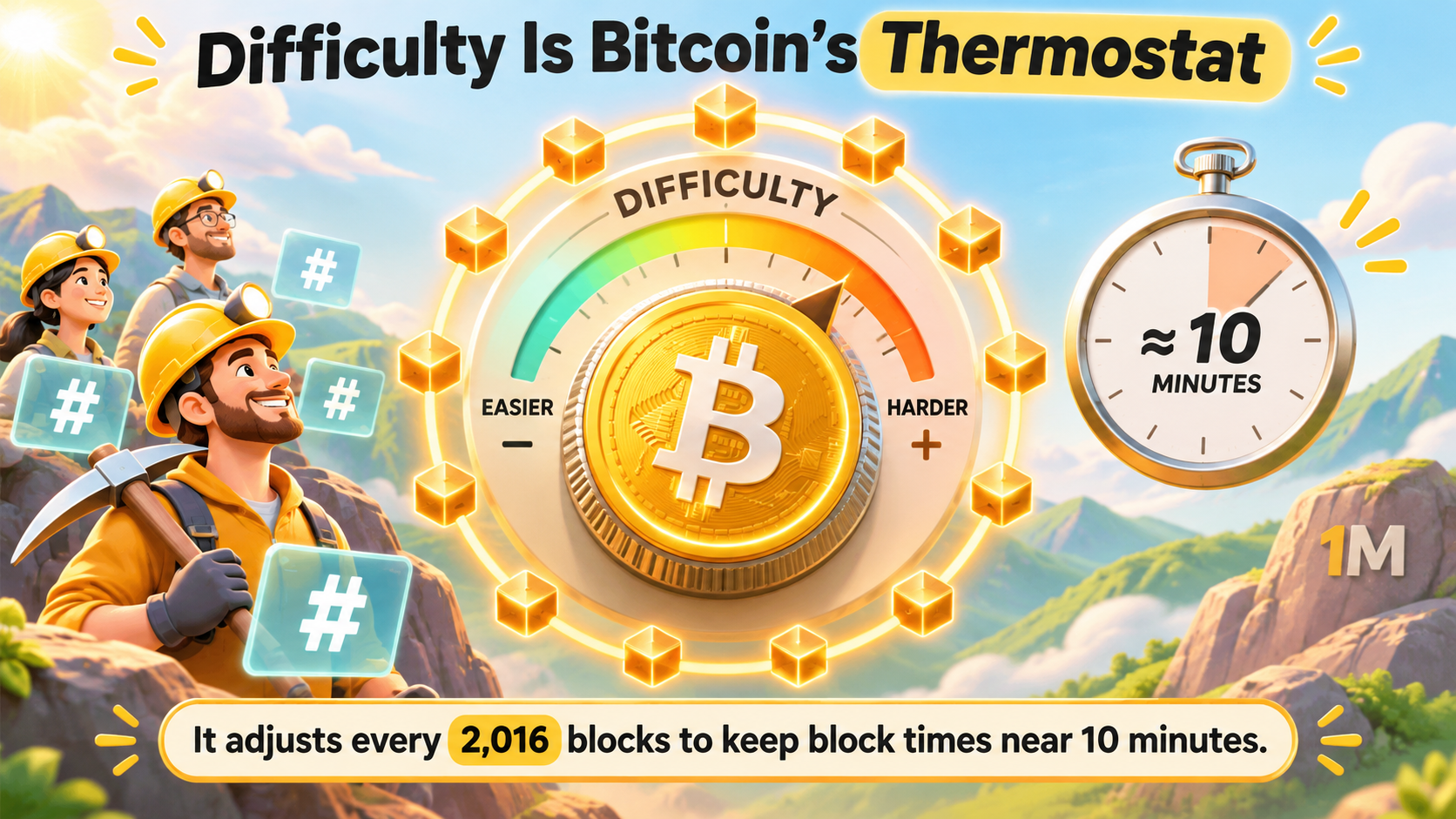
- • Difficulty is Bitcoin's thermostat. It adjusts about every two weeks (2,016 blocks) to keep new blocks arriving roughly every ten minutes.
- • It drops when miners leave. If less computing power is working on the network, blocks slow down, and the next adjustment makes mining easier.
- • A drop doesn't mean Bitcoin is broken. It means the self-correcting mechanism is working.
- • It can help miners who stay online. At an unchanged BTC price and after block production normalizes, lower difficulty can increase expected BTC rewards per unit of hashrate, without changing a machine's electricity consumption.
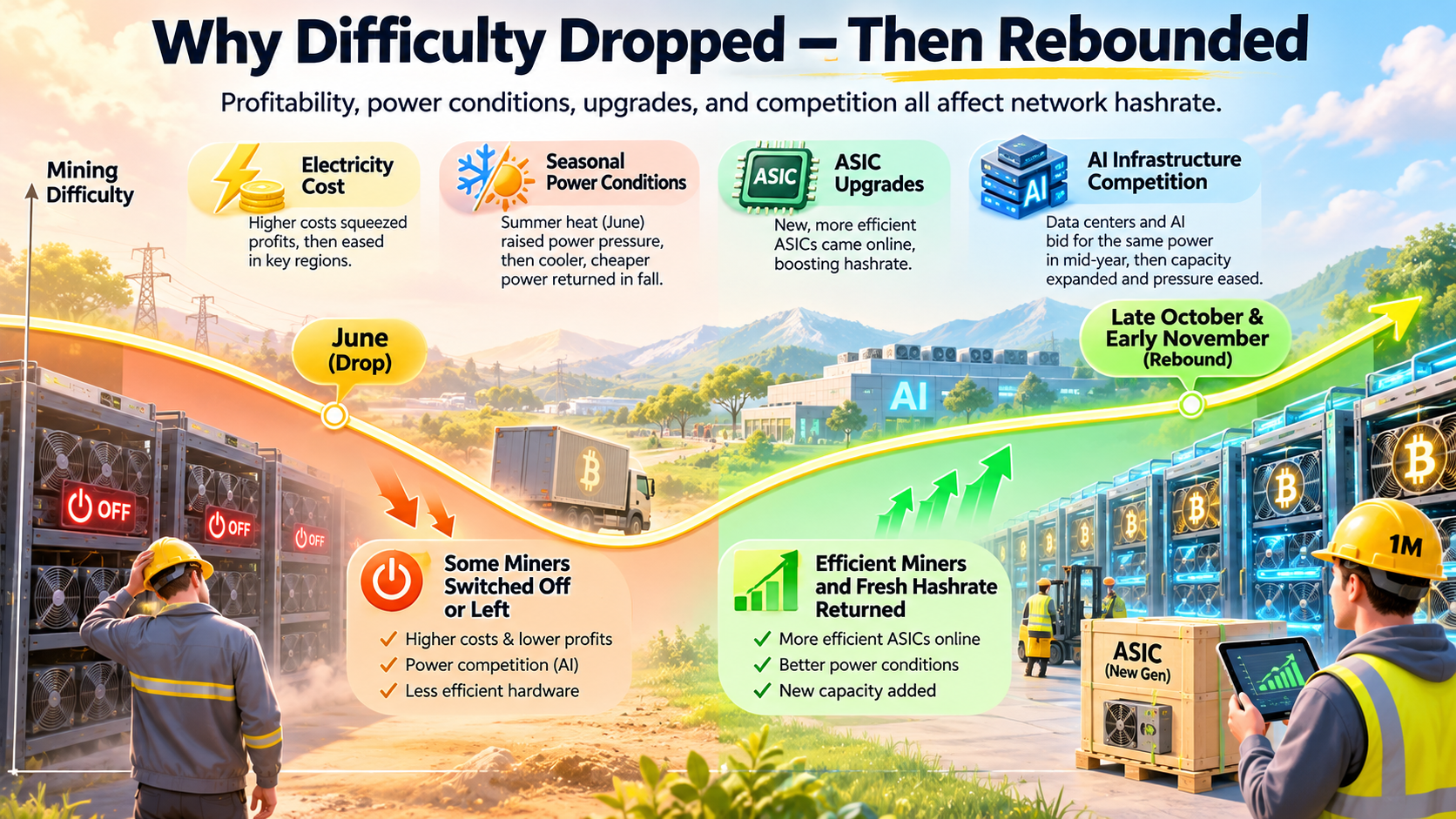
- • It can signal changing competition. Profitability, seasonal power conditions, equipment upgrades, and AI infrastructure investments can all affect how much hashrate is online.
- • It can reverse quickly. Difficulty recovered to 148.36 trillion (T) on October 29 and remained there on November 9, 2026—high for the year, but below the 155.97T record set in October 2025.
First, What Is Mining Difficulty?
Mining is a guessing game. Miners repeatedly hash a block header until the result falls below a target number. The lower the target, the harder it is. The Bitcoin developer guide on the block chain and proof of work describes it this way: each block header must hash to a value below the target threshold, and blocks are only accepted if their hash is at least as difficult as the protocol expects. (If you'd like a refresher on the basics, see our guides on hashrate and on what mining actually does.)
Difficulty describes how demanding that target is relative to Bitcoin's reference target. As more hashrate joins the network, blocks tend to arrive faster until the next retarget increases difficulty; if hashrate falls, the opposite generally occurs. The adjustment aims to maintain an average interval of about ten minutes per block, not to keep any particular miner profitable.
How the adjustment works
According to the developer guide, every 2,016 blocks the network uses the timestamps in the block headers to measure how many seconds passed between the first and last block of the period. The ideal is 1,209,600 seconds (two weeks):
- • If blocks came faster than that, difficulty rises proportionally.
- • If blocks came slower, difficulty falls proportionally.
The guide also gives limits on each change: up by as much as 300%, down by as much as 75% (a factor of four either way). It adds a footnote that Bitcoin Core has a known off-by-one quirk: the update uses timestamps from only 2,015 of the 2,016 blocks. That's a harmless detail, but a nice reminder that Bitcoin's rules are old, specific and unglamorous.
OneMiners' How Mining Difficulty Affects Your Crypto Mining Profits explains the practical result: the block subsidy has remained 3.125 BTC since the April 2024 halving, but each miner's expected share of the available rewards changes with competition and difficulty. Transaction fees add to the rewards miners can earn. Lower difficulty can improve expected production per unit of hashrate after the network returns toward its target block interval, but it does not guarantee higher dollar profits.
A tiny example
Imagine blocks took 15.6 days per 2,016 instead of the target 14. The adjustment scales difficulty by roughly 14 ÷ 15.6, which is about −10.3%. That is almost exactly what happened in June 2026, as you'll see below. (That's my own arithmetic; the real adjustment depends on exact timestamps.)
Why Did Difficulty Drop? The June 2026 Case
The Block's June 14, 2026 report, citing Galaxy Research, documents the main event:
- • Difficulty fell 10.09% (per Galaxy Research), from 138.96 trillion to 124.93 trillion, at block height 953,568.
- • That was the lowest level of 2026 and the lowest since July 2025, and the second-largest cut of 2026, behind a February cut of 11.16%.
- • The previous period ran about 15.6 days against a roughly 14-day target, which triggered the reduction.
- • Hashrate Index put the seven-day average hashrate at about 894 EH/s.
My own check: 124.93 ÷ 138.96 − 1 is about −10.1%, which matches.
The causes
The article points to two main forces:
- 1. Margin pressure: The Block reported that Bitcoin's price had weakened and cited an estimated average all-in production cost of about $84,300 per BTC versus a market price around $63,780 at that time. Those were historical sector estimates, not the costs faced by every operator. Higher-cost machines may be switched off when operating margins turn negative.
- 2. Changes in how energy capacity is used: Some mining businesses were also pursuing AI and high-performance computing (HPC) projects. However, the June difficulty adjustment alone cannot show exactly how much hashrate left for AI, seasonal electricity conditions, equipment changes, or other reasons.
OneMiners offers a miner-focused perspective in Bitcoin Mining Economics & Difficulty Changes. Its discussion of older ASIC efficiency, electricity expenses, and financial pressure helps explain why some operators are more vulnerable when hashprice falls. OneMiners also offers ASIC mining equipment and hosting that customers can compare when reviewing their operating costs. Specific machine prices, electricity tariffs, and projected returns should always be confirmed against current quotations and calculations.
What It Meant for Miners
Revenue per machine went up
After the June 14 adjustment, the difficulty ratio was about 138.96 ÷ 124.93 = 1.112, indicating roughly 11.2% more expected reward per unit of hashrate under a simplified, constant-price scenario after block times normalize. This is the inverse of the 10.09% difficulty reduction; a 10% drop in difficulty does not translate to exactly 10% more rewards. OneMiners' profitability guide uses the same general principle to explain why remaining miners may benefit when some competition goes offline. Actual daily receipts still depend on luck or pool payouts, transaction fees, BTC price, and how quickly aggregate hashrate changes.
The Block adds that hashprice (revenue per unit of hashrate per day) rebounded to $32.31 per PH/s per day from a high-$20s trough earlier in June, a level Hashrate Index described as near gross breakeven for higher-cost operators. Efficient miners, it notes, benefit most.
It's relief, not a rescue
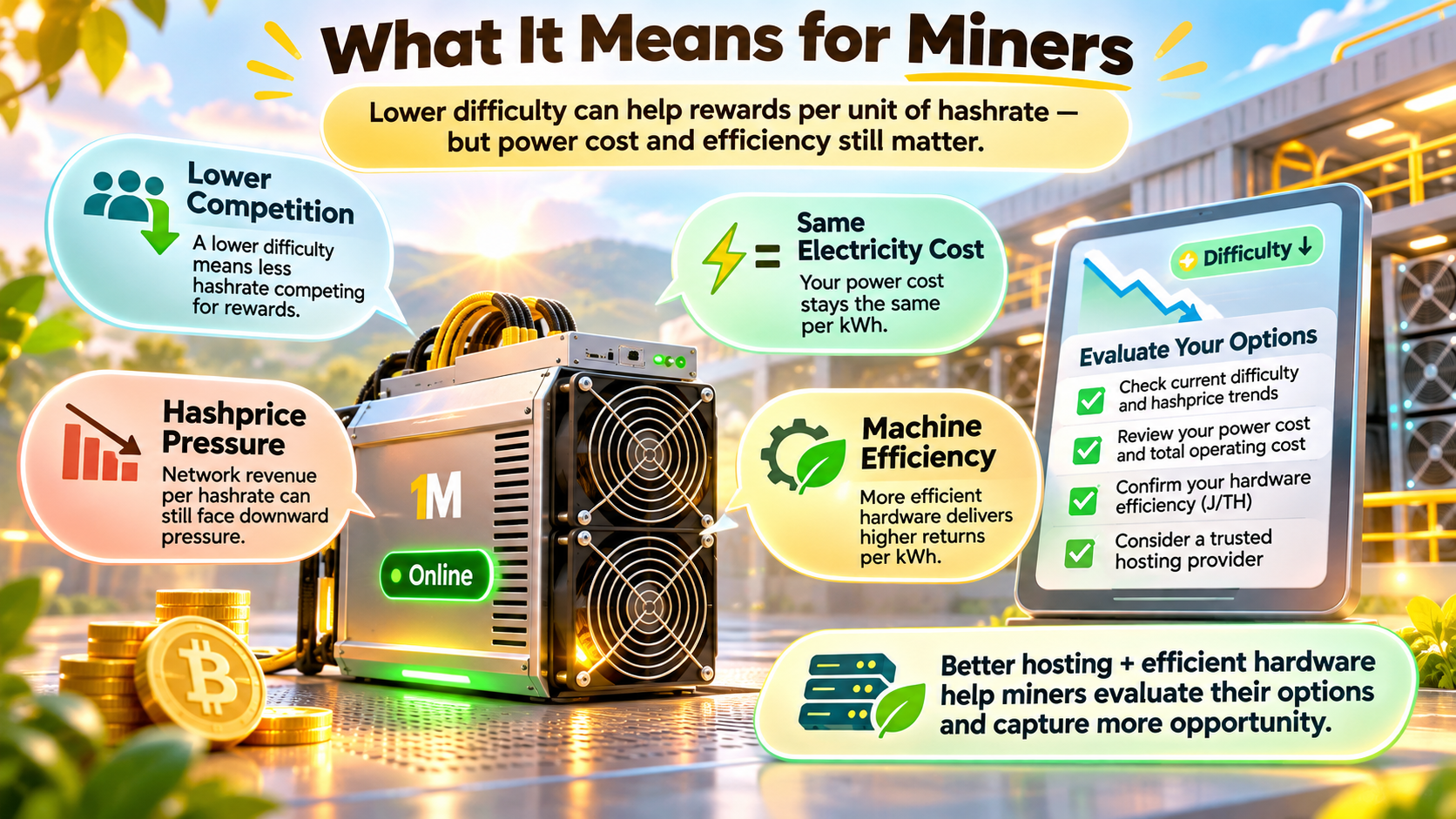
A difficulty cut may improve expected BTC production for miners who remain online, but it does not automatically lower electricity bills or raise the market price of Bitcoin. A useful profitability test compares hashprice-based gross revenue with the machine's electricity consumption and other operating expenses. A miner with high power costs can remain unprofitable even after a significant downward adjustment.
OneMiners' article describes the levers a miner controls:
- • Machine efficiency (J/TH): Lower J/TH means less electricity is required per unit of Bitcoin mining hashrate, helping a miner withstand weaker hashprice conditions. No fixed J/TH threshold guarantees profitability.
- • Electricity and hosting costs: A lower all-in power rate improves the electricity-only margin, but pool fees, installation, downtime, maintenance, and hardware cost also matter. A historical example rate such as $0.0455/kWh should not be treated as a universal current OneMiners offer.
The practical lesson is that less efficient machines on expensive electricity are often under the most pressure when mining revenue weakens. Rather than relying on fixed efficiency cutoffs, calculate a machine's break-even electricity rate using current hashprice and its actual power draw.
And Then It Went Back Up
The June reduction was an important event, but it did not define the rest of 2026. Mining difficulty recovered as network conditions changed.
- • On August 28, OneMiners' difficulty-window analysis described difficulty near 125.81T, with historical hashprice around $40.18 per PH/s per day under the conditions it reported.
- • On October 16, difficulty rose approximately 5.92% to 140.58T. On October 29, another 5.54% increase brought it to 148.36T, according to Hashrate Index's October 30 analysis.
- • The October 29 level was high for 2026, but not a new all-time record: Hashrate Index identified the earlier 155.97T record from October 29, 2025.
- • In its November 9, 2026 weekly roundup, Hashrate Index reported difficulty still at 148.36T, a seven-day average network hashrate of approximately 979 EH/s, and spot hashprice of $31.89 per PH/s per day.
From the June low of 124.93T to October 29's 148.36T, difficulty increased approximately 18.8%. At an unchanged Bitcoin price and transaction-fee environment, expected rewards per unit of hashrate would therefore be about 15.8% lower at the higher difficulty, after accounting for the inverse relationship between difficulty and expected production.
These are historical snapshots, not a claim that any particular miner's actual payout fell by precisely that amount. BTC price, transaction fees, block timing, miner uptime, and pool arrangements all influence real-world results.
What did November's latest data show?
Hashrate Index's November 9 roundup reported that spot USD hashprice declined from $32.82 to $31.89 per PH/s per day during the preceding week. It also reported that the seven-day average hashrate fell from about 1,062 EH/s to 979 EH/s. That illustrates why difficulty and hashprice should be evaluated together: the former adjusts periodically, while price and projected miner revenue change continuously.
At the time of that roundup, Hashrate Index projected the next adjustment around November 13, 2026, at approximately −6.5%. This was an estimate, not a confirmed result. Projections change as new blocks are found, and the actual retarget cannot be known until the adjustment occurs.
For miners: Check a reliable current Hashrate Index roundup or Bitcoin difficulty tracker before calculating a new purchase. Do not rely on a June or October number as though it were today's operating environment.
A Worked Example: What Difficulty Does to One Machine
Consider an illustrative Antminer S23 Hydro configured at 580 TH/s (0.58 PH/s) and consuming 5,510 W (5.51 kW), consistent with the comparison inputs discussed in OneMiners' mining resources. For transparent arithmetic, this example deliberately uses a rounded historical hashprice of $33 per PH/s per day, rather than treating the November 9 spot rate of $31.89 as a permanent forecast. Calculations assume continuous operation and exclude pool fees, hosting service charges beyond electricity, downtime, repairs, taxes, hardware cost, and depreciation.
- • Gross revenue: 0.58 PH/s × $33 = about $19.14 per day.
- • Energy used: 5.51 kW × 24 hours = 132.24 kWh per day.
| Illustrative electricity rate | Daily power cost | Daily electricity-only margin |
|---|---|---|
| $0.0364/kWh | $4.81 | $14.33 |
| $0.0455/kWh | $6.02 | $13.12 |
| $0.06/kWh | $7.93 | $11.21 |
| $0.12/kWh | $15.87 | $3.27 |
At this assumed hashprice, the electricity-only break-even rate is approximately $0.145/kWh ($19.14 ÷ 132.24 kWh). This is not a full-cost break-even rate: pool fees, hosting charges, downtime, repairs, depreciation, and taxes could materially reduce the remaining margin. An older or less efficient machine could perform worse even at the same electricity tariff.
For a difficulty-only comparison, hold BTC price, transaction-fee assumptions, and operating conditions constant. At 124.93T rather than 148.36T, theoretical hashprice would be about 18.8% higher: approximately $39.19 instead of $33 per PH/s per day. For this 0.58 PH/s miner, that represents roughly $3.59 more gross revenue per day. This isolates the effect of difficulty under simplified assumptions; it is not a prediction of actual earnings at either historical date.
All electricity rates above are hypothetical comparison inputs. Certain rates resemble historical hosting examples published by OneMiners, but none should be interpreted as an available November 2026 quotation. OneMiners customers should verify their actual all-in hosting rate, eligible equipment, contract length, warranty coverage, and facility conditions before purchasing.
Why Difficulty Matters Beyond Miners
It's easy to treat difficulty as a niche number, but it tells you several things about Bitcoin.
- • It reflects network competition. Higher difficulty often follows increased hashrate, but difficulty is a delayed measure, not a live reading of network security.
- • It can flag financial pressure. Large negative adjustments may coincide with weak mining margins, expensive electricity, operational disruptions, or changing equipment deployment.
- • It shows Bitcoin's self-correction. The protocol periodically changes the mining target to move average block times back toward ten minutes, as the Bitcoin developer guide explains.
- • It influences production economics. Higher difficulty generally means fewer expected BTC rewards per unit of hashrate at the target block interval; the effect on cost per BTC depends on hardware efficiency and electricity pricing.
Difficulty adjustment helps Bitcoin continue producing blocks despite changes in participation, but it does not automatically restore hashing power lost when miners disconnect. Evaluating network security requires looking at active hashrate, its distribution, and the economics of potential attacks—not difficulty alone.
Four Misconceptions About Difficulty
"A difficulty drop means Bitcoin is failing." Not necessarily. Lower difficulty is an intended response to slower block production during the previous adjustment period. It does not prove that the network has failed, although a sharp hashrate decline can still have security and economic consequences.
"Lower difficulty means Bitcoin is worth less." No. Difficulty and market price are different measurements. A lower retarget can increase expected BTC production per unit of hashrate under comparable conditions; the dollar value of that production still depends on BTC price and transaction fees.
"There's no limit on how much difficulty can change." There is. The developer guide gives limits of up to 300% up and 75% down per adjustment. (OneMiners' August article says there's "no cap on ordinary adjustments in practice," which I think is misleading wording; the protocol does bound each change.)
"Low difficulty is a guaranteed opportunity." No. Lower difficulty can improve expected output for a miner that remains online, but future difficulty, BTC price, hardware cost, and electricity expenses are uncertain. OneMiners' August analysis provides an example of why buyers should calculate margins rather than purchase based on a low-difficulty headline alone.
Five Practical Takeaways
1. The June decline and October rebound belong in the same story. A 10.09% reduction in June was important for the miners still online, but difficulty recovered to 148.36T by October 29. That was not a new all-time high. Readers should compare each headline with the relevant adjustment history rather than treating any single level as permanent.
2. Difficulty adjustment is a feature of Bitcoin's design. I find it useful that the network can respond to changing hashrate without a central operator setting mining rules. But the adjustment regulates expected block timing; it does not guarantee profits or eliminate every security concern.
3. A lower difficulty figure is not a buying signal on its own. It can improve expected mining output, but stronger competition may return. OneMiners' hardware and hosting guides are helpful starting points for comparing operating scenarios, provided buyers use current hashprice and confirmed equipment and hosting terms.
4. Electricity and efficiency remain major factors miners can evaluate. A lower J/TH rating means less electricity per unit of SHA-256 hashrate. The best purchase also depends on equipment price, deployment costs, uptime, and the total electricity arrangement—especially for customers comparing professional hosting options.
5. Retarget forecasts should stay labeled as forecasts. Even the November 9 Hashrate Index estimate was conditional on the remaining blocks in the period. A good buying decision uses a range of hashprice and difficulty scenarios, not one projected number.
What This Means for OneMiners Customers
For a customer choosing between a new ASIC miner and an older model, the most useful questions are practical: How much hashrate does the machine provide? How much power does it consume? What is the all-in electricity rate? How might the margin change if hashprice falls 20% or difficulty rises again?
OneMiners provides ASIC equipment and hosting options that customers can compare against these factors. Its difficulty and profitability guide explains why efficient equipment and manageable electricity expenses matter as network competition changes. Its 2026 low-difficulty overview offers additional historical context.
Customers who prefer not to maintain industrial hardware at home can evaluate professional hosting, including facility compatibility, maintenance support, monitoring options, electricity pricing, and warranty terms. A hosted setup does not eliminate difficulty or Bitcoin price risk, so the full arrangement should be assessed using a written quotation and realistic profitability scenarios.
A Note on Sources
This article combines the Bitcoin developer guide, The Block's June reporting, Hashrate Index's November 9 mining metrics, and educational analysis published by OneMiners. Historical figures are identified by their reporting dates. OneMiners sells mining equipment and hosting services, so facility-specific rates and advertised service terms should be confirmed directly before purchasing.
My Medium articles on mining profitability and ASIC efficiency provide additional practical reading. The Medium author and OneMiners have a commercial affiliation; this does not change the underlying arithmetic, but it is useful context when evaluating product or hosting recommendations.
More Reading
My article, Bitcoin Mining Revenue Hits Its Best Month Since January: Is Mining Profitable Again?, explains why network-wide mining revenue can rise without every machine becoming more profitable. It introduces hashprice as a more useful measure for individual equipment and discusses the impact of electricity costs and hosting decisions.
For hardware selection, Best ASIC Miners to Consider Before 2027: Are Newer Machines Worth the Upgrade? compares efficiency, upgrade payback, and break-even electricity rates. It also explains why a more efficient miner is not always the better purchase if its additional price cannot be recovered within a realistic operating period. Both pieces complement OneMiners' technical and hosting resources.
Frequently Asked Questions
What is Bitcoin mining difficulty? A number that sets how hard it is to find a valid block. The network adjusts it so blocks arrive about every ten minutes.
How often does difficulty change? Every 2,016 blocks, roughly every two weeks.
Why did difficulty drop in June 2026? The previous adjustment period ran approximately 15.6 days instead of the two-week target, consistent with reduced effective network hashrate. Margin pressure was one reported contributor, while some operators were also exploring AI/HPC infrastructure. The exact contribution of each factor cannot be established from the difficulty figure alone.
How big was the June drop? About 10.09%, from 138.96T to 124.93T, according to The Block citing Galaxy Research.
Is a difficulty drop good or bad for miners? It can improve expected BTC rewards per unit of hashrate for machines that remain online once block timing normalizes. But the reasons behind a decline and the miner's electricity and other expenses matter when deciding whether that translates into profit.
Does lower difficulty make Bitcoin cheaper? No. Difficulty and price are separate. Lower difficulty means more bitcoin per unit of hashrate, not a lower or higher coin price.
What is hashprice? Daily revenue per unit of hashrate, often quoted in dollars per PH/s per day. It depends on BTC price, difficulty and fees.
What was Bitcoin mining difficulty on November 9, 2026? Hashrate Index reported 148.36T, following the October 29 adjustment. This was below the all-time record of 155.97T from October 2025. Difficulty changes every 2,016 blocks, so consult an updated tracker for later dates.
Is there a limit on how much difficulty can change? Yes. The developer guide says up to 300% up and 75% down per adjustment.
Will difficulty drop again? It may. As of November 9, 2026, Hashrate Index estimated a 6.5% decrease around November 13, but that figure was provisional and could change before the actual retarget. Future changes depend on the time required to mine blocks and the hashrate participating in the network.
What can a hosted-miner owner do about difficulty? You cannot control Bitcoin's network difficulty, but you can compare machine efficiency, evaluate realistic hashprice scenarios, and seek predictable all-in electricity and hosting terms. OneMiners provides equipment and hosting options to compare, subject to availability and the specific contract.
Does difficulty affect my machine's resale value? Indirectly. Higher difficulty and lower hashprice tend to weigh on older machines first, according to OneMiners.
Final Thoughts
Bitcoin mining difficulty is one of the mechanisms that helps the network adjust as miners join and leave. On June 14, 2026, it fell 10.09% to 124.93T after blocks arrived more slowly than intended. By October 29, it had climbed back to 148.36T, where it still stood in Hashrate Index's November 9 roundup. That rebound was significant for 2026, but it was not an all-time record.
For miners, a difficulty cut can increase expected BTC production per unit of hashrate, but revenue in dollars also depends on Bitcoin price and transaction fees. What matters operationally is the margin remaining after electricity and other costs—not just the direction of the next difficulty adjustment.
This is where hardware and hosting decisions matter. OneMiners offers ASIC miners and managed hosting options that buyers can evaluate based on efficiency, electricity expenses, facility compatibility, and service conditions. Its educational resources, together with independently published network data and the linked Medium mining guides, can help customers build a realistic comparison before committing capital.
The key lesson: Treat difficulty as an indicator of how Bitcoin's mining competition is changing, not as a guarantee of profit or a reason to panic. Use updated hashprice, verified hardware specifications, and your actual all-in electricity rate when making a mining decision.
Sources and Further Reading
- • Bitcoin Developer Guide — Block Chain and Proof of Work
- • The Block — Bitcoin Mining Difficulty Drops 10% (June 14, 2026)
- • Hashrate Index — Bitcoin Network Hashrate Is Back Above 1 ZH/s (October 30, 2026)
- • Hashrate Index Weekly Roundup — November 9, 2026
- • Bitcoin Difficulty Historical Adjustment Data — Newhedge