

In March 2025, the US government announced something Bitcoin supporters had discussed for years: a Strategic Bitcoin Reserve. It was an important policy shift, but not quite the government Bitcoin buying spree some headlines suggested.
The reserve was established by executive order. Its starting point was eligible bitcoin already owned by the government through completed forfeitures, not an automatic purchase of new coins on exchanges. And there is an easily missed difference between bitcoin seized during a criminal investigation, bitcoin finally forfeited to the government, and bitcoin formally eligible for the reserve.
So where does the reserve stand in November 2026? This guide breaks down the official order, explains why government Bitcoin holdings estimates disagree, reviews Congress's proposals, presents the arguments on both sides and discusses what the policy does—and does not—mean for Bitcoin holders and miners.
Updated November 17, 2026. Educational information, not financial, legal or political advice.
Key Takeaways
- • The reserve exists as federal policy. Executive Order 14233, signed on March 6, 2025, directed Treasury to create the Strategic Bitcoin Reserve and a separate US Digital Asset Stockpile.
- • The initial source of reserve BTC is eligible, finally forfeited bitcoin. Seized coins in ongoing cases should not automatically be counted as reserve assets.
- • The executive order establishes a no-sale policy for BTC deposited in the reserve, subject to applicable law and the order's defined exceptions and authority.
- • Additional acquisition is possible, not automatic. Treasury and Commerce were directed to explore budget-neutral approaches; I found no independently confirmed completed open-market purchasing program in the sources reviewed for this update.
- • The exact reserve balance is not publicly established by an independently verified, comprehensive Treasury audit. Outside estimates of US-associated holdings are not the same thing as a certified reserve balance.
- • Congress is considering legislation. The American Reserve Modernization Act advanced in a House committee in September 2026, but committee approval is not enactment.
What Is the Strategic Bitcoin Reserve?
The primary source is the White House's March 6, 2025 executive order, Establishment of the Strategic Bitcoin Reserve and United States Digital Asset Stockpile.
The order directs the Secretary of the Treasury to establish an office to administer and maintain control of custodial accounts called the Strategic Bitcoin Reserve. Those accounts are to be capitalized with BTC held by Treasury that has been finally forfeited through qualifying criminal or civil proceedings or received in satisfaction of civil monetary penalties, subject to statutory restrictions and other provisions.
A second group of accounts, the US Digital Asset Stockpile, is intended for eligible government-owned digital assets other than Bitcoin. Its management rules differ from the reserve's rules.
The order also instructed agencies to account for their digital assets and evaluate whether they could legally transfer qualifying assets. Treasury was tasked with evaluating legal, custodial and investment considerations, including whether additional legislation might be necessary.
The key point: creating a reserve framework does not, by itself, prove the exact quantity of bitcoin transferred into it.
Can the Government Sell Its Reserve Bitcoin?
The order says BTC deposited into the Strategic Bitcoin Reserve shall not be sold and is to be maintained as a reserve asset for governmental objectives under applicable law. This is a meaningful change from the government's historical practice of auctioning forfeited bitcoin.
But the policy is not quite the same as saying that every government-controlled coin must be held forever under every circumstance. Section 3(d) addresses exceptions involving court orders, legal requirements, returns to verified crime victims, law-enforcement operations, and other specifically authorized dispositions. Some of these provisions concern government digital assets more broadly and should not be interpreted as an unlimited permission to sell reserve BTC.
The executive order is also not a permanent statute. A future administration could attempt to modify or revoke it, subject to applicable law. That is one reason supporters have proposed legislation.
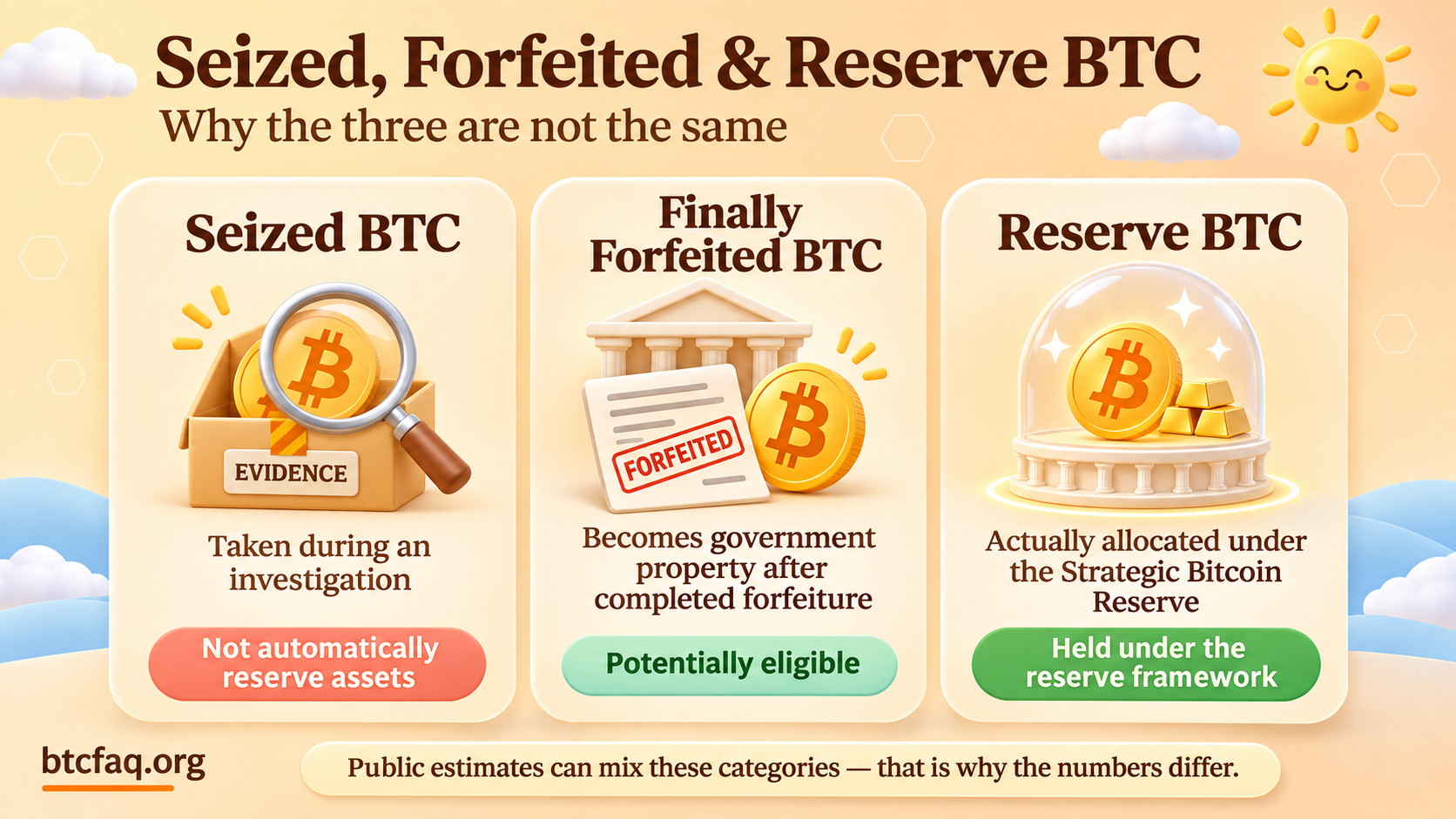
Seized, Forfeited and Reserved BTC: Three Different Categories
This distinction matters more than any large headline number.
| Category | What it means | Automatically in the reserve? |
|---|---|---|
| Seized BTC | Bitcoin taken into government control during an investigation or legal proceeding | No; ownership and restitution issues may remain unresolved |
| Finally forfeited BTC | Bitcoin that has become government property through a completed legal forfeiture | Potentially eligible, subject to the order and statutory requirements |
| Reserve BTC | Qualifying BTC administered under the Strategic Bitcoin Reserve framework | Yes, when actually allocated under that framework |
For example, US court proceedings involving approximately 127,271 BTC tied to the Prince Group were still active in September 2026. The case involves competing legal claims and an ongoing civil forfeiture action. Those coins cannot simply be added to a confirmed reserve balance on the assumption that the forfeiture is already final.
The 2022 Bitfinex-related recovery of approximately 94,636 BTC is another major government Bitcoin case, but the same principle applies: custody, title, victim restitution and reserve eligibility are distinct questions.
How Much Bitcoin Does the US Government Actually Hold?
The honest answer is that publicly cited government wallet estimates are not a verified official reserve accounting.
The Block's September 17, 2026 update discusses estimates ranging from roughly 200,000 to 328,000 BTC, while parts of the article cite approximately 330,000 BTC. These are estimates based on tracking identifiable government-associated wallets and cases; they are not a published, comprehensive Treasury audit of coins legally owned and deposited into the reserve.
Why do the figures disagree? Blockchain trackers can group addresses differently. Court cases may be unresolved. Assets can be earmarked for restitution. Some wallets may be unattributed, reclassified or moved. And a tracked government-associated address is not necessarily a reserve custody account.
For scale only, 328,372 BTC equals about 1.56% of Bitcoin's 21 million maximum supply. That arithmetic is correct; it does not make 328,372 BTC an official reserve balance.
What to watch: a Treasury accounting that clearly separates seized assets, finally forfeited assets, restitution obligations, transfers between agencies and BTC actually administered as reserve assets.
Where Did the Bitcoin Come From?
Historically, the federal government acquired large quantities of BTC through cases such as Silk Road and the Bitfinex recovery, rather than a planned investment strategy. The Prince Group case illustrates how large seized balances may still be tied up in litigation.
This history is central to the debate. Supporters argue that automatically selling forfeited Bitcoin may sacrifice potential long-term gains if the asset appreciates. Critics respond that governments should not use hindsight about volatile markets to justify speculative public-asset management.
The White House's fact sheet on the reserve presents previously sold government BTC as a missed opportunity. That is the administration's policy argument, not proof that holding every forfeited coin indefinitely would always have produced the best fiscal outcome.
Germany provides a much-discussed comparison: officials sold nearly 50,000 BTC in 2024. The sales provide a real-world reference point, but looking at later BTC prices does not fully capture the original legal, fiscal or political considerations behind selling.
Has the US Government Bought New Bitcoin for the Reserve?
The executive order directs Treasury and Commerce to develop strategies for acquiring additional BTC that are budget neutral and impose no incremental taxpayer costs. It does not require immediate market purchases, appropriate a fixed purchase budget or establish an automatic monthly buying schedule.
The Block's September 2026 explainer said there was no confirmed open-market purchase as of its cited July snapshot. I could not independently verify a subsequently completed federal open-market purchase program from official disclosures available during this November 17 review. Therefore, it is more accurate to say no confirmed purchase was established by the sources reviewed than to claim categorically that none could have occurred.
One floated financing idea involves revaluing government gold certificates, whose statutory accounting price has historically been $42.22 per troy ounce, and using a related financial mechanism to support acquisition. That remains a proposal requiring legal, accounting and economic scrutiny, not proof of free money or an executed transaction.
Where Does the Reserve Stand in November 2026?
| Date | Verified milestone | Why it matters |
|---|---|---|
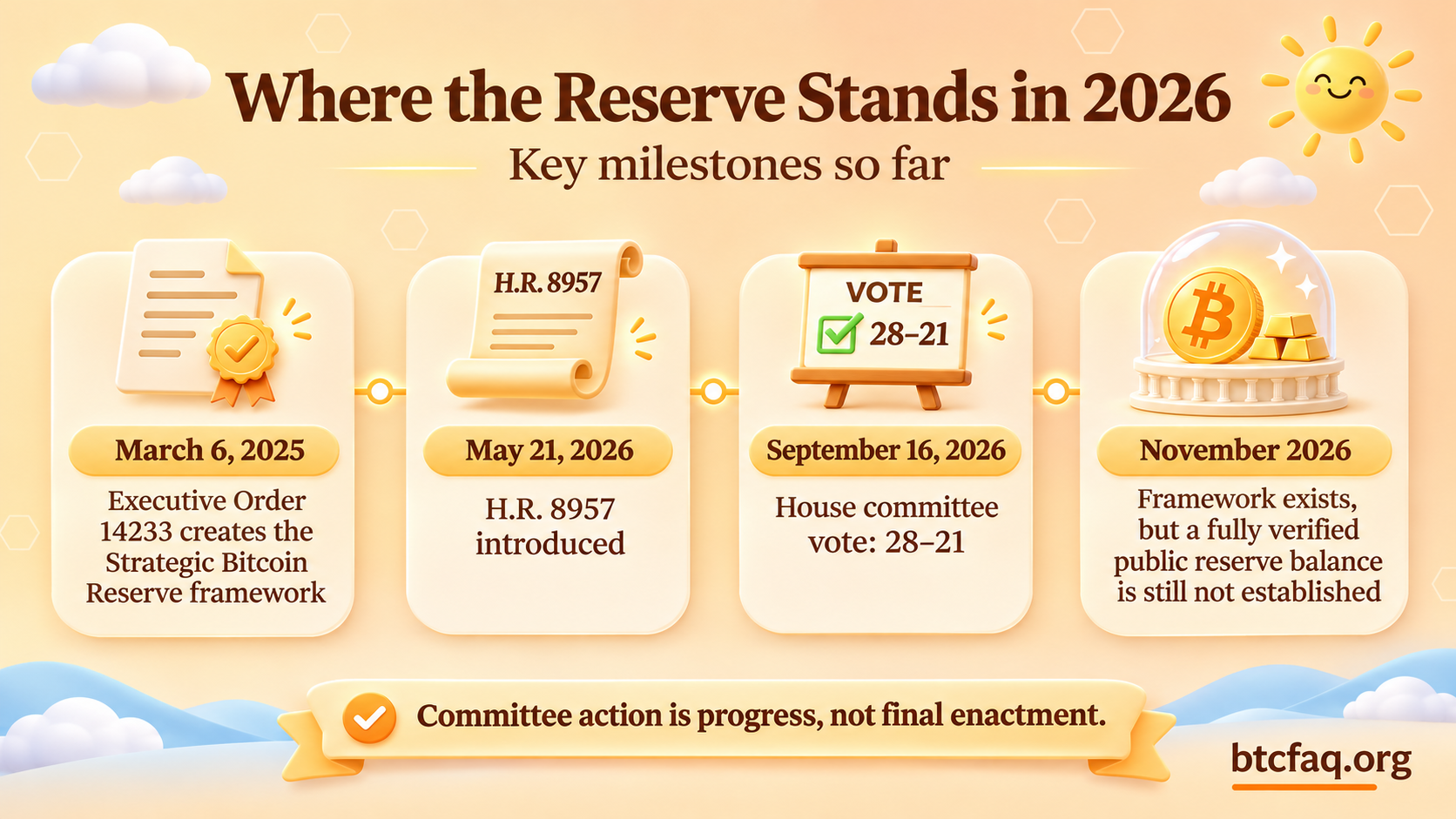
| March 6, 2025 | Executive Order 14233 establishes the reserve and digital-asset stockpile framework | Creates federal executive policy |
| July 2025 | White House digital-assets working-group report discusses the reserve | Provides additional administration policy context |
| May 21, 2026 | H.R. 8957, the American Reserve Modernization Act, introduced | Opens a legislative path |
| September 16, 2026 | House Financial Services Committee votes 28–21 to order H.R. 8957 reported as amended | Advances legislation; does not make it law |
| November 17, 2026 | The executive-order framework remains the verified basis discussed here | Public reserve accounting and any new acquisition program require separate confirmation |
The reported committee action is reflected in legislative tracking for H.R. 8957 and corroborated by an SEC filing discussing the September vote.
What Is the BITCOIN Act?
The BITCOIN Act associated with Senator Cynthia Lummis is a separate legislative proposal that has contemplated a much more active federal acquisition program, including a widely cited framework of up to 200,000 BTC annually for five years, or one million BTC in total, with lengthy holding restrictions.
That is a proposal, not an existing Treasury purchasing mandate. Legislative drafts and amendments can change, and the latest text—not a summary of an earlier version—should control any specific numerical claim. There is no basis to present the one-million-BTC target as already funded, enacted or guaranteed.
What Is the American Reserve Modernization Act?
The American Reserve Modernization Act of 2026 (H.R. 8957) was introduced in the House on May 21, 2026 by Representative Nick Begich and co-sponsors. It seeks to establish a statutory reserve structure and address transparent federal management and reporting of Bitcoin holdings.
The House Financial Services Committee voted on September 16, 2026 to order the bill reported as amended, 28–21. That is further progress than the original article described. However, a committee vote is not passage by the House, Senate or president. Consult the subsequent official legislative record and amended bill text before publishing any detailed claim about the final scope of acquisitions, audits or financing.
The Case for a US Bitcoin Reserve
Supporters advance several arguments. First, Bitcoin's capped supply makes it attractive to some as a scarce long-term asset. Second, holding already-forfeited BTC rather than selling it might preserve upside if prices appreciate. Third, consolidating custody and maintaining an inventory could improve accountability and reduce inconsistent handling across agencies. Fourth, they believe the reserve signals long-term US engagement with digital assets and may encourage further policy clarity.
These are substantive arguments, but each depends on assumptions. Scarcity does not guarantee higher prices, and centralization improves security only if custody controls and oversight are strong.
The Case Against a US Bitcoin Reserve
Critics emphasize volatility, because Bitcoin can experience large drawdowns that complicate public balance-sheet management. They also raise governance and legal concerns: a presidential executive order may be revised, and the rationale for holding seized assets is different from the rationale for buying more with public resources.
Security is another concern. Large concentrated holdings create a valuable target; public reporting about government digital-asset custody illustrates why secure key management, clear authorization and auditability matter. Finally, even a strategy described as budget neutral can involve opportunity costs or financial trade-offs that deserve public scrutiny.
Neither argument proves that Bitcoin should or should not be held in the reserve. The useful questions are what assets legally belong there, who has authority to manage them, how the public can verify the balance and what financial risks taxpayers bear.
How Does the US Compare With Other Bitcoin Holders?
A comparison with a publicly reporting investment fund helps show the difference between an audited financial filing and an estimated government wallet balance.
The iShares Bitcoin Trust ETF (IBIT) Form 10-Q filed November 6, 2026 reports 801,033 BTC at September 30, 2026, with a fair value of approximately $67.04 billion. Its per-BTC valuation was about $83,697, and reported net assets were approximately $67.03 billion. The quarterly financial statements are explicitly labeled unaudited, even though the document is a formal SEC filing.
| Comparison | BTC quantity | Status |
|---|---|---|
| IBIT, Sept. 30, 2026 | 801,033 BTC | Reported in SEC Form 10-Q (unaudited interim statements) |
| US-associated BTC estimate | About 328,000 BTC | External tracking estimate, not an audited Treasury reserve figure |
Using 328,372 BTC solely as an illustration, IBIT's reported Bitcoin balance is approximately 2.44 times larger. This is not a comparison of legal beneficial ownership: an ETF holds BTC on behalf of its shareholders, whereas government holdings come with different legal obligations and political oversight.
Does the Strategic Bitcoin Reserve Affect Bitcoin's Price?
It can affect expectations. Some investors see the no-sale policy as a reduction in potential future government selling. Announcements about possible future purchases could also influence sentiment.
But expected market effects are not guaranteed. The reserve does not directly change Bitcoin's 21-million-coin supply limit, network issuance schedule or transaction-validation rules. Nor does the executive order itself prove that a new government buyer has entered the market.
The most useful evidence to follow is verified transfers, legal forfeiture status, Treasury disclosures, official acquisition announcements and enacted legislation, rather than viral estimates of how much the government might buy.
What Does It Mean for Bitcoin Miners?
For miners, federal Bitcoin policy is an important background issue, but it does not directly determine mining revenue or electricity costs. A mining business still depends on Bitcoin's market price, network difficulty, transaction fees, hardware efficiency, uptime and the actual all-in cost of power.
OneMiners' July 2026 analysis, Trump's Crypto Billions 2026: Time to Mine?, makes a practical point: pro-Bitcoin political headlines do not automatically make mining profitable. That is the part worth carrying into this guide. Political announcements might influence sentiment or investment decisions, but a miner still needs realistic operating margins.
This is where OneMiners' focus on ASIC equipment, hosting locations, cooling and electricity-rate comparisons can be useful for miners deciding whether their operation remains viable through price swings. The right comparison is not simply the lowest advertised cents per kWh: it is the written rate, any prepaid commitment, applicable service and repair charges, equipment compatibility, uptime terms and projected income under weaker hashprice conditions. Explore OneMiners' hardware and hosting services for current offerings, with published terms confirmed before purchase.

For a clear explanation of the revenue-versus-profit distinction, Cassy Soriano's Bitcoin Mining Revenue Hits Its Best Month Since January: Is Mining Profitable Again? explains why a strong industry revenue month is not automatically a profitable month for every miner. The Medium article is accessible and relevant to this discussion.
My takeaway for miners: treat the Strategic Bitcoin Reserve as a policy development to monitor, not a substitute for a realistic profitability calculation. Low and predictable operating costs can help a miner manage risk, but neither hosting nor a government reserve guarantees returns.
Five Questions Worth Following Next
- 1. Will Treasury publish a complete reserve accounting? Look for an explicit distinction between seized, finally forfeited and reserve-held BTC.
- 2. Will a budget-neutral acquisition method be publicly announced and executed? A proposal is not a completed purchase.
- 3. Will Congress enact reserve legislation? Track the BITCOIN Act proposals and H.R. 8957, including amended text.
- 4. How will victim restitution and custody oversight work? Both affect what coins may legally be retained.
- 5. Will policy developments change actual mining economics? Watch price, hashprice, difficulty, power rates and uptime rather than assuming political announcements produce profit.
Frequently Asked Questions
What is the US Strategic Bitcoin Reserve? A federal policy framework established by executive order on March 6, 2025, for eligible government-owned, finally forfeited Bitcoin to be administered as a long-term reserve asset.
Is the US government buying Bitcoin? The order authorizes development of budget-neutral acquisition strategies. The sources reviewed for this November 17 update did not establish a confirmed open-market purchase program. That is different from proving no purchase could have occurred.
How much BTC is in the reserve? A complete publicly verified Treasury reserve balance was not established by the sources reviewed. Roughly 200,000–328,000 BTC are outside estimates of government-associated holdings, not a certified reserve total.
Are seized Bitcoins automatically reserve assets? No. Final forfeiture, victim claims, applicable law and actual reserve allocation all matter.
Can the government sell reserve Bitcoin? The order states that Bitcoin deposited in the reserve shall not be sold. Its broader government-asset provisions include legally defined exceptions, and future executive or legislative actions could change the policy.
Is the Strategic Bitcoin Reserve permanent law? No. Its verified foundation is an executive order; congressional proposals would create statutory rules if enacted.
What is the BITCOIN Act? A legislative proposal associated with Senator Cynthia Lummis that has contemplated a large multi-year federal Bitcoin acquisition strategy. The numerical target and details depend on the version of the bill.
What is H.R. 8957? The American Reserve Modernization Act of 2026. It was introduced in May 2026 and advanced after a House committee vote in September, but committee approval is not enactment.
Does the reserve make Bitcoin legal tender? No. Holding a government reserve asset and making an asset legal tender are distinct legal decisions.
Could the US control Bitcoin by holding a large balance? Owning coins does not, by itself, confer authority to change Bitcoin's consensus rules or direct the decentralized network.
Does the reserve make mining more profitable? Not directly. Miners must still account for block rewards, fees, difficulty, electricity, equipment costs and downtime.
The Bottom Line
The US Strategic Bitcoin Reserve is a real federal policy, but the details are more limited—and more legally complicated—than many headlines imply. The March 2025 order creates a framework for holding eligible government Bitcoin, restricts sales of reserve BTC and directs officials to explore budget-neutral ways of acquiring more. It does not itself establish a million-BTC purchasing program or prove that every seized coin has entered the reserve.
The next milestones to watch are official reserve accounting, the outcome of forfeiture proceedings, any confirmed acquisition program and congressional legislation. These would tell us much more than speculation about government wallet addresses.
For Bitcoin holders, that means separating confirmed policy from market expectations. For miners, it means remembering that favorable government headlines are not a substitute for equipment efficiency, affordable electricity and dependable operations. That is where practical resources from OneMiners and independent mining research can be most useful.
Disclaimer: This article is for educational purposes only and does not provide financial, legal, tax or political advice. Government holdings, court cases and legislation can change. Verify important developments using primary official records.
Sources and Further Reading
- • White House — Executive Order Establishing the Strategic Bitcoin Reserve (March 6, 2025)
- • White House — Strategic Bitcoin Reserve Fact Sheet
- • The Block — What Is the US Strategic Bitcoin Reserve? (updated September 17, 2026)
- • US Court Filing — Approximately 127,271 BTC Civil Forfeiture Proceedings
- • H.R. 8957 — American Reserve Modernization Act (introduced bill)
- • H.R. 8957 — Legislative Action and September 2026 Committee Vote
- • SEC — iShares Bitcoin Trust ETF Form 10-Q, Sept. 30, 2026
- • OneMiners — Trump's Crypto Billions 2026: Time to Mine?
- • OneMiners — Hardware and Hosting
- • Medium — Bitcoin Mining Revenue Hits Its Best Month Since January
#Bitcoin #StrategicBitcoinReserve #BitcoinPolicy #BitcoinMining #OneMiners #USBitcoinReserve #CryptoNews #ASICMining