For more than a decade, Bitcoin has been called digital gold. Both assets attract people who are concerned about currencies losing purchasing power. Both have supply constraints, and both can be held outside a conventional bank account. But they behave very differently when markets are under stress.
In 2026, that difference has been hard to miss. Gold has experienced its own significant sell-off, but Bitcoin has generally suffered deeper drawdowns. So is Bitcoin's store-of-value argument falling apart—or are we asking two very different assets to do the same job?
I looked at research from Fidelity Digital Assets, Coin Bureau, State Street, the World Gold Council, and OneMiners. My conclusion is simple: gold has the longer record of protecting purchasing power during crises; Bitcoin has a different, higher-risk growth and scarcity case. Which is better depends on the job you need it to do.
This article is for education, not personalized financial, legal or tax advice. Market figures are dated snapshots, not live quotations.
Key Takeaways
- • Gold has the stronger defensive record. Its demand comes from investors, central banks, jewelry and industry, and it has generally been less volatile than Bitcoin.
- • Bitcoin has the stricter programmed issuance schedule. Its widely adopted rules cap issuance at 21 million BTC, although a protocol's rules are maintained by its participants rather than enforced by nature.
- • Bitcoin's long-run price gains have been enormous, but so have its drawdowns. Recent gold outperformance does not erase Bitcoin's ten-year history, and that history cannot promise future returns.
- • The market-size gap is wider than older articles suggest. At the November 16, 2026 prices used below, above-ground gold is worth roughly $27.8 trillion versus approximately $1.3 trillion of issued BTC—an illustrative ratio near 21.5 to 1.
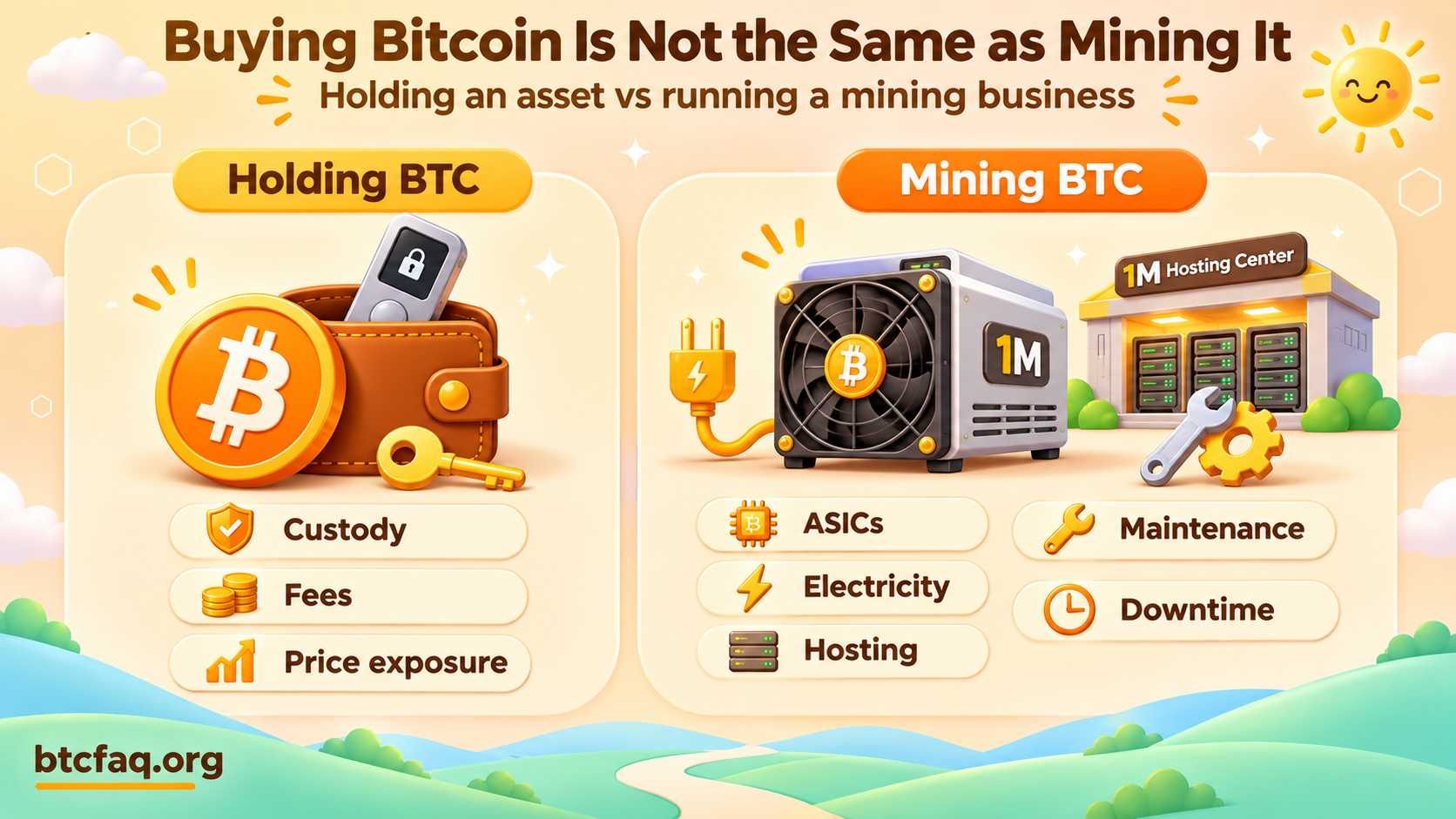
- • Mining Bitcoin is not the same as holding Bitcoin. A mining business has equipment, electricity, hosting, maintenance, downtime and financing costs.
What Makes Something a Store of Value?
A store of value should preserve useful purchasing power across the time period that matters to its owner. Scarcity helps, but it is not enough. Demand, market liquidity, ease of sale, custody, durability and price stability also count.
That definition immediately explains why people disagree. Someone protecting an emergency fund may care deeply about a 40% drawdown over six months. Someone thinking about monetary scarcity over ten years may pay more attention to the issuance schedule. Neither perspective makes the other irrelevant.
Gold has a long history as money, jewelry, investment collateral and a central-bank reserve asset. Bitcoin has operated since 2009 as a decentralized digital asset with publicly verifiable ownership and monetary rules. Bitcoin can be transferred without moving metal, but successful self-custody requires competent key management. Gold can be stored without an internet connection, but physical storage, insurance and transport also have costs.
Bitcoin vs. Gold: The Structural Differences
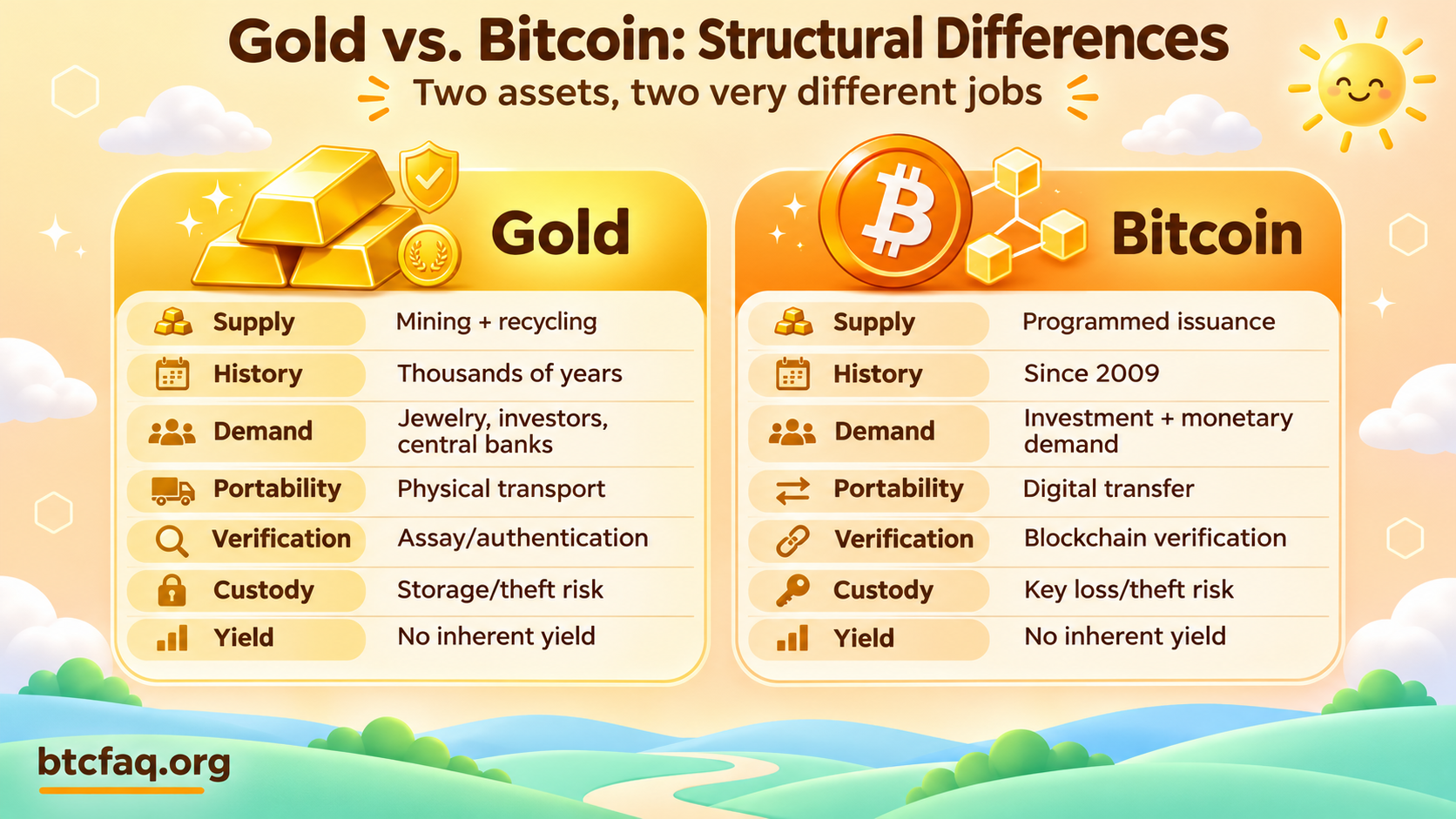
The OneMiners Bitcoin-versus-gold guide provides a useful introduction to scarcity, portability, verification and mining. Independent sources add important context about historical risk and demand.
| Feature | Gold | Bitcoin |
|---|---|---|
| Supply | Existing stock grows through mining and recycling; extraction responds gradually to economics | Protocol issuance follows a known schedule, with a widely accepted 21 million BTC cap |
| History | Thousands of years of monetary and nonmonetary use | Live since 2009 |
| Demand | Jewelry, investment, industry and central banks | Predominantly investment and monetary demand, plus some payment and network use |
| Portability | Physical transfer requires transport and custody arrangements | Digital settlement is possible across borders, subject to network, legal and access constraints |
| Verification | Physical authentication and assay can be needed | Ownership and supply can be checked against the blockchain |
| Divisibility | Bars and coins can be subdivided, but at a practical cost | One BTC equals 100 million satoshis |
| Custody risks | Theft, counterfeit products, storage and intermediary risks | Lost or stolen keys, phishing, software/hardware failures and intermediary risks |
| Yield | No inherent yield from holding physical bullion | No inherent yield from simply holding BTC; mining is a separate business |
One nuance matters: Bitcoin's fixed supply is a rule supported by broad network consensus, not a promise that software can never be changed by anyone under any circumstances. Likewise, gold's supply is constrained but not perfectly fixed; existing gold can be recycled and new gold can be mined.
How Big Is Gold Compared With Bitcoin in November 2026?
Older comparisons often cite gold at $18–20 trillion and Bitcoin near $2 trillion. Those figures are no longer a reliable description of November 2026.
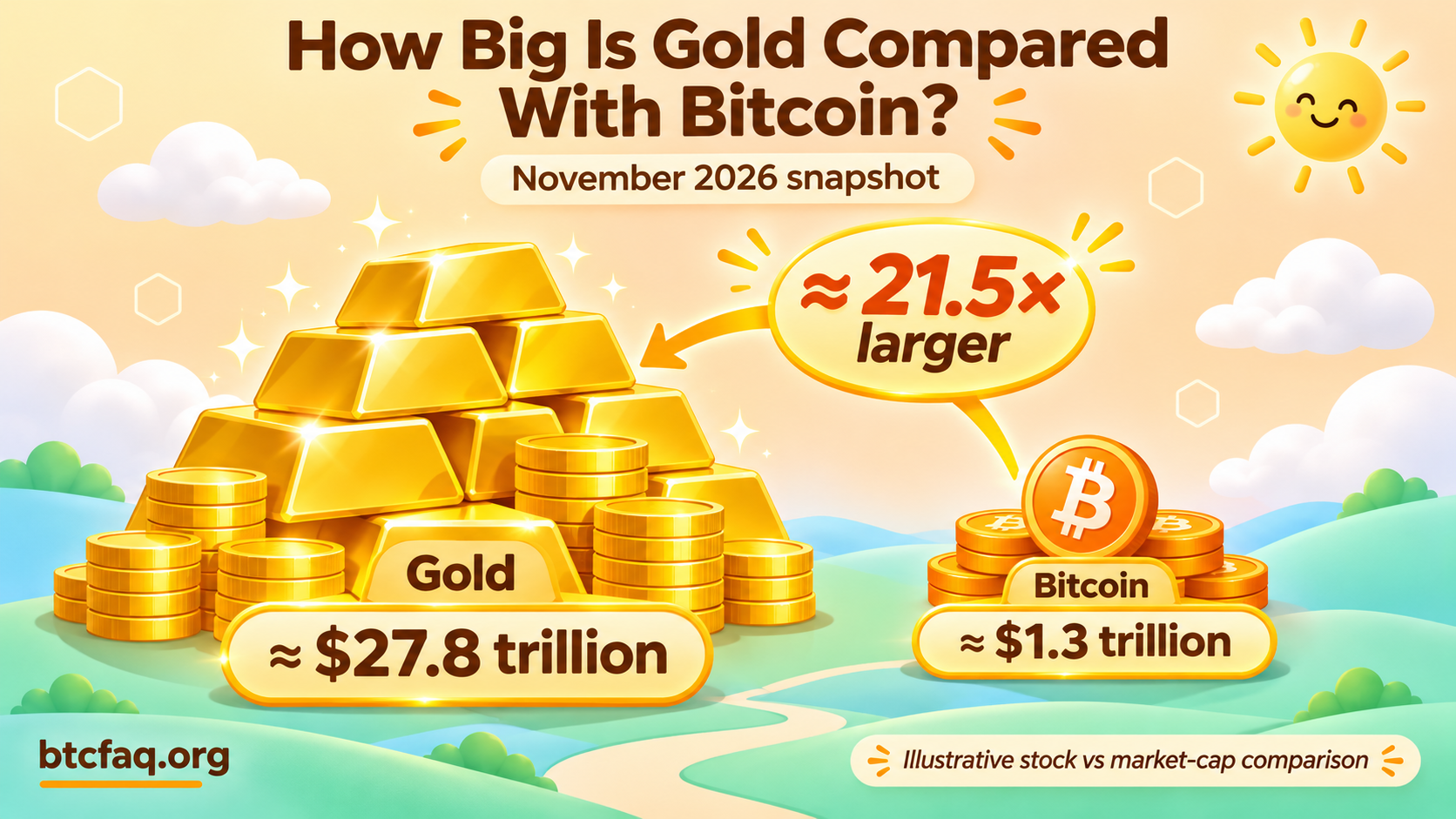
The World Gold Council's updated above-ground stock estimate is approximately 224,200 metric tonnes at the end of Q3 2026. Using a November 16 gold price of about $3,858.40 per troy ounce, reported by Reuters, that represents approximately $27.8 trillion in above-ground gold. This is a rough stock-times-spot-price estimate; it does not mean all that gold is available for sale.
On the Bitcoin side, a November 15 circulating-supply reading was about 20.11 million BTC. Applying the approximately $64,300 BTC price reported around November 16, gives roughly $1.3 trillion in Bitcoin market capitalization.
| Approximate comparison | Gold | Bitcoin |
|---|---|---|
| Stock / issued supply | 224,200 tonnes | 20.11 million BTC |
| November price assumption | $3,858/oz | $64,300/BTC |
| Implied total market value | $27.8 trillion | $1.3 trillion |
Gold's estimated stock value is roughly 21.5 times Bitcoin's implied market cap under these assumptions. The comparison is imperfect: a gold-stock valuation is not constructed exactly like an exchange-traded crypto market cap. Prices change constantly, and neither figure represents money that would actually flow into the asset if demand rose.
If Bitcoin's issued supply were held constant, matching $27.8 trillion would correspond to roughly $1.38 million per BTC. That's a mathematical thought experiment, not a forecast or a price target. Supply, gold prices and demand would all change over time.
What the 2026 Performance Data Actually Shows
A good comparison uses matching start and end dates. Mixing a July BTC quote with a November gold quote can make either asset look better or worse than it was.
Coin Bureau's September 18 research update provides synchronized data through September 17, 2026:
| Period ending Sept. 17, 2026 | Gold return | Bitcoin return |
|---|---|---|
| 2026 year-to-date | −0.81% | −12.83% |
| Trailing one year | +16.20% | −34.71% |
| Trailing three years | +122.91% | +187.48% |
| Trailing five years | +144.41% | +61.27% |
| Trailing ten years | +227.34% | +12,372.52% |
These results explain why time horizons matter. Gold led over one and five years in that dataset. Bitcoin led over three and ten years, with its early-period growth heavily influencing the longest comparison.
By November 16, both markets had moved materially again. Reuters reported gold near $3,858, and Bitcoin traded near $64,000 after a sharp weekend decline. These November prices update the market-size illustration; they do not replace the synchronized September performance table with a new year-to-date calculation.
Volatility, Drawdowns and the Real Meaning of Risk
The same Coin Bureau comparison reports the following risk statistics for the trailing-year period ending September 17, 2026:
| Measure | Bitcoin | Gold |
|---|---|---|
| Annualized volatility | 36.95% | 25.31% |
| Maximum drawdown | −53.08% | −26.61% |
Gold was less volatile in that comparison, but 25% annualized volatility is not calm. Gold can suffer deep losses. Bitcoin's historical losses have been steeper, including several earlier bear-market drawdowns exceeding 70%.
Recovery math makes the difference vivid. After a 26.61% loss, an asset needs approximately a 36.3% gain to return to its starting value. After a 53.08% loss, the required gain is approximately 113.1%. That is why the path matters even if an investor expects long-term appreciation: selling during a drawdown can permanently lock in a loss.
A low correlation to stocks can also be useful. State Street's October discussion reports gold's long-run monthly correlation of 0.03 with the S&P 500 under its specified historical window. These are historical measurements, not guarantees that gold will rise during every future market sell-off.
Which Has Been the Better Safe Haven?
If “safe haven” means an asset that tends to protect capital during sudden market stress, gold has more evidence behind it. State Street argues that gold's multiple sources of demand and central-bank role help it behave differently from stocks and other risk assets. Its article also argues that Bitcoin remains too volatile and investment-demand-driven to provide comparable historical diversification during downturns.
That is a serious case, but it should be read with attribution: State Street offers gold investment products and therefore has a commercial interest in gold's investment role. Its research is still useful when the methodology and dates are clear.
Bitcoin supporters counter that gold's supply responds to price over time while Bitcoin's issuance schedule does not. Bitcoin is easier to move and verify digitally, and some buyers value holding an asset directly instead of relying on banks or physical vaults. Those are real differences. They do not prove that Bitcoin will act as a safe haven during the next liquidity shock.
The fairest summary is this: gold has a longer defensive track record; Bitcoin has a stronger fixed-issuance and digital-portability proposition, with much greater demonstrated market risk.
Fidelity's “Bitcoin Priced in Gold” Signal
One useful approach is to price Bitcoin in ounces of gold, rather than always measuring both in U.S. dollars. That tells you whether Bitcoin is gaining or losing ground against another scarce asset.
In its Q2 2026 Signals Report, with chart data through March 31, Fidelity Digital Assets marked Bitcoin Priced in Gold as a negative investment-thesis signal. But the report also noted a narrower period when BTC gained about 4% in dollars and roughly 19% measured in gold, suggesting that gold's earlier outperformance might be moderating. The percentages refer to that period—not all of 2026.
Fidelity's more cautious point is important: short-term price action can put Bitcoin's store-of-value argument under pressure without conclusively settling its long-term merits. That is a better reading of the evidence than declaring that one bad period has permanently disproved “digital gold.”
As another dated reference, the BTC-to-gold ratio was around 16.6 ounces per BTC on November 16, 2026, according to MetalAPI. It changes as both markets move.
Inflation Protection: Neither Asset Is Automatic
It is tempting to think that inflation always sends both gold and Bitcoin higher. Markets are more complicated.
Gold has a long history as a hedge against monetary uncertainty, but rising real interest rates can hurt it because bullion produces no interest income. A strong U.S. dollar can also weigh on gold prices. Bitcoin has fixed issuance, but its price is sensitive to global liquidity, leverage, regulatory developments and the appetite for risk.
That is why Coin Bureau cautions that neither asset is a reliable month-to-month inflation tracker. The long-term argument against currency debasement should not be confused with a promise to rise whenever a monthly inflation report is hot.
Costs, Custody and Taxes
Neither asset is free to own or risk-free to secure.
With physical gold, buyers may face a dealer premium, storage, insurance, transport or authentication costs. Gold ETFs can make trading simpler but bring fund fees and an intermediary.
With Bitcoin, direct holders must protect private keys and backups, and they may pay transaction or exchange fees. Custodial platforms introduce counterparty risk. Spot Bitcoin exchange-traded products provide another ownership route, but the investor owns fund shares rather than directly controlling the underlying BTC.
Tax treatment also depends on jurisdiction and vehicle. In the United States, physical gold bullion may be subject to the collectibles rules, while Bitcoin generally follows property-tax principles. ETF treatment, holding periods and individual circumstances can change the calculation. These differences deserve professional advice rather than a blanket rule for every reader.
What Does Bitcoin Mining Add to the Comparison?
Gold and Bitcoin are both produced, but buying Bitcoin and operating a Bitcoin miner are different economic decisions.
A gold investor can buy and hold bullion without running a mine. Likewise, a Bitcoin investor can buy and hold BTC without paying for ASIC equipment. Bitcoin miners invest in computing hardware and electricity to compete for block rewards and transaction fees. The number of BTC they receive depends on their effective hashrate, overall network competition, pool terms and uptime. That revenue does not automatically translate into profit.
This is where OneMiners has a practical role in the story. Its Bitcoin vs. Gold guide explains why Bitcoin's known supply schedule makes mining interesting to some buyers. OneMiners also offers ASIC equipment and managed hosting options, potentially helping miners compare hardware efficiency, cooling requirements, electricity costs and operational support before committing to a site.
That is a valuable distinction: hosting can simplify some operational work and improve cost visibility, but it does not guarantee positive returns or make mining equivalent to earning interest on Bitcoin. Advertised electricity rates, service levels, warranties and long-term prepaid offers should be checked in a current written quote.
For a grounded explanation of the difference between industry revenue and individual profitability, Cassy Soriano's Medium article, Bitcoin Mining Revenue Hits Its Best Month Since January: Is Mining Profitable Again?, explains how hashprice and electricity cost affect the economics of an individual ASIC. It is a useful companion to a discussion of Bitcoin as an investment asset.
My view: If your goal is simply exposure to Bitcoin's price, compare direct ownership and its custody costs with the full cost of mining. Mining may be attractive under the right equipment and electricity conditions, but it is an operating business—not a free source of yield.
Six Things I Take Away from This Comparison
1. Define your goal before choosing a winner. Preserving wealth through a market shock is different from pursuing long-run growth.
2. Look at matching dates. A November gold quote and a July Bitcoin price do not make a fair annual performance comparison.
3. Respect drawdowns. A theoretically excellent long-term asset may still be wrong for someone who needs the money next year.
4. Separate scarcity from demand. Bitcoin's predictable issuance is a meaningful design feature, but a supply limit alone cannot determine market price.
5. Account for ownership costs. Physical storage, ETF fees, private-key security and the operating expenses of mining can all alter the result.
6. Be aware of commercial interests. Gold-fund managers, crypto research publishers and mining hosts can all provide useful information. Their incentives are still worth understanding.
Frequently Asked Questions
Is Bitcoin better than gold as a store of value? It depends on what you need. Gold has a longer defensive history and lower measured volatility in the cited studies. Bitcoin has delivered larger long-run gains but much deeper price declines.
Is Bitcoin really digital gold? The comparison works for scarcity and some monetary properties, but it is incomplete. Bitcoin has not consistently behaved like gold during severe market stress.
Which performed better in 2026? In Coin Bureau's synchronized data through September 17, gold was down 0.81% year-to-date and Bitcoin was down 12.83%. Both moved considerably after that date; those figures should not be described as November results.
How large is gold compared with Bitcoin? Using the World Gold Council's end-Q3 estimate of above-ground gold and November 16 price assumptions, gold's implied stock value is approximately $27.8 trillion versus around $1.3 trillion for issued Bitcoin, a rough ratio of 21.5 to 1.
Does gold always rise when stocks fall? No. Gold has a strong historical diversification case, but it can still decline when investors need cash or when real yields rise.
Does Bitcoin always protect against inflation? No. Fixed issuance does not guarantee short-term protection against inflation or market sell-offs.
Can Bitcoin ever reach gold's total market value? The question can be modeled mathematically, but no demand or price outcome is guaranteed. The roughly $1.38 million-per-BTC parity illustration in this article is not a prediction.
Is buying an ASIC miner the same as buying BTC? No. An ASIC produces mining revenue under uncertain network conditions and incurs hardware and electricity expenses. Direct BTC ownership involves different risks and costs.
How can OneMiners help someone considering mining? It offers ASIC equipment, hosting options and mining-economics educational materials that can help customers compare electricity, efficiency and operational requirements. Always verify the current written terms.
Can I hold both Bitcoin and gold? Yes. They can serve different purposes in a portfolio, subject to personal risk tolerance, time horizon, fees and tax circumstances.
The Bottom Line
If you need a cleaner historical record of defensive value preservation, gold has the stronger evidence. If you are attracted to a transparent issuance schedule, digital self-custody and the possibility of long-term appreciation—and can withstand severe drawdowns—Bitcoin presents a different proposition.
I would not pretend either asset is a perfect shield. Gold can fall sharply. Bitcoin's fixed supply does not make its price stable. And mining Bitcoin requires an extra layer of business decisions that holding BTC does not.
The most useful question is not simply Which one is better? It is What risk am I trying to manage, over what time frame, and what will owning this asset actually cost me?
Sources and Further Reading
- • Bitcoin vs Gold 2026: Key Differences for BTC — OneMiners
- • Bitcoin Mining Revenue Hits Its Best Month Since January: Is Mining Profitable Again? — Cassy Medium
- • Cryptocurrency vs Gold — Coin Bureau
- • Signals Report Q2 2026 — Fidelity Digital Assets
- • Gold: A Distinct and Independent Asset Class — State Street
- • How Much Gold Has Been Mined? — World Gold Council
- • Gold Price on November 16, 2026 — Reuters
- • Bitcoin Price on November 16, 2026 — Barron's
- • Bitcoin Circulating Supply — Axel Adler Jr.
- • Bitcoin Priced in Gold — MetalAPI
- • OneMiners: ASIC Equipment and Hosting
Editorial data check: November 17, 2026. All comparisons are historical or illustrative and should not be interpreted as a current trading quote.