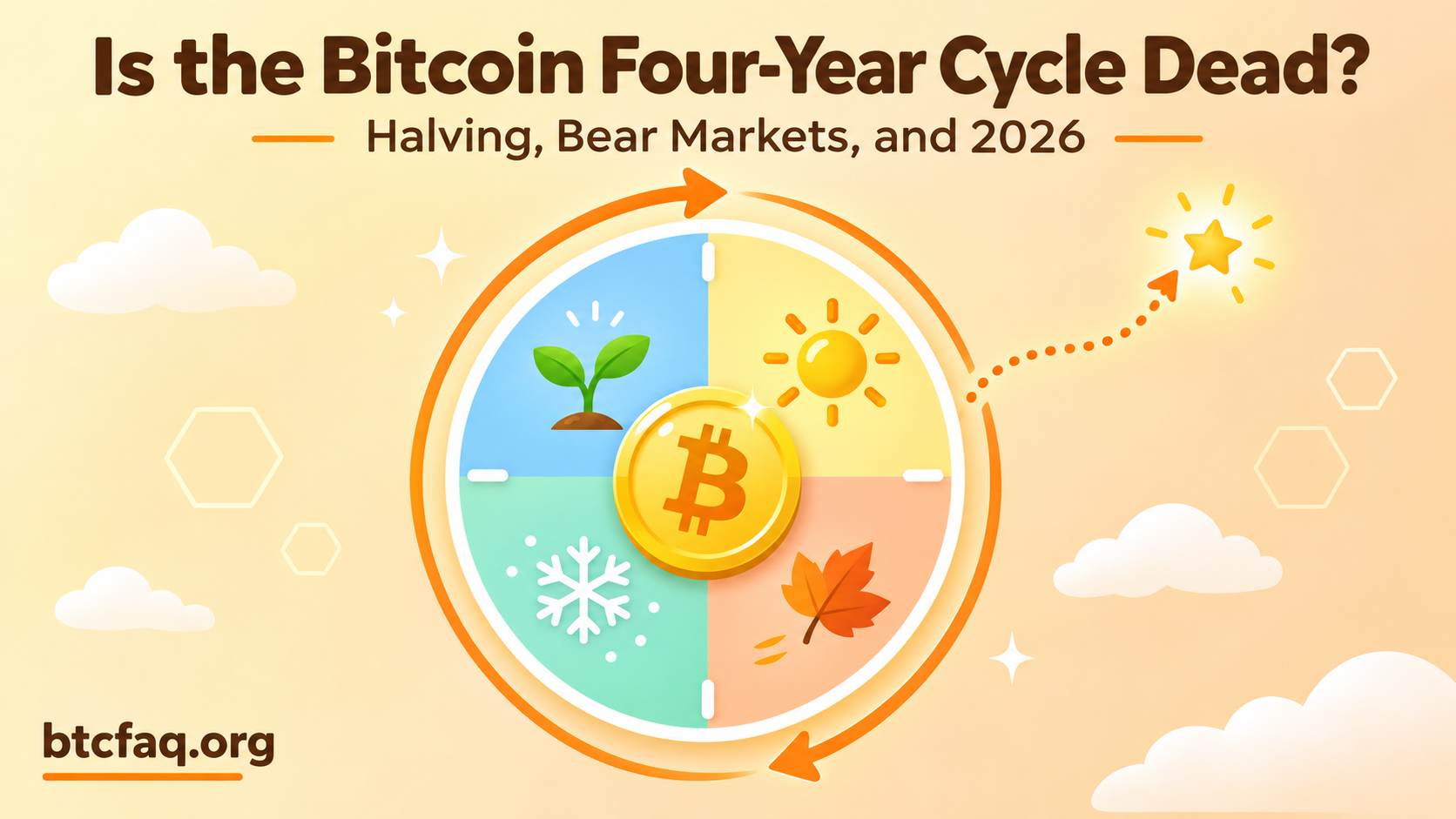
For more than a decade, Bitcoin watchers have used the same simple map: a halving, a roaring bull market, a peak, a painful bear market, a bottom, and then it starts again. People call it the four-year cycle, and it's been so popular that traders plan around it.
Then 2024 and 2025 complicated that story. US spot Bitcoin exchange-traded products launched, institutional participation grew, the October 2025 peak looked less euphoric than previous peaks, and the drawdown measured by mid-2026 was shallower than the major bears of earlier cycles. Naturally, a new question took over timelines and comment sections: is the four-year cycle dead?
In this guide, I’ll explain the halving schedule, compare the arguments from Galaxy, Grayscale, Schwab, and Bitwise, and distinguish their historical research from November 2026 market data. I’ll also explain why ASIC efficiency and electricity pricing still matter for miners, including those evaluating OneMiners equipment and hosting.
This article is educational, not financial advice. Nobody can predict Bitcoin's price, and the scenarios discussed are illustrations, not forecasts. Consider speaking with a qualified professional before making financial decisions.
The Short Answer
- • The halving itself isn't going anywhere. It's built into Bitcoin's code. The next one is expected around 2028.
- • The price cycle is the debated part. Some researchers say it's intact but weaker, some say Bitcoin is now a macro asset, and some say the pattern may never have been a law of nature.
- • The drawdown measured in June 2026 was shallower than earlier major bears. That was a historical observation, not proof that the bear market had ended.
- • Nobody knows where the bottom is. Even the best research teams disagree on whether it has already happened.
- • For miners, the halving schedule still matters. The block subsidy is programmed to halve every 210,000 blocks; transaction-fee revenue and Bitcoin’s dollar price are not halved by the protocol.
Let's go through it.
What Is the Four-Year Cycle?
It rests on two things: a schedule and a pattern.
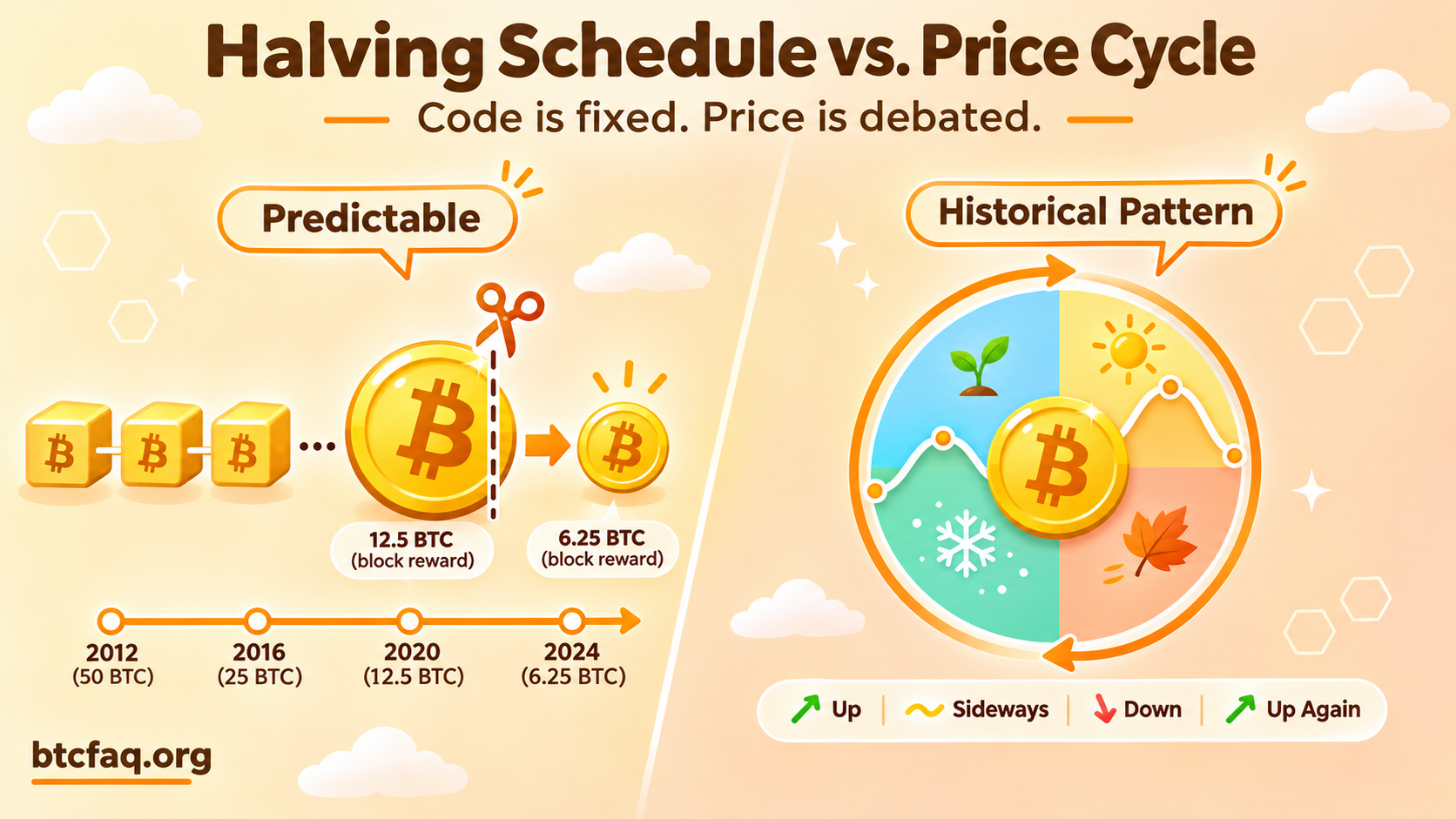
The schedule: Roughly every four years (every 210,000 blocks), the block subsidy is cut in half; transaction fees remain a separate part of miners’ block rewards. The April 2024 halving reduced it from 6.25 to 3.125 BTC. OneMiners’ post-halving mining guide (10 July 2026) says the next one is expected around 2028 at block 1,050,000, cutting the subsidy to 1.5625 BTC. (If you want the basics, see our guide on what a halving is.)
The pattern: Schwab’s article Will the Bitcoin Halving Cycle Persist? (24 June 2026) describes the lore: each halving has been followed by roughly a two-year bull market, a deep bear market in the third year, and modest recoveries in the fourth. In past cycles, peaks have landed roughly 18 to 20 months after the halving. Schwab links that to the median length of major asset bubbles, about 18 months across 13 bubbles over 400 years.
Here's the key point that gets lost: the halving is a rule. The price pattern is an observation. Only a handful of cycles exist to observe, which is why the argument is so heated.
The cycle in numbers
Galaxy Research’s Bitcoin’s Four-Year Cycle: Where Is the Bottom? (12 June 2026, data to 9 June) gives the history in tidy form:
- • Peak-to-trough declines have shrunk each cycle: about 85%, then 84%, then 77%.
- • Each top has been followed by a bottom roughly 12 to 13 months later.
- • The last three tops arrived about 1,060 days after the prior low.
CoinGecko’s analysis How Deep Into the Bear Market Are We? (updated 25 June 2026) uses a different method, any stretch of at least 30 days below the 200-day moving average, and gets slightly different numbers:
| Bear market | Duration (days) | Max drawdown |
|---|---|---|
| 2014–2015 | 321 | −81.6% |
| 2018–2019 | 385 | −83.6% |
| 2019–2020 | 81 | −66.3% |
| 2020 COVID | 52 | −74.4% |
| 2021 mid-cycle | 80 | −52.9% |
| 2022–2023 | 381 | −76.7% |
| 2025–2026 (at the time) | 233+ | −51.2% |
Notice the difference: Galaxy describes the first major drawdown as about 85%, while CoinGecko reports −81.6% for its 2014–2015 episode. Their definitions and data methods differ. CoinGecko’s 2025–2026 row was as of June 24, 2026 and should not be mistaken for a confirmed full-cycle result.
What Happened This Time?
Here's the 2025–26 story as the sources tell it.
- • Bitcoin peaked in October 2025. The exact high differs by source: Galaxy says $124,824 on 6 October 2025; Bitwise cites $126,080; the OneMiners articles I read cite about $126,000 to $126,500. CoinGecko uses approximately $124,773 in its June study. These are different historical price series and observation methods, so it is better to report a dated range rather than declare one universally correct high.
- • Galaxy calls the October 2025 peak the calmest top on record: only 2 of 11 magnitude signals fully confirmed, and the Pi Cycle Top indicator, which flagged prior peaks within days, never triggered. It credits institutional buying, including spot ETF inflows, for pulling euphoria forward to early 2024.
- • By the time of the report, the drawdown was about −51%, roughly eight months after the peak. CoinGecko puts the low at about $60,862 on 7 June 2026 (−51.2%), the mildest bear on record at that point.
- • Bitcoin subsequently recovered and retreated again. Hashrate Index’s November 9, 2026 roundup reported spot BTC near $74,624. Compared with CoinGecko’s June 7 reference low of approximately $60,862, that is about 22.6% higher, but still roughly 40% below Galaxy’s October 2025 high. These are cross-source comparisons for perspective, not identical daily-close series.
As of November 9, the picture was a major decline from the October 2025 peak, followed by a partial recovery that had not regained the prior high. The June low had not been proven to be the final cycle bottom. This is consistent with several possible interpretations, not evidence that one forecaster has won the debate.
Four Views on the Cycle
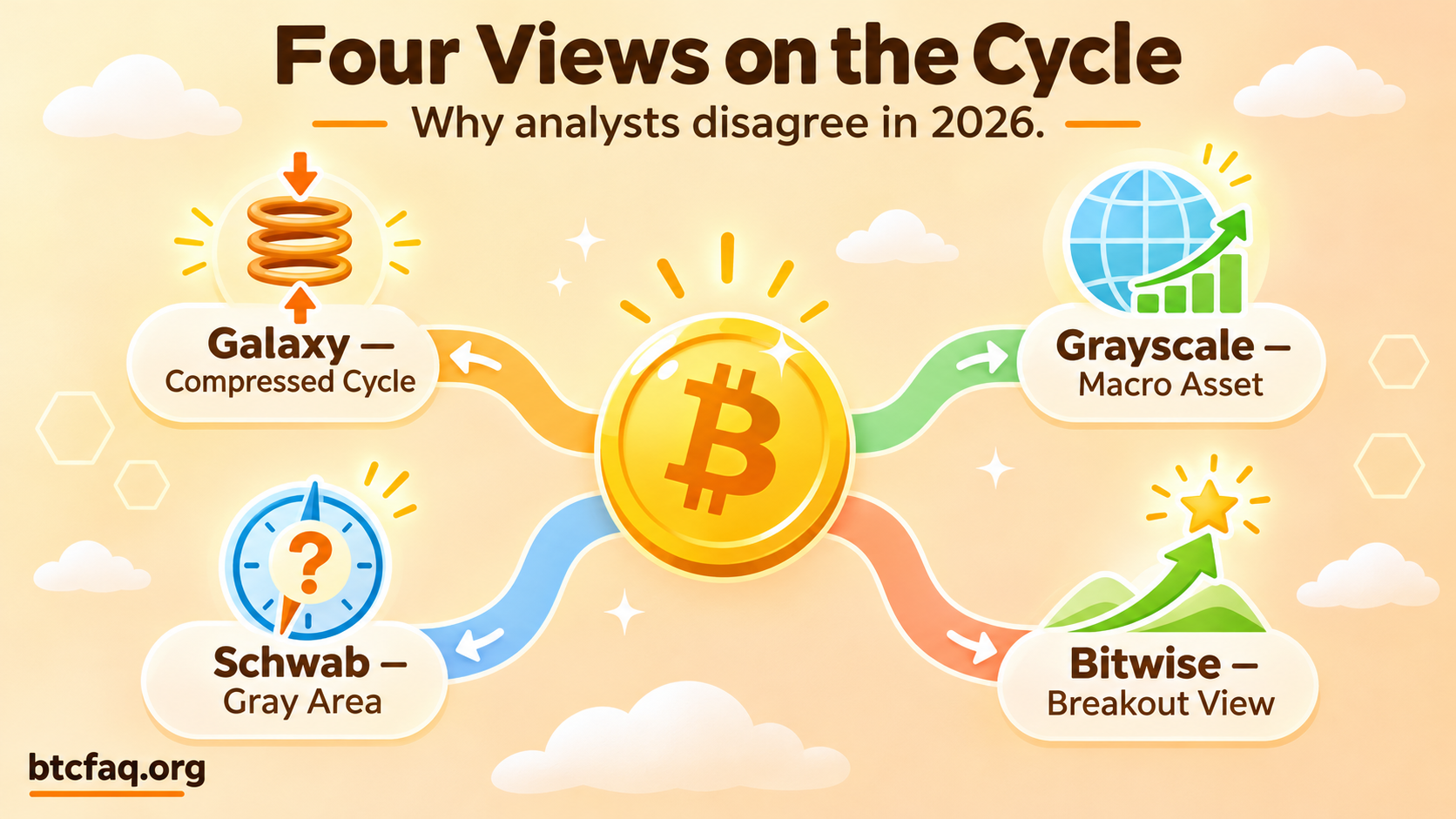
This is where it gets interesting, because the major research teams read the same data differently.
View 1: The cycle still holds, but it's compressed (Galaxy)
Galaxy's thesis: the four-year halving cycle still holds, but its amplitude is shrinking. The calmer top left the average holder's cost basis (the "realized price," about $53,000 in the report) at 43.7% of the all-time high, compared with 34.2% in 2021, 21.2% in 2017 and 16.9% in 2013. A higher cost basis raises the price floor.
Galaxy’s conclusion in its June 2026 report was that the bottom had not formed yet: only 4 of 13 bottoming signals had hit, and the strongest ones (price below cost basis, deep capitulation) had not appeared. It says the window for a bear-market low opens around late 2026.
It presents illustrative scenarios, which it stresses are not predictions:
| Scenario | Estimated bottom |
|---|---|
| Shallow | 51k–54k |
| Base case | 40k–46k |
| Harsh washout | 30k–37k |
| Old "−77% to −85%" rule (which Galaxy considers obsolete) | 19k–29k |
My own check: a 40k–46k base case is about a 63% to 68% fall from the high, which is milder than the previous three cycles, consistent with the "shrinking amplitude" idea. The old rule applied to $124,824 gives roughly $18,700 to $28,700.
Note what happened next: the June low of about $60.9k did not reach even the "shallow" scenario, and price has since recovered. That doesn't disprove Galaxy (its base case window runs to Q4 2026), but it's worth keeping in mind that scenario lists are not forecasts.
View 2: Bitcoin is now a macro asset (Grayscale)
Grayscale’s Zach Pandl wrote Bitcoin: Four-Year Cycle or Macro Asset? (22 July 2026). It sets two views side by side:
- • Cycle view: halvings drive price; bottoms come about a year after the peak and roughly 2.5 years after the halving; past cumulative drawdowns averaged about 80%. If the pattern holds, the bottom could come around September or October, with lower lows.
- • Macro view: Bitcoin has matured and responds to macro conditions like other major assets. Past bear markets coincided with slowing growth, rising real interest rates, or both, and this one has included a big shift in Fed expectations and rising real rates.
Grayscale's research team sides with the macro view. Its conclusion: if the Fed avoids rate hikes and growth holds up, the price may already have bottomed, while the cycle view "predicts lower lows." (Note the disclosure: Grayscale and its affiliates may have financial interests in the assets discussed.)
View 3: It's a gray area (Schwab)
Schwab says it is in the "gray area." It argues the cycle has become part of Bitcoin lore and may fade over time, and it treats the cycle as one input in an allocation framework, not a timing signal. Its balanced list of arguments:
For persistence: the halving reduces new supply; production costs rise after each halving; price has repeatedly struggled near the cost of production for inefficient miners (about $95,000 as of 31 May 2026, per Glassnode, as quoted) until a catalyst arrives; and many people follow the cycle, so it may influence behavior.
Against: the sample is tiny and might be data-mining; each bear market had a different trigger (Mt. Gox and China's ban, the ICO bust, then inflation, rate hikes and a string of failures like TerraUSD, Three Arrows and FTX); volatility keeps falling; and a $1 trillion asset can't easily gain tenfold.
I like how honest this is. "We don't know" is underrated.
View 4: It's already broken, and 2026 should be a new high (Bitwise)
Bitwise’s The Year Ahead: 10 Crypto Predictions for 2026 was written around the end of 2025 (the PDF shows no date; its data runs to 5 December 2025). Its first prediction, in its own words: "Bitcoin will break the four-year cycle and set new all-time highs."
Its reasons: each halving matters less because it cuts supply by a smaller amount than the one before; interest rates were expected to fall in 2026; and leverage had been reduced after the October 2025 liquidations. It also expected ETFs to buy more than 100% of new supply, estimating 2026 supply at about 166,000 BTC.
Here is the scorecard as of November 9, 2026: from the $74,624 spot price in Hashrate Index’s weekly roundup, Bitcoin would need to gain approximately 67% to exceed Galaxy’s $124,824 historical high. That is a substantial hurdle, but it is not proof that Bitwise’s year-end prediction will fail. The prediction remains a scenario to assess at year-end, not a guaranteed outcome. Hashrate Index source.
So, Is It Dead?
My answer: "Dead" is the wrong word, and so is "alive and well." Here's how I separate it:
- 1. The halving schedule is not dead. It's code. Block rewards will halve on schedule.
- 2. The timing pattern is weakened but not disproved. Peaks around 18 months after the halving and a bear year after that fit 2025–26 reasonably well: April 2024 plus 18 months lands in October 2025, right when the high occurred. Galaxy, Grayscale's cycle view and Schwab's historical data all line up on that.
- 3. The measured drawdown was smaller through June 2026. That is consistent with a weaker or compressed cycle, but the magnitude of a bear market is only known conclusively in hindsight.
- 4. The cause is genuinely unknown. Is it the halving, macro conditions, leverage, liquidity or just crowd psychology? Schwab even notes that because so many people follow the cycle, it might partly fulfill itself.
The honest summary: the halving is real, the price pattern is a habit, and habits can change.
What It Means for People Who Mine Bitcoin
If you only watch the price, you miss half the story. Miners experience the halving directly.
OneMiners’ guide explains that the halving immediately reduces the block subsidy while a miner’s operating expenses do not automatically decline. Unless price, fees, or competition offset the change, this squeezes margins. The article emphasizes electricity pricing, efficiency in J/TH, and hashprice as key inputs to evaluating a machine’s operating economics.
A useful screening calculation from OneMiners’ Is Bitcoin Mining Still Worth It in 2026? is electricity-only break-even price (USD/kWh) = hashprice (USD per PH/s per day) ÷ [24 × efficiency (J/TH)]. This uses consistent PH/s and TH/s units and excludes other costs. At the article’s September 21 hashprice of $40.54 per PH/s per day, a 9.5 J/TH miner breaks even on electricity alone near **$0.178/kWh**. At Hashrate Index’s November 9 spot hashprice of $31.89, the equivalent rate is about $0.140/kWh. Neither is an all-in profitability threshold; hardware, hosting fees, repairs, downtime, taxes, and financing can lower the viable rate. Hashrate Index data.
Here is the halving connection: the expected block subsidy falls from 3.125 to 1.5625 BTC at the next halving. If BTC price, mining difficulty, uptime, and transaction-fee revenue were unchanged, subsidy-derived revenue per unit of hashrate would halve. Total mining revenue need not fall by exactly 50%, because transaction fees are separate from the subsidy. With negligible fees assumed, the illustrative $0.140/kWh electricity-only break-even rate would fall toward **$0.070/kWh**. This is a scenario illustrating subsidy exposure, not a 2028 forecast. Electricity rates, hardware efficiency, transaction fees, and network competition may all change before then.
OneMiners’ 2026 post-halving guide emphasizes efficient equipment, predictable electricity costs, uptime, and preparation for the 2028 subsidy reduction. These are useful purchasing criteria, but any suggested tariff or J/TH cutoff depends on hashprice, equipment cost, and the specific hosting contract. A prospective customer should request a current all-in quote and test margins at current hashprice and at a meaningfully lower figure.
The "hosted models dominate" argument
OneMiners’ Why Hosted Models Now Dominate (April 2026) argues that professionally managed hosting can make industrial ASIC operation more practical for customers who do not have suitable power and cooling infrastructure at home. The article discusses bulk electricity arrangements, equipment deployment, and a historical advertised hosting rate of $0.0455/kWh. Such features can be valuable for comparing options, but the quoted rate is not a guaranteed offer for every model or location. Before committing, buyers should confirm the all-in electricity and service rate, equipment compatibility, uptime terms, warranty coverage, prepayment requirements, and how any long-range BTC-output estimates were calculated. Good hosting can reduce operational complexity; it cannot eliminate Bitcoin price or network-difficulty risk.
More mining reading
Two Medium articles by Cassy Soriano connect the market cycle to decisions miners actually make. Bitcoin Mining Revenue Hits Its Best Month Since January: Is Mining Profitable Again? discusses why an improvement in network-wide revenue does not automatically mean every ASIC has a healthy margin. Best ASIC Miners to Consider Before 2027: Are Newer Machines Worth the Upgrade? offers a framework for comparing equipment efficiency, purchase price, power tariffs, and upgrade payback. Both provide context for comparing machines available through OneMiners, while buyers should still confirm product specifications and hosting terms.
Price Cycle vs. Mining Cycle: Two Different Clocks
It helps to keep two clocks in mind:
| Factor | Price cycle | Mining/halving clock |
|---|---|---|
| What drives it | Sentiment, liquidity, macro conditions, flows | Code (every 210,000 blocks) |
| How predictable | Debated, small sample | Very predictable |
| What can change it | ETFs, interest rates, leverage | Nothing short of a consensus change |
| Who feels it | Anyone holding BTC | Miners (revenue per block) |
If the price cycle is fading, the halving clock keeps ticking anyway. For a miner, that's the clock that matters more.
What Should a Regular Person Do With This?
I'm not going to tell you what to buy or sell. Instead, here are some sensible principles drawn from the sources:
- 1. Don't treat the cycle as a calendar. Schwab explicitly treats it as one input, not a timing signal.
- 2. Prepare for uncertainty in both directions. Galaxy's scenarios, Grayscale's macro view and Bitwise's prediction can't all be right.
- 3. Watch the macro backdrop, especially real interest rates and Fed policy, which Grayscale highlights.
- 4. Avoid leverage. Schwab notes that hidden leverage often amplified past downturns.
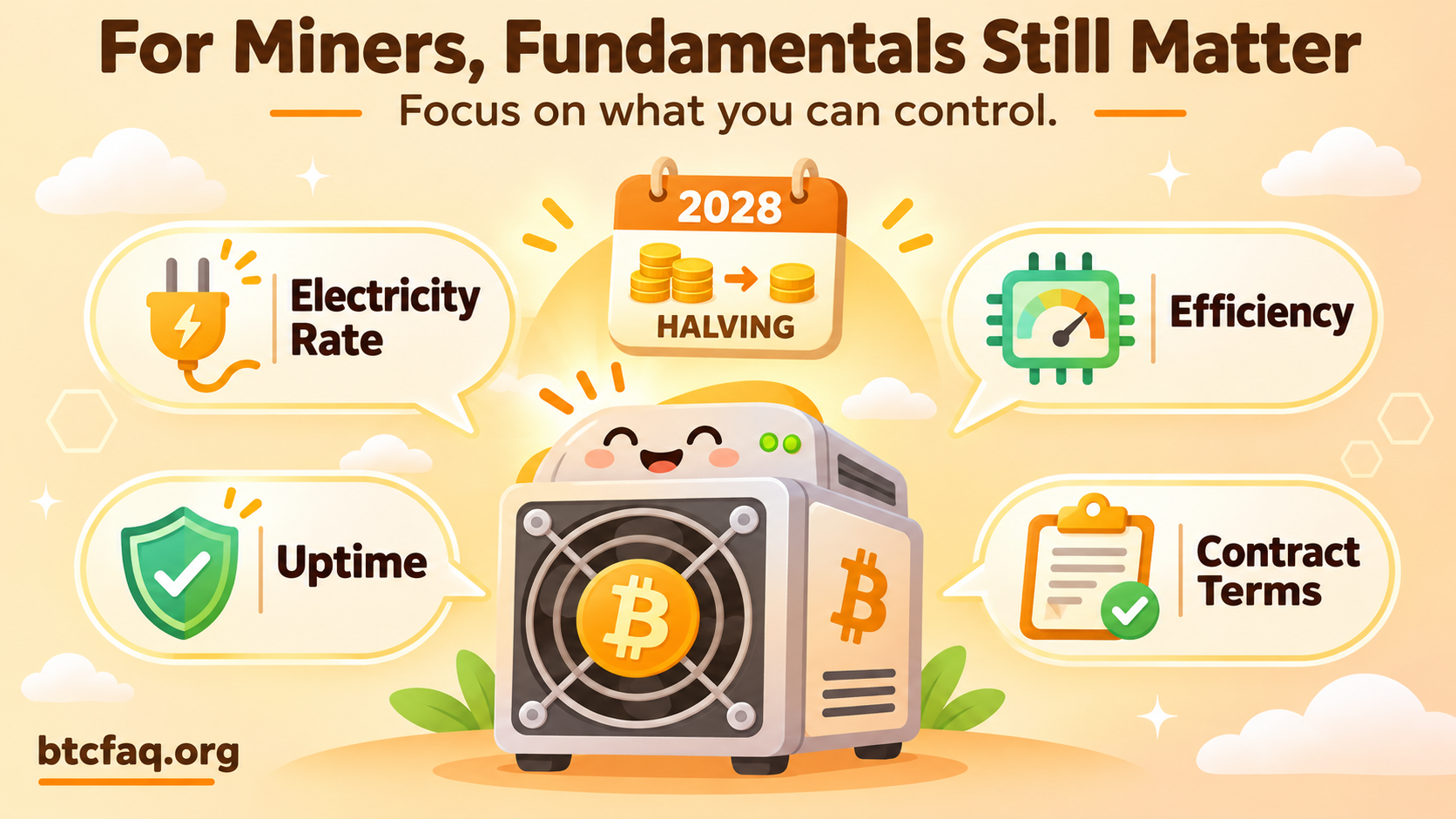
- 5. If you mine, focus on what you control: electricity rate, efficiency and contract terms.
- 6. Check the date on anything you read. In this one topic I found data from June, July, September and November that told different stories.
Five Honest Opinions
1. The price cycle is a historical pattern, not a law. The halving is code, but "prices peak 18 months later" is a pattern that emerged from a few data points. I'd give it respect, not faith.
2. The mid-2026 drawdown is informative, but not final. Research published in June found a shallower decline than the major earlier bears. Whether that reflects ETFs, maturing market structure, or an unfinished cycle is still open to debate.
3. Scenario tables are not forecasts. Galaxy’s 40,000–46,000 base-case range was a conditional June research scenario, not a promised future low. Bitcoin subsequently traded above its June reference low, but the eventual bear-market bottom cannot be confidently named in real time.
4. Be suspicious of confident calls in either direction. Bitwise confidently predicted a new high; others said "lower lows." Researchers with real expertise disagree, which tells me that certainty is the red flag.
5. If you’re a miner, the scheduled subsidy change matters more than a price narrative. The historical pattern may evolve, but the block subsidy will halve at the next 210,000-block milestone. Model the subsidy reduction, transaction fees, equipment efficiency, and your actual all-in hosting or electricity costs instead of relying on a bull-market prediction.
A Note on Sources
This guide uses dated research from Galaxy, Grayscale, Schwab, Bitwise, and CoinGecko, together with Hashrate Index’s November 9 market snapshot. These organizations have different research approaches and, in several cases, commercial interests in digital assets. Their scenarios are attributed to their publication dates and should not be treated as current forecasts. OneMiners provides ASIC hardware, hosting services, and educational mining resources; the Medium articles by Cassy Soriano are commercially affiliated with OneMiners. Their practical examples are useful for evaluating equipment and electricity arrangements, but any rates, availability, and projected margins should be checked against current written terms.
Common Misconceptions
"The halving makes the price go up automatically." No. The halving reduces new supply, but price depends on demand, macro conditions and sentiment. Schwab calls the cycle's effect on the broader market uncertain.
"Every bear market falls 80%+." No historical rule guarantees that. Galaxy documents major historical declines of about 85%, 84%, and 77%; CoinGecko’s June 2026 study measured a roughly 51% drawdown so far. The final depth of the current cycle was not established by that snapshot.
"The four-year cycle is dead because the June 2026 drawdown was mild." A shallower drawdown through one research date could be consistent with a compressed cycle; it cannot establish whether the eventual bear market is over. Galaxy’s June analysis argues for that distinction.
"If the cycle is real, the bottom is guaranteed on a date." No. Grayscale's cycle view suggests a bottom around September to October; Galaxy's window opens in late 2026. Both are estimates from a small sample.
"Miners are unaffected by the cycle debate." Miners feel the halving directly, whatever the price does.
"ETFs killed the cycle." ETFs may have changed it. Galaxy credits them with pulling euphoria forward to early 2024, and Bitwise expects them to absorb more than the new supply. But Galaxy also notes ETF flows were net negative in 2026, so they cut both ways.
Frequently Asked Questions
What is the Bitcoin four-year cycle? The pattern in which Bitcoin's price has historically peaked about 18 months after a halving, then fallen in a bear market, then recovered, in roughly four-year loops.
Is the four-year cycle dead? The Bitcoin halving schedule remains intact, but the four-year price pattern is disputed. Galaxy argued the pattern had compressed, Grayscale emphasized macroeconomic drivers, Schwab described uncertainty, and Bitwise forecast a break from the old price pattern. These were their dated 2026 positions.
When was the last halving? April 2024, cutting the block reward from 6.25 to 3.125 BTC.
When is the next halving? Expected around 2028, at block 1,050,000, cutting the reward to 1.5625 BTC (per OneMiners).
Has the Bitcoin bear market bottomed? There is no confirmed answer. Grayscale’s July macro view suggested a low may already have formed, while Galaxy’s June research argued further downside was plausible. CoinGecko recorded a June 7 reference low around $60.9K, but a past low is not necessarily the final cycle bottom.
How deep was the 2025–26 drop? CoinGecko’s June 24 study reported a maximum drawdown of about 51.2% at that time, shallower than its earlier major bear-market episodes. That is a dated research finding, not the final drawdown for all of 2026.
What was Bitcoin's all-time high? Sources cite roughly $124,800 to $126,500, from October 2025, depending on the price feed.
Why was the drawdown shallower through June 2026? Researchers considered institutional buying, ETFs, changing leverage, macroeconomic conditions, and lower volatility. A key caveat is that the cycle could still deepen after the research snapshot.
Does the halving still matter for miners? Yes. The block subsidy halves every 210,000 blocks. That reduces subsidy-derived BTC revenue per block, but transaction fees are separate, and a miner’s actual revenue also depends on Bitcoin price, hashrate competition, and uptime.
What happens to mining profitability at the next halving? If transaction fees are negligible and all other conditions stay fixed, subsidy-related income and an electricity-only break-even rate would be roughly halved. Actual profitability depends on fees, Bitcoin price, mining difficulty, hardware costs, and hosting terms.
Should I trade based on the four-year cycle? That's a personal decision. The sources here treat it as one input at most, not a reliable timing tool.
Will Bitcoin hit a new high in 2026? Bitwise predicted one. At Hashrate Index’s November 9 reference price of about $74,624, BTC would need to rise approximately 67% to pass Galaxy’s October 2025 reference high of $124,824. Whether that happens remains uncertain; neither scenario is guaranteed.
Final Thoughts
The Bitcoin halving schedule is part of the protocol; a repeating four-year price cycle is not. Previous markets exhibited broadly similar peaks and bear phases, but only a few examples exist, and the June 2026 research shows why simple cycle forecasts are unreliable. Galaxy, Grayscale, Schwab, and Bitwise offered materially different interpretations of the same evolving market. None established a guaranteed future price path.
For investors, the cycle is best used as historical context rather than a calendar for trades. For miners, the next subsidy reduction is a concrete planning milestone even if the price pattern changes. Hardware efficiency, electricity cost, uptime, and realistic hashprice scenarios remain practical considerations. OneMiners offers ASIC equipment and professional hosting options that buyers can compare, alongside its educational guides and the linked Cassy Medium analyses. Confirm any equipment specifications, hosting rate, and contractual conditions before committing.
The bottom line: The halving will happen on the protocol’s schedule; Bitcoin’s next bull or bear market will not. Prepare for the known subsidy change, treat predictions cautiously, and keep every chart and quote tied to its actual date.
Sources and Further Reading
- • Galaxy Research — Bitcoin’s Four-Year Cycle: Where Is the Bottom? (June 2026)
- • Grayscale — Bitcoin: Four-Year Cycle or Macro Asset? (July 2026)
- • Charles Schwab — Will the Bitcoin Halving Cycle Persist? (June 2026)
- • CoinGecko — How Deep Into the Bear Market Are We? (June 2026)
- • Bitwise — The Year Ahead: 10 Crypto Predictions for 2026
- • Hashrate Index — Weekly Roundup, November 9, 2026