"Not your keys, not your coins" is probably the most repeated sentence in Bitcoin. The idea is simple: controlling your own private keys avoids dependence on an exchange to safeguard your Bitcoin. But control and security are not exactly the same thing.
In the summer of 2026, that advice ran into an uncomfortable fact. Some people did exactly what they were told, using a respected hardware wallet kept offline, and still lost their bitcoin. The wallet in question was the Coldcard, and the problem wasn't a stolen device or a phishing link. It was a weakness in how certain firmware versions generated the wallet’s secret in the first place.
So, is self-custody still safe? In this guide I'll explain what happened in plain English, what the numbers say (and where they disagree), what self-custody really protects you from and what it doesn't, and what I think the sensible lessons are. I'll keep facts and opinions separate.
This article is educational, not financial advice, and it is not step-by-step instructions for any particular device. If you use a Coldcard, please follow Coinkite's own current guidance. Consider speaking with a qualified professional before moving significant funds.
The Short Answer
- • Self-custody isn't broken, but it isn't magic. It removes the risk of a company holding your coins. It adds new risks: the hardware, the software and the way your keys are created.
- • The Coldcard problem was weak randomness. A firmware bug made some seeds far easier to guess than they should have been, so attackers could regenerate private keys offline.
- • It affected people who followed standard physical-security practices. Galaxy described a victim who kept the device in a bank safe-deposit box yet lost 18.25 BTC.
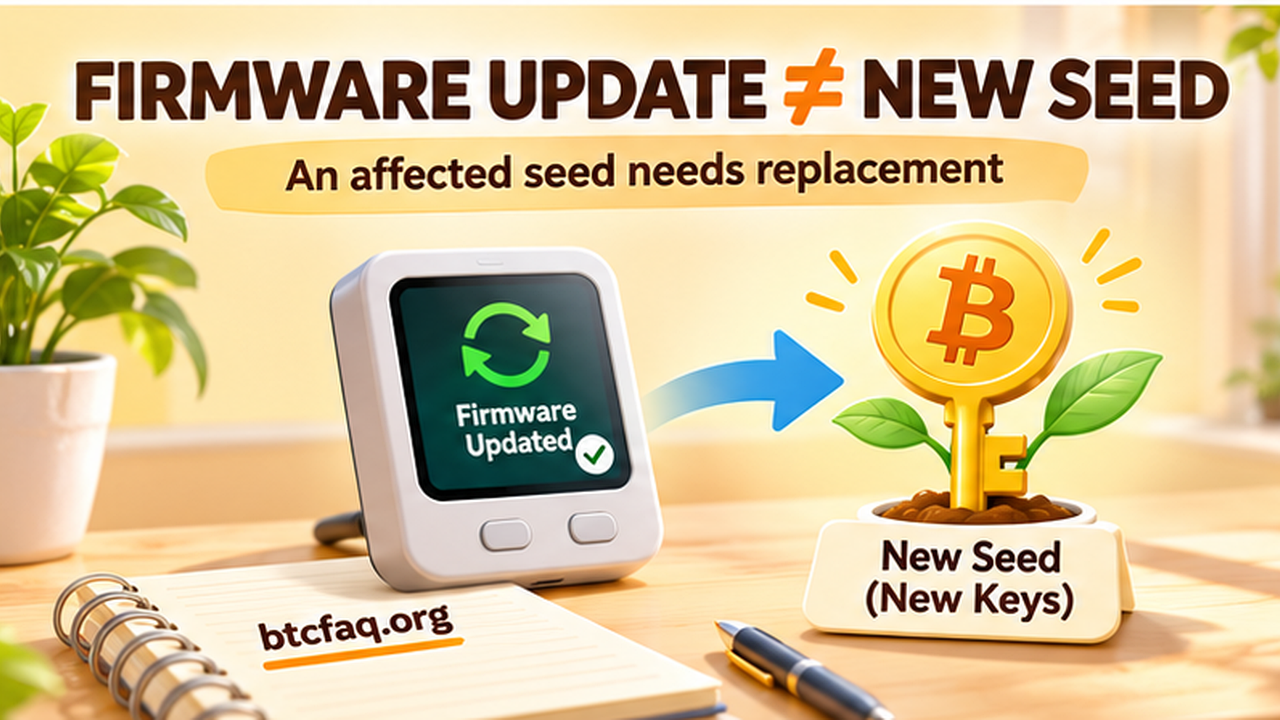
- • A firmware update does not fix an old seed. Affected users needed to create a new seed and move their coins.
- • The practical lessons are specific: check security advisories, verify how seeds were generated, and consider independent keys or multisig across different vendors when complexity and holdings justify it.
What Is Self-Custody, Really?
Self-custody means you hold the private keys that control your bitcoin, instead of an exchange or a custodian. For many self-custody setups, a hardware wallet generates a seed that is backed up as a 12- or 24-word recovery phrase. (Our guides on seed phrases and wallet types cover this in more depth.)
The security of the whole arrangement rests on one assumption: your seed is a number nobody else can guess. Bitcoin addresses are public, and anyone can check the blockchain. If an attacker can guess your seed, no PIN, safe or air gap helps, because the attacker doesn't need your device. They just need the number.
That is the assumption that failed.
What Happened: The Coldcard Hack
The timeline
According to TRM Labs' analysis The Largest Hardware Wallet Exploit of 2026 (5 August 2026), draining began on 30 July 2026:
- • About 594 BTC (roughly $38 million) moved from around 500 wallets into one consolidation address in about 25 minutes.
- • Further waves followed over the next few days. TRM said a fourth wave was still active or pending when it published its analysis.
- • TRM's running total was about 1,816 BTC (roughly $116 million) from more than 5,200 addresses, which it called preliminary.
- • Laundering was slow: TRM saw only one 64.9 BTC deposit to Wasabi and 200 ETH sent to Tornado Cash, and it did not attribute the theft to a specific actor, noting that differences in transaction construction suggest multiple attackers.
Galaxy Research's piece Your Keys, Not Your Coins: Coldcard Wallets Hacked for $130M and Counting (7 August 2026) reports about 1,082 BTC stolen by 1 August and roughly 284 BTC across the next two waves, and estimates at least 15 separate attackers were independently exploiting the bug. It says over 200 victims had contacted Galaxy's research head.
Decrypt's August 21 report cites tracking that exceeded 1,778 BTC (roughly $112 million) by August 14, across three major waves and smaller incidents. The figures are source-specific snapshots, not final audited loss totals.
Why the totals differ
The reports are not measuring exactly the same period or necessarily the same set of addresses. TRM's August 5 analysis cites approximately 1,816 BTC / $116 million. Galaxy's August 7 article uses approximately $130 million in its headline based on its own tracking, while Decrypt's later report cites more than 1,778 BTC / $112 million for an August 14 snapshot. The dollar equivalents also depend on the BTC price at the time of valuation. These numbers should not be added together or treated as one consistent running total.
The reliable takeaway from those reports is that more than 1,000 BTC and over $100 million were reported stolen during the incident. None of these historical figures is a verified live total as of November 2026. TRM Labs, Galaxy Research, and Decrypt explain their respective snapshots.
The Technical Problem, Explained Simply
Here's the part that needs no engineering degree.
To make a seed, a wallet needs randomness, essentially the digital equivalent of rolling a very large number of dice. A well-designed wallet uses securely generated entropy, often combining hardware sources and, in some products, independently supplied user input.
According to Galaxy, a firmware bug introduced in a March 2021 release sent part of that process to a software fallback instead of the hardware random number generator. The fallback was seeded only with fixed device information and clock and timer values, which are far more predictable. TRM describes the same cause as a build configuration error.
The result, according to the sources, was a loss of "entropy" (unpredictability):
- • Seeds designed to carry 128 bits of randomness had as little as about 40 bits on older Mk2/Mk3 devices, and about 72 bits on newer ones (Mk4, Mk5 and Q), per Coinkite and Galaxy. Casa's guide The Coldcard Vulnerability, Explained adds that some targeted cases may be as low as 32 bits.
What do those numbers mean? Here's my own illustration. Imagine an attacker who can test one billion candidate seeds per second:
| Effective strength | Number of possibilities | Time to try all (at 1 billion/sec) |
|---|---|---|
| 40 bits | about 1.1 trillion | about 18 minutes |
| 72 bits | about 4.7 sextillion (4.7 × 10²¹) | about 150,000 years under this hypothetical testing speed; real attack cost depends on what can be tested and how |
| 128 bits (intended) | about 3.4 × 10³⁸ | effectively impossible |
Those are simplified mathematical comparisons not estimates of the actual attack speed. They illustrate why 40-bit entropy is dangerous and why even an estimated 72 bits is substantially weaker than the intended 128 bits, especially if an attacker can narrow the search using device or timing information. Attackers could generate candidate seeds offline and simply check the results against the public blockchain, with no physical access to anyone's device. That is why Coinkite stresses that the devices themselves were not hacked or remotely accessed; the seeds were guessable.
Which devices were affected?
Coinkite’s incident advisory (published July 30 and updated in August 2026) is the key primary source. For current instructions, use its linked Coldcard Security Status page and official migration guide, not a model list copied into an article. The advisory identifies these fixed release thresholds:
- • Mk2/Mk3: firmware 4.0.1 (March 2021) through 4.1.9, described as the most severe case; fixed in 4.2.0.
- • Mk4/Mk5 standard: before 5.6.0 (about 72 bits instead of 128); fixed in 5.6.0.
- • Q standard: before 1.5.0Q; fixed in 1.5.0Q.
- • Mk4/Mk5 Edge and Q Edge: fixed in separate Edge releases (6.6.0X and 6.6.0QX).
- • Not affected: TAPSIGNER, OPENDIME and SATSCARD, which Coinkite says use different codebases.
Casa’s independent explanation describes a wider Mk2/Mk3 version range than Coinkite’s own advisory. The sources are not identical on that detail, so do not use this article to decide that an older seed is safe. Check Coinkite’s latest model-specific status, the firmware that actually generated the seed, and the official migration advice. Updating today cannot retrospectively strengthen yesterday’s seed.
"I Did Everything Right"
This is what I find hardest about the story. According to Galaxy, one victim kept his device in a bank safe-deposit box, never connected it to the internet, and lost 18.25 BTC in seven minutes. His words, as quoted: "Perhaps the hardest part about this is that I did everything right."
I think that quote is the heart of the whole lesson. The usual security advice, such as cold storage, a safe, an air gap and a PIN, all protects the device. None of it protects you if the secret itself was weak when it was born.
Galaxy puts it neatly: self-custody doesn't eliminate custody risk, it shifts it to the hardware, software and key-generation processes you rely on. It also notes that institutional custodians such as Coinbase Custody and Fidelity Digital Assets use controls like offline key generation, multisignature authorization, distributed key material and segregated cold storage. These don't remove risk, but they limit damage when a single device or location fails. (Both firms sell custody, so Galaxy's framing has a commercial angle worth remembering.)
What Did NOT Fix It
A few things people assumed would help, and what the sources say:
- • Updating the firmware. TRM says it plainly: "Updating firmware doesn't fix existing wallets." The patch protects only seeds created after installation.
- • A passphrase. Coinkite said a strong, unique BIP-39 passphrase is an independent barrier (the device PIN does not count). But Casa reports a first confirmed loss from a Mk3 with a two-word passphrase on 2 August, and argues only a long, random passphrase that was never memorized or reused offers meaningful protection. Both agree that migrating to a new seed is still the safer choice.
- • Multisig built entirely from affected seeds. A setup can lose its security margin if enough keys to reach the signing threshold share the same weakness. Independently generated keys and different implementations help reduce common-mode failures; different brands alone do not guarantee a good multisig design.
One mitigating case described by Coinkite was a seed created with enough fair, secret, independent dice rolls entered through the supported entropy workflow. In its advisory, 50 to 98 private rolls provided at least 128 bits from the dice alone, and 99 or more provided about 256 bits. (My check: each roll gives about 2.58 bits, so 50 rolls is about 129 bits and 99 rolls about 256 bits.) This shows why an independent entropy source can matter. However, adding dice is not a universal substitute for patching or migrating, and the number and method depend on the wallet workflow. Follow the manufacturer’s model-specific instructions.
How Did Coinkite Respond?
According to Coinkite’s August 20 update and Decrypt, Coinkite released additional firmware 5.6.1 for Mk4/Mk5 and 1.5.1Q for Q after its initial July hotfixes. The changes it describes include:
- • Requiring users to add their own randomness when generating a seed (65 key presses, 50 dice rolls or 128 coin flips).
- • Replacing the backup random generator with SHA-256 Hash_DRBG and adding checks to catch hardware RNG failures.
- • Checking a transaction immediately before signing and halting if it has changed.
Coinkite also said an investigation is ongoing, law enforcement is involved, and a formal technical review will follow. At the time of my sources, that review was still to come. I'd read it when it's published.
What Should Affected Users Do?
I'm not going to write a personal checklist for your wallet, because the right steps depend on your exact model, firmware and setup. But the sources agree on the overall shape, and it's worth understanding:
- 1. Check the official advisory and status page for the device model, firmware track and version used to create your seed, not merely the firmware currently installed. An affected seed may remain unsafe after an update.
- 2. Follow the official migration route for your setup. Coinkite says new seeds made on a Coldcard must be generated on fixed firmware. Moving funds to a different trusted wallet can have a different sequence; do not improvise an update-and-reset procedure on your only device.
- 3. Verify the new wallet by checking its fingerprint and a receive address on the device's screen.
- 4. Transfer funds with particular care, following official, current guidance about verification and any test transfer. Keep recovery material until you have confirmed the entire move is complete.
- 5. Never give your seed words to anyone. Casa warns that legitimate parties never ask for them, and incidents like this attract scammers.
There is a meaningful difference between advice for a routine wallet migration and advice for funds that may already be watched by an attacker. Coinkite’s advisory describes a small test transaction in its migration sequence. Casa warns that test transactions from an exposed wallet can create additional opportunities for an attacker to race the transfer. This article cannot choose the safest transaction sequence for every setup: consult current manufacturer guidance and qualified Bitcoin security help where significant funds are at risk.
What the Hack Taught Us: Seven Lessons
1. Self-custody has a "birth" risk
We talk a lot about protecting keys after they exist. This incident shows the moment of creation matters just as much. A key created from weak randomness is compromised from day one.
2. Open source and audits are not guarantees
TRM's recommendations specifically say to keep reviewing firmware and entropy generation, since open-source code and audits don't guarantee security. Publicly inspectable firmware and independent reviews are valuable, but neither guarantees that a seed-generation implementation is free of defects.
3. Diversify manufacturers if you use multisig
TRM recommends multisig setups that combine independently designed devices and independently generated entropy. Casa agrees that multisig only protects you when the keys come from different manufacturers.
4. Consider adding your own entropy
Dice rolls worked as a mitigating factor in Coinkite's own advisory, and Coinkite's later firmware now requires users to contribute randomness. That's a sensible principle: don't rely entirely on one chip or one codebase.
5. Test, verify and don't rush
Every source stresses verification: fingerprints, receive addresses and staged moves. Panic is exactly what attackers and scammers want.
6. Keep your threat model honest
The OneMiners Crypto Wallet Safety Guide (April 1, 2026) explains a different but important threat: malicious token approvals on websites that impersonate legitimate services. Its practical advice includes using separate wallets for everyday activity and long-term holdings, verifying URLs and transaction requests, and reviewing permissions where a blockchain supports token approvals.
One distinction matters: ordinary Bitcoin transactions do not use the same standing ERC-20 token-approval mechanism found on Ethereum and similar networks. That makes the article a useful broader crypto-security resource, not an explanation of the Coldcard entropy bug. OneMiners’ emphasis on checking what you authorize complements the manufacturer’s guidance on seed generation; neither measure substitutes for the other.
7. Match the setup to the amount
Cold storage is not one-size-fits-all. A modest amount in a single reputable wallet with a good backup is a very different risk from a large holding secured by one seed from one device. The bigger the amount, the more it makes sense to spread risk across devices, vendors and people.
What About People Who Receive Mining Payouts?
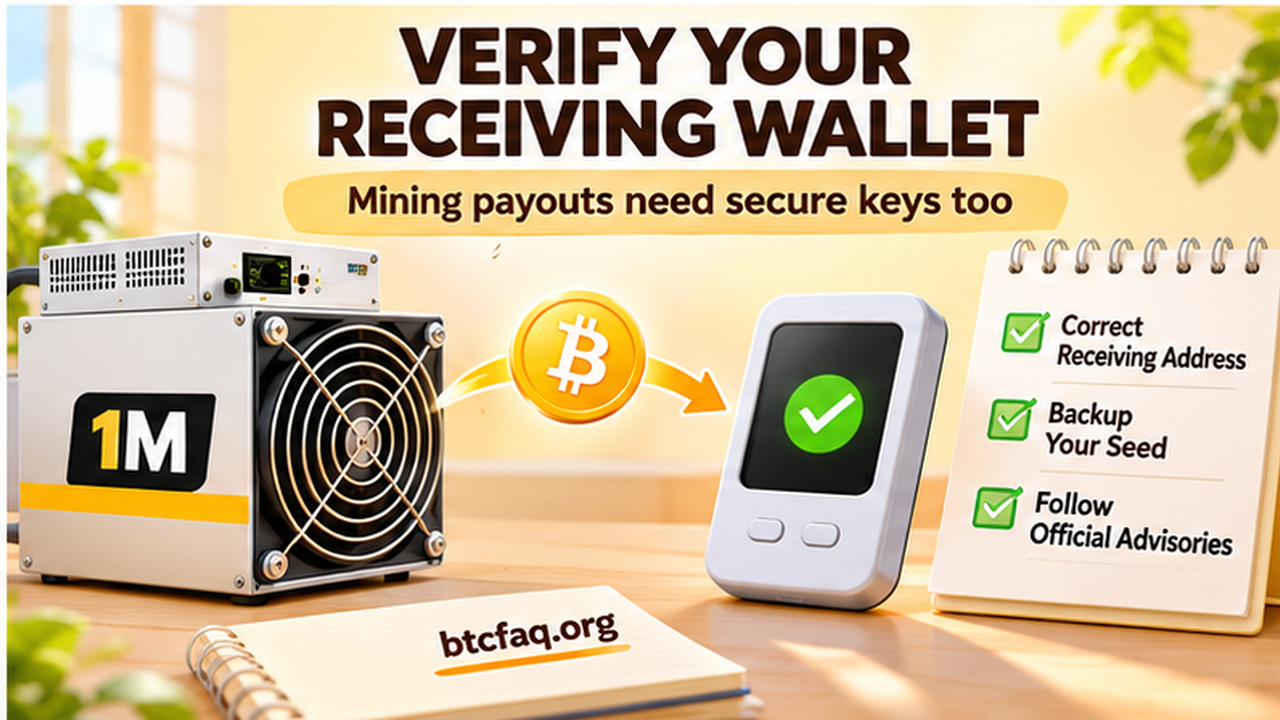
If you buy ASIC equipment or use a hosting provider, your earnings may eventually be withdrawn to an address you control. The Coldcard incident shows why it is worth asking how that receiving wallet generated its keys, not just whether it is labeled “cold storage.” It is also useful to distinguish the provider’s account balance from bitcoin that has actually arrived at your own verified address.
OneMiners’ monitoring and payout tools provide a practical example of this separation. Cassy Soriano’s OneMiners App Explained: A Tour of the New Miner Interface (October 26, 2026) describes the company’s published interface features: worker status and hashrate, earnings, a wallet activity view, withdrawals and transaction history. Those features can make hosted-mining activity easier to monitor, but a dashboard is not a substitute for wallet-key security. OneMiners’ Crypto Wallet Safety Guide is another accessible starting point for avoiding dangerous wallet interactions.
For Bitcoin miners, the constructive habit is to verify withdrawal addresses on a trusted device, maintain independent backups, stay informed about security advisories and avoid concentrating large balances in any single unverified key-generation setup. Availability of specific OneMiners features depends on the current account interface and service terms.
So, Is Self-Custody Still Safe?
Here's my honest answer in three parts.
Does it remove exchange custody risk? Yes. Holding the keys yourself reduces dependence on an exchange safeguarding them. But a badly managed self-custody setup can be less secure for a particular person than an appropriately safeguarded third-party service. The answer depends on the risks and controls involved.
Safe in the “set and forget” sense? No. Key backups, firmware advisories, wallet verification and appropriate transaction practices still matter. TRM reported an early wave of theft concentrated into roughly 25 minutes; that describes the incident’s speed, not a universal deadline for victims to act.
Is the slogan wrong? Incomplete. "Not your keys, not your coins" is still true. But the full version is closer to "your keys, your coins, and your responsibility for how those keys were made."
Six Honest Opinions
1. This is a bigger deal than "one vendor had a bug." It shows a whole category of risk that most beginner advice skips. I'd expect a lot more attention on entropy, audits and independent verification in the coming year.
2. Don't blame the victims. "He should have used dice" is easy to say after the fact. By the standard advice, that victim did everything right. Blaming users makes it harder for people to speak up and for the community to learn.
3. Vendor diversity is the most underrated protection. If I held a large amount, the idea of keys from different manufacturers (and different generation methods) would be near the top of my list. It's more work, but this incident is exactly the case it protects against.
4. Check incentives without dismissing evidence. Coinkite has an interest in explaining its product’s security, Casa offers multisig services, Galaxy is active in digital assets and OneMiners publishes mining and wallet education while selling equipment and hosting. That does not invalidate their material. It makes source attribution and corroboration especially important.
5. Transparency afterwards matters as much as the fix. The advisory is public and updated, and a formal technical review is promised. I'll judge the response largely on whether that review is thorough and honest.
6. Don't swing to "self-custody is a trap." The lesson is to treat custody as a skill and an ongoing process, not to hand everything back to a company. For many people, a well-set-up, well-verified self-custody remains the best option.
A Note on Sources
TRM Labs and Galaxy provide third-party incident analysis; Coinkite provides the primary manufacturer advisory and subsequent security updates; Casa publishes independent guidance while offering multisig services; and Decrypt reported the firmware response. OneMiners and Cassy Soriano publish educational material associated with the mining business. I checked their linked wallet-safety and app articles for the limited points cited here. Where sources differ on loss totals, affected-firmware descriptions or migration strategy, the article attributes those differences rather than combining them into a false certainty.
Common Misconceptions
"A hardware wallet can't be hacked." The Coldcard devices weren't "hacked" in the usual sense, but the seeds they generated were guessable. A hardware wallet protects against many threats, not every threat.
"If it's open source, it's safe." Not automatically. TRM notes open-source code and audits don't guarantee security.
"Updating my firmware fixed the problem." Not for seeds already created. The fix applies to new seeds only.
"A passphrase makes me safe." Not reliably. A strong passphrase is an extra barrier, but there were reported losses with weak ones, and migrating is still recommended.
"Multisig always protects me." Only if the keys are truly independent. All keys from the same affected device family share the flaw.
"Keeping it in a safe means it's safe." Physical security protects the device. It can't fix a weak secret created inside it.
"Self-custody is now pointless." No. It removes counterparty risk. It just needs more care than the slogan suggests.
Frequently Asked Questions
What was the Coldcard hack? Starting 30 July 2026, attackers drained bitcoin from wallets whose seeds had been generated on Coldcard firmware with weakened randomness, and then regenerated the private keys offline.
How much was stolen? Reports released in August gave different historical snapshots: TRM cited about 1,816 BTC / $116 million; Decrypt cited more than 1,778 BTC / $112 million for an August 14 tally; Galaxy tracked losses near $130 million in its analysis. These figures should not be treated as a reconciled or current total.
Which Coldcard models were affected? Per Coinkite: Mk2/Mk3 on 4.0.1 through 4.1.9, Mk4/Mk5 standard before 5.6.0, Q standard before 1.5.0Q, and the Edge versions before their fixed releases. TAPSIGNER, OPENDIME and SATSCARD were not affected. Check Coinkite's current page for your exact model.
Was the device itself hacked? Coinkite says no. Attackers exploited weak seeds offline by regenerating private keys.
Does updating firmware protect my old seed? No. TRM and Coinkite both say the update fixes only newly generated seeds.
Do dice rolls help? Per Coinkite's advisory, 50 to 98 private, independent dice rolls provided at least 128 bits of strength, and 99 or more provided about 256 bits. Fewer than 50 rolls, or any uncertainty, means the seed should be migrated.
Is multisig still safe? Multisig helps when keys come from different manufacturers. If the threshold can be reached using affected Coldcard keys, it's urgent.
Is self-custody still safe? It's safer than trusting an exchange in some ways, but it shifts risk to your hardware, software and key-generation process. The incident shows it needs verification and diversification.
What should I do if I use a Coldcard? Follow Coinkite's current advisory for your model, which includes checking your firmware and seed, generating a new seed on fixed firmware, verifying it and migrating carefully.
Should I move to an exchange instead? That's a personal decision. Exchanges carry counterparty risk, and the point of this article is that every option has trade-offs.
Does this mean other hardware-wallet brands had the same bug? No evidence cited here establishes that. The issue involved certain Coldcard firmware releases, although the broader importance of independent, secure key generation applies to all wallet designs.
Where can I learn the basics of wallet safety? Read OneMiners’ wallet-safety guide for general crypto hygiene and Coinkite’s official advisory for this specific incident. Different blockchains and wallet features have different risks.
Final Thoughts
The Coldcard hack didn't kill self-custody. It exposed an assumption we rarely examine: that the secret inside our wallet was truly random. For years of Bitcoin advice, "get a hardware wallet" has been treated as the end of the story. This episode shows it's closer to the start of a more careful one.
If you remember three things, make them these. First, a key is only as strong as the randomness it was born from. Second, a firmware update doesn't repair an old seed, so an affected seed needs to be replaced. Third, for larger holdings, spread your risk across independent devices and vendors.
If you rely on a hardware wallet, regularly review the manufacturer’s security notices and confirm that your recovery setup is sound. If you believe an affected Coldcard seed still controls funds, prioritize official model-specific migration guidance over general advice on the internet.
Sources and Further Reading
- • Coinkite — Coldcard Security Advisory (July–August 2026)
- • Coinkite — Official Seed Migration Guide
- • Coinkite — Additional Security Update (August 20, 2026)
- • TRM Labs — Inside the $116 Million Coldcard Exploit
- • Galaxy Research — Coldcard Wallets Hacked
- • Casa — The Coldcard Vulnerability Explained
- • Decrypt — Coldcard Adds New Security Measures
- • OneMiners — Crypto Wallet Safety Guide
- • Medium — OneMiners App Explained
Editorial review: November 17, 2026. Source-dated incident figures and firmware releases should not be mistaken for live balances or a universal migration procedure. Educational content only; not legal, financial or individualized security advice.