
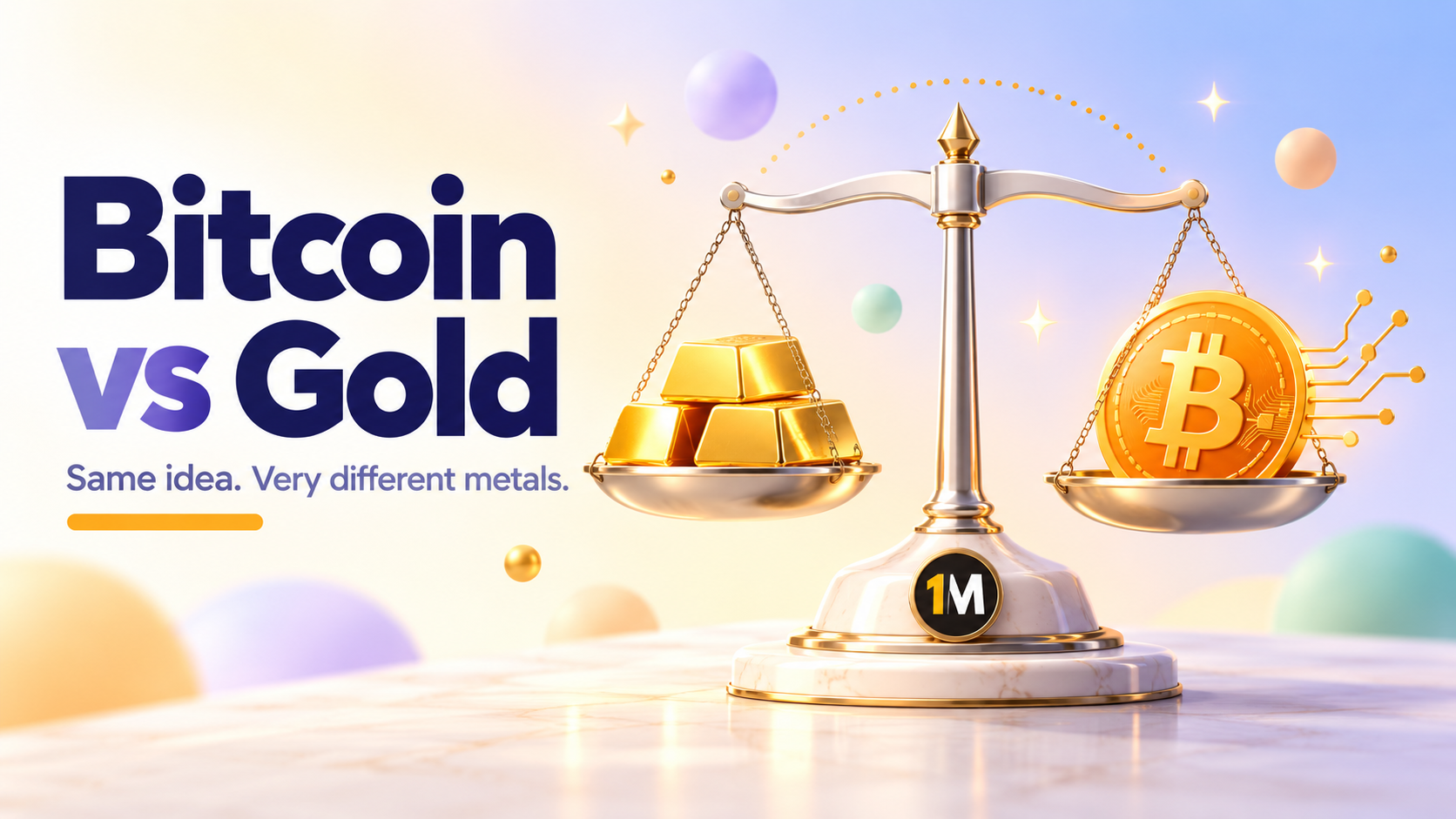
People have been trading gold for thousands of years. Bitcoin has existed for less than two decades. Yet the two are compared constantly, and Bitcoin is regularly nicknamed "digital gold." Is the nickname fair? Are they competitors, or do they do different jobs?
This guide compares Bitcoin and gold side by side in plain language: how each is created, how scarce each really is, how you store and move them, how wildly their prices swing, and what each can and can't do for you. We'll lean on published research from several sources and note where those sources have something to sell, so you can weigh them accordingly.
This article is educational, not financial advice. Bitcoin and gold can both lose value, and you should consider your own situation, or speak with a qualified professional, before investing.
The Short Answer
Bitcoin and gold share a basic idea: both are scarce assets that some investors use as stores of value outside the direct control of any single government or bank. But they differ in almost everything else.
Gold is physical, has a track record spanning thousands of years, and has historically been much less volatile than Bitcoin. Its above-ground supply grows gradually as new metal is mined and recycled, but there is no fixed maximum supply.
Bitcoin is digital, has been operating since 2009, and has a much shorter track record of a little more than 17 years as of 2026. Its price has historically been far more volatile, while its protocol limits total issuance to 21 million BTC.
Think of gold as the older and generally steadier asset, while Bitcoin is the newer, more volatile and more technologically distinct one. They share some store-of-value characteristics, but their histories, risks and practical uses are very different.
Why Bitcoin Is Called "Digital Gold"
The comparison is useful, but it's not a perfect match. Fidelity's research emphasizes the same limitation: Bitcoin has only a small fraction of gold's historical record. The Case for Bitcoin used about 15 years of Bitcoin data through March 2025, whereas gold has been used as a store of value for thousands of years. As of 2026, Bitcoin itself has been operating for more than 17 years, but that is still a very short history compared with gold.
The comparison is useful, but it's not a perfect match. As Fidelity's authors point out, Bitcoin lacks gold's long track record, with roughly 15 years of price history compared with thousands of years for gold.
Bitcoin vs Gold: Side-by-Side Comparison
| Gold | Bitcoin | |
|---|---|---|
| Form | Physical metal | Digital, on a global network |
| Supply | Grows through mining; no fixed cap | Capped at 21 million coins |
| Track record | Thousands of years | About 15 years |
| Divisibility | Limited; bars, coins, fractions | Down to 100 million satoshis per coin |
| Portability | Heavy, needs secure transport | Moves over the internet |
| Verifying authenticity | Needs testing; counterfeits exist | Verified by software on the network |
| Storage | Vaults, safes, banks | Wallets and private keys |
| Price swings | Generally lower | Much higher |
| Pays interest or income? | No | No |
| Main risks | Theft, storage cost, counterparty risk | Volatility, lost keys, scams, regulatory change |
The sections below explain the rows that matter most.
Difference 1: Supply and Scarcity
This is where the two assets are most different, even though both are described as "scarce."
Gold is scarce, but its supply is not capped. OneMiners' Bitcoin vs gold comparison discusses the same basic distinction and estimates annual gold-stock growth at roughly 1.5% to 2%. More recent World Gold Council data puts the total above-ground stock at about 222,600 tonnes as of the end of Q2 2026 and describes annual mined supply as adding roughly 1.8% to the existing stock. New gold continues to be mined, recycled and discovered, so its scarcity is real but not mathematically fixed in the way Bitcoin's supply is.
Bitcoin is scarce by design. The protocol limits total issuance to 21 million BTC. OneMiners' comparison notes that roughly 19.8 million had already been mined by mid-2026 and that the April 2024 halving reduced the block subsidy to 3.125 BTC. By October 2026, circulating supply had passed 20 million BTC. Unlike gold production, Bitcoin's issuance schedule does not increase simply because its market price rises.

The practical difference is that Bitcoin's issuance cannot increase simply because demand or price rises. There is no new Bitcoin deposit to discover, and the protocol's issuance schedule is predetermined. That fixed supply is one of Bitcoin's main attractions to supporters, but it also means changes in demand are absorbed primarily through price rather than through an elastic supply response. That can contribute to larger price movements in either direction.
Difference 2: Portability and Divisibility
Imagine moving $1 million of gold across a border. It would weigh many kilograms, need insurance, secure transport, customs paperwork, and often an assay to confirm authenticity. River notes that gold bars are worth thousands to hundreds of thousands of dollars each, and that spending gold typically means melting or exchanging it first.

Bitcoin moves over the internet. You can store it in a software wallet, and River points out that the Lightning Network can enable near-instant transfers. OneMiners also notes that one Bitcoin divides into 100 million satoshis, so you can buy or send very small amounts. (Our guide on satoshis explains this in detail.)
This is Bitcoin's clearest practical advantage over gold. Gold's physical nature is also what makes it hard to seize remotely or hack, but it makes everyday movement slow and costly.
Difference 3: Verification and Trust
How do you know what you're holding is real? With gold, you may need testing equipment or a trusted assayer, because counterfeits exist. And, as River observes, nobody can independently audit exactly how much gold exists above ground.
With Bitcoin, anyone running the software can verify coins and the full transaction history. The network's rules are public, and the entire supply schedule can be checked. CoinShares adds that the Bitcoin network has had no outage in thousands of days of operation, with 99.98% uptime as of its 2023 analysis. That figure is dated and comes from a company that sells Bitcoin products, but the general point, that Bitcoin's state is transparent and checkable, is widely accepted.
Difference 4: Volatility, and This One Matters
This is the difference that most surprises newcomers. Bitcoin's price swings are far larger than gold's.
CoinShares' 2023 analysis, citing Bloomberg data, found Bitcoin's average intraday price move was nearly 5% between 2018 and 2021, compared with about 1.6% for gold, and that Bitcoin fell 64% in 2022. Fidelity's paper reports Bitcoin's annualized volatility at 69% across January 2018 to March 2025, falling to about 60% on a three-year basis. Fidelity's model assumes it could eventually converge toward 20%, but that is an assumption, not a certainty.
Why does this matter for a "store of value"? Because a store of value is supposed to hold its worth over time. A big drop in the short term can undermine that, which is why River says gold is generally considered more stable in the short term.
The Bitcoin crowd's counterargument is that volatility reflects a young, small asset still being discovered, and that it should decline as the market grows. That could happen, but it hasn't been proven. For now, if you hold Bitcoin, expect large swings in both directions.
Difference 5: Market Size and the "Room to Grow" Argument
A recurring theme in Bitcoin-versus-gold debates is size. Gold's market is much larger, and the gap defines the argument that Bitcoin has room to grow.
Market-cap comparisons change quickly because both Bitcoin and gold prices move. Older sources therefore give very different numbers. CoinShares' September 2023 analysis valued above-ground gold at about $12.9 trillion and Bitcoin at roughly $530 billion. OneMiners' June 2026 comparison used an estimate of roughly $18–20 trillion for gold and about $2 trillion for Bitcoin.

More recent data paints a different picture. The World Gold Council valued the above-ground gold stock at about $29 trillion at the end of Q2 2026, while Bitcoin's market capitalization was around 1.6–1.7 trillion in mid-October 2026. That makes gold's total estimated value roughly 17 times Bitcoin's at those particular snapshots, although the ratio changes as both prices move.
The large difference is often used to support the argument that Bitcoin has more “room to grow.” CoinShares, for example, cites a 2022 Goldman Sachs scenario in which Bitcoin capturing a much larger share of the store-of-value market could support a significantly higher Bitcoin price. But scenarios like that are not forecasts. A smaller market does not automatically become as large as the market it is being compared with, and there is no guarantee that capital will move from gold into Bitcoin.
Difference 6: Custody and Control
- Both assets can be held directly or through third parties, but the custody risks are different.
- Gold: Physical gold can be kept at home, in a private vault, with a bank, or indirectly through products such as gold ETFs. Using a third-party custodian introduces counterparty and access risk, while self-storage creates security, insurance and logistical responsibilities. Gold ownership has also been subject to government restrictions historically. In the United States during 1933–34, the government restricted private ownership of monetary gold and required much of it to be transferred into the monetary system, with holders receiving currency in exchange.
- Bitcoin: Bitcoin can be held through an exchange or custodian, or in a self-custody wallet. Self-custody removes reliance on a financial intermediary, but it shifts responsibility to the owner: losing access to the private keys or recovery information can make the Bitcoin permanently inaccessible. Governments can regulate exchanges, taxation and access to Bitcoin, even though no single government controls Bitcoin's global protocol.
In both cases, "not your keys, not your coins" has a gold-world equivalent: "not your vault, not your bars." Our articles on wallets versus exchanges and on seed phrases cover Bitcoin custody in detail.
Difference 7: The Cost of Producing Them
Both gold and Bitcoin must be "mined," and both cost real resources to produce. For gold, it's excavation and energy. For Bitcoin, it's electricity and specialized computers.
That cost matters for price. A mid-August 2026 data review by Cassys on Bitcoin mining's margin problem found mining revenue per unit of computing power at a historic low when Bitcoin traded near $64,900, and estimated the median cost to produce a coin at about $85,604, well above the market price at that time. The author works for a mining-hosting company and doesn't cite a methodology for that estimate, so treat it as an illustration rather than a precise benchmark.

Production cost matters primarily because it affects miners' profitability and behavior. When mining becomes uneconomic, some operators may shut down older machines, seek cheaper electricity or sell reserves to cover expenses. But production cost does not mechanically determine Bitcoin's market price or create a fixed price floor. Bitcoin can trade above or below miners' estimated production costs for extended periods, just as gold can trade well above or below the cost of extracting a new ounce.
What About Using Both?
Another way to look at "Bitcoin vs gold" is that you may not have to choose. Fidelity's research notes that Bitcoin's behavior differs from gold's in an important way: its five-year correlation to stocks was about 55%, compared with about 6% for gold. In other words, Bitcoin has tended to move more with the stock market, while gold has been more independent of it. That suggests the two don't serve the same role in a portfolio.
The Fidelity paper models small Bitcoin allocations, in the range of roughly 2% to 5% (up to 7.5% for young investors), inside multi-asset portfolios, and finds that modest sizes limited the downside if Bitcoin went to zero while offering upside in optimistic scenarios. These are hypothetical simulations written for institutional audiences, not recommendations, and Fidelity itself stresses that digital assets are speculative and highly volatile, that the projections aren't guaranteed, and that the company has commercial interests in related products. We mention it to show how professional researchers think about the question, not to suggest any allocation for you.
A Note on Sources
It's worth being upfront about the incentives behind the material above:
- OneMiners is a Bitcoin mining-hosting company, and its comparison article ends by recommending its own hosted-mining services. Its claim that 2026 could be Bitcoin's year to outperform gold is an opinion built partly on timing assumptions around the halving cycle.
- CoinShares sells Bitcoin investment products, and its piece promotes Bitcoin's prospects. Its figures are from 2023.
- River is a Bitcoin financial services company, so it naturally favors Bitcoin's strengths, though its comparison is balanced on volatility and custody.
- Fidelity's paper is written for institutional investors and discloses its own conflicts of interest.
None of that makes the information wrong, but it's a good reason to read all of these with a critical eye and to check the numbers against independent data before acting.
Common Misconceptions
"Bitcoin is just digital gold." They share traits, but Bitcoin is far more volatile, far newer, and behaves differently in portfolios.
"Gold has a fixed supply." Gold is scarce, but new gold is still mined and the global stock grows by roughly 1.5% to 2% a year according to OneMiners.
"Bitcoin will overtake gold." Some analysts think it could; others disagree. It's a possibility argued by people who often have a stake in the outcome, not an established fact.
"Gold is risk-free." Gold prices fall too, and holding physical gold involves storage, insurance, and counterparty costs.
"You must choose one." Many people hold both, because the two assets behave differently.
Frequently Asked Questions
What is the main difference between Bitcoin and gold? Gold is a physical, long-established asset with a slowly growing supply. Bitcoin is a digital asset with a fixed cap of 21 million coins, a much shorter history, and far greater price volatility.
Is Bitcoin better than gold? It depends on what you want. Bitcoin is more portable, divisible, and verifiable, with a hard supply cap. Gold has a vastly longer track record and has been less volatile. Neither is better in every way.
Why is Bitcoin called digital gold? Because it shares gold's key traits as a store of value: scarcity, divisibility, portability, and durability, as CoinShares and Fidelity both describe.
Is gold safer than Bitcoin? Gold has historically been steadier in the short term. Bitcoin's price has swung much more widely, so most analysts view it as the riskier of the two.
Can Bitcoin replace gold? Some argue it could take over part of gold's role over time, but gold's market is much larger and its track record much longer. There's no guarantee that happens.
How much Bitcoin supply is left to be mined? Bitcoin's maximum supply is 21 million BTC. OneMiners' June 2026 comparison reported roughly 19.8 million had already been mined at that point, and circulating supply had passed 20 million BTC by October 2026. Because the block subsidy is cut roughly in half every four years, issuance will continue at a progressively slower rate, with the final fractions of Bitcoin expected to be mined around 2140.
Do Bitcoin and gold move together? Not reliably. CoinShares found the correlation between them has swung from nearly +1 to nearly -1 over four years, so the relationship changes over time.
Should I buy Bitcoin or gold? That's a personal decision based on your goals, time horizon, and risk tolerance. Consider speaking with a qualified financial professional.
Final Thoughts
Bitcoin and gold both try to answer the same old question: where can you put wealth that no government can print more of? Gold answers it with thousands of years of trust and a steadier price. Bitcoin answers it with a hard-coded 21 million cap, near-instant global movement, and software-verifiable scarcity, in exchange for much wilder swings and a short track record.
The most honest way to describe them is as two different tools. Gold is the proven, slower-moving one; Bitcoin is the newer, faster, riskier one with a potentially larger upside. Understanding exactly where they differ is the best way to decide whether either one belongs in your plans.