For years, most retail investors who wanted direct exposure to Bitcoin had to buy BTC through a crypto exchange, brokerage service, peer-to-peer platform, or wallet-connected provider. Then, on January 10, 2024, the U.S. Securities and Exchange Commission approved the listing and trading of spot Bitcoin exchange-traded products (ETPs), commonly called spot Bitcoin ETFs. That gave investors another way to get exposure to Bitcoin's price through conventional brokerage accounts without having to manage a crypto wallet.
That convenience raises an obvious question: if you can get exposure to Bitcoin's price without touching a wallet, why would anyone buy Bitcoin directly? And if you can buy Bitcoin directly, why bother with an ETF? The short answer is that they are two different ways of getting exposure to the same underlying asset. Their values tend to move closely together, but ownership, control, fees, trading hours, custody, and risks are different. This guide explains those differences, what each option is good for, and who may prefer one over the other.
This article is educational, not financial or tax advice. Bitcoin and Bitcoin funds can lose value, and availability, rules, and taxes vary by country. Consider speaking with a qualified professional before investing.
The Short Answer
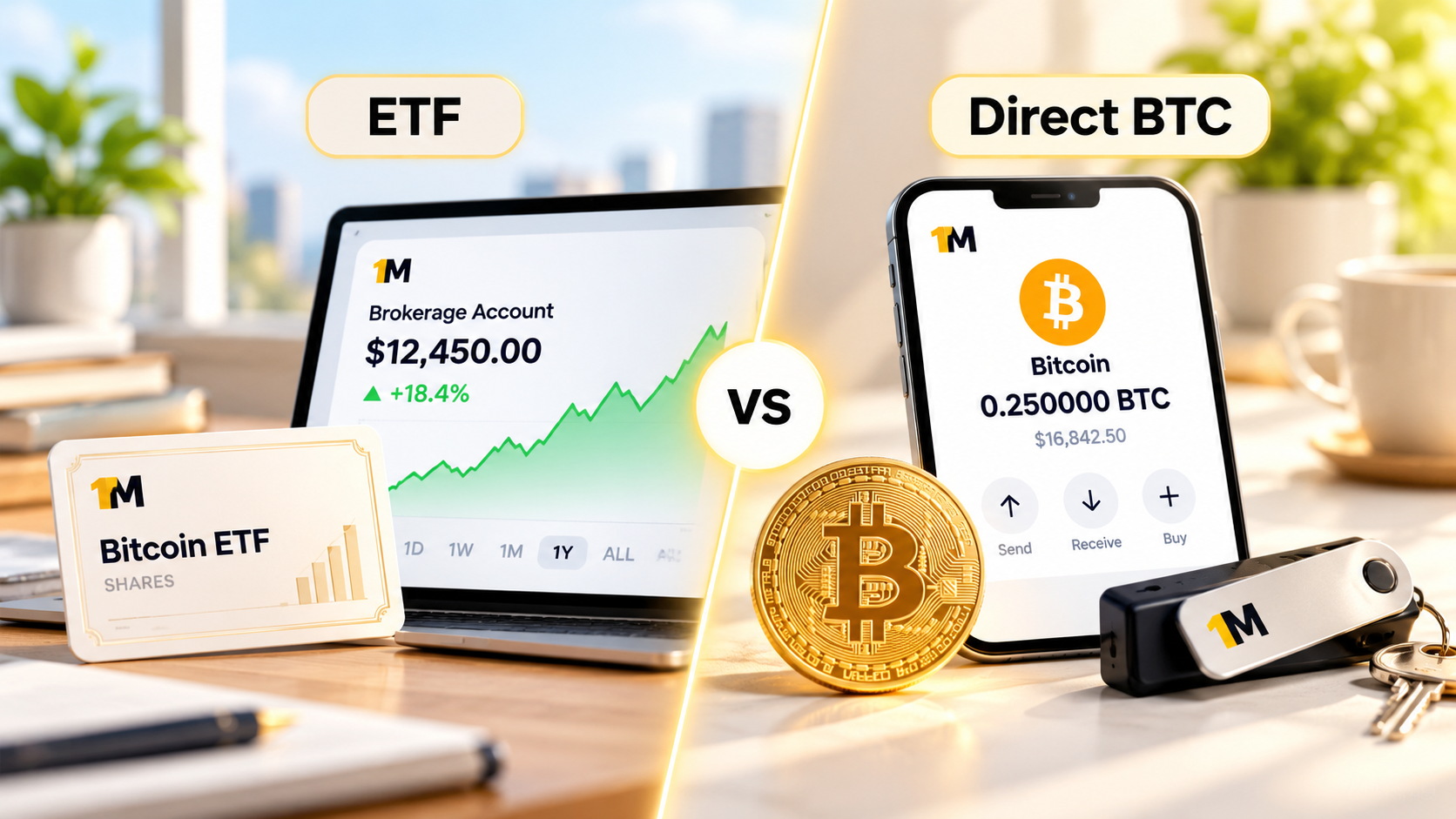
When you buy Bitcoin directly, you own BTC itself. You can hold it in your own wallet, send it to other people, and spend it anywhere Bitcoin is accepted. When you buy a spot Bitcoin ETP, commonly called a Bitcoin ETF, you own shares of an investment product that holds Bitcoin as its underlying asset. You do not directly own or control the Bitcoin held by the product, and you cannot send those underlying coins from the fund to your own wallet.
Neither is automatically better. An ETF trades convenience and familiarity for control. Direct ownership gives you more control, but it also gives you more responsibility.
What Is a Bitcoin ETF?
An exchange-traded product, or ETP, is an investment product that trades on a stock exchange similarly to a share of a company. ETFs are one type of ETP, but U.S. spot Bitcoin products are more precisely classified as exchange-traded commodity trusts rather than traditional ETFs registered under the Investment Company Act of 1940. They are still commonly called “Bitcoin ETFs” by investors and the media. A spot Bitcoin ETP is designed to provide exposure to Bitcoin's price without requiring investors to buy and store the cryptocurrency themselves, as River's guide to Bitcoin ETFs explains.
There are two main kinds:
- • Spot Bitcoin ETFs hold actual Bitcoin, so the fund's value follows the market price of the coins it holds.
- • Futures Bitcoin ETFs hold futures contracts, which are agreements to buy or sell Bitcoin at a set price on a future date. Before 2024, U.S. Bitcoin ETFs were of this type.
The spot funds are the ones that made headlines. Coinbase's newsletter from the week they launched reports that the U.S. Securities and Exchange Commission approved 11 spot Bitcoin ETFs on January 10, 2024, and that they began trading the next day. The issuers included BlackRock, Fidelity, Grayscale, and Bitwise. Because they trade on conventional exchanges, the newsletter noted, retirement accounts, pension funds, and other institutions could gain Bitcoin exposure through familiar brokerage channels.
For that reason, this article uses both “Bitcoin ETF” and “spot Bitcoin ETP.” Fidelity's guide to spot Bitcoin ETPs uses the more precise ETP terminology. The distinction matters because spot Bitcoin ETPs hold Bitcoin as their underlying asset but do not have exactly the same legal structure or protections as traditional registered ETFs.
How an ETF Holds the Bitcoin
Spot Bitcoin ETPs hold actual Bitcoin through custodians, but the way new shares are created and redeemed has changed since the products first launched. In January 2024, U.S. spot Bitcoin ETPs initially used a cash-only creation and redemption model. In July 2025, the SEC permitted in-kind creations and redemptions for crypto ETPs, allowing authorized participants to exchange Bitcoin for shares, or shares for Bitcoin, under approved structures. Ordinary retail investors still normally buy and sell ETP shares through a brokerage rather than directly exchanging their shares for Bitcoin.
What Does "Buying Bitcoin" Mean?
Buying Bitcoin means acquiring actual coins, usually through a crypto exchange or app that lets you pay in regular currency. Once you've bought it, you have two broad choices:
- • Leave it on the platform. This is convenient, but the platform holds the private keys, so you're trusting that company with custody.
- • Move it to your own wallet. This is called self-custody. You hold the keys, which means full control and full responsibility.
If any of those terms are unfamiliar, our other guides on wallets versus exchanges and on seed phrases explain them in plain language.
Bitcoin ETF vs Buying Bitcoin: Side by Side
| Spot Bitcoin ETP (Bitcoin ETF) | Buying Bitcoin directly | |
|---|---|---|
| What you own | Shares of an ETP | The Bitcoin itself |
| Where you get it | Brokerage, IRA, or similar account | Crypto exchange, app, or wallet |
| Who holds the keys | The fund's custodian | You (or the platform, if you leave it there) |
| Can you send or spend it? | No | Yes |
| Trading hours | Stock market hours | 24 hours a day, 7 days a week |
| Ongoing fee | Yearly expense ratio built into the fund | No fund fee, but trading fees or spreads apply |
| Setup | Use an existing brokerage account | Create an exchange account and possibly a wallet |
| Tax reporting | Typically supported by brokerage reporting; tax treatment varies | Often requires tracking your own transactions |
| Price tracking | Close to Bitcoin's price, but not identical | Direct exposure to BTC itself; execution prices can vary slightly by venue and spread |
| Main extra risk | Issuer and custodian risk | Losing keys, scams, and platform risk |
The rest of this article walks through the rows that matter most.
Difference 1: Ownership and Control
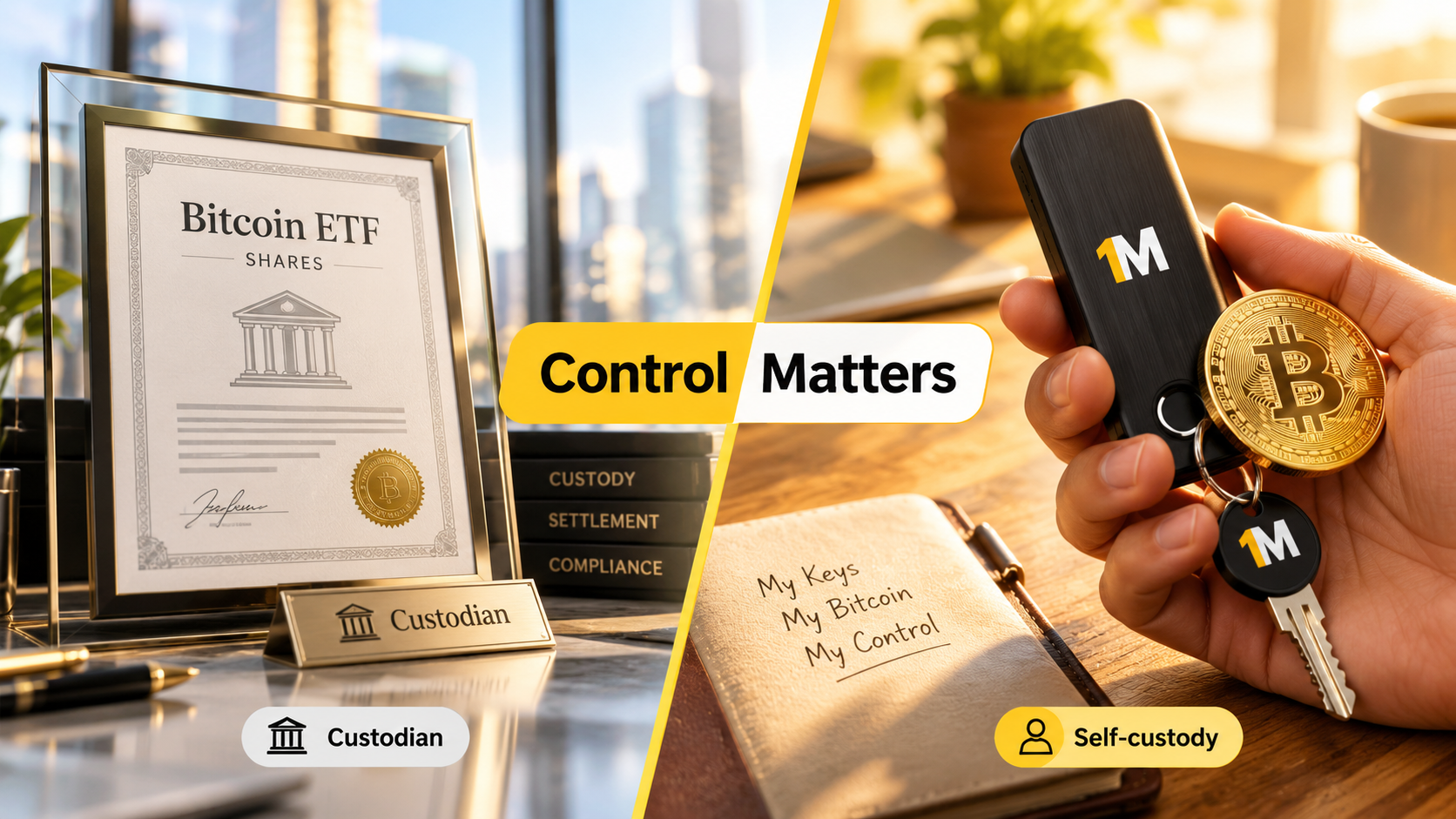
This is the biggest difference. As Fidelity puts it, with an ETP you own shares of the product, not the Bitcoin itself. That has consequences:
- • You can't send it or spend it. Fidelity notes you can't transfer an ETP's Bitcoin to other people or use it to pay merchants.
- • You generally can't personally redeem your shares for Bitcoin. Ordinary retail investors normally buy and sell spot Bitcoin ETP shares through their brokerage rather than exchanging those shares for Bitcoin. Since 2025, authorized participants have been permitted to create and redeem certain crypto ETP shares in kind using Bitcoin, but that institutional process does not mean a typical retail shareholder can simply withdraw the fund's Bitcoin to a personal wallet. Buying Bitcoin directly through a platform that permits withdrawals is different because you can move the BTC to a wallet you control.
- • You depend on institutions. Bitcoin was designed to work without banks or financial institutions. An ETF, by definition, relies on an issuer, a custodian, and a brokerage.
For someone who simply wants exposure to the price, these limits may not matter at all. For someone who wants Bitcoin's original purpose, a censorship-resistant asset they control themselves, they matter a lot.
Difference 2: Custody and Risk
When you own Bitcoin directly, the custody risks depend on how you hold it. If you use self-custody, the main risks include losing access to your wallet backups or seed phrase, exposing your credentials, or falling for a scam. If every valid recovery method is lost, there is generally no central institution that can restore access to the coins. If you leave Bitcoin with an exchange or other platform instead, you take on that company's custody and counterparty risks.
Spot Bitcoin ETPs remove many of the day-to-day security tasks involved in holding Bitcoin yourself. You don't need to manage a crypto wallet, private keys, or recovery phrase for the underlying coins. In exchange, you rely on the product's issuer and custodian to secure the Bitcoin properly. That introduces issuer, custodian, cybersecurity, and operational risks in addition to Bitcoin's price volatility.
There is also an important distinction when it comes to regulation. Spot Bitcoin ETPs are securities products subject to federal securities laws and regulatory oversight, but they are not registered investment companies under the Investment Company Act of 1940. That means they do not receive all of the same protections that apply to traditional registered ETFs and mutual funds.
Directly held Bitcoin is not FDIC-insured or protected by SIPC. If ETP shares are held through a SIPC-member brokerage, however, SIPC protection may apply to eligible securities or cash that go missing if the brokerage fails, subject to its rules and limits. That protection does not cover Bitcoin price declines, normal investment losses, or a drop in the market value of the ETP.
Both routes carry the full volatility of Bitcoin. A fund doesn't smooth the ride. Because it holds only Bitcoin, Fidelity notes, it isn't diversified like a broad stock fund.
Difference 3: Fees
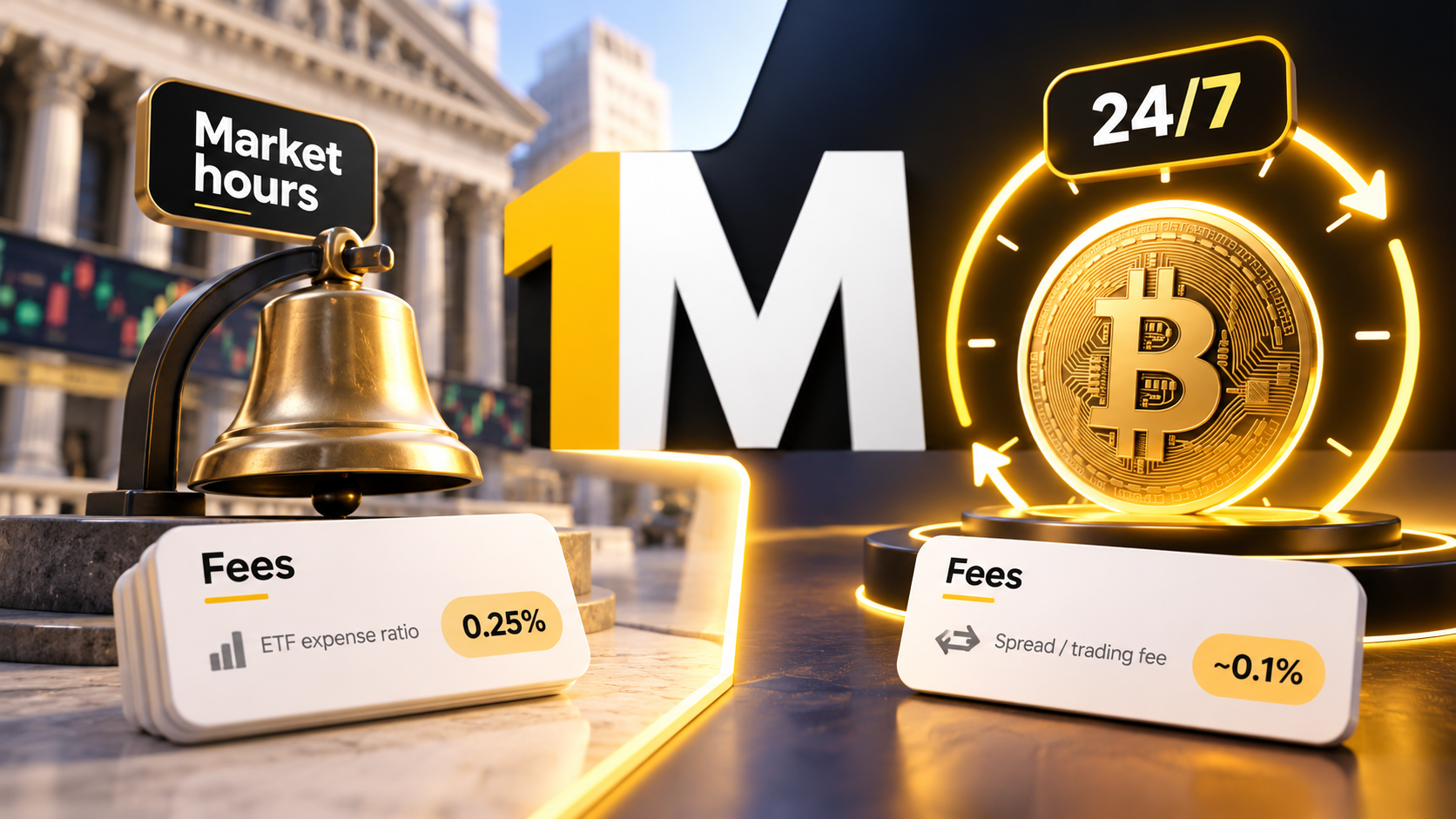
ETFs charge an annual expense ratio, a percentage of your holdings deducted from the fund's assets. You don't see a bill, but over many years it can meaningfully reduce returns. River gives a futures-based fund's 0.95% yearly ratio as one example. For the spot funds, Coinbase's launch-week newsletter reported very low introductory pricing, such as BlackRock's fund charging 0.12% for the first 12 months or first $5 billion in inflows, and another issuer waiving its fee for six months or up to $5 billion. Those were promotional launch terms limited by time or fund size, so check each fund's current fee before you buy.
Buying Bitcoin directly has no fund fee. Instead, you pay in other ways: trading fees or a spread when you buy, network fees when you move coins, and possibly the cost of a hardware wallet if you choose one. For small, one-time purchases, these costs can be higher in percentage terms than an ETF's annual fee, and for long-term holders who buy once and hold, they can be lower. The right comparison depends on how much you invest, how often you trade, and how long you hold.
Difference 4: Trading Hours
Bitcoin trades around the clock, every day of the year. ETFs trade only during stock-market hours. Fidelity points out the practical effect: if Bitcoin makes a large move over a weekend, ETP holders may be unable to react until markets reopen.
This cuts both ways. Some investors find it a feature, since it forces a pause before reacting. Others find it a limitation, especially when markets move fast.
Difference 5: Convenience, Accounts, and Taxes
For many people, convenience is the whole point of an ETF. You can buy it through a standard brokerage account, IRA, or trust, with no crypto exchange to sign up for, no wallet to set up, and no recovery phrase to protect. Coinbase's newsletter expected the funds to bring many new investors into Bitcoin for this reason, and Fidelity says the product avoids wallets, private keys, and exchange-based storage.
Taxes can also be simpler. Fidelity notes that tax reporting for traditional assets is often automated through brokerage platforms, whereas crypto tax reporting may require uploading transaction records to tax software. Tax rules vary widely by country and by account type, and neither Fidelity's page nor this article provides specific rates or rules, so confirm the treatment in your own situation with a qualified tax professional.
Difference 6: How Closely the Price Matches
When you own Bitcoin directly, you hold BTC itself, but there is no single universal execution price across every exchange or trading platform. Prices, spreads, and transaction costs can vary slightly by venue. A spot Bitcoin ETP, meanwhile, is designed to track Bitcoin through a benchmark and the value of the Bitcoin it holds, but its market price and returns will not match Bitcoin perfectly. Management or sponsor fees, trading frictions, premiums or discounts to net asset value, and tracking effects can create small differences. Fidelity notes that spot Bitcoin ETPs provide exposure to Bitcoin's broader price movements without tracking them on a perfectly precise one-to-one basis.
The Arguments People Make Against Spot ETFs
Not everyone in the Bitcoin community is enthusiastic about ETFs. River summarizes the concerns some people raise:
- • Bitcoin could become concentrated among a small number of custodians.
- • Fund shares could create "paper Bitcoin" claims, a worry that more claims on Bitcoin might exist than actual coins.
- • Large traders could influence price discovery through ETF trading.
On the other side, River lists the benefits supporters point to: large inflows of capital, added legitimacy, easier access for financial advisors who want to include Bitcoin in client portfolios, and simple access through existing brokerage accounts. Both sets of arguments are opinions about the future, not settled facts, and thoughtful people land on different sides.
A Third Option: Mining It Instead
Buying and ETFs aren't the only ways to end up with Bitcoin. You can also earn it by mining, and some people compare mining to buying directly. The logic is simple: mining only beats buying if it costs you less to produce a coin than the market charges for one.

The comparison is useful, but both mining examples should be treated as case studies rather than universal forecasts. This one-week mining-margin analysis from Cassys on Medium is a snapshot based on the Bitcoin price, hashprice, network conditions, hardware, and electricity assumptions at that particular point in August 2026. The OneMiners mining-versus-buying analysis uses a different September 24, 2026 snapshot and models specific hardware at both a low hosted electricity rate and a much higher household rate.
Those examples show why the answer can change dramatically depending on electricity cost. In the OneMiners model, mining could produce Bitcoin below the market price under cheap hosted power, while the same hardware was far more expensive than simply buying Bitcoin at a household electricity rate.
The main lesson from both examples is that mining economics depend heavily on the assumptions used. Electricity cost is especially important, but hardware price, efficiency, uptime, hosting fees, Bitcoin's market price, transaction fees, and changes in network difficulty can also affect the result. Before choosing between mining and buying Bitcoin directly, compare the options using current figures and several realistic scenarios rather than relying on a single snapshot.
Who Might Prefer an ETF?
An ETF can make sense if you:
- • Want Bitcoin exposure inside an existing brokerage or retirement account.
- • Don't want to manage wallets, keys, or recovery phrases.
- • Prefer a regulated product with familiar tax reporting.
- • Mainly care about price exposure and don't need to spend or move Bitcoin.
Who Might Prefer Buying Bitcoin Directly?
Direct ownership can make more sense if you:
- • Want full control of your coins, including the ability to hold them in your own wallet.
- • Want to send, receive, or spend Bitcoin.
- • Value not depending on a fund issuer, custodian, or brokerage.
- • Want to trade or access the market at any hour.
- • Plan to hold for a long time and are comfortable learning basic security.
Can You Do Both?
Yes. Many people keep part of their Bitcoin exposure in an ETF inside a retirement or brokerage account and hold some real Bitcoin in a wallet they control. The two aren't mutually exclusive, and each can serve a different purpose.
Common Misconceptions
"A Bitcoin ETF means I own Bitcoin." You own shares of a fund that holds Bitcoin. That's different from owning coins you control.
“ETFs are risk-free because they're regulated." Regulation does not make a spot Bitcoin ETP risk-free. You are still exposed to Bitcoin's price volatility, tracking differences, issuer and custodian risk, cybersecurity risk, and the product's structure. Spot Bitcoin ETPs are also not registered investment companies under the Investment Company Act of 1940 like traditional ETFs. Directly held Bitcoin itself is not FDIC-insured or SIPC-protected. SIPC protection for securities held through an eligible brokerage is a separate matter: it may apply if a SIPC-member brokerage fails and customer securities or cash are missing, but it does not protect against Bitcoin or ETP market losses.
"Buying directly is always cheaper." Not necessarily. It depends on your trading fees, how much you invest, and how long you hold.
“If I buy a Bitcoin ETF, I can withdraw the underlying Bitcoin later.” Not as an ordinary retail investor. Retail shareholders normally sell their ETP shares through a brokerage rather than redeeming them for Bitcoin. Authorized participants may use approved in-kind creation and redemption processes, but that is an institutional mechanism and is different from withdrawing BTC from a crypto platform to your personal wallet.
"ETFs and Bitcoin always move identically." They move closely together, but fees and structure can create small differences.
Frequently Asked Questions
What is the main difference between a Bitcoin ETF and buying Bitcoin? With a spot Bitcoin ETP, you own shares of a product that holds Bitcoin rather than owning the underlying coins directly. When you buy Bitcoin directly, you own BTC itself. If you move that Bitcoin into a self-custody wallet, you control the private keys and can send or receive the coins yourself.
Is a Bitcoin ETF safer than buying Bitcoin? It removes risks such as losing your own keys, but adds issuer and custodian risk, and both carry Bitcoin's volatility. "Safer" depends on which risks you're more comfortable with.
Can I put a Bitcoin ETF in a retirement account? Spot Bitcoin funds trade through brokerage channels, and Fidelity says you can buy them through a standard brokerage account, IRA, or trust. Availability and rules depend on your country and provider.
Do Bitcoin ETFs trade on weekends? No. They trade during stock-market hours, while Bitcoin itself trades 24/7.
Can I withdraw Bitcoin from an ETF? Ordinary retail investors generally cannot turn their spot Bitcoin ETP shares into Bitcoin and withdraw the coins to a personal wallet. Retail investors normally sell their shares through a brokerage. However, authorized participants may be able to create or redeem shares in kind using Bitcoin under approved ETP structures. This is different from buying Bitcoin directly through a platform that allows withdrawals to a self-custody wallet.
Which has lower fees, an ETF or buying directly? It depends. ETFs charge a yearly expense ratio, while direct buying involves trading fees or spreads and possibly wallet costs. Compare the actual fees for the specific products you're considering.
Is mining better than buying? It can be more cost-efficient under certain conditions, but it is not automatically better. Mining makes the strongest economic case when your all-in cost of producing Bitcoin—including hardware, electricity, hosting, maintenance, and expected changes in network difficulty—is below the cost of buying the same amount of Bitcoin directly. The result can change significantly with electricity prices and network conditions, so any comparison should use current data rather than assuming one option will always win.
Do I have to choose just one? No. Many people use both.
Final Thoughts
A Bitcoin ETP and Bitcoin itself offer two different ways to gain exposure to the same underlying asset. The ETP offers simplicity, familiar brokerage access, and potentially easier reporting, but you give up direct control over the Bitcoin and cannot use the underlying coins for payments or transfers. Buying Bitcoin directly gives you the actual BTC and, if you use self-custody, control over the private keys—but that control also comes with additional security responsibilities. Neither option is right for everyone. Ultimately, the choice comes down to what you want most: exposure to Bitcoin's price through a familiar investment product, or direct ownership of Bitcoin itself.