
If you bought Bitcoin during the run-up to the October 2025 high, there's a decent chance you're sitting on a paper loss right now. After the sharp November 2026 decline, unrealized losses are an important year-end concern for some investors. Any price reference in this article is historical, not a live quotation.
Here's the part many people miss: a loss on paper does nothing for your tax return. A loss you've actually realized might. And for most people filing on a calendar year, the window to realize a loss for 2026 closes on December 31, for calendar-year taxpayers.
This guide walks through how capital losses work for Bitcoin, what changed with cost-basis rules and the new Form 1099-DA, how proposed digital-asset wash-sale legislation could change strategies that involve selling and rebuying, how choosing which coins you sell can swing your tax bill, and a practical checklist to finish before the year ends. I'll also give you my honest opinions along the way.
A quick but important note up front: this article uses US federal tax rules, because that's what the main sources (the IRS and its Taxpayer Advocate Service) cover. If you live somewhere else, your rules will differ, sometimes a lot. And whatever country you're in, this is education, not tax advice. A qualified tax professional who knows your situation is worth far more than any blog post, including this one.
The Short Answer
- • The IRS generally treats Bitcoin as property for federal tax purposes. Disposing of Bitcoin held as an investment generally creates capital gain or loss; business-held assets can require different treatment.
- • Losses only count when they're realized. The IRS Taxpayer Advocate Service says a decline in value isn't deductible until a closed transaction, such as a sale or exchange.
- • Capital losses first offset capital gains. If losses exceed gains, up to $3,000 a year can offset other income, and the rest carries forward to future years.
- • Existing stock wash-sale rules do not automatically apply to ordinary spot Bitcoin. Digital assets that are securities may be different. A House committee advanced H.R. 10357, which would extend anti-abuse provisions to digital assets, but the bill is not enacted law as of this November 24 review. Its proposed effective date could reach some 2026 transactions if passed.
- • Which coins you sell matters. Under the newer IRS rules, choosing specific lots (and documenting that choice before you sell) can change whether a sale creates a gain or a loss.
- • Records win. Whatever you decide, the single most valuable thing you can do before December 31 is get your transaction history and cost basis in order.
Let's take these one at a time.
Step 1: Understand What the IRS Counts as Taxable
The IRS's FAQs on digital asset transactions (page last reviewed 29 June 2026) start with a simple framing: digital assets are property, so the general property-transaction rules apply. According to that page, a taxable event occurs when you:
- • Sell digital assets for US dollars or similar currency
- • Use digital assets to pay for services
- • Exchange digital assets for other property or for other digital assets that differ materially in kind or extent
The page also lists what is not taxable, including transferring assets between your own wallets or accounts (though assets used to pay the transaction fee are a different story) and receiving a bona fide gift, which isn't income until you later dispose of the asset. The IRS Taxpayer Advocate Service's digital assets page says the same: transfers between wallets or accounts you own aren't taxable, and gifts received are taxed only when you later sell.
Coinbase's guide to understanding crypto taxes groups it neatly:
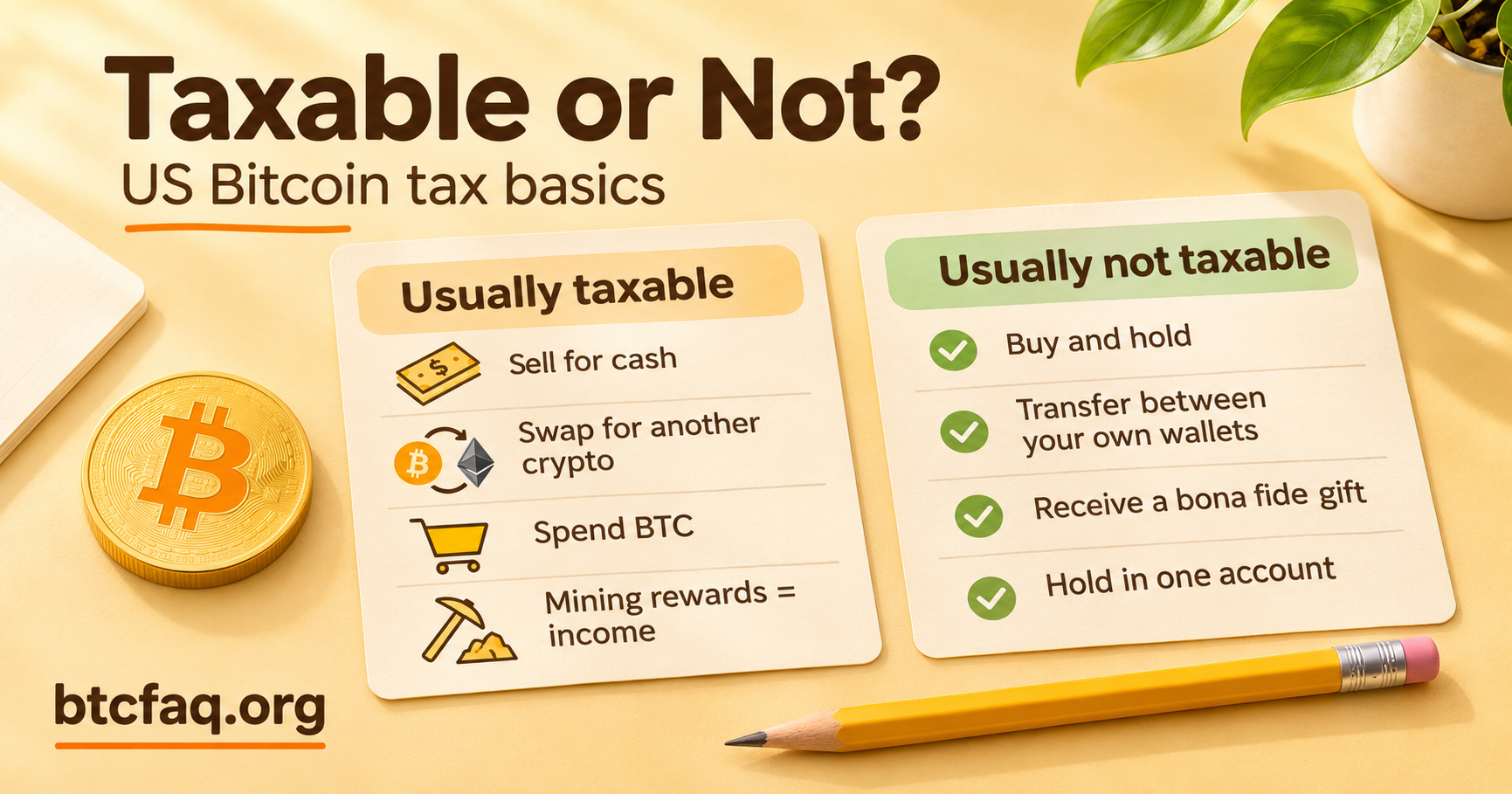
- • Not taxable: buying and holding, donating to a qualified charity, receiving a gift, moving crypto between your own wallets.
- • Taxed as capital gains or losses: selling for cash, trading one crypto for another, spending crypto.
- • Taxed as ordinary income: crypto received as pay, mining rewards, staking rewards, airdrops, hard-fork assets and similar. Those are valued at fair market value when you receive them.
Why this matters for losses: the third item is a trap. If you swap Bitcoin for another coin (not just for dollars) that is a disposition, and it can create a gain or a loss. The same goes for paying a network fee with crypto. The IRS FAQ generally treats using digital assets to pay transaction fees as a disposition that may create a gain or loss; a bill proposes limited fee relief, but that proposal is not current law.
Step 2: How Capital Losses Actually Work
This is the heart of the topic, so let's go slowly.
Gain or loss = amount realized − adjusted basis. The IRS FAQ defines the amount realized on a sale as cash received (plus the fair market value of any services received), minus allocable transaction costs. Your basis for a cash purchase is what you paid plus transaction costs. Gas fees, transfer taxes and commissions count as transaction costs, but costs to move assets between your own wallets do not.
Short-term vs long-term. Per the IRS FAQ, if you held the asset one year or less, it's short-term; more than one year, long-term. The holding period starts the day after you acquire the asset. Long-term gains are taxed at lower federal rates, which Coinbase's guide puts at 0%, 15% or 20% depending on income (higher earners may also owe the 3.8% Net Investment Income Tax), while short-term gains are taxed at ordinary income rates.
The netting order, in plain words:
- 1. Your losses first offset your capital gains. Coinbase notes this works dollar-for-dollar, including against gains from stocks.
- If you still have losses left over, you can deduct up to $3,000 per year against other income (Coinbase's guide cites this limit; it is $1,500 if you're married filing separately), and carry the remainder forward.
- 3. Carryforward losses keep their character (short-term stays short-term, long-term stays long-term) and can be used in later years.
A worked example (hypothetical, my own arithmetic)
Say you bought 0.5 BTC in October 2025 for $110,000 per coin, a cost basis of $55,000. You sell it in December 2026 at $62,000 per coin, receiving $31,000.
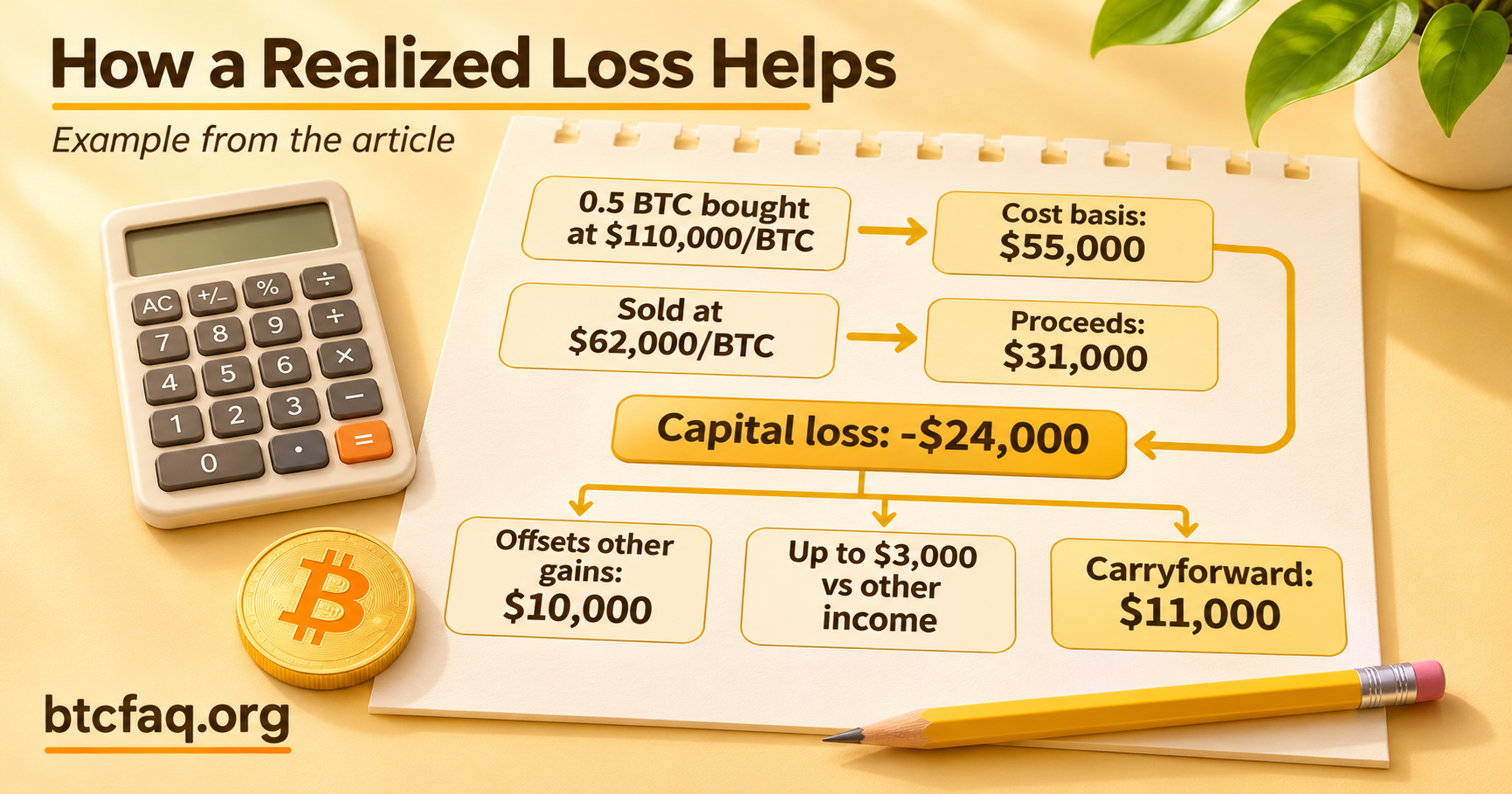
| Step | Amount |
|---|---|
| Proceeds | $31,000 |
| Cost basis | $55,000 |
| Capital loss | −$24,000 |
| Other capital gain this year (say, from stock) | +$10,000 |
| Net capital loss after offsetting the gain | −$14,000 |
| Deductible against other income this year | $3,000 |
| Carried forward to next year | $11,000 |
In a simplified illustration, offsetting a $10,000 gain otherwise taxed at 15% could reduce federal tax by $1,500. If the $3,000 capital-loss deduction is fully usable against income otherwise taxed at 24%, it could add $720, for a hypothetical combined reduction of $2,220. Real results depend on short-term/long-term netting, income thresholds, filing status, other gains, the net investment income tax and state rules. The $11,000 carryforward is not a cash refund.
Notice what the loss doesn't do: it doesn't give you your money back. You still lost $24,000, and a tax saving of a couple of thousand dollars is a small consolation. I'll come back to that in my opinions.
When is a loss "real" for tax purposes?
The Taxpayer Advocate Service page is helpful on edge cases:
- • A drop in value is not deductible until there's a closed transaction.
- • If an exchange freezes your account or goes into bankruptcy proceedings, you generally don't get a deductible loss until the matter is resolved.
- • Theft losses are treated differently and must meet the legal definition of theft in your jurisdiction.
- • A "worthless" asset must be completely worthless, not just nearly worthless.
If any of those apply to you, this is a clear case for a professional rather than a blog.
Step 3: Which Coins Did You Sell? (Cost Basis and Lot Selection)
This is the part most people don't realize matters until they see a tax bill.
If you bought Bitcoin at different times and prices, each purchase is a separate lot. When you sell part of your holdings, which lot you sold determines your gain or loss.
According to the IRS FAQ:
- • Specific identification: For assets in your own wallet or at a custodian that isn't a broker, you must identify the units no later than the time of sale or transfer, using an identifier such as purchase date or price, and keep records showing it.
- • Broker custody, after December 31, 2025: you must specify the units to your broker no later than the time of sale, using the broker's designated identifiers. A standing order must be in place with the broker by then. (For 2025 transactions, Notice 2025-7 provided more flexibility.)
- • If you don't identify: the default is treated as selling the earliest acquired units first.
- • Wallet by wallet: the IRS moved to tracking basis wallet by wallet and account by account. Rev. Proc. 2024-28 allowed a reasonable allocation of unused basis as of 1 January 2025.
Why it matters: a second worked example (hypothetical)
Suppose you hold two lots in the same account:
- • Lot A: 0.5 BTC bought in October 2025 at $110,000 (basis $55,000)
- • Lot B: 0.5 BTC bought in January 2024 at $40,000 (basis $20,000)
You sell 0.5 BTC at $62,000, receiving $31,000.
| If you sold... | Result |
|---|---|
| Lot A (specific identification) | $31,000 − $55,000 = −$24,000 loss |
| Lot B (what the default "earliest first" rule would pick) | $31,000 − $20,000 = +$11,000 gain |
| Difference | $35,000 swing from the same sale |
(Both lots would generally be long-term if the December 2026 sale occurs more than one year after the exact October 2025 purchase date.)
It's the same Bitcoin sold at the same price. What changes is the validly identified tax lot. You cannot retroactively designate the best lot after selling if you did not follow the required identification rules. That's why the IRS rules about when and how you identify lots are not a technicality.
My advice, as someone writing a blog and not your accountant: before you sell anything this month, find out exactly how your exchange or wallet software picks lots, and whether you can specify them. Then write down your choice. If you can't prove what you identified, you may be stuck with the default.
Step 4: The New Form 1099-DA (And Why Your Records Still Matter)
Starting with the 2025 tax year, crypto brokers began issuing Form 1099-DA. The IRS's instructions for Form 1099-DA say that for 2025 brokers reported gross proceeds, and for sales on or after 1 January 2026 they must also report cost basis for digital assets that are "covered securities." Bloomberg Law reports that covered status applies only to assets acquired on or after 1 January 2026 and held in the same custodial account until sold, and that transfers into self-custody or between platforms break covered status.
In plain English:
- • For reportable 2026 sales: brokers generally report gross proceeds, with cost basis for qualifying covered digital assets acquired after 2025 and held under the reporting broker’s required custody conditions. Special transaction rules and exceptions apply.
- • For noncovered coins, such as many acquired before 2026 or moved between platforms, proceeds may appear with no reported basis. Blank basis is not the same as a $0 purchase cost. The IRS FAQ is explicit that you still must report taxable transactions even without a payee statement or information return.
- • Reconcile, don't just copy. Bloomberg Law's guidance for tax professionals is that proceeds reported to the IRS should be reconciled with the client's own records so gains and losses use complete and accurate cost basis. A form with blank basis can look like a $0 cost if you're careless, which could make you overpay.
The Taxpayer Advocate Service page adds the filing mechanics: report most sales and dispositions on Form 8949, summarize on Schedule D, report ordinary digital asset income on Schedule 1 (or the applicable form), and answer the digital asset question on page 1 of Form 1040 truthfully. It also says to keep records for at least three years after reporting a taxable event, or longer if other requirements apply, and records should cover purchases, receipts, sales, exchanges and the fair market value of anything received.
Step 5: The Wash-Sale Question — What Is Law and What Is Proposed?
Tax-loss harvesting sometimes involves selling an investment at a loss and repurchasing it. For stocks and securities, Internal Revenue Code Section 1091 generally disallows a loss if the taxpayer acquires substantially identical securities in a window spanning 30 days before through 30 days after the loss sale. The treatment of the disallowed loss and the replacement asset's basis depends on the rules.
For ordinary spot Bitcoin held as a capital asset, the stock wash-sale provision has not automatically applied solely because Bitcoin is a cryptocurrency. That is not a blanket exemption for digital assets that are themselves securities, and it is not a promise that an artificial transaction will receive the intended treatment.
The 2026 bill is not enacted law
On September 16, 2026, the House Ways and Means Committee approved H.R. 10357, the Digital Asset Tax Certainty Act, 38–5. The committee announcement and Congressional Research Service overview dated November 20 describe the proposal, including expanding wash-sale rules to specified digital assets. It had not been enacted as of this review.
The proposed committee text has been described as applying to certain dispositions after September 14, 2026. That could affect earlier transactions if a law with that language is enacted, but the final rule and effective date cannot be assumed today. Consult the latest congressional bill record and a qualified tax professional immediately before acting.
Do not assume that simply waiting 31 days after selling necessarily eliminates wash-sale problems: where these rules apply, purchases in the preceding 30 days can matter too. Nor should readers assume that buying a related token or ETF is automatically an acceptable workaround. A tax-loss strategy has both market risks and legal requirements; a blog cannot decide it for an individual taxpayer.
Your Year-End Checklist (Before December 31)
Here's a practical list. Not every item applies to everyone.
- 1. Know your jurisdiction and tax year. Everything above is US federal. Calendar-year taxpayers have until December 31 to realize 2026 losses.
- 2. Export your full transaction history from every exchange, wallet and app. Include deposits, withdrawals, trades, rewards and fees. Coinbase's guide reminds readers its own report covers only activity on Coinbase and isn't official tax documentation, so verify before filing.
- 3. Reconstruct your cost basis, lot by lot, including transfers between your own wallets. The IRS says to track basis wallet by wallet.
- 4. List your realized gains and losses so far this year. Include stock and other assets if you're planning to offset gains.
- 5. Check your unrealized positions. Which lots are underwater, and by how much? What would selling each one do to your net result?
- 6. Decide whether to harvest, not just how. Do you actually want to sell, or are you just chasing a tax saving?
- 7. Plan lot selection and write it down. Specify the lots to your broker or document them for self-custody at or before the time of sale.
- 8. Mind the clock. Exchange timestamps may use UTC. A trade near midnight on 31 December could land in a different year than you expect. Don't leave it to the last hour.
- 9. Understand the wash-sale risk as of the day you act (see above), and keep notes on what you did and why.
- 10. Review ordinary income. Mining, staking, airdrops and similar are taxed at fair market value when received. Make sure you've captured those, and check whether estimated tax payments apply to you.
- 11. Consider charitable giving if it already fits your goals. Donations of qualifying long-term appreciated Bitcoin may receive favorable treatment, but eligible organizations, deduction limits and substantiation rules matter. A qualified appraisal is generally necessary for donated crypto when a claimed deduction exceeds $5,000, along with applicable Form 8283 requirements.
- 12. Answer the Form 1040 digital asset question accurately when you file.
- 13. Keep records for at least three years, and longer if the rules require it.
- 14. Book a tax professional now, not in March.
If You Mine or Host Bitcoin Miners
Mining can complicate a U.S. tax return because block or pool rewards are generally included in gross income when the taxpayer receives or controls them, measured at fair market value. That amount generally establishes tax basis. Later disposing of the coins can create a gain or loss, but the character depends on whether the coins are capital assets or held as part of a trade or business. Business miners may also face self-employment tax, deductible operating costs and equipment depreciation; none of these should be assumed without examining the actual setup.
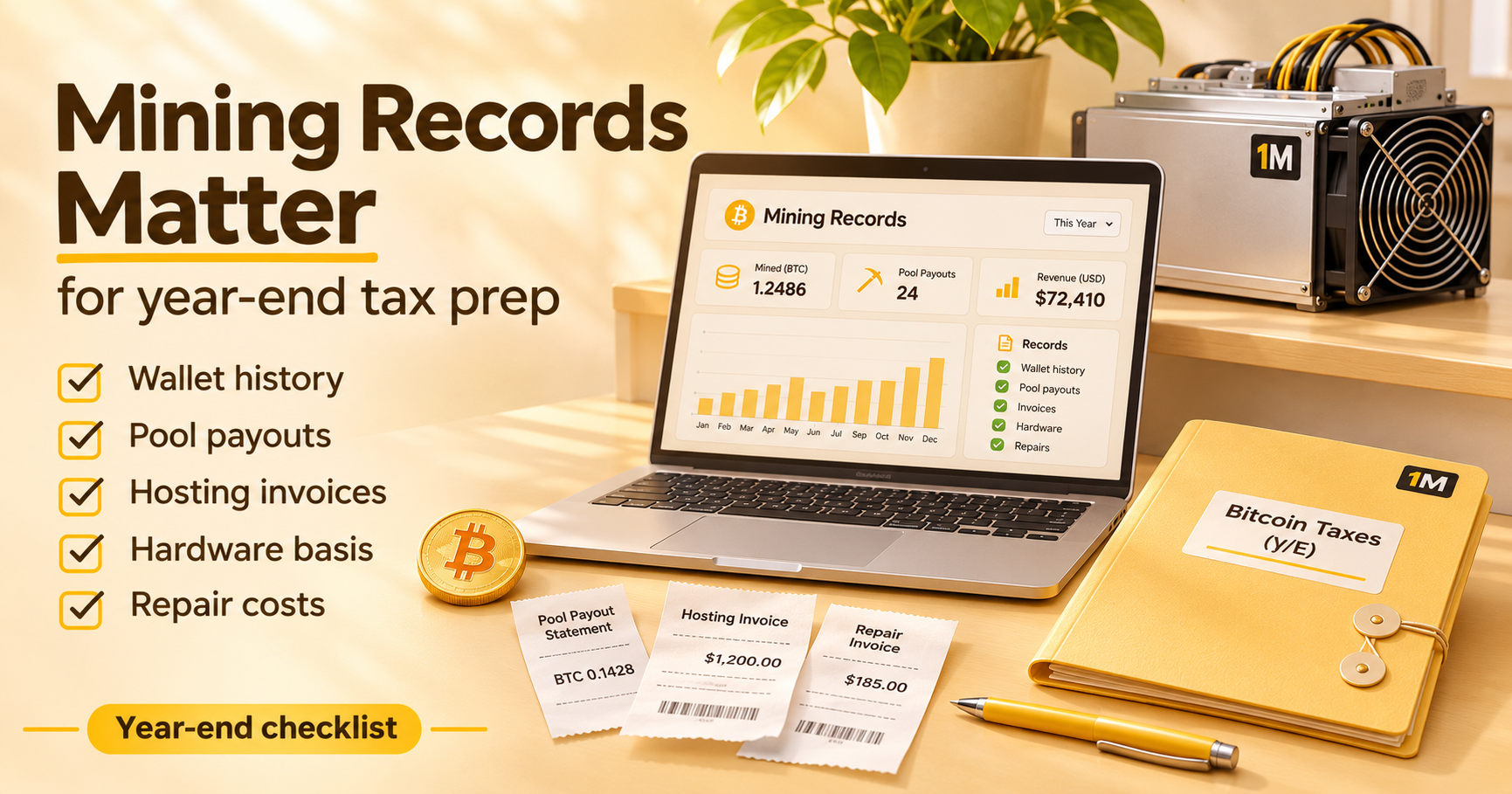
Keep records of wallet and exchange transactions, pool payout timestamps, reward values, electricity and hosting invoices, hardware acquisition and service dates, repairs and equipment disposals. The IRS digital-asset FAQs and current accountant guidance should be the starting points for classifying these items.
Why OneMiners' tax service is worth knowing about
OneMiners offers a crypto and mining tax service that specifically addresses mining payouts, hosting invoices and equipment depreciation—not just exchanges. The company's published page advertises a free 30-minute consultation, open to noncustomers, and full return preparation starting at $300 per tax year, with scope and price agreed before paid work begins. The advertised service currently covers U.S. and Czech Republic tax residents, and filings are reviewed by a licensed advisory partner. It is not advertised for taxpayers in every country.
For existing OneMiners hosting customers, the company says payout and invoice history can be pulled through its platform, potentially reducing manual reconciliation work. The Medium walkthrough of the OneMiners app is another resource for understanding the monitoring environment, though it is not tax guidance.
This is a practical advantage worth comparing, not a guarantee that a particular mining expense is deductible or that an advisor will obtain a refund. Confirm credentials, filing jurisdictions, security for your records, exact return scope and costs with any provider you consider.
Honest Opinions: What I Think About Tax-Loss Harvesting
Here are my own views. Treat them as one person's opinion, not advice.
- 1. I think the tax tail shouldn't wag the investment dog. A tax saving of a couple of thousand dollars isn't a reason to sell something you want to hold for years, especially if you might miss a rebound while sitting out. Decide on your investment thesis first, taxes second.
- 2. I think losses aren't a silver lining, just a small cushion. In my worked example, you lose $24,000 to save roughly $2,200 of tax. It softens the blow. It doesn't cancel it.
- 3. I would check the legal status before any sale-and-repurchase plan. The proposed bill could change the treatment of some 2026 transactions if enacted, but it is not current law at the date reviewed.
- 4. I think lot selection is the most underrated tax lever. Most people never choose their lots and let the default pick for them. Learning to document your choices is worth more than most tax tricks.
- 5. I think record keeping beats cleverness. I'd rather have a boring spreadsheet with every purchase and fee than an elegant strategy I can't prove.
- 6. I think the new 1099-DA forms will cause confusion for years. Blank basis, partial basis, moved coins: anyone who has moved Bitcoin between platforms should expect to reconcile.
- 7. I think paying a professional is usually worth it if you have mining income, multiple wallets, DeFi, or large positions. A few hundred dollars is cheap against a mistake that costs thousands.
A Note on Sources
I used IRS and Taxpayer Advocate Service pages for the core rules, a Coinbase educational article for general rules, law-firm and accounting-firm commentary (EY, Forvis Mazars, RSM, Bloomberg Law) for the legislative picture, and OneMiners' own tax services page for the mining-related items. A few caveats:
- • The IRS FAQ page I read was last reviewed 29 June 2026, and rules and guidance can change.
- • The Coinbase article has no publication date and refers to older gift-tax figures. I used it only for general rules.
- • The OneMiners tax page is a promotional service page from a company with a commercial interest, and prices can change.
- • Legislative status (H.R. 10357) moves fast. Please verify it before acting.
- • I couldn't read the Medium write-up, so I took no content from it.
Common Misconceptions
"My Bitcoin is down, so I can deduct the loss." Not until you sell, exchange or otherwise dispose of it. A drop in value isn't deductible until a closed transaction.
"I can deduct all my crypto losses against my salary." No. Capital losses offset capital gains first, and then only $3,000 a year against other income, with the rest carried forward.
"Moving Bitcoin to my own wallet is a taxable sale." Generally no. Transfers between your own wallets or accounts aren't taxable, though using crypto to pay the network fee can be a disposition.
"The exchange's 1099-DA is all I need." It may show proceeds without cost basis for older coins, and it won't cover activity elsewhere. You're still responsible for reporting accurately.
"Wash-sale rules never apply to crypto." That is too broad. The existing rule covers stocks and securities, and a pending bill would extend it to specified digital assets. The bill is not yet law as of the date checked.
"If I don't get a tax form, I don't have to report." The IRS FAQ says taxable transactions must be reported even without a payee statement or information return.
Frequently Asked Questions
Can I deduct Bitcoin losses on my taxes?
In the US, yes, once you've realized them through a sale or exchange. Losses first offset capital gains, then up to $3,000 a year can offset other income, with the remainder carried forward.
What is the $3,000 capital loss limit?
It's the maximum net capital loss you can deduct against ordinary income in a single year ($1,500 if married filing separately). Unused losses carry forward to future years.
Does the wash sale rule apply to Bitcoin?
Current law does not automatically extend stock wash-sale rules to ordinary spot Bitcoin. The September 2026 House committee bill H.R. 10357 proposes broader rules and a potentially earlier 2026 effective date, but the proposal is not enacted as of November 24, 2026.
What's the deadline for tax-loss harvesting in 2026?
For calendar-year taxpayers, the sale must happen by 31 December 2026. Don't wait until the last hour, since exchange timestamps may use a different time zone.
Is moving Bitcoin between my wallets taxable?
Generally not. The IRS and Taxpayer Advocate Service both say transfers between wallets or accounts you own are not taxable events, but paying the network fee with crypto can be a disposition.
Do I have to report crypto if I only lost money?
Yes. You should still report your transactions. Reporting losses is also how you claim them.
What is Form 1099-DA?
It's the form that crypto brokers use to report digital asset sales to you and the IRS. For 2025 it reported gross proceeds. For 2026 sales, brokers must also report cost basis for "covered" assets acquired on or after 1 January 2026 and held in the same account.
Which coins do I sell first?
Under the IRS rules, you can use specific identification if you identify the units at or before the time of sale and keep records. If you don't, the default is the earliest acquired units first.
Is mining income taxed differently?
Mining rewards generally create income at fair market value when received or controlled. That value typically establishes basis. Later tax treatment depends on whether the coins are held as capital or business assets; business expenses and self-employment tax may also apply.
Should I hire a tax professional?
If you have significant holdings, mining income, multiple wallets, DeFi or international issues, it's usually worth it. This article is general education only.
What if I live outside the US?
Your country's rules apply, and they vary widely. This article covers US federal rules only. OneMiners' tax service covers US and Czech residents only, per its page.
Sources and Further Reading
- • IRS: Digital-Asset Transaction FAQs
- • IRS: Form 1099-DA Instructions
- • IRS: Topic 409 — Capital Gains and Losses
- • IRS: Form 8283 Instructions
- • Taxpayer Advocate: Digital Assets
- • Congressional Research Service: Income Tax Treatment of Cryptocurrency (Nov. 20, 2026)
- • OneMiners: Crypto & Mining Tax Services
- • Medium: OneMiners App Explained
Final Thoughts
If you remember three things, make them these. First, a loss only counts once it's realized, so decide deliberately whether you want to realize it. Second, which lots you sell, and whether you can prove it, can matter more than the headline price. Third, confirm the status of proposed wash-sale legislation before relying on a sell-and-rebuy strategy, especially because the committee proposal could reach certain 2026 transactions if enacted.
Bitcoin's drop is already painful enough. Don't let sloppy records or a rushed December trade make it more expensive. Export your history, work out your lots, check the current rules, and talk to a professional before December 31 arrives.
This article is for education and information only. It is not tax, legal, financial or investment advice. It describes US federal tax rules as understood on 24 November 2026 from the sources linked; rules, guidance and pending legislation change, and rules in other countries differ. Cryptocurrency is highly volatile and you can lose some or all of your money. Consult a qualified tax professional about your own situation.