Here's a situation that will sound familiar. In November 2026, Bitcoin fell sharply from above $80,000 earlier in the month to around 60,000–64,000 later on. These are historical reference levels, not a live quote. You've been wanting to buy some for months. But now every instinct says wait: what if it falls another 20%? And then, if it bounces 10%, a different instinct says quick, buy before it's gone. You end up doing nothing, or doing the wrong thing at the wrong time.
That exact loop is one reason dollar-cost averaging (DCA) is often discussed as a way to buy Bitcoin. It's also one of the most misunderstood. People treat it as a magic trick that "beats" the market, when really it's a behavior tool with real strengths and real limits.
In this guide I'll explain how DCA works, show worked examples (including a staged-buy illustration using three reported November prices), look at what the research and the exchanges' own guides say, cover the downsides nobody likes to mention, and give you my honest opinion on whether it's smart. This is educational content, not financial advice.
The Short Answer
Dollar-cost averaging is a sensible way to enter a volatile market if your main risks are bad timing and emotional decisions. It is not a way to avoid losses, and it often returns less than investing everything at once if prices rise.
Here's the version to keep in your head:
- • What it does well: removes the pressure to pick the "right" day, spreads your purchases across good and bad prices, and makes it easier to keep buying calmly.
- • What it doesn't do: protect you from a market that keeps falling, guarantee a profit, or beat lump-sum investing on average when prices trend up.
- • What it needs from you: the discipline to keep buying when prices are low and everyone around you is panicking. That's the hard part, not the setup.
So is it smart? It can be a sensible way to invest manageable amounts from income if buying Bitcoin fits your financial goals and ability to bear losses. The schedule is not a reason to buy an asset you otherwise would not want to hold.
What Is Dollar-Cost Averaging?
DCA means buying a fixed amount of money worth of an asset at regular intervals, no matter what the price is. Fidelity's guide to crypto dollar-cost averaging, dated 5 May 2026, describes it as investing equal amounts at regular intervals whether the market is rising or falling, so you don't need to time the market. Its examples are simple: $100 of Bitcoin on the first day of every month, or a slice of each paycheck.
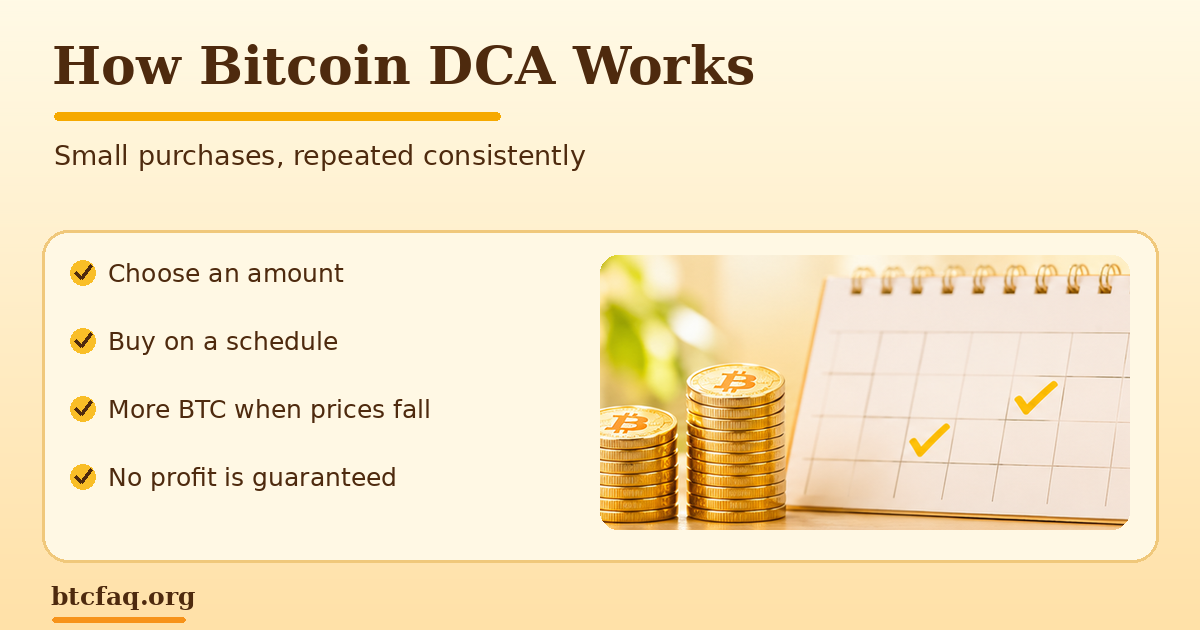
The key thing to understand is the mechanism. Because your dollar amount is fixed, you buy more bitcoin when the price is low and less when the price is high. With equal dollar purchases, your cost basis per coin is the harmonic mean of the sampled prices before fees. That is below the simple arithmetic mean of those sampled prices, but it does not guarantee a profit or a better result than investing a lump sum at the beginning.
Why the "average" is better than it looks
Blockstream's education article on DCA into Bitcoin makes a nice technical point: for equal-dollar, fee-free purchases, your average price paid per bitcoin is the harmonic mean of the purchase prices. It is no greater than their arithmetic mean, but fees and unequal contributions change the calculation. Here's the intuition with a tiny example (my own calculation): if you put $100 into Bitcoin at $60,000 and another $100 at $30,000, the simple average of the two prices is $45,000. But you actually bought 0.00167 BTC the first time and 0.00333 BTC the second time, for $200 total. Your average acquisition cost is $40,000 per BTC, before fees. That's the built-in benefit of buying a fixed dollar amount: the cheap purchases carry more weight.
Why DCA Appeals to Bitcoin Buyers in Particular
Bitcoin isn't a gentle asset. Wells Fargo Investment Institute noted earlier this year that Bitcoin's annualized volatility has often been 50% to 80%, versus about 15% to 20% for the S&P 500. Blockstream's article says Bitcoin's bear markets have brought declines of roughly 50% to 94%, and that 30% to 50% pullbacks within a year are common.
When the price swings like that, two problems show up:
Problem 1: Timing. Nobody reliably calls the top or bottom. Blockstream points out that even large institutions and quant funds miss turns, and that Bitcoin's best days often arrive during periods of fear, so sitting out waiting for the "perfect" entry can cost you.
Problem 2: Emotion. Most people buy when it feels good (rallies) and sell when it hurts (crashes). Kraken's guide to DCA frames it as a way to reduce FOMO and fear-driven decisions by making purchases predetermined, and Fidelity says it reduces guesswork and emotion in market entry.
DCA tackles both by turning one scary decision ("is now the right time?") into a boring routine ("it's the first of the month").
A November Price Illustration: Staged Buying Versus a Lump Sum
Let me show you how DCA behaves in the kind of market we've actually had this month. I'll use reported prices at three points: about $81,105 on 4 November (the November high, per Blockhead), $69,135 on 13 November (Fortune's price tracker) and $63,748 on 19 November (Fortune again). Prices came from different times of day and different sources, so this is a price-snapshot illustration, not an executable trading backtest. Also, purchases on November 4, 13 and 19 are unevenly spaced: this example shows the arithmetic of spreading a purchase across dates, not a strict fixed-day weekly or monthly DCA plan. An actual DCA test should use a fixed calendar schedule and consistently timed prices.
Suppose you invested $300 two ways:
| Strategy | What you did | BTC acquired | Average cost | Value at $63,748 | Result |
|---|---|---|---|---|---|
| Lump sum | $300 on 4 Nov at $81,105 | ~0.003699 BTC | $81,105 | ~$235.80 | −21.4% |
| DCA | $100 each on 4 Nov, 13 Nov, 19 Nov | ~0.004248 BTC | ~$70,620 | ~$270.81 | −9.7% |
The DCA buyer is still down, because nothing changes the fact that the price fell. But they lost less than half as much and ended up with about 15% more bitcoin for the same $300 (0.004248 vs 0.003699 BTC, my own arithmetic). That shows why spreading purchases helped on this falling price path. It is not evidence that DCA will always beat investing at once.
Now the flip side: if prices had risen consistently across those three dates, the lump-sum buyer would have accumulated more BTC, because the entire $300 was deployed at the lower first price. The example excludes trading fees, spreads, taxes and interest on uninvested cash. DCA gives up some potential upside in exchange for protection against buying everything at the top. Which brings us to the real trade-offs.
Three Hypothetical Markets: When DCA Wins and When It Doesn't
To see the pattern, I modeled 100permonthfor12months(1,200 total) and compared it with investing the entire $1,200 at the first month's price. These are invented monthly price paths, not forecasts or historical backtests. Each strategy is valued at the final month's price, with no fees, spread, tax or interest on idle cash. In the rising and falling cases, purchase prices move in equal monthly increments between the endpoints. In the dip-and-recovery case, the 12 purchase prices are $60k, $54k, $48k, $42k, $36k, $30k, $36k, $42k, $48k, $54k, $60k and $66k.
| Market scenario (12 months) | DCA average cost | DCA result | Lump-sum result | Winner |
|---|---|---|---|---|
| A. Steady rise ($50k → $100k) | ~$71,600 | +39.7% | +100.0% | Lump sum |
| B. Dip then recovery ($60k → $30k → $66k) | ~$45,500 | +45.0% | +10.0% | DCA |
| C. Steady decline ($60k → $15k) | ~$31,400 | −52.3% | −75.0% | DCA (but both lose) |
What this shows:
- • In a rising market, lump sum wins, simply because it's invested earlier. Fidelity says this directly: DCA may return less than a lump sum if prices rise over time, and Kraken says the same about average cost in a rising market.
- • In a dip-and-recovery market, DCA shines. You keep buying through the low, and your average cost ends up well under the final price.
- • In these two declining-price examples, DCA loses less by the end date, but still loses. Fidelity notes that DCA doesn't assure a profit or protect against losses in falling markets, and Blockstream warns that a permanent decline with no recovery would leave DCA with a falling average cost that never catches up.
My own takeaway: DCA is a hedge against regret and bad timing, not against Bitcoin going down.
What Does the Evidence Say?
A few data points worth knowing, each from the sources above:
- • Lump sum often wins on paper. Blockstream cites a 2012 Vanguard study in which lump-sum investing beat DCA about two-thirds of the time in equity markets, and argues the case may be stronger for an asset with a strong upward trend, though that's not guaranteed. Fidelity gives a Bitcoin example too: investing the whole $1,000 near the late-2018 bottom would have beaten spreading it out.
- • Longer DCA windows have often fared better in selected historical Bitcoin backtests. Blockstream's educational guide discusses favorable multi-year windows. This is a retrospective result influenced by the dataset, exact entry dates, price source, fees and ending date—not a rule that any new four-year schedule must be profitable.
- • Short windows can be rough. The same article notes that a one-year DCA starting in November 2021 was underwater for over a year, while one starting in January 2023 was profitable within months. Timing still matters at short horizons.
- • Fidelity's historical scenario is a nice reminder: someone who bought $100 of Bitcoin monthly for 10 months in early 2018 would have been down by the end of that bear-market year, but by mid-2021 (when Bitcoin hit new highs) would have been well ahead. The catch: they had to keep buying and keep holding for years.
The Downsides Nobody Puts in the Ad
DCA gets promoted heavily, and some of the people promoting it sell crypto. So let me be direct about the drawbacks:
- 1. It doesn't protect you from a bear market. If prices fall for a long time, you'll sit on losses. Fidelity warns about "long periods with investments showing losses."
- 2. It can underperform lump sum. Covered above.
- 3. It requires conviction. Fidelity says DCA may only make sense if you're confident the asset will rise over the long term. If you're not, DCA just means "slowly buying something you doubt."
- 4. Fees can add up. Kraken notes that more frequent orders can cost more, especially on centralized exchanges. Weekly buys with a 1.5% fee are very different from monthly buys with a 0.2% fee.
- 5. Recurring buys may not execute at the best price. Kraken's own terms say recurring buys aren't guaranteed to execute at prices as favorable as manual orders.
- 6. Holding cash between purchases may earn little. Fidelity points this out for people who save up a lump sum and deploy it gradually (it doesn't apply if you invest a slice of each paycheck).
- 7. It works only if you keep going. Blockstream lists common mistakes: pausing during drawdowns, checking prices constantly, overcommitting and tinkering with the schedule.
I'd add an eighth, which is more of a mindset trap: DCA can feel like a safe strategy. It isn't. It's a disciplined strategy applied to a risky asset, and those are different things.
Is DCA Smart Right Now?
I'm not going to tell you whether to buy this week. Nobody can. But I can tell you what the current environment does to the DCA argument.
The case that DCA fits this market. Bitcoin is down roughly 50% from its October 2025 peak of around $125,000, volatility is high, headlines are loud, and November alone has had flash drops and heavy liquidations. If you want a taste of how sudden these moves can be, there's a separate Medium write-up titled Bitcoin Drops From $75,500 to $74,000 in 20 Minutes: What Happened on November 9, 2026. Trying to catch the exact low in a market like this is a coin flip. A schedule takes that pressure away.
The case for caution. Prices may fall further. As of the November 24 review date, the Federal Reserve's December meeting and the effects of ETF flows, macroeconomic expectations and leveraged liquidations remain uncertainties—not a reliable short-term Bitcoin forecast. DCA doesn't stop you from buying into more weakness. If a 30–50% further drop would make you quit, the problem is the size of your plan, not the schedule.
My practical stance. If you're going to DCA into this market, size it so that a further large drop doesn't change your behavior. That usually means smaller amounts than your first instinct says.
How to Set Up a DCA Plan (A Practical Checklist)
Here's the process I'd follow. It combines the guidance in the three guides above with my own opinions:
- 1. Decide the total you can afford to lose entirely. Fidelity says to only invest an amount you're willing to lose. Kraken mentions that some traders cap crypto at no more than 10% of savings; Wells Fargo's report views roughly 2% to 3% as appropriate for certain portfolio types. Those are very different numbers from different institutions, which tells you there's no universal right answer. Choose a cap that lets you sleep.
- 2. Pick an amount per purchase you can sustain. If it feels uncomfortable in a month, it's too big. Blockstream's examples use $50 or $100 a week, which works out to $2,600 or $5,200 a year.
- 3. Pick a frequency. Weekly or monthly are the most common. More frequent buys spread timing risk further (Blockstream notes 52 weekly buys in a year versus 208 over four years), but cost more in fees if your platform charges per trade.
- 4. Choose a duration. Kraken's guide mentions anywhere from 6–12 months to several years depending on goals. Blockstream's backtest hints that longer horizons have historically done better, but remember that's a backtest.
- 5. Check the fees. Compare the fee per recurring buy and the spread. A strategy with high spreads or fees can quietly reduce the BTC acquired; compare total execution cost, including minimum fees, before automating small buys.
- 6. Automate carefully. Recurring orders can reduce repeated decisions, but review the platform's total fees, deposit method, execution price, cancellation controls and security. Automation is optional; it does not make the purchase safe.
- 7. Plan your custody. Blockstream recommends not leaving Bitcoin on an exchange long-term, since exchanges are exposed to insolvency, hacks, freezes and regulatory action, and suggests a regular withdrawal habit: for example, moving coins to a self-custody wallet every few months as balances grow. Verify and securely store your recovery phrase before sending anything. (We have separate guides on seed phrase backups and multisig if you want the details.)
- 8. Keep records. Tax rules vary by country, and Kraken reminds readers that tax may apply to gains. Record every purchase date, amount and price.
- 9. Write down your rules for stopping. Decide in advance what would make you pause or stop (for example, losing your job or needing the money). Don't decide in the middle of a crash.
- 10. Check in rarely. Reviewing monthly or quarterly is plenty. Blockstream lists constant price-checking as a common mistake.
DCA Cost Basis: A Formula You Can Reuse
For equal-dollar purchases without fees, your average acquisition price per BTC is:
Average cost per BTC = total dollars invested ÷ total BTC received.
If you make n equal-dollar purchases at prices P₁, P₂, …, Pₙ, this is equivalent to n ÷ (1/P₁ + 1/P₂ + … + 1/Pₙ), the harmonic mean. Unequal contributions, commissions, spreads and transaction fees require using the actual executed cash spent and coins received.
A practical spreadsheet needs only five fields: purchase date, dollars charged, trading fees/spread, BTC received and cumulative BTC. For example, if $100 is charged but fees mean only $99.50 purchases BTC, use the actual BTC received—not a fee-free estimate—to calculate your true cost basis. Keep purchase records for tax reporting, which depends on jurisdiction.
Common DCA Mistakes to Avoid
An automated order can become an expensive habit if you set it up without considering the full picture. Buying without an emergency reserve, increasing the purchase amount after a dramatic rally, taking on debt, paying high recurring-order spreads, failing to secure your account or losing track of your transactions can all undermine the purpose of a disciplined plan.
Remember that buying at lower prices increases your BTC quantity, but also increases the amount exposed to potential future losses. You can revise or stop a plan when your personal financial circumstances or investment thesis change. Discipline should not mean ignoring new information.
DCA, Lump Sum or a Mix?
| Approach | How it works | Best when | Main drawback |
|---|---|---|---|
| Lump sum | Invest everything at once | You have a long horizon, a strong conviction and can stomach an immediate drop | Biggest regret risk if you buy near a peak |
| DCA | Fixed amount at regular intervals | You're investing from income, or you worry about timing and emotions | May earn less than lump sum if prices rise |
| Hybrid | Part now, the rest over several months | You want some immediate exposure but also timing protection | More decisions to make; neither pure strategy |
A hybrid, such as allocating part now and spreading the remainder over several months, is another hypothetical option. Its trade-off is exposure earlier while keeping some cash for later entry prices; it is not inherently optimal. With a lump sum, the choice should reflect your risk tolerance and cash needs, not a prediction that Bitcoin will rebound. If you're investing from your paycheck, DCA is already what you're doing by default.
Mining Bitcoin Versus Buying With DCA: What OneMiners Adds to the Discussion
Readers who follow Bitcoin mining sometimes ask whether operating an ASIC is another way of accumulating BTC. It's a useful comparison, but mining is not the same as fixed-dollar DCA.
With conventional DCA you choose how many dollars to spend each period and receive BTC at the prevailing purchase price, less fees. Mining instead produces BTC through equipment that consumes electricity. Its daily output depends on the miner's hashrate, network difficulty, block rewards, transaction fees, pool arrangements and uptime. Costs also include hardware, cooling, hosting, maintenance, potential financing and repair.
OneMiners' July 2026 article, Future Bitcoin Value 2026: Why Mining Today Wins, describes the possibility of accumulating sats at a lower production cost than a direct market purchase. That is a potential advantage under favorable assumptions, not a built-in discount. Its cited $35,000-per-BTC example is an illustrative vendor scenario, not a verified all-in production cost for every OneMiners customer or mine. Electricity rates, difficulty and machine economics can change the cost dramatically.
To see why the comparison is tempting, imagine a hypothetical miner with a genuine, fully accounted $35,000 cost per BTC and a separate direct buyer purchasing at $90,000. At a later $62,000 BTC price, the direct purchase is worth about 31.1% less than its purchase cost, while BTC produced at the assumed $35,000 full cost would be valued at about 1.77 times that cost. This is purely conditional arithmetic. It ignores the timing of equipment payments and BTC production, and should not be used as a quote, yield or return forecast.
OneMiners' October 2026 miner stress test reinforces the central economic point: the same ASIC can have very different electricity-only margins at a hosted industrial tariff and at a more expensive household rate. Those figures are snapshots, and an electricity-only margin does not cover hardware depreciation or every business expense.
Why OneMiners may be worth comparing
OneMiners offers ASIC hardware and managed hosting arrangements. That can be useful for buyers who cannot safely power, cool or maintain an industrial ASIC at home. A buyer can compare miner efficiency, site compatibility, advertised electricity tariffs, monitoring and repair arrangements as part of one planning process. Its 2026 hosting cost guide provides helpful context on why location and contract terms matter.
These are useful operational services, but they do not make mining returns predictable. Any advertised low prepaid electricity rate should be checked against the current site-specific offer, eligible term, upfront commitment, additional charges, uptime provisions and warranty rules. Long prepaid agreements can stabilize a stated energy rate while introducing liquidity and counterparty risks.
| Question | Buying Bitcoin with DCA | Operating a hosted ASIC miner |
|---|---|---|
| How BTC is acquired | A fixed cash amount buys BTC periodically | Equipment earns BTC as it hashes |
| Spending pattern | Regular chosen purchases | Hardware commitment plus energy and service bills |
| What determines unit cost | Market entry price, spreads and trading fees | Hardware, electricity, network difficulty, uptime and all-in operating costs |
| Operational complexity | Relatively simple | Higher: equipment, power, site and repairs |
| Primary risks | BTC price, custody and platform risk | BTC price plus hardware, difficulty, operating and hosting risk |
| Exit flexibility | BTC can usually be sold, subject to liquidity and restrictions | BTC can be sold, but the ASIC and any prepaid commitments may be harder to exit |
My conclusion: buying BTC through DCA and running a mining business solve different problems. For someone simply looking to build a small position, recurring purchases can be much simpler. For someone prepared to evaluate hardware and running costs, OneMiners' equipment and hosting information gives a practical starting point for comparing a more complex route. Neither method guarantees a lower acquisition cost or a profit.
Honest Opinions: What I Think About DCA
Here are my own views. Take them as one person's opinion, not advice.
- 1. I think DCA's biggest benefit is psychological, and that's a real benefit. A plan you can stick with beats a "better" plan you abandon in a panic. Most investors' worst mistakes are behavioral.
- 2. I think people oversell it as a way to "beat" the market. On average, lump sum wins in a rising market. DCA's honest pitch is "lower regret," not "higher returns."
- 3. I think the hardest moment is the third month of a falling price. Starting is easy. Continuing when everything is red is the real test, and Blockstream's list of mistakes starts with exactly that: pausing during drawdowns.
- 4. I think you should be suspicious of any source that says DCA is risk-free, including the ones that sell the products used to do it. Kraken's guide, for instance, promotes its own recurring buys and cites its own survey, and Blockstream recommends its own app and wallet. That doesn't make the advice wrong, but it does mean you should read it with that in mind.
- 5. I think the amount matters more than the schedule. A perfect DCA plan with too-large amounts is a bad plan.
- 6. I think self-custody habits deserve as much attention as the buying plan. Plenty of people DCA diligently for years and then lose everything to an exchange failure or a lost recovery phrase.
- 7. I think a hybrid is underrated for anyone who has a lump sum sitting in cash.
A Note on Sources
I used guides from a broker (Fidelity), an exchange (Kraken), a bitcoin hardware and software company (Blockstream), a bank's research arm (Wells Fargo Investment Institute) and a mining hosting company (OneMiners). Most of them have something to sell, and I've said so where it matters:
- • Fidelity's page promotes Fidelity Crypto and carries standard disclosures that investing involves risk, including total loss.
- • Kraken's guide is promotional material from an exchange and cites its own survey data.
- • Blockstream's performance claims are its own backtest and should be verified independently.
- • OneMiners markets hosted mining and hardware. Its July 2026 production-cost scenario is illustrative and must not be mistaken for a current customer quote.
- • I couldn't read the Medium write-up, so I took no figures from it.
Common Misconceptions
"DCA guarantees profit." It doesn't. Fidelity states it doesn't assure a profit or protect against losses in declining markets.
"DCA always beats lump sum." No. A lump sum generally benefits if the asset rises after the initial date; DCA can do better in falling or dip-and-recovery paths. Broad-market studies do not establish a guaranteed winning strategy for Bitcoin.
"DCA removes the risk." It reduces timing risk, not market risk. Blockstream's own caveats say as much.
"If I DCA, I never need to think about price." You still need to think about how much you invest, where your coins are stored and when you'd stop.
"A longer DCA is always better." Longer windows have historically done better in Bitcoin backtests, but that's one asset's history, not a law.
Frequently Asked Questions
What is dollar-cost averaging in Bitcoin?
It's buying a fixed dollar amount of Bitcoin at regular intervals, such as weekly or monthly, regardless of price. You buy more BTC when the price is low and less when it's high.
Is dollar-cost averaging a good strategy for Bitcoin?
It's a reasonable one for people investing from income or worried about timing, because it reduces emotional decisions. It doesn't guarantee profit and may trail lump sum in a rising market.
Is DCA better than lump sum?
Not usually in raw returns. Studies cited by Blockstream found lump sum beat DCA about two-thirds of the time in equities. DCA is better for managing regret and reducing the chance of buying everything at a peak.
How often should I buy Bitcoin with DCA?
Weekly or monthly are the most common. More frequent buys spread timing risk but can cost more in fees. Choose a frequency you can sustain.
How long should I DCA into Bitcoin?
Kraken's guide mentions anywhere from 6–12 months to several years. Blockstream's backtest suggests longer horizons have historically fared better, but that is not a prediction.
Should I DCA during a bear market?
DCA is designed for volatile markets, and bear markets are where it can lower your average cost. But you must be willing to keep buying through further drops, and only with money you can afford to lose.
How much should I invest each week or month?
An amount you can keep up without stress. Fidelity says to invest only what you're willing to lose; Kraken mentions some traders cap crypto at 10% of savings; Wells Fargo's report points to roughly 2% to 3% for certain portfolio types. These are reference points, not advice.
Does DCA work with bitcoin mining?
Not in the literal sense: mining produces BTC in exchange for hardware and operating costs rather than spending a fixed amount to buy BTC at regular intervals. It can sometimes offer a lower all-in cost per coin, but also carries equipment, difficulty, uptime, hosting and resale risks.
Should I keep my DCA bitcoin on an exchange?
Blockstream recommends against holding large balances on an exchange long-term, citing insolvency, hacks, freezes and regulatory risk, and suggests moving coins to self-custody on a regular schedule.
Is DCA taxable?
Rules vary by country. Kraken reminds readers that tax may apply to gains, and you should keep records of every purchase and talk to a tax professional.
Final Thoughts
Dollar-cost averaging won't make Bitcoin less volatile, and it won't save you from a market that keeps falling. What it does is arguably more valuable: it gives you a plan you can follow when your emotions are screaming at you to do something else.
If you remember one thing, make it this: a DCA schedule can help with decisions, but it cannot improve the underlying asset's value or make a bad investment safe. Choose an amount you can afford to lose, keep emergency savings separate, check trading fees, plan custody and review whether Bitcoin still fits your goals rather than automatically committing to buy forever. That may not sound exciting, but boring is exactly what you want from a strategy in a market this loud.
This article is for education and information only. It is not financial, investment, legal or tax advice. Cryptocurrency is highly volatile and you can lose some or all of your money. Dollar-cost averaging does not assure a profit or protect against loss in declining markets. Market figures are dated November 2026 and illustrative calculations are shown with their assumptions. Prices and conditions will change. Do your own research and consider speaking with a licensed professional before making decisions.