
If you've been watching Bitcoin slide from the $120,000s down into the low $60,000s, a particular question has probably crossed your mind at 2 a.m.: what if it just keeps going until there's nothing left?
It's a fair question, and honestly it's one that deserves a straight answer instead of the usual "to the moon" or "it's all a scam" shouting. So let's do this properly. We'll define what "going to zero" would actually require, go through the biggest fears one at a time (quantum computers, miners quitting, ETF outflows, regulation, leveraged treasury companies, a "better coin"), look at what past bear markets really looked like, and finish with my own honest opinions.
One quick promise: I'm not going to tell you what the price will do. Nobody knows. What I can do is show you how to think about the risk clearly. This is educational, not financial advice.
Key Takeaways: Can Bitcoin Really Go to Zero?
In principle, yes. There is no law of finance that prevents Bitcoin from losing nearly all, or even all, of its market value. But a decline toward zero is not the same as a typical bear-market drawdown, and no credible evidence lets us assign an exact probability to either outcome.
- • A large loss is possible without a collapse to zero. Bitcoin declined approximately 83% in 2017–18 and 77% in 2021–22, according to Wells Fargo Investment Institute.
- • A permanent collapse would require sustained failure of demand or confidence—not necessarily several disasters at once. Severe cryptographic failures, hostile restrictions, competition and loss of market confidence are possible pathways, not a checklist that must occur together.
- • Bitcoin's difficulty adjustment helps after miners switch off, but it does not guarantee profitable mining, constant security or an immediate return to ten-minute blocks.
- • Quantum computing is a real longer-term cryptographic challenge, chiefly for transaction signatures. It is not accurate to say that quantum computers already break Bitcoin or that an upgrade is guaranteed.
- • Risk planning matters more than a confident forecast. An investor can suffer an extraordinary loss even if the market never reaches zero.
The useful question is not just “Will Bitcoin disappear?” It's “What would make my original investment thesis wrong, and could I absorb the loss?”
First, What Does “Going to Zero” Mean?
People often blend three very different outcomes:
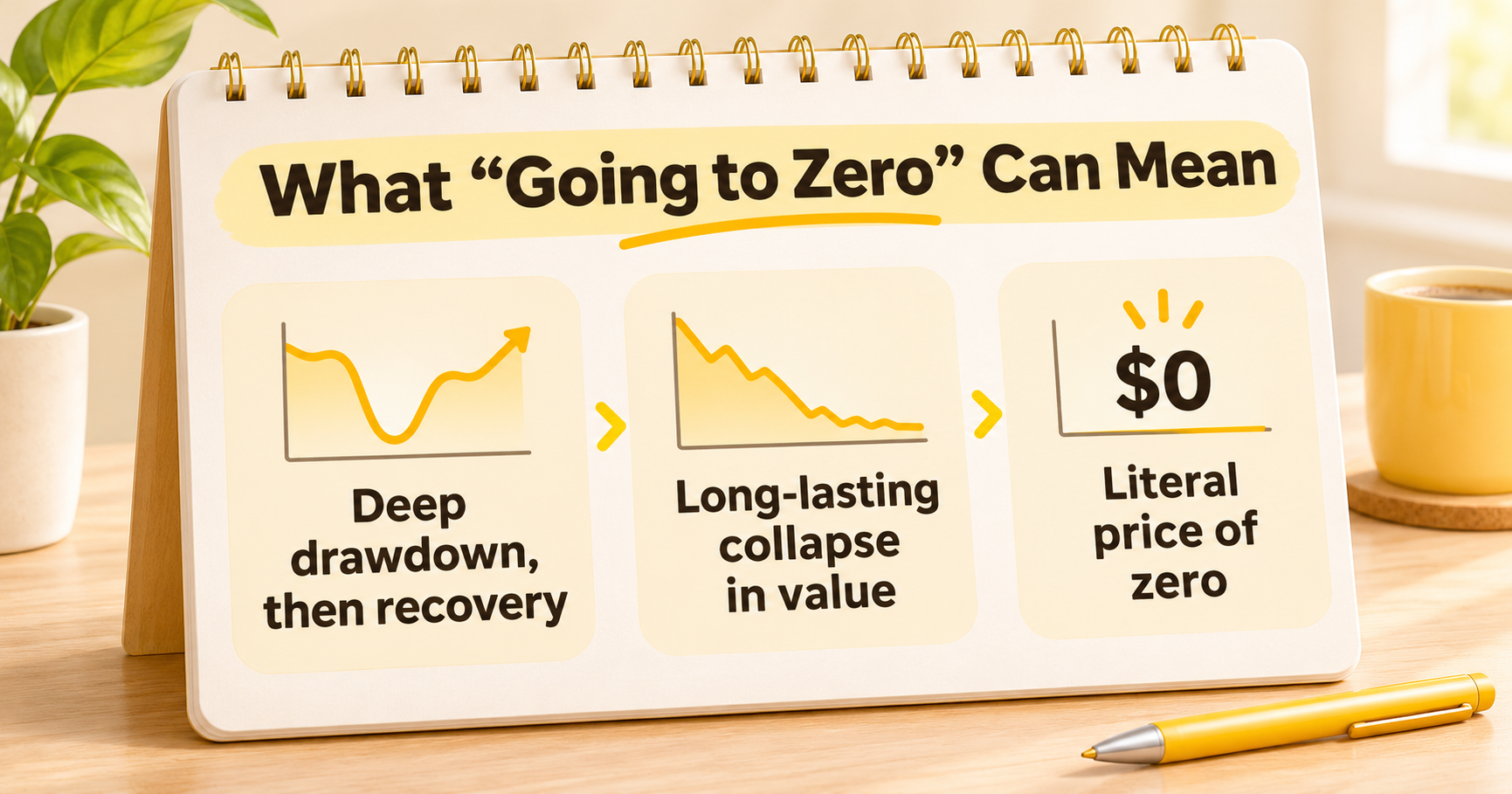
- 1. A deep drawdown followed by recovery. Bitcoin has repeatedly experienced falls greater than 70%, then later made new highs. This is history, not a promise about the next cycle.
- 2. A lasting collapse in value. Bitcoin could trade at a small fraction of its peak for years if investor demand and confidence do not recover. The protocol might continue operating while the market value stays depressed.
- 3. A literal price of zero. In economic terms, there would be no meaningful market bid. It is an extreme endpoint, not something we can rule out with certainty or dismiss by assuming that all developers, miners and holders would have to disappear at once.
Bitcoin's source code, mining network and market price are related, but they are not interchangeable. A network can keep producing valid blocks while the token falls sharply in price. Conversely, a serious security or coordination failure could damage demand.
Where We Stand in November 2026
Bitcoin's October 2025 record was above $125,000, depending on the exchange and price feed. During November 2026, the market fell sharply: Reuters reported a dip below $60,000 on November 20, followed by an intraday low near $55,252 on November 21 and a rebound above $60,000. Those observations illustrate volatility; they are not a live quotation for November 24.
The drawdown from a $125,000 reference high to a $55,252 low is about 55.8%. For a $126,000 reference high, it is about 56.1%. That is painful, but it does not by itself establish whether Bitcoin will recover or keep falling.
Grayscale's June analysis offered an optimistic and a downside scenario, including risks from tighter monetary policy and leveraged corporate Bitcoin holders. Grayscale offers crypto investment products, so its market outlook should be read as one informed perspective, not a settled prediction.
The November sell-off also included sharp intraday moves. The separate Medium analysis Bitcoin Drops From $75,500 to $74,000 in 20 Minutes: What Happened on November 9, 2026 discusses one such episode. A short-lived price cascade is important to understand, but it is not evidence of an inevitable permanent collapse.
What the Historical Drawdowns Actually Look Like
Let's look at the record. Wells Fargo Investment Institute's report on digital asset volatility (dated 7 July 2026) lays out the approximate declines:
| Asset / event | Approximate decline |
|---|---|
| Bitcoin, Dec 2017 to Dec 2018 | about 83% |
| Bitcoin, Nov 2021 to Nov 2022 | about 77% |
| S&P 500, 2008 financial crisis | about 57% |
| S&P 500, 2022 bear market | about 25% |
Two things jump out. First, Bitcoin's crashes are brutal, far deeper than even the worst stock-market drawdown of the last two decades. Second, it recovered each time and went on to set new highs, a point the Wells Fargo report makes explicitly. That second fact is not a guarantee about the future, but it matters.
The same report says that over the eight years through June 2026, Bitcoin's annualized volatility was often 50% to 80%, versus roughly 15% to 20% for the S&P 500 and 10% to 15% for gold. In plain words: this asset swings several times harder than most things in your portfolio, and you should expect to live through stomach-churning drops.
The "How low could it go?" math (my own calculation)
Here's a simple table using a ~$125,000 peak and the historical drawdowns above. It's not a forecast, just arithmetic:
| Drawdown from peak | Price | Gain needed to get back to the peak |
|---|---|---|
| −50% (illustrative) | ~$62,500 | +100% |
| −77% (2021–22 bear market) | ~$28,750 | +335% |
| −80% (typical "old cycle" depth) | ~$25,000 | +400% |
| −83% (2017–18 bear market) | ~$21,250 | +488% |
| −90% | ~$12,500 | +900% |
Two lessons from the table. One: if the old pattern repeated in full, the price would still be well above zero, but also very far below today's level. Two: losses are asymmetric. A 50% loss needs a 100% gain to recover, and an 80% loss needs a 400% gain. That's exactly why position sizing matters more than prediction.
Must an old drawdown pattern repeat? Not necessarily. Grayscale's Zach Pandl wrote that prior cycles saw Bitcoin fall about 80% from peak to trough, but that Grayscale doesn't expect a drawdown that deep this time, citing a more muted bull market and stickier institutional demand. That is an opinion from a company that sells crypto investment products, so apply the usual skepticism, but it's a reasonable argument to hear. I'd treat it as a possibility, not a promise.
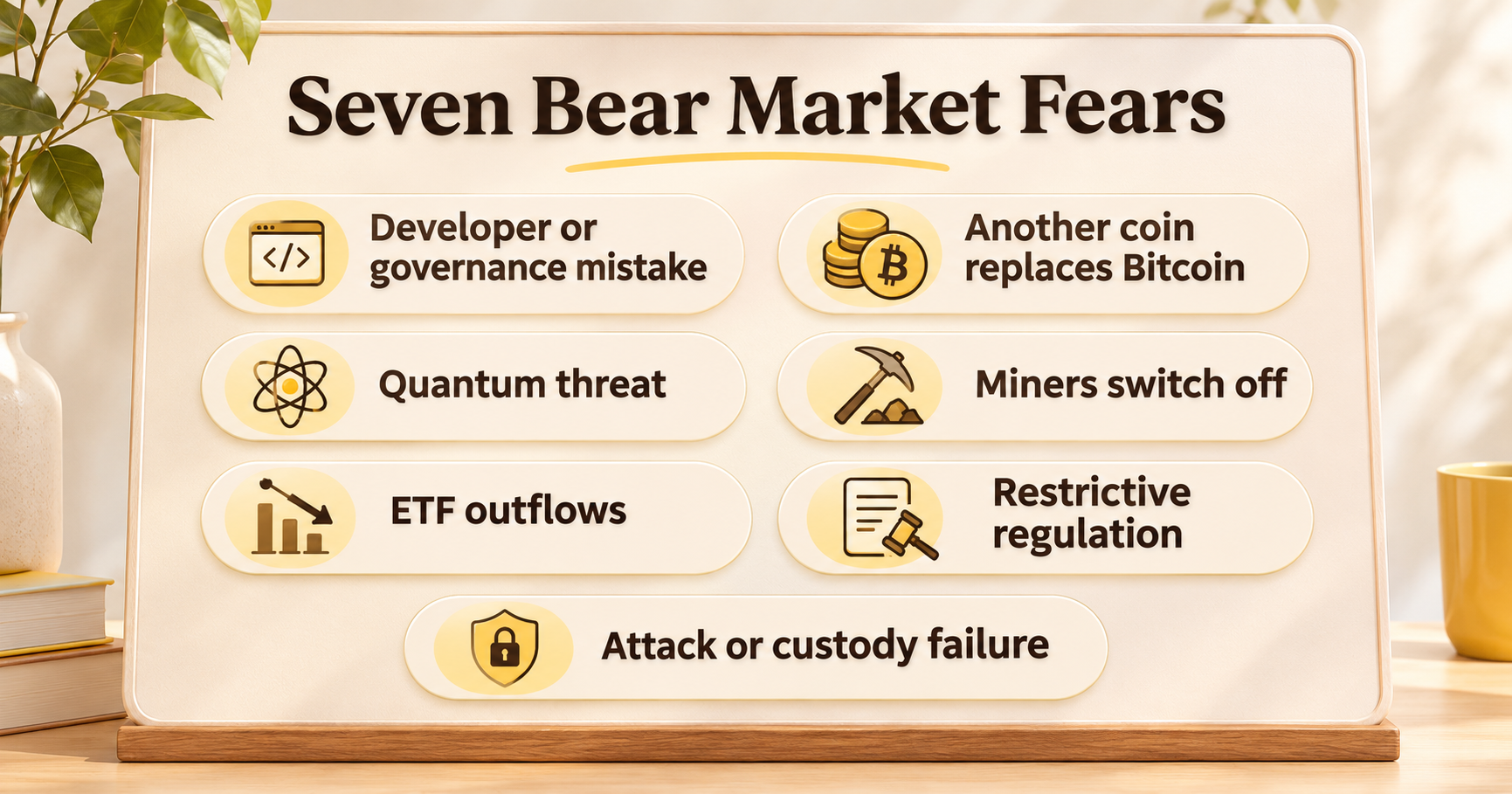
Bear Market Fear #1: “Developers Will Break It or Another Coin Will Replace It”
The Motley Fool's June article on whether Bitcoin could reach zero identifies technical mistakes, quantum computing and competition as risks worth considering. None offers a reliable timeline or probability for a market collapse.
Developer and governance risk. Bitcoin's software is open source, and changes are debated among developers, node operators, miners, businesses and other users. No one individual can simply issue a universally accepted protocol upgrade. That's a safeguard against some mistakes, but it can make urgent coordination difficult. Security defects, economic design problems or contentious upgrades remain possible.
A better alternative. Software features can be copied; a long-running network, liquidity, distribution and established trust are harder to reproduce. Those network effects may help Bitcoin remain relevant. However, they do not guarantee that demand will last forever, and competing technologies can change user preferences.
Bear Market Fear #2: “Quantum Computers Will Crack Bitcoin”
This deserves more care than a headline about “breaking Bitcoin's encryption.” Bitcoin primarily relies on digital signatures (ECDSA and Schnorr) to authorize spending, along with hash functions that serve different security purposes. A sufficiently capable fault-tolerant quantum computer could threaten the elliptic-curve signatures, with implications for funds whose public keys are exposed. The mining hash function does not face the identical attack.
Fidelity Digital Assets' research on Bitcoin's path to quantum resistance explains why migration is not simply a matter of changing one line of code. Wallet compatibility, signature size, old addresses, key exposure and coordinated adoption all matter. At the time of its research, cryptographically relevant quantum computers capable of this attack did not yet exist. Their arrival date is uncertain.
The right conclusion isn't “Bitcoin will definitely fail” or “developers will definitely fix it.” It is that there is an identifiable risk and a difficult, ongoing engineering response. Watch credible cryptography research, Bitcoin improvement proposals, wallet compatibility and real adoption—not speculative countdown clocks.
Bear Market Fear #3: “Miners Are Quitting, So Bitcoin Will Die”
When Bitcoin's price falls, the dollar value of a miner's rewards usually falls too. Electricity, equipment and financing bills don't necessarily fall alongside it. Less efficient operators can shut down or relocate. That is an economic squeeze, but it does not mean the protocol immediately stops.
Bitcoin targets a difficulty adjustment every 2,016 blocks. If many miners leave suddenly, blocks can take longer to find until the next adjustment. If block production slows enough, the next adjustment lowers the required mining difficulty. Remaining miners can then earn a greater expected share of block rewards per unit of hashrate, assuming other relevant conditions stay comparable.
There is a limitation people often skip: the retarget depends on block count, not a fixed two-week calendar. A severe hashrate collapse can delay the next adjustment. Lower difficulty also does not pay every miner's electricity bill or make network security independent of economics. Mining participation matters because a lower aggregate hashrate can change the cost of attacking the network.
Industry reports described significant miner stress in 2026. For example, BeInCrypto summarized a decline in a 30-day hashrate measure, while Hashrate Index's November 16 roundup quoted hashprice around $30.45/PH/s/day. These figures depend on the measurement window, and a temporary drop is not the same as every miner permanently quitting.

What a Price Crash Does to a Miner: A Worked Example\
OneMiners' October 2026 miner stress test used an Antminer S23 Hydro 580 TH/s, approximately 5,510 W, and a hypothetical Bitcoin price decline from $79,874 to $63,899. It compared electricity-only operating margins at different power rates:
| Scenario | Assumed BTC price | Margin/day at 5.2¢/kWh | Margin/day at 13¢/kWh |
|---|---|---|---|
| October starting point | $79,874 | $13.84 | $3.53 |
| 20% BTC price decline | $63,899 | $9.70 | −$0.62 |
Source: OneMiners' historical example, using its October difficulty and subsidy-only assumptions. Figures exclude hardware acquisition, pool fees, many hosting charges, taxes, repair costs and downtime. These are not full net-profit forecasts.
The lesson is practical: the same machine can cover electricity at an industrial tariff while falling short at an expensive residential tariff. OneMiners calculated an electricity-only break-even BTC price of approximately $26,513 at 5.2¢/kWh versus $66,281 at 13¢/kWh in that historical model. A cheaper tariff can improve an operating margin, but it cannot protect someone against every market or hardware outcome.
Where OneMiners Can Add Practical Value
For readers considering mining rather than just holding Bitcoin, OneMiners offers ASIC equipment, managed hosting and remote monitoring. Its mining profitability guide helps readers compare mining rewards with electricity use, while the October stress test shows why energy costs matter under pressure.
OneMiners also advertises site-specific hosting and prepaid electricity plans. Its lowest published around 3.6¢/kWh rate is tied to an eligible long-term prepaid plan in Nigeria; it should not be interpreted as a universal monthly price. The company's terms describe extended hardware warranty coverage for eligible equipment purchased directly and hosted at a OneMiners location. Buyers should check the actual written contract, warranty exclusions, repairs, uptime terms, fees and prepaid-energy provisions.
I see real value in being able to assess hardware efficiency, hosting location, power cost and monitoring together, instead of buying an industrial ASIC without first solving the electricity and cooling questions. But hosting is not a way to guarantee profits or make Bitcoin immune to price declines. For a miner, the strongest defense is understanding the complete operating economics and risks.
Does mining create a price floor for Bitcoin? No. Miners' marginal costs influence decisions to mine, sell or shut down, but there is no guaranteed market floor at production cost. The network can adjust while the traded price stays depressed for a long time.
Bear Market Fear #4: “ETFs and Institutions Are Abandoning Bitcoin”
ETF outflows reflect net redemptions of fund shares, but they do not prove that every investor has the same view of Bitcoin. Some redemptions can come from portfolio rebalancing, risk reduction or unwinding a hedged trade rather than a permanent rejection of the asset.
The numbers were large in November: Cointelegraph's November 23 report cited approximately $1.79 billion in US spot Bitcoin ETF net outflows during November 16–20, taking the reported November total through November 20 to about $4.14 billion. That is more current than the early-November or November 18 totals in the original draft. Trackers may disagree or revise figures as reporting becomes complete.
A useful distinction is flows versus assets under management. ETF asset values also fall when Bitcoin's price falls, even with no redemptions. And a cash or in-kind share redemption is not automatically a same-day sale of an identical dollar amount of spot Bitcoin. ETFs are important, but they do not represent every Bitcoin buyer, holder or seller.
Bitcoin investment products can retain significant assets while suffering large outflows, just as an asset can remain liquid while its price collapses. No ETF total proves that the market has found a bottom, and no one-week outflow proves a path to zero.
Bear Market Fear #5: “A Large Bitcoin Treasury Company Will Be Forced to Sell”
Some listed businesses hold large Bitcoin treasuries and have debt, preferred securities or other financial commitments. In a severe downturn, financing costs, refinancing needs or investor pressure could encourage sales. Grayscale described treasury-company deleveraging as a possible downside scenario in June 2026.
But a corporate funding problem is not the same thing as a Bitcoin protocol failure. Forced sales could drive prices sharply lower, and large concentration of holdings is a legitimate liquidity risk. They cannot by themselves rewrite the rules used by all participating Bitcoin nodes.
Bear Market Fear #6: “Governments Will Ban Bitcoin”
Regulation can affect exchanges, custody, taxation, mining operations, banking access and demand for investment products. Rules vary by jurisdiction and can change. Discussion of the CLARITY Act in 2026 belongs in this category as a dated legislative question, not an assumed outcome.
An effective prohibition across major markets could be very damaging to liquidity and demand. A coordinated global restriction is harder than a national ban, but it is not impossible for legislation and enforcement to materially weaken Bitcoin's adoption. Bitcoin holding and transactions do not become risk-free simply because the protocol is distributed.
Bear Market Fear #7: “An Attack, Software Bug or Custody Failure Will Destroy It”
Bitcoin's security should not be confused with the security of an exchange or wallet provider. Many of the most damaging crypto losses involve custody, account security, smart contracts, social engineering or a compromised service rather than a successful attack on Bitcoin consensus.
A majority-hashrate attack could allow certain transaction reorganizations and double-spending attempts, but it would not simply let the attacker mint unlimited new BTC under the ordinary validation rules. A serious protocol bug would be different and could require coordinated fixes. Neither risk is zero.
For individual holders, the immediate practical protections are more ordinary: verify addresses, use trustworthy wallets, protect recovery phrases, consider the trade-offs of self-custody and keep backups secure.
The “Zero Test”: What Would Have to Go Wrong?
I would not make a checklist of failures that must all happen at once. An asset can lose nearly all its demand because of a single sufficiently serious problem, or because several pressures reinforce one another. Instead, I use a risk map:
| Risk | How it could hurt Bitcoin | What to monitor | What it cannot tell you alone |
|---|---|---|---|
| Quantum vulnerability | Trust in transaction ownership could fail without a workable migration | Credible research, protocol proposals, wallet readiness | The year a successful attack will happen |
| Miner shutdowns | Slower blocks, lower security budget and weaker mining profitability | Hashrate, difficulty, fees, security considerations | That the protocol has already failed |
| Weak ETF demand | Less demand through a major investment channel | Multiple weeks of fund-level net flows | That all investors have abandoned BTC |
| Treasury deleveraging | Large, forced sales in weak markets | Debt maturities, liquidations and company disclosures | That Bitcoin's code is broken |
| Restrictive regulation | Reduced legal access, liquidity and infrastructure | Passed laws, court decisions and implementation | Whether every jurisdiction will respond alike |
| Competition or loss of confidence | Long-lasting reduction in willingness to hold BTC | Adoption, liquidity and real usage | A reliable “zero probability” |
| Custody or protocol failure | Loss of funds or loss of confidence in settlement | Security advisories, audits, incident reporting | That all losses come from the base protocol |
This table is a framework for thinking, not a statistical model. We do not have enough evidence to assign a trustworthy percentage probability to Bitcoin reaching zero or to put a date on a permanent collapse.
My Assessment: What I Think Investors Should Fear Most
My concern is less about predicting a literal zero print and more about the damage that can happen well before it.
- 1. Large losses are normal enough to plan for. Bitcoin's historical drawdowns make that difficult to dispute.
- 2. A recovery is not guaranteed. Past highs do not create an obligation for future buyers.
- 3. A security threat and an investment-price threat are different. An exchange hack, quantum breakthrough and ETF outflow require different responses.
- 4. Mining is not a guaranteed backstop. Difficulty changes can keep the network functioning while individual mining operations fail economically.
- 5. Institutional adoption cuts both ways. Easier investment access can attract demand, but investors can also redeem in a downturn.
- 6. Confidence should be proportional to evidence. I would rather stress-test a position than rely on “it always rebounds” or “it must go to zero.”
Practical Steps If You're Worried About Another Crash
These steps are general education, not instructions to buy, sell or hold:
- 1. Know your downside limit. Consider whether you could absorb a 50%, 80% or even total loss without disrupting essential expenses.
- 2. Avoid using borrowed money you cannot safely repay. Leverage can force liquidation before a long-term thesis has any chance to work.
- 3. Decide what would change your view. Write down the technical, regulatory or market developments you would consider genuinely important.
- 4. Keep short-term needs separate. Cash needed for bills, emergencies or near-term commitments should not depend on a volatile market recovering.
- 5. Treat regular investing as an approach, not a guarantee. Dollar-cost averaging spreads purchase timing, but does not prevent losses.
- 6. Protect your custody. Secure devices, recovery phrases and account access; beware of impersonators and “recovery” scams.
- 7. Verify market data. Read the date and the calculation behind drawdowns, ETF flows, hashprice and difficulty before sharing a claim.
How to Read the Sources
The analysis combines sources with different incentives and purposes:
- • Wells Fargo Investment Institute provides historical drawdowns and volatility comparisons; historical outcomes do not predict future ones.
- • Grayscale publishes investment research and offers crypto products, so its forecasts are viewpoints, not certainties.
- • Fidelity Digital Assets describes quantum-signature risks and the difficulty of transitioning to new cryptography.
- • OneMiners sells mining hardware and hosting; its historical stress tests are useful illustrations, not independently audited profit results.
- • Cointelegraph reported November ETF outflows; different trackers may revise totals.
- • The Medium analysis of the November 9 price move is included for additional context; the article does not rely on it to verify an exact trade or liquidation figure.
Common Misconceptions
“A 50% drop means Bitcoin is headed to zero.” No single drawdown percentage establishes a path to zero. Large losses are still real losses.
“Difficulty adjusts, so mining can never fail.” Difficulty responds to the time taken to mine blocks, but it cannot guarantee adequate security, cheap electricity or miner profitability.
“ETF outflows mean institutions have sold all their Bitcoin.” Net redemptions are meaningful demand indicators, not an inventory of every investor's trading motives or holdings.
“Quantum computers already broke Bitcoin.” The major cryptographic concern involves a future sufficiently powerful fault-tolerant machine threatening elliptic-curve signatures. Timeline and mitigation remain uncertain.
“Bitcoin always recovers.” It has recovered after past major bear markets, but nobody can prove it will do so again.
“A miner's operating break-even creates a market price floor.” There is no guaranteed floor at production cost, and miners can shut down as prices decline.
Frequently Asked Questions
Is Bitcoin going to zero?
Nobody knows. A fall to literal zero is an extreme outcome, but it is possible in principle. The available evidence does not support a precise probability or a confident forecast that it can never happen.
Can Bitcoin lose 80% without going to zero?
Yes. Wells Fargo reports approximate 83% and 77% drawdowns in two earlier bear markets. A price can decline severely and remain above zero.
What is the biggest risk in the current bear market?
There is no universally “biggest” risk. Price volatility, weak demand, leverage, custody failures and the ability to meet one's financial commitments matter differently to different people.
Will Bitcoin recover?
Bitcoin recovered from several previous bear markets and later reached new highs. That history cannot guarantee the outcome of the present downturn.
Can quantum computers steal Bitcoin?
A future sufficiently powerful quantum computer could threaten certain Bitcoin transaction-signature systems. No generally accepted timetable establishes when such a system might become practical; migration is a difficult, active research question.
What happens if miners stop mining?
Blocks can slow down when hashrate falls. Bitcoin adjusts difficulty every 2,016 blocks, which can improve remaining miners' expected output per unit of hashrate. That adjustment does not promise profitability or eliminate security concerns.
Do ETF outflows mean Bitcoin will become worthless?
No. They signal net redemptions through one group of investment products, not all global Bitcoin demand. A sustained trend matters, but it is not a prediction of zero.
Do miners set a minimum Bitcoin price?
No. Mining production costs influence operating choices, but they do not impose a binding floor on the market price.
Is OneMiners a way to avoid Bitcoin price risk?
No hosting provider can remove Bitcoin price or network-difficulty risk. OneMiners offers equipment and hosting options that may help customers compare power costs and monitor machines, subject to current location-specific contracts and fees.
Should I buy Bitcoin during a bear market?
That depends on your finances, liquidity needs, time horizon and capacity to bear losses. Do not treat an article, a previous cycle or a price target as personalized financial advice.
Final Thoughts
Could Bitcoin go to zero? Yes, in principle. That is true of speculative assets even when they have working technology and an established market. But zero is not the only—or necessarily the most useful—scenario to worry about. Bitcoin can remain active while its price falls enough to cause serious financial harm.
The evidence points in two directions at once. Bitcoin has endured extraordinary drawdowns and recovered before. It also has genuine technical, security, regulatory, demand and market-structure risks. Mining difficulty can adapt; it cannot promise a price floor. ETFs can widen access; they cannot guarantee permanent demand. Work on post-quantum security can progress; successful coordination cannot be assumed.
The sensible takeaway is to understand the downside, monitor the evidence, and protect the money and information that matter most. A clear risk plan is more useful than either a confident promise of recovery or an unsupported prediction of collapse.
Educational information only, not financial, investment, legal or tax advice. Historical price, difficulty and ETF figures refer to dated observations through November 24, 2026 and can change. Cryptocurrency is highly volatile; you may lose some or all of your investment.
Sources and Further Reading
- • Wells Fargo Investment Institute — Digital asset volatility
- • Grayscale — Two Scenarios for the Bitcoin Bear Market
- • Motley Fool — Is Bitcoin Going to $0?
- • Fidelity Digital Assets — Bitcoin's Path to Quantum Resistance
- • OneMiners — Bitcoin Down 20%: A Miner Stress Test
- • OneMiners — Mining Profitability Calculator Explained
- • OneMiners — Terms and Conditions
- • Medium — Bitcoin Drops From $75,500 to $74,000 in 20 Minutes
- • Cointelegraph — Bitcoin ETF Outflows in November 2026
- • Reuters — Bitcoin Rises After Falling to a Two-Year Low
#Bitcoin #BitcoinBearMarket #BitcoinMining #OneMiners #CryptoSecurity #BitcoinETF #ASICMining